
Test 11 of 25 · 20 questions · Free 2026
OK Permit Practice Test 11
Jump to the test ↓A fixed 20 question set from the Oklahoma bank with answers and plain English explanations. The real OK exam is 20 questions, 75 percent to pass; take the full length version on the main practice page.
Question 1 of 20 · 0 right so far
All 20 questions in test 11
Every question below comes from the Oklahoma question bank on this page. Open a question to see the correct answer and the explanation. Nothing here is hidden behind a signup.
1. On a four-lane street, you stop for a teenager stepping into the crosswalk, but cars in the next lane don't seem to see her. What does the Oklahoma manual suggest you do?
- Wave her across quickly so she clears the lanes
- Warn drivers with a stop hand signal or brake taps
- Pull forward and angle your car to block the lane
- Honk continuously until she reaches the curb
Show answer
Warn drivers with a stop hand signal or brake taps. The manual describes this exact danger: one driver stops for a pedestrian on a four-lane street, but drivers in the next lane do not see her or know why the first car stopped. If you are the stopped driver, do everything you can to help protect her, such as warning drivers behind you with a stop hand signal or several taps on your brakes to flash your brake lights. Waving her to hurry or blocking another lane with your car creates new risks.
Study this in the handbook: Pedestrians, Blind Persons and Funeral Processions
2. Where parking is allowed along a highway, how should you park?
- With just the right wheels on the shoulder
- In the right lane with hazard flashers on
- Completely off the main traveled roadway
- Half on the pavement so drivers can see you
Show answer
Completely off the main traveled roadway. When you park along a highway where parking is permitted, the manual says to signal, slow down, and drive completely off the pavement or the main traveled part of the roadway. A car left partly in the lane is in the path of fast traffic, and flashers do not make a travel lane a parking spot. If your vehicle breaks down, the same idea applies: move it completely off the highway and turn on the emergency flashers. Watch out for fast traffic as you get out of the car.
Study this in the handbook: Parking Rules
3. In which situations does the Oklahoma manual say to always increase your following distance?
- Only when you are driving on an interstate
- Slick roads, large vehicles, motorcycles, night, fog
- Only when the car ahead is going under the limit
- When you are in a hurry and want to pass soon
Show answer
Slick roads, large vehicles, motorcycles, night, fog. The manual's safety tip on following distance says to always increase your distance on slick roads, when following large vehicles or motorcycles, at night, and in fog or bad weather. The rule is not limited to interstates, and it has nothing to do with the speed of the car ahead or a wish to pass. To check your gap, watch the rear of the vehicle ahead pass a sign, pole, or other fixed point and count the seconds until you reach the same point.
Study this in the handbook: Following Distance and Stopping
4. A driver says a green light always means go. Which duty does the manual say still applies when your signal turns green?
- You must still yield to pedestrians and to vehicles legally in the intersection
- None, because a green light gives you the right-of-way over everyone
- You only need to yield to vehicles that are turning left
- You must wait three seconds before moving
Show answer
You must still yield to pedestrians and to vehicles legally in the intersection. A green light lets you go, but the manual tells you to enter the intersection cautiously. You must yield to pedestrians in the crosswalk and to other vehicles legally in the intersection, for example a car that entered on its own light and is still completing a turn. The green does not clear everyone else from your path, and the manual gives no waiting count or a rule limited to left turners.
Study this in the handbook: Traffic Signals
5. You see this emblem on the back of a farm vehicle ahead. What does it tell you about the vehicle's speed?

- It travels at highway speed but turns often
- It must pull over at least every mile
- It may go up to 45 mph on state highways
- It travels at 25 mph or less
Show answer
It travels at 25 mph or less. The orange triangle with a red border is the Slow Moving Vehicle emblem. The manual says it is used on vehicles such as agricultural equipment and highway construction or maintenance equipment traveling on public highways at speeds of 25 mph or less. When you see it, slow down early, because you will close on the vehicle quickly. Follow at a safe distance until you can see far enough ahead to pass safely.
Study this in the handbook: Work Zone, Guide and Service Signs
6. You are turning left on a flashing yellow arrow, and a car is coming toward you from the opposite direction. Who has the right-of-way?
- You do, because your arrow is lit
- Whoever reaches the intersection first
- The oncoming car; you must yield to it
- You do, if you signaled your turn
Show answer
The oncoming car; you must yield to it. A flashing yellow arrow allows a left turn, but it is not a protected turn. The manual says to reduce speed and proceed cautiously with the left turn only after yielding to oncoming traffic and pedestrians, and it states that oncoming traffic has the right-of-way. Having the arrow lit, signaling, or arriving first does not change that. Wait for a safe gap in oncoming traffic, then complete the turn.
Study this in the handbook: Traffic Signals
7. When sharing the road with a bicycle, what should you always expect the rider to do?
- Make sudden moves to avoid road hazards
- Ride in a perfectly straight line
- Stop at every driveway along the street
- Pull onto the sidewalk to let cars pass
Show answer
Make sudden moves to avoid road hazards. Bicyclists have the same rights and responsibilities on the street that you do, and in most cases they must share the lane. The manual says to always expect a rider to make sudden moves, because trash, minor oil slicks, a pothole or crack, a barking dog, a parked car, or an opening car door can force a bicycle rider to swerve suddenly in front of you. Leave extra room so a swerve does not become a crash, and do not expect the rider to give up the road.
Study this in the handbook: Bicycles, Motorcycles, Trucks and Farm Vehicles
8. You are driving in a funeral procession. The lead car has gone through an intersection, and the light turns red as you reach it. What may you do?
- Stop and wait for green, then catch up
- Follow through with the procession
- Turn off and rejoin the procession later
- Stop unless a police escort waves you on
Show answer
Follow through with the procession. When the funeral lead vehicle enters an intersection, the manual says the remaining vehicles in the procession may follow through the intersection regardless of any traffic control devices. So a light turning red does not split the procession. Keep your headlights on so other drivers know not to drive between or interfere with the procession, and drive carefully. Other motorists must yield the right-of-way to the procession.
Study this in the handbook: Right of Way at Intersections
9. On a rural road, you reach a crossing highway where there are no stop signs, yield signs, or signals. What should you do?
- Keep going, since no sign tells you to stop
- Stop and yield, then go only when it is safe
- Slow down and honk as you cross
- Speed up to cross before others arrive
Show answer
Stop and yield, then go only when it is safe. The manual's list of times you must always yield begins with entering or crossing highways without traffic signs or signals: stop and yield to approaching traffic, and go only when it is safe. The absence of a sign is not permission to keep going. A horn does not clear the way, and speeding up to beat other vehicles is the opposite of yielding. Look carefully in both directions, and look left again before you go.
Study this in the handbook: Right of Way at Intersections
10. It is 2 a.m. and you are stopped at a steady red light with no other traffic anywhere. You want to go straight. What must you do?
- Go after a full stop, since the road is empty
- Flash your lights, then proceed carefully
- Treat it as a flashing red after one minute
- Stay stopped until the light turns green
Show answer
Stay stopped until the light turns green. At a steady red light, the manual says to come to a complete stop before the crosswalk or intersection and remain stopped until the light turns green. The time of night and an empty road do not change that. The manual gives no waiting period after which you may go, and flashing your headlights gives you no right to proceed. Only right turns, and left turns from one one-way street into another, are allowed on red after a stop.
Study this in the handbook: Traffic Signals
11. What mistake does the Oklahoma manual warn against when making a right turn?
- Swinging to the left before or during the turn
- Staying too close to the right side of the road
- Signaling more than 100 feet before the corner
- Looking both ways before you start the turn
Show answer
Swinging to the left before or during the turn. A right turn has four steps in the manual: far before the corner, move over to the right side; begin signaling and slowing at least 100 feet from the corner; select the proper gear and look both ways; then keep as close as possible to the right through the turn. The warning is to be careful not to swing to the left before or during the turn. Signaling early, hugging the right, and looking both ways are correct steps, not mistakes.
Study this in the handbook: Passing and Turning
12. Overhead lane-use signs show a straight arrow above Lane 1 and an arrow pointing both straight and right above Lane 2. Which movements are allowed from Lane 2?
- A right turn only, with no straight travel
- Straight ahead only, with no right turn
- Either a right turn or straight ahead
- A right turn or a left turn, but not straight
Show answer
Either a right turn or straight ahead. The Oklahoma manual pictures this pair of lane-use signs and explains that Lane 1 must go straight ahead, while Lane 2 is optional: a driver there may either turn right or continue straight. A combined arrow on a lane-use sign gives a choice; it does not force one movement. No left turn is shown for either lane, so turning left from Lane 2 would break the sign. If you need to turn right on this approach, Lane 2 is the only lane that allows it, so move into it before you reach the intersection.
Study this in the handbook: Stop, Yield and Regulatory Signs
13. In a work zone, what are cones, barrels, and barricades placed there to do?
- Mark spots where drivers may park and wait
- Show where the speed limit returns to normal
- Direct you through safely and protect workers
- Warn drivers that passing is now allowed
Show answer
Direct you through safely and protect workers. Orange means you are nearing or in a work zone. The manual explains that signs, barricades, and lane-channeling devices such as cones and barrels are placed to direct you through the work zone safely and to protect workers and flagpersons. Follow the path they create, even when it shifts you into a different lane. They do not mark parking areas or passing zones, and they do not tell you when the normal speed limit returns; posted signs do that. Speeding fines double when workers or equipment are present.
Study this in the handbook: Work Zone, Guide and Service Signs
14. After a snowstorm, the face of a sign is covered so you cannot read any letters, but you can see it is a red octagon. What must you do?
- Treat it as a yield sign until you can read it
- Ignore it, since unreadable signs do not count
- Slow down and proceed if the road looks clear
- Come to a complete stop, as at any stop sign
Show answer
Come to a complete stop, as at any stop sign. The manual explains that even if a stop sign is damaged or blocked by dirt or snow, the octagonal shape and red color tell you that you must stop. That is why it asks you to learn sign shapes and colors well enough to recognize them immediately. A covered sign still carries its full meaning, so come to a complete stop before the crosswalk and stay stopped until the way is clear in all directions.
Study this in the handbook: Stop, Yield and Regulatory Signs
15. Your car has a passenger-side airbag. Where does the Highway Safety Administration recommend that children under 12 ride?
- In the front seat with the seat pushed all the way back
- In the front seat if they wear a lap and shoulder belt
- In the back seat, away from the passenger airbag
- In any seat, as long as an adult sits next to them
Show answer
In the back seat, away from the passenger airbag. The Oklahoma manual warns that the explosive power of an airbag has killed children and elderly adults under 5 feet tall. For that reason, when a vehicle has a passenger-side airbag, the Highway Safety Administration recommends that children under 12 ride in the back seat. Pushing the front seat back or adding a shoulder belt does not remove the danger from the airbag itself, and an adult sitting nearby is no substitute. The manual also notes that the back seat is safer in general, because most serious crashes involve the front of the vehicle.
Study this in the handbook: Insurance, Seat Belts and Child Restraints
16. On a curving road, you pass this yellow sign but cannot yet see the intersection beyond the curve. What should you do?
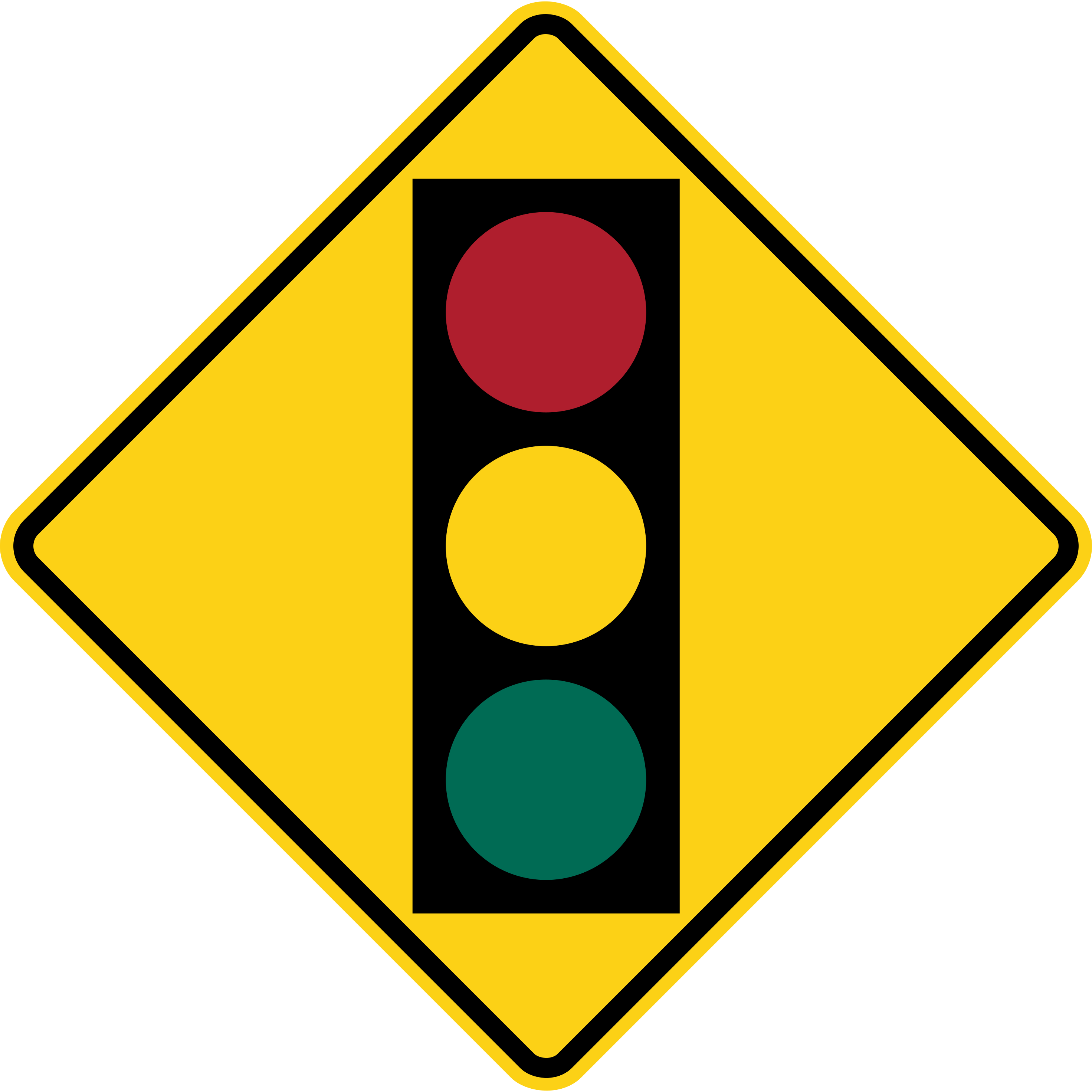
- Keep your speed until you see the light color
- Speed up to clear the signal before it changes
- Move to the left lane to get a better view
- Be prepared to stop at the signal ahead
Show answer
Be prepared to stop at the signal ahead. This warning sign shows a traffic signal symbol, meaning a traffic control signal is ahead and you should be prepared to stop. On a curve, the light may already be red when it comes into view, so ease off and be ready to brake. Holding your speed until you can see the color, or speeding up to beat it, works against the warning. Changing lanes for a better view adds a new risk instead of preparing you to stop.
Study this in the handbook: Warning Signs
17. When is carbon monoxide most likely to leak into your car, according to the Oklahoma manual?
- Heater on, faulty exhaust, or heavy traffic
- When the windows are rolled all the way down
- When the car is parked with the engine off
- When the air conditioner runs on the highway
Show answer
Heater on, faulty exhaust, or heavy traffic. You can't see, smell, or taste carbon monoxide, but the gas from an engine can kill you. The manual says it is most likely to leak into your car when the heater is running, when your exhaust system is not working properly, or when you are in heavy traffic breathing exhaust fumes from other cars. A faulty exhaust can also leak fumes into the back seat where children may be sitting or sleeping. A parked car with the engine off is not producing exhaust.
Study this in the handbook: Floods, Crashes and Roadside Emergencies
18. When are roads likely to be the most slippery during a rainstorm, according to the Oklahoma manual?
- After an hour of steady heavy rain
- Just after it begins to rain or drizzle
- Only when the temperature is below freezing
- Once the rain has completely stopped
Show answer
Just after it begins to rain or drizzle. The manual warns that the first few drops of rain signal danger. Roads are likely to be very slick just after it begins to rain or drizzle, because those first drops loosen built-up grease and dirt on the road surface and cover it with a slippery film. Slow down and use extra caution right away instead of waiting for heavy rain. As long as the road stays wet, keep your speed down to avoid hydroplaning.
Study this in the handbook: Following Distance and Stopping
19. A driver refuses to blow into a breath tester, but the officer saw weaving, slurred speech, and the smell of alcohol. Can those observations be used in court?
- Yes, they are evidence that can convict
- No, only a BAC test result counts as evidence
- No, unless a second officer agrees
- Only if the driver admits to drinking
Show answer
Yes, they are evidence that can convict. The manual says observations and information gathered by the arresting officer are also evidence that may be used in court and can result in a conviction without a BAC test. Weaving, slurred speech, and the smell of alcohol are that kind of evidence. Refusing the test does not avoid it; refusal itself leads to automatic revocation of the driving privilege. No second officer or confession is required.
Study this in the handbook: Implied Consent and DUI Penalties
20. You are about to make a right turn at a city intersection. About what speed does the Oklahoma manual recommend for the turn itself?
- About 20 mph
- About 25 mph
- About 15 mph
- 10 mph or less
Show answer
10 mph or less. The manual recommends a speed of 10 mph or less when turning. Its turning steps call for slowing before you reach the stop line or crosswalk, choosing the proper gear before you enter the intersection, and accelerating slightly through the turn. Speeds of 15 to 25 mph are above the manual's recommendation. Slow first, then turn smoothly and finish in the proper lane.
Study this in the handbook: Speed Limits and Expressway Speeds
Every question is written from the official Oklahoma Driver Manual. Need paper? Printable OK practice test with answer key.
Last verified 2026-10-05. How we check every question · Study all 500 as flashcards
Frequently asked questions
How many questions are on this Oklahoma practice test?
This fixed set has 20 questions. It is test 11 of 25 from the 500 question Oklahoma bank. The real OK exam asks 20 questions and you need 15 correct.
What is the passing score for the real Oklahoma test?
15 out of 20 questions correct to pass That figure comes from the official Oklahoma source cited on the DMV facts page.
How does this fixed test relate to the full Oklahoma bank?
Each numbered test is a fixed set of questions in a fixed order, so you can retake the same test later and compare. Every test mixes road signs and the other topics in about the same proportion as the full bank. Tests 1 to 25 together cover every question in the Oklahoma bank once. The full practice page mixes the whole bank at random.
Last verified 2026-10-05. See the Oklahoma DMV facts page for sourced state details.
Return to the full Oklahoma practice test · Study road signs