
Test 4 of 10 · 20 questions · Free 2026
OK Permit Practice Test 4
Jump to the test ↓A fixed 20 question set from the Oklahoma bank with answers and plain English explanations. The real OK exam is 20 questions, 75 percent to pass; take the full length version on the main practice page.
Question 1 of 20 · 0 right so far
All 20 questions in test 4
Every question below comes from the Oklahoma question bank on this page. Open a question to see the correct answer and the explanation. Nothing here is hidden behind a signup.
1. On a flashing yellow arrow for a left turn, who has the right-of-way?
- Vehicles behind the turning driver
- The driver turning left
- Oncoming traffic and pedestrians
- Only vehicles in the left-turn lane
Show answer
Oncoming traffic and pedestrians. A flashing yellow arrow permits a cautious left turn only after the driver yields to oncoming traffic and pedestrians. It is not the protected movement provided by a solid green arrow. The turning driver must reduce speed, check the path, and wait for a gap that does not interfere with people or vehicles already entitled to proceed. A vehicle behind cannot claim priority merely because it is queued in the same lane.
Study this in the handbook: Traffic Signals
2. A 14 year old in Oklahoma has a motorcycle only license. When may the rider operate the motorcycle?
- Only between 4:30 a.m. and 9:00 p.m., with no passenger
- Any time, with one passenger
- Only between 6 a.m. and 6 p.m., with one passenger
- Only on weekends
Show answer
Only between 4:30 a.m. and 9:00 p.m., with no passenger. Riders under 16 on a motorcycle only license may ride only between 4:30 a.m. and 9:00 p.m. and cannot carry a passenger. The 6 a.m. to 6 p.m. and weekends only choices are not the hours in the manual, and any choice that allows a passenger breaks the rule. The same young riders are held to a motorcycle of no more than 300 cc. These limits lift at 16 once the motorcycle only restriction is removed.
3. What should you do first if rain makes the roadway dangerously slick?
- Brake hard to remove the water film immediately
- Slow down and use extra caution
- Accelerate until the tires cut through the water
- Follow the vehicle ahead more closely for guidance
Show answer
Slow down and use extra caution. The first rain or drizzle can loosen grease and dirt, creating a slippery film. The manual says to slow down and use extra caution, which preserves traction and increases the time available to respond. Hard braking can produce a skid, acceleration raises the risk of hydroplaning, and close following removes the space needed if another driver loses control. Watch for the first drops after a dry period, ease off the accelerator, increase your following gap, and avoid abrupt steering until the pavement has better grip.
Study this in the handbook: Following Distance and Stopping
4. When a funeral procession's lead vehicle enters an intersection, what may the remaining vehicles do?
- Yield to every vehicle entering from the side
- Stop permanently until the procession leader returns
- Split into separate routes immediately
- Follow through regardless of traffic control devices
Show answer
Follow through regardless of traffic control devices. Once the lead vehicle of a funeral procession enters an intersection, the remaining vehicles in that procession may follow through regardless of traffic control devices. Other motorists must yield and should not drive between or interfere with the line. Stopping the procession or splitting it apart defeats the coordinated movement described in the manual. The rule does not mean ordinary traffic may ignore signals; it protects the procession as a group after its lead vehicle has entered. The cue is the lead vehicle already in the intersection, plus the procession's headlights identifying the line.
Study this in the handbook: Pedestrians, Blind Persons and Funeral Processions
5. Who must wear a seat belt under Oklahoma's seat belt law as described in the driver manual?
- Every driver and front-seat passenger
- Only the driver
- Only passengers under 18
- Only people on highways over 55 mph
Show answer
Every driver and front-seat passenger. The manual states that every driver and front-seat passenger must wear a properly adjusted and fastened safety belt, factory installed and meeting federal standards. Limiting it to the driver or to minors is too narrow, and the law is not tied to road type or speed. Children under 8 have their own child restraint rules, and the manual notes that when all passengers are buckled in there is much less danger of being thrown forward or from the vehicle.
Study this in the handbook: Insurance, Seat Belts and Child Restraints
6. What should a pedestrian do when a flashing Don't Walk signal appears?
- Wait in the roadway for the next Walk signal
- Start crossing before the countdown ends
- Run diagonally to the opposite corner
- Do not leave the curb, but finish if already in the intersection
Show answer
Do not leave the curb, but finish if already in the intersection. A flashing Don't Walk indication means a pedestrian should not leave the curb, but someone already in the intersection should continue across. Starting during the flashing phase can leave a new pedestrian exposed when the available crossing time is ending. Running diagonally is unpredictable and waiting in the roadway creates a new hazard. If you are still at the curb, wait for the next Walk indication. If you have already begun, keep moving to the far side while watching traffic. The cue is location at the moment the signal starts flashing.
Study this in the handbook: Traffic Signals
7. What action is prompted by the yellow pedestrian crossing warning?

- Speed up so the crossing area is cleared before anyone arrives
- Use the shoulder because pedestrians must remain outside the roadway
- Slow down, watch both sides, and prepare to stop and yield
- Stop only if a traffic officer is physically present
Show answer
Slow down, watch both sides, and prepare to stop and yield. The warning identifies a place where people may cross, so the driver must create time and space for them. Slow down, watch both sides of the street, prepare to stop, and yield to pedestrians. The shoulder is not a substitute for careful roadway scanning, and an officer does not have to be present for the duty to apply. A cautious approach protects people who may enter from either side.
Study this in the handbook: Warning Signs
8. At an uncontrolled intersection, two vehicles arrive at the same time. Which vehicle has priority?
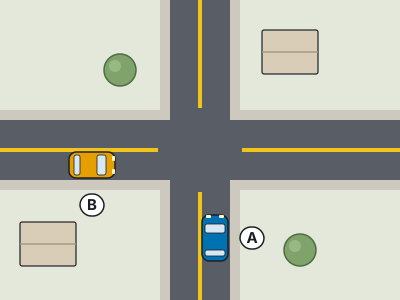
- The vehicle closest to the centerline
- The vehicle on the left
- The vehicle going straight
- The vehicle on the right
Show answer
The vehicle on the right. When two vehicles reach an intersection without signs or signals together, the driver on the left must yield to the driver on the right. That gives the right-side vehicle priority to proceed first. Traveling straight does not cancel this tie-breaking rule, and being nearer the centerline does not create priority. Ease off the accelerator before the intersection, identify the other vehicle’s side, and allow the right-side driver to move through before you cross the shared path.
Study this in the handbook: Right of Way at Intersections
9. What is the Oklahoma manual's first safety tip for phoning while driving?
- Dial only at red lights
- Whenever possible, pull off the road before calling
- Keep calls under one minute
- Hold the phone below the dash
Show answer
Whenever possible, pull off the road before calling. The manual's safety tips for phoning while driving start with pulling off the road before calling whenever possible. Others include not unbuckling your seat belt to reach for a phone, using memory dial and voice activated dialing, and keeping conversations short and calm. Dialing at a red light still divides attention in traffic, and hiding the phone or timing the call does not remove the distraction.
Study this in the handbook: Headlights, Night Driving and Distractions
10. Why does the Oklahoma manual stress good driving posture?
- You drive more effectively and with less fatigue when you are comfortable, aligned in the seat, and at the proper distance from the wheel and pedals
- It is required by law
- It improves fuel economy
- It is only for tall drivers
Show answer
You drive more effectively and with less fatigue when you are comfortable, aligned in the seat, and at the proper distance from the wheel and pedals. You will drive more effectively and with less fatigue if you are comfortable, your body is well aligned in the seat, you are the proper distance from the steering wheel and pedals, and you can use your mirrors to best advantage. Adjust the seat and mirrors before moving. The manual presents posture as a matter of comfort, control and fatigue rather than a legal requirement, and it matters for every driver, not only tall ones.
Study this in the handbook: Headlights, Night Driving and Distractions
11. What does a steady yellow traffic light warn you to do?
- Continue without checking the intersection
- Speed up to beat the red light
- Stop if you can do so safely before the crosswalk
- Stop only after entering the crosswalk
Show answer
Stop if you can do so safely before the crosswalk. A steady yellow light warns that the signal is about to turn red. The manual says to stop if you can stop safely before entering the crosswalk, adjusting speed early for a smooth stop. Speeding up to beat the light is specifically unsafe, and a yellow light is not permission to continue without checking. Waiting until after the crosswalk places the vehicle in the intersection and may block pedestrians. The cue is a controlled approach: check your stopping distance, brake smoothly, and enter only if stopping safely is no longer possible.
Study this in the handbook: Traffic Signals
12. How long must an Oklahoma child ride in a rear-facing child restraint?
- Until age 1
- Until age 4
- Until age 2, or until reaching the weight or height limit of the system as allowed by the manufacturer
- Until 20 pounds
Show answer
Until age 2, or until reaching the weight or height limit of the system as allowed by the manufacturer. Oklahoma's child passenger restraint law requires the restraint system to stay rear facing until the child reaches 2 years of age, or until the child reaches the weight or height limit of the system as allowed by the manufacturer. The system must also meet federal crash-tested standards. Age 1 and 20 pounds are not the figures the manual gives. Age 4 marks a different stage, since the manual's booster seat rule covers children at least 4 but younger than 8 who are not taller than 4 feet 9 inches.
Study this in the handbook: Insurance, Seat Belts and Child Restraints
13. What clearance must an Oklahoma driver leave when passing a bicycle?
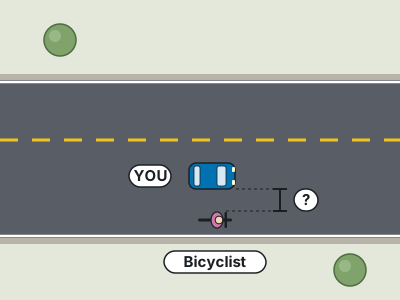
- At least 3 feet until the vehicle is safely past the bicycle
- At least 1 foot
- At least 10 feet
- Enough to avoid contact, with no set distance
Show answer
At least 3 feet until the vehicle is safely past the bicycle. Oklahoma requires a driver overtaking a bicycle to exercise due care by leaving a safe distance of not less than 3 feet between the motor vehicle and the bicycle until the vehicle is safely past, under Title 47-11-1208-A. The manual also warns to watch for riders turning in front of you without looking or signaling, especially children. Three feet is the legal minimum, not a target.
Study this in the handbook: Bicycles, Motorcycles, Trucks and Farm Vehicles
14. What does the Oklahoma litter barrel sign identify?
- A recycling center
- The only lawful place on the highway to throw trash, found at rest areas, picnic areas and turnpike toll stations
- A landfill entrance
- A trash pickup point for trucks
Show answer
The only lawful place on the highway to throw trash, found at rest areas, picnic areas and turnpike toll stations. Watch for the litter barrel sign. It marks the only lawful place on the highway where you can throw trash, and litter barrels are located at all rest and picnic areas and all turnpike toll stations. Throwing trash anywhere else from a vehicle is littering. The state's Keep Our Land Grand campaign and a litter hotline back up the rule.
Study this in the handbook: Work Zone, Guide and Service Signs
15. At an intersection with a yield sign, what action is required?
- Stop at the sign every time, even when the intersection is empty
- Slow to a reasonable speed and be ready to stop for traffic or pedestrians
- Enter at full speed because the sign gives the driver priority
- Yield only to vehicles, never to people walking across the road
Show answer
Slow to a reasonable speed and be ready to stop for traffic or pedestrians. A yield sign requires a controlled approach, not an automatic stop in every circumstance. The driver should slow to a reasonable speed and be prepared to stop if another vehicle or pedestrian is approaching. Entering at full speed removes the time needed to respond. The rule includes pedestrians, so treating the sign as vehicle-only is incomplete. The cue is the triangular sign: reduce speed early, scan the crossing path, and enter the traffic flow only after the roadway is safe.
Study this in the handbook: Right of Way at Intersections
16. What should you do first after a tire blowout?
- Accelerate to keep the damaged tire rotating
- Brake suddenly as hard as possible
- Turn sharply toward the shoulder before slowing
- Take your foot off the gas and brake cautiously
Show answer
Take your foot off the gas and brake cautiously. A blowout can upset the vehicle's balance, so the driver needs gentle control. The manual says to remove your foot from the accelerator and apply the brakes cautiously, specifically warning against sudden braking. The hard-braking choice can worsen instability, while a sharp steering move may cause a swerve before the vehicle is under control. Keep both hands ready, maintain a steady path, and reduce speed progressively before moving to a safe location. The goal is controlled deceleration, not an abrupt maneuver.
Study this in the handbook: Floods, Crashes and Roadside Emergencies
17. What does a rectangular regulatory sign provide to a driver?
- A guarantee that every lane is open
- Laws, regulations, or instructions for traffic
- A warning that pavement is slippery
- A route distance without any traffic rule
Show answer
Laws, regulations, or instructions for traffic. The manual describes a rectangle as a regulatory sign that tells drivers about laws, regulations, or instructions. Such a sign may set a speed limit or control a movement, so it must be read and obeyed. A rectangular sign does not guarantee open lanes, identify wet pavement by itself, or provide only route distance without a rule. When approaching one, reduce distractions, read the wording, and follow the stated requirement or restriction before continuing.
Study this in the handbook: Stop, Yield and Regulatory Signs
18. What must a driver consider before choosing a safe speed under Oklahoma's Basic Speed Rule?
- Only the speed of vehicles behind the driver
- Only the number on the speed-limit sign
- All conditions that affect driving
- Only whether the road has a center line
Show answer
All conditions that affect driving. The Basic Speed Rule starts with the conditions affecting the drive. A driver must select a speed that is safe for those conditions and be able to stop without hitting anyone. Traffic, visibility, weather, pavement, road width, and nearby pedestrians can all change the safe choice. The posted sign remains important, but it is not the only consideration. A vehicle behind you cannot determine a safe speed, and a center line says nothing about every hazard ahead. Recheck conditions whenever the roadway or weather changes.
Study this in the handbook: The Basic Speed Rule
19. What roadway condition does a gentle curved-arrow warning show?

- A passing lane that begins inside the bend
- A mandatory right turn at the next signalized intersection
- A detour that requires leaving the road onto the shoulder
- A road curve ahead where the driver should slow down and keep right
Show answer
A road curve ahead where the driver should slow down and keep right. The curved arrow describes the road alignment ahead, not a compulsory turn at an intersection. Reduce speed before reaching the bend, keep the vehicle to the right, and avoid passing where the view is limited. The detour and passing-lane choices invent actions not conveyed by the symbol. Preparing before the curve preserves control and gives the driver more time to respond to hidden traffic or obstacles.
Study this in the handbook: Warning Signs
20. What may happen to an Oklahoma driver license when the BAC level is 0.08 or more?
- The license is automatically renewed for one year
- The license will be revoked, even without a DUI conviction
- The license is unaffected unless the driver caused a crash
- The license is suspended only after a second offense
Show answer
The license will be revoked, even without a DUI conviction. The implied consent passage says that when the BAC level is 0.08 or more, the driver license will be revoked even if the driver is not convicted in court of DUI. The same paragraph applies to any measurable BAC for a driver under 21. A renewal is not granted by the rule, and the passage does not wait for a crash or a second offense before describing revocation. Treat the BAC threshold as a separate license consequence from the criminal penalties discussed later, because the administrative action can occur without a court conviction.
Study this in the handbook: Implied Consent and DUI Penalties
QualitySpace is expanding to Oklahoma
We are a California-based independent insurance brokerage working on licensing in more states. We cannot help with Oklahoma insurance yet. Leave your email and we will let you know when we can.
Every question is written from the official Oklahoma Driver Manual. Need paper? Printable OK practice test with answer key.
Last verified 2026-10-05. How we check every question · Study all 218 as flashcards
Frequently asked questions
How many questions are on this Oklahoma practice test?
This fixed set has 20 questions. It is test 4 of 10 from the 218 question Oklahoma bank. The real OK exam asks 20 questions and you need 15 correct.
What is the passing score for the real Oklahoma test?
15 out of 20 questions correct to pass That figure comes from the official Oklahoma source cited on the DMV facts page.
How does this fixed test relate to the full Oklahoma bank?
Each numbered test is a fixed set of questions in a fixed order, so you can retake the same test later and compare. Every test mixes road signs and the other topics in about the same proportion as the full bank. Tests 1 to 10 together cover 200 of the 218 questions in the Oklahoma bank, each once. The full practice page mixes the whole bank at random.
Last verified 2026-10-05. See the Oklahoma DMV facts page for sourced state details.
Return to the full Oklahoma practice test · Study road signs