
Test 19 of 25 · 20 questions · Free 2026
OK Permit Practice Test 19
Jump to the test ↓A fixed 20 question set from the Oklahoma bank with answers and plain English explanations. The real OK exam is 20 questions, 75 percent to pass; take the full length version on the main practice page.
Question 1 of 20 · 0 right so far
All 20 questions in test 19
Every question below comes from the Oklahoma question bank on this page. Open a question to see the correct answer and the explanation. Nothing here is hidden behind a signup.
1. After parallel parking, you notice your right wheels are about 2 feet from the curb. Are you parked legally in Oklahoma?
- Yes, anything under 3 feet is legal
- No, you must be within 18 inches
- Yes, if the street is wide enough
- No, you must be touching the curb
Show answer
No, you must be within 18 inches. Unless signs prohibit parking or the curb is painted yellow, you may park parallel to any curb within 18 inches of it. Two feet is 24 inches, which is outside that limit, so pull out and try again. You do not have to touch the curb, but you must be within 18 inches. A wide street does not change the rule. On a hill, the manual asks for even less space: within six inches.
Study this in the handbook: Parking Rules
2. You are stopped in the intersection waiting for oncoming traffic to clear before turning left. How should your front wheels be pointed?
- Turned left, so you are ready to go quickly
- Straight ahead until you can complete the turn
- Turned right, away from oncoming traffic
- Turned left if a car is stopped behind you
Show answer
Straight ahead until you can complete the turn. While you wait to turn left, the manual says not to turn the steering wheel to the left. If you are hit from the rear while your wheels are turned, the impact can push you right into oncoming cars. Keep the wheels straight and wait until you are sure you can complete the turn before turning them. Pointing the wheels right is not the answer either, and having a car behind you is exactly when a rear impact is possible.
Study this in the handbook: Passing and Turning
3. What does Oklahoma law say about texting while driving?
- It is allowed for drivers 18 and older
- It is allowed when stopped in traffic or below 25 mph
- It has been illegal for all drivers since 2015
- It is only illegal for commercial drivers
Show answer
It has been illegal for all drivers since 2015. The manual states that as of 2015, it is illegal to text while driving in Oklahoma. Commercial and public transit drivers face an extra rule: they are also prohibited from making hand-held phone calls while driving. The texting ban is not limited by age or speed, and it is not only for commercial drivers. Learner permit and intermediate license holders can also be suspended or have their license canceled for using a hand-held device while driving, except in a life-threatening emergency.
Study this in the handbook: Headlights, Night Driving and Distractions
4. On a two-lane highway with a single broken yellow centerline, when may you drive to the left of the centerline?
- Whenever the road ahead is straight
- Only to pass, when you can pass safely
- Whenever there is no oncoming traffic in sight
- To avoid potholes, as long as you signal
Show answer
Only to pass, when you can pass safely. Two-lane highways have a single broken yellow centerline, and the manual says you should always drive to the right of it, except to pass when you can pass safely. A straight road or an empty oncoming lane is not by itself a reason to drift left; you cross only to complete a safe pass. Before passing, you still need at least 200 feet of clear roadway without a No Passing Zone. Turning on a signal does not make other trips across the line acceptable.
Study this in the handbook: Pavement Markings and Lanes
5. Why does the Oklahoma manual call night driving a serious danger, especially on poorly lit roads?
- Most traffic laws change after dark
- You see less far, and dark objects are hard to see
- Headlights make all road signs unreadable
- Speed limits are higher at night on rural roads
Show answer
You see less far, and dark objects are hard to see. At night, especially on poorly lit highways and country roads, the distance you can see clearly is greatly reduced. The manual warns that dark-colored animals, dark objects on the road, and people walking or riding bikes in dark clothing will be hard to see. That is why you should reduce speed at night and not overdrive your headlights. Traffic laws and speed limits do not rise after dark, and headlights do not make signs unreadable; the danger is reduced visibility.
Study this in the handbook: Speed Limits and Expressway Speeds
6. Why should you never assume a flooded road is safe just because the water looks shallow?
- Shallow water always drains in a few minutes
- Water level indicators are rarely accurate
- Floodwater makes your brakes work better
- The roadbed beneath may have washed away
Show answer
The roadbed beneath may have washed away. Among its flood safety rules, the manual warns that beneath the water's surface, roadbeds may have been washed away. A crossing that looks shallow can hide a missing road, and the manual adds that 6 inches of water may be enough to make you lose control. Water level indicators at low-water crossings are something to observe, not distrust, and water does nothing to help your brakes. If you encounter a flooded roadway, turn around, don't drown.
Study this in the handbook: Floods, Crashes and Roadside Emergencies
7. You have stopped at a red light and want to turn right. A bicyclist is riding through the intersection from your left. What must you do?
- Yield, because the rule covers all vehicles, including bicycles
- Go first, because you already stopped
- Yield only if the bicyclist is in a marked lane
- Honk so the bicyclist knows you are turning
Show answer
Yield, because the rule covers all vehicles, including bicycles. Oklahoma allows a right turn on red after a stop unless a sign prohibits it, but stopping does not give you priority. The manual says that when you turn, you must yield to all pedestrians and vehicles using the intersection, including bicycles. A bicycle does not need a marked lane to count, and a horn does not give you the right to go. Turn only when everyone is clear of your path.
Study this in the handbook: Traffic Signals
8. A bicyclist is riding in the middle of a lane that is too narrow for a car and a bike to share safely. What does the Oklahoma manual say?
- The rider must move to the far right edge at once
- The rider must get off the road and walk
- The rider may take the full lane; that is safest
- You may pass within the same lane if you go slowly
Show answer
The rider may take the full lane; that is safest. Bicycle riders must ride as far right as possible only when the lane can be safely shared by a car and a bicycle side by side. The manual lists times when a bike can take the full lane, including when the lane is too narrow for both to share safely, and says that in this case it is safest to let the bicycle take the full lane. Squeezing past in the same lane leaves no room, and the rider is not required to leave the road. Wait until you can pass safely.
9. Approaching railroad tracks, you find that trees block your view down the track to the left. What should you do?
- Speed up to cross before a train appears
- Drive very slowly until you can see down the track
- Honk your horn and cross at normal speed
- Look only to the right, where you can see
Show answer
Drive very slowly until you can see down the track. The manual's advance warning sign section says that if your view is blocked in either direction, drive very slowly until you can see down the track, and if you see a train coming, stop. Speeding up to beat a train you cannot see is a gamble, a horn does not warn the train, and checking only the open side leaves the blocked side unchecked. The manual also warns that a train appears to be moving much slower than it really is.
Study this in the handbook: Warning Signs
10. On a four-lane road, a white dashed line separates your lane from the lane to your right, where traffic moves the same way. When may you change into that lane?
- Never, since lane lines may not be crossed
- At the next intersection, as long as you signal
- Only when turning into a driveway or alley
- When it is safe, after signaling and checking
Show answer
When it is safe, after signaling and checking. White dashed lines separate lanes of traffic moving in the same direction, and the manual says passing is permitted when it is safe. You may change lanes across a dashed white line after checking your mirrors, signaling, and looking over your shoulder at your blind spot. Dashed lines are meant to be crossed with care; a solid white line instead warns that changing lanes is hazardous, as near an intersection or merge area.
Study this in the handbook: Pavement Markings and Lanes
11. You want to turn right at an intersection where the light is red and no sign prohibits the turn. What must you do before turning?
- Slow to a crawl and turn if the way looks clear
- Wait for the light to turn green
- Come to a complete stop, then turn when safe
- Honk once, then turn ahead of cross traffic
Show answer
Come to a complete stop, then turn when safe. Oklahoma allows a right turn on a red light, but only after coming to a complete stop and only when no sign forbids the turn. Rolling through slowly is not a stop. Once stopped, you must yield to all pedestrians and vehicles using the intersection, including bicycles, before you make the turn. You do not have to wait for green when the turn is allowed, and a horn never gives you the right-of-way.
Study this in the handbook: Traffic Signals
12. Unless a sign posts a different limit, what is the speed limit on Oklahoma controlled access highways?
- 75 mph
- 65 mph
- 70 mph
- 80 mph
Show answer
75 mph. Oklahoma's state speed chart lists 75 mph for controlled access highways when no other limit is posted. Turnpikes appear separately at 80 mph and undivided state highways at 65 mph, so mixing up the road type leads to the wrong number. Picking 80 mph applies the turnpike figure to a different kind of highway, and 70 mph is not a default figure anywhere in the chart. These numbers apply under normal conditions only. The Basic Speed Rule still requires slowing down for rain, fog, heavy traffic, or darkness, and any posted sign replaces the chart figure.
Study this in the handbook: Speed Limits and Expressway Speeds
13. Which of these behaviors does the Oklahoma manual list as an example of road rage?
- Driving 5 mph under the limit in the right lane
- Using hazard flashers during a breakdown
- Signaling 100 feet before a turn
- Tailgating and cutting off other vehicles
Show answer
Tailgating and cutting off other vehicles. The manual asks drivers to recognize the warning signs of aggressive driving. Its examples of road rage include tailgating, cutting off other vehicles, careless lane changes, speeding, and running red lights. Escalated road rage can include obscene gestures, verbal assault, intentionally hitting another vehicle, and threatening to use a weapon. Signaling ahead, using flashers in a breakdown, and driving modestly in the right lane are ordinary safe behaviors, not aggression.
Study this in the handbook: Speed Limits and Expressway Speeds
14. When you park on a hill next to a curb, how close to the curb does the Oklahoma manual say to stop?
- Within six inches
- Within 18 inches
- Within two feet
- Within three feet
Show answer
Within six inches. Parking on a hill uses the same parallel parking method, but the manual says to stop within six inches of the curb instead of the usual 18 inches. Then brace the wheels against the curb, set the parking brake, put the car in reverse, low gear, or park, and turn off the switch. Being that close lets the turned wheels rest against the curb, so the curb can stop the car if it starts to roll. Two or three feet away leaves too much room.
Study this in the handbook: Parking Rules
15. What does the Oklahoma manual say happens when alcohol is mixed with other drugs?
- The effects can multiply and even cause death
- Each drug cancels out the other's effects
- The alcohol wears off faster than normal
- Nothing changes if the drug is legal
Show answer
The effects can multiply and even cause death. Mixing drugs is especially dangerous because they react with each other and multiply the harmful effects on concentration and coordination, and the manual says this is especially true when one of the drugs is alcohol. Alcohol mixed with other drugs may multiply the effects of the alcohol, and the combination can cause serious health problems, even death. Drugs do not cancel each other out, alcohol does not leave faster, and a legal prescription can still be deadly with alcohol.
Study this in the handbook: Implied Consent and DUI Penalties
16. From a distance you see a diamond-shaped sign with a yellow background and black symbols. What kind of sign is it?
- A regulatory sign giving a law you must obey
- A guide sign showing routes and distances
- A service sign showing gas, food, or lodging
- A warning sign about conditions just ahead
Show answer
A warning sign about conditions just ahead. Warning signs are diamond-shaped, with a yellow background and black letters or symbols. They signal conditions immediately ahead, such as road hazards or changes in direction, so be prepared to use extra caution or adjust your driving. Regulatory signs are black and white rectangles, guide signs are green, white, or brown, and service signs are blue. Learning shapes and colors lets you know a sign's meaning even before you can read it.
Study this in the handbook: Warning Signs
17. What does this yellow warning sign tell you?

- There is a stop sign ahead, so be prepared to stop
- Cross traffic ahead must stop, so you may keep going
- A police checkpoint is ahead, so slow to 25 mph
- A railroad crossing is ahead, so stop within 50 feet
Show answer
There is a stop sign ahead, so be prepared to stop. A yellow diamond showing a red octagon is an advance warning: a stop sign is ahead, and the manual says to be prepared to stop. Warning signs like this one are yellow diamonds that signal conditions immediately ahead. The sign does not promise that cross traffic will stop for you, and checkpoints and railroad crossings are marked in other ways. When you reach the stop sign itself, you must stop before the crosswalk, even an unmarked one, and stay stopped until the way is clear in all directions.
Study this in the handbook: Warning Signs
18. A driver on an expressway keeps looking only at the bumper of the car in front. How far ahead does the manual say to be watching instead?
- About 3 seconds ahead, the same as a following gap
- 15 to 20 seconds ahead
- About 1 second ahead, just past the hood
- About 40 seconds ahead, near the horizon
Show answer
15 to 20 seconds ahead. Watching only the car directly ahead leaves no time to react to trouble farther along. The manual says to watch 15 to 20 seconds ahead for cars braking, entering and exiting, and to observe all highway signs. Looking that far also lets you move to the exit lane as early as possible when you plan to leave the expressway. Gaps of one to three seconds are far too short for scanning, and looking out to the horizon is not the distance the manual gives.
Study this in the handbook: Expressway Driving
19. A driver's test shows an alcohol concentration of 0.06. The driver says that is under 0.08, so it cannot matter. What does Oklahoma law say?
- A reading under 0.08 cannot be used as evidence
- The reading counts for commercial drivers, not private ones
- The reading counts once the driver has caused a crash
- A concentration over 0.05 is relevant evidence of impaired driving
Show answer
A concentration over 0.05 is relevant evidence of impaired driving. Oklahoma law prohibits driving while impaired by alcohol or other substances. The manual states that an alcohol concentration more than 0.05 is relevant evidence that the driver's ability to drive was impaired. A reading below 0.08 therefore does not prove the driver was fit to drive. The rule is not limited to commercial drivers, and evidence of impairment does not depend on a crash happening.
Study this in the handbook: Implied Consent and DUI Penalties
20. You missed the street you wanted, and this sign is posted at the next intersection. How should you get turned around?
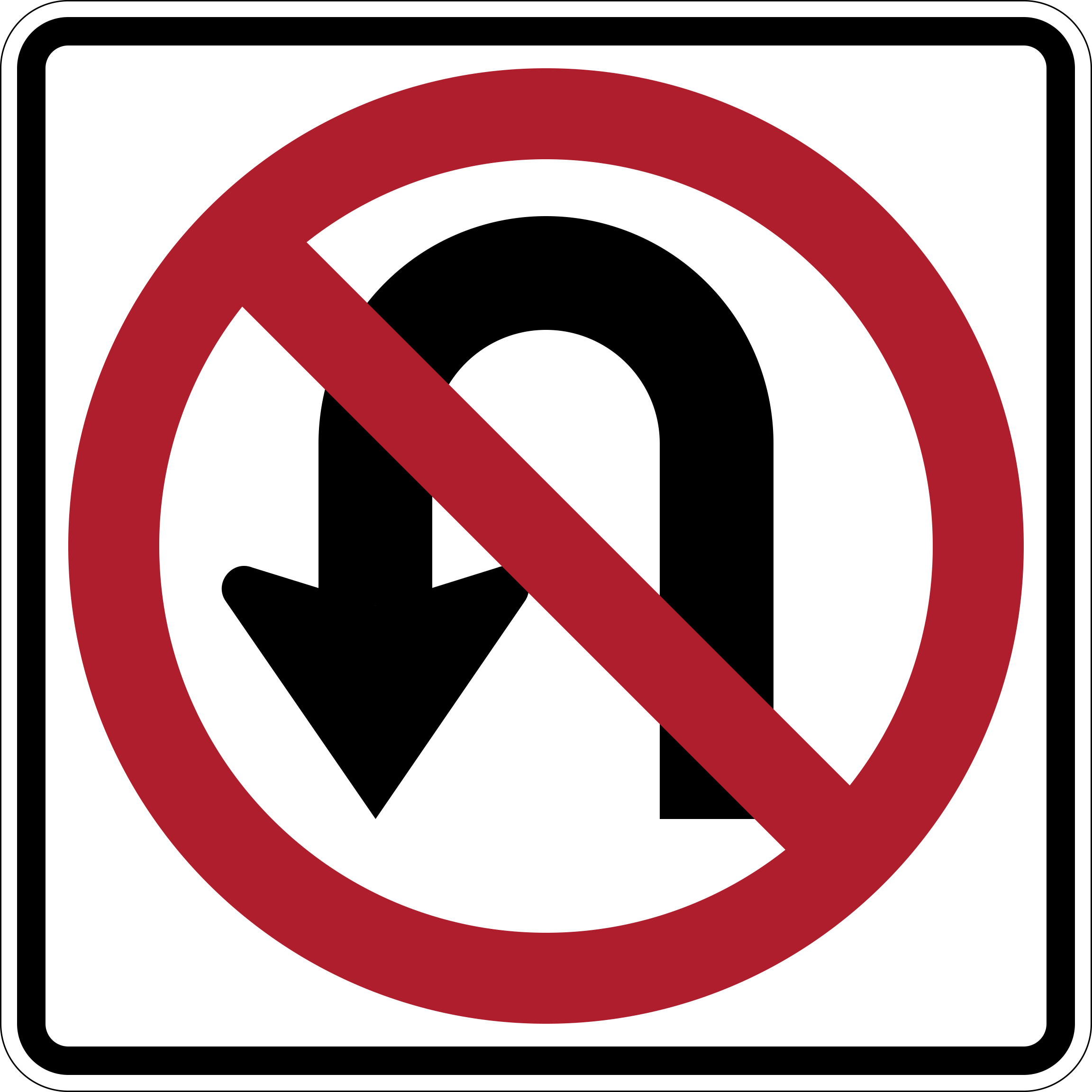
- Make a quick U-turn while no cars are coming
- Back up to the street you missed
- Go around the block or find another legal route
- Turn around in the middle of the intersection
Show answer
Go around the block or find another legal route. A U-shaped arrow inside a red circle with a slash means no U-turn: do not turn around in the street or intersection at that spot. An empty road does not lift the rule. Backing up toward the street you missed is also dangerous, and the manual's backing rules say it is much safer to drive around the block than to back into an intersection to turn around. Continue on and use a route that lets you come back legally.
Study this in the handbook: Stop, Yield and Regulatory Signs
Every question is written from the official Oklahoma Driver Manual. Need paper? Printable OK practice test with answer key.
Last verified 2026-10-05. How we check every question · Study all 500 as flashcards
Frequently asked questions
How many questions are on this Oklahoma practice test?
This fixed set has 20 questions. It is test 19 of 25 from the 500 question Oklahoma bank. The real OK exam asks 20 questions and you need 15 correct.
What is the passing score for the real Oklahoma test?
15 out of 20 questions correct to pass That figure comes from the official Oklahoma source cited on the DMV facts page.
How does this fixed test relate to the full Oklahoma bank?
Each numbered test is a fixed set of questions in a fixed order, so you can retake the same test later and compare. Every test mixes road signs and the other topics in about the same proportion as the full bank. Tests 1 to 25 together cover every question in the Oklahoma bank once. The full practice page mixes the whole bank at random.
Last verified 2026-10-05. See the Oklahoma DMV facts page for sourced state details.
Return to the full Oklahoma practice test · Study road signs