
Printable OK Permit Practice Test
20 questions in the real OK exam format, 75 percent (15 of 20) to pass. Answer key on the last page. Last verified 2026-09-05 against the official Oklahoma driver manual.
1. What hazard is announced by a round yellow and black warning sign?
- A recreational area
- A hospital entrance
- A low clearance underpass
- Railroad tracks ahead
2. At a railroad crossbuck, what action does the Oklahoma manual require before crossing?
- Slow down, look, listen, and be prepared to yield
- Accelerate to clear the tracks quickly
- Stop only if the crossbuck has flashing lights
- Cross without checking when no gate is present
3. At an intersection without traffic signs or signals, what must a driver do before entering?
- Enter first because the larger road has priority
- Wait only for pedestrians
- Accelerate to make other traffic yield
- Stop and yield to approaching traffic
4. On a flashing yellow arrow for a left turn, who has the right-of-way?
- Vehicles behind the turning driver
- The driver turning left
- Oncoming traffic and pedestrians
- Only vehicles in the left-turn lane
5. At a yield sign, when may you enter the flow of traffic?
- After slowing and yielding when entering can be done safely
- Immediately, because a yield sign gives the entering vehicle priority
- Only after stopping for one full minute
- Before checking for pedestrians if no vehicle is approaching
6. Which situation is listed as a reason to stop at a highway rail crossing?
- An approaching train is plainly visible and dangerously close to the crossing
- A crossing has a crossbuck sign but no train is visible
- The road is empty and the crossing has no gate
- A driver wants to stop on the tracks to look for a train
7. What information is commonly provided by blue service signs?
- Locations of facilities such as service stations, restaurants, and motels
- The maximum speed for the current road
- A warning that a curve is immediately ahead
- The number of tracks at a railroad crossing
8. How should you respond when a yellow merge warning appears?

- Assume your lane ends immediately and stop in the travel lane
- Expect other traffic may enter your lane and adjust speed or lane safely
- Accelerate without checking because merging traffic must always yield to you
- Turn at the next side street to avoid the joining roadway
9. What should an Oklahoma driver expect from speed limits set by cities and towns?
- They can be ignored outside school hours
- They must match the statewide table everywhere
- They apply only on turnpikes
- They may differ by local zone and posted signs must be obeyed
10. What happens to speeding fines in an Oklahoma construction or maintenance zone?
- They are doubled when workers or equipment are present
- They apply only at night
- They are cut in half during weekends
- They are replaced with a warning
11. If the solid yellow line is in the driver's lane, what passing rule applies?
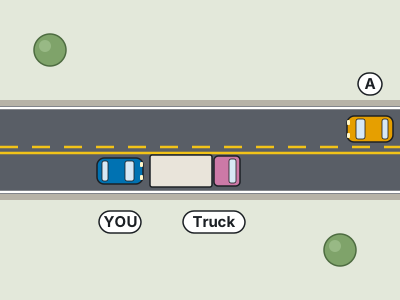
- Passing is allowed if the driver uses the horn first
- Passing is prohibited from that lane
- Passing is allowed only for motorcycles and farm equipment
- Passing is required to keep traffic moving at the speed limit
12. On a two-lane Oklahoma road, how should a driver respond to a stationary vehicle with flashing lights on the roadside?
- Speed up before reaching it
- Slow down and drive carefully
- Stop in the opposing lane
- Pass without changing speed or attention
13. At a stop sign, where must you stop when a pedestrian crosswalk is present?
- After entering the intersection
- Before the crosswalk
- Beside the stop sign post
- Only when a pedestrian is visible
14. A 14 year old in Oklahoma has a motorcycle only license. When may the rider operate the motorcycle?
- Only between 4:30 a.m. and 9:00 p.m., with no passenger
- Any time, with one passenger
- Only between 6 a.m. and 6 p.m., with one passenger
- Only on weekends
15. Which roadway condition permits passing another vehicle on the right?
- Only when the vehicle ahead is stopped at a red light
- By driving onto the shoulder whenever the vehicle ahead is slow
- On any two lane road if the driver sounds the horn
- On a one way road, or where two or more lanes move each way without obstruction
16. What is the purpose of Walk and Don't Walk pedestrian signals?
- To authorize vehicles to ignore a traffic signal
- To set speed limits for vehicles near intersections
- To direct and protect people crossing on foot or in wheelchairs
- To identify which lane a vehicle must use
17. What general response does the Oklahoma manual recommend for warning signs of hazards near the roadway?

- Stop in every lane immediately, even when traffic is behind you
- Accelerate so the hazard is passed before it becomes visible
- Watch both sides of the road and be prepared to slow down or stop
- Ignore the warning if the sign is diamond-shaped
18. What may happen if proof of driver education completion is not presented for an Oklahoma license application?
- The applicant automatically receives an unrestricted license
- Additional restrictions may be imposed
- The written test is permanently waived
- The vehicle registration is canceled
19. What is the penalty in Oklahoma for failing to obey construction and maintenance zone signs, signals and markings?
- A fixed $50 fine
- Two points, but no fine
- A mandatory one year license revocation
- A fine between $100 and $1,000, up to 30 days in jail, or both
20. Under Oklahoma's "T" graduated license restriction, how many passengers may a teen carry when no licensed adult is riding along?
- None at all
- Up to three friends
- Any number, as long as everyone wears a seat belt
- One passenger, or only people who live in the driver's home
Answer key
- 1. D
- 2. A
- 3. D
- 4. C
- 5. A
- 6. A
- 7. A
- 8. B
- 9. D
- 10. A
- 11. B
- 12. B
- 13. B
- 14. A
- 15. D
- 16. C
- 17. C
- 18. B
- 19. D
- 20. D