
Test 10 of 10 · 20 questions · Free 2026
OK Permit Practice Test 10
Jump to the test ↓A fixed 20 question set from the Oklahoma bank with answers and plain English explanations. The real OK exam is 20 questions, 75 percent to pass; take the full length version on the main practice page.
Question 1 of 20 · 0 right so far
All 20 questions in test 10
Every question below comes from the Oklahoma question bank on this page. Open a question to see the correct answer and the explanation. Nothing here is hidden behind a signup.
1. What happens to speeding fines in an Oklahoma construction or maintenance zone?
- They are doubled when workers or equipment are present
- They apply only at night
- They are cut in half during weekends
- They are replaced with a warning
Show answer
They are doubled when workers or equipment are present. Oklahoma doubles speeding fines in construction and maintenance zones when workers or equipment are present, and the manual says the same about school zones. Nothing limits the rule to night hours, halves fines on weekends, or swaps the fine for a warning. The doubling applies while people or machines are in the zone, which is exactly when a speeding driver is most likely to hurt someone.
Study this in the handbook: Work Zone, Guide and Service Signs
2. Under Oklahoma's "T" graduated license restriction, how many passengers may a teen carry when no licensed adult is riding along?
- None at all
- Up to three friends
- Any number, as long as everyone wears a seat belt
- One passenger, or only people who live in the driver's home
Show answer
One passenger, or only people who live in the driver's home. A graduated license holder may carry one passenger, or any number of people who live in the same home. The limit lifts only when a licensed driver at least 21 years old sits in the front passenger seat. Carrying no one at all is stricter than the law, three friends is more than it allows, and seat belt use does not change the passenger cap. The same graduated restriction also limits driving hours to 5 a.m. through 10 p.m. outside its listed exceptions.
Study this in the handbook: Learner Permits and the Graduated License
3. When rain, fog, or ice makes the posted speed unsafe, what does Oklahoma's Basic Speed Rule require?
- Continue at the sign's number
- Drive at the minimum speed shown on an interstate
- Adjust speed to conditions so you can stop within a clear distance ahead
- Use hazard lights instead of slowing
Show answer
Adjust speed to conditions so you can stop within a clear distance ahead. The Basic Speed Rule requires a speed that is careful and prudent for current conditions, with enough control to stop within a clear distance ahead. A posted number is not a guarantee that the same pace is safe in rain, fog, ice, darkness, or heavy traffic. Hazard lights do not substitute for speed control, and an interstate minimum is unrelated. The best cue is whether the driver can see and stop within the open space ahead.
Study this in the handbook: The Basic Speed Rule
4. What does a flashing yellow light require at an Oklahoma intersection?
- Stop and remain stopped until green
- Proceed at the posted maximum without checking
- Slow down, look in both directions, and drive slowly and carefully
- Make a left turn immediately
Show answer
Slow down, look in both directions, and drive slowly and carefully. A flashing yellow light means caution. Drivers should slow down, look in both directions, proceed slowly and carefully, and be prepared to stop. It does not impose the complete stop associated with a flashing red light, and it never grants permission to rush through at the posted maximum. The left-turn choice adds a movement the signal does not require. Treat the flashing yellow as a warning that demands observation and controlled speed.
Study this in the handbook: Traffic Signals
5. When a school bus has flashing red lights or displays its red STOP sign, when may approaching drivers proceed?
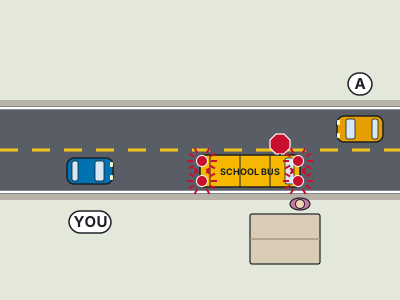
- After the bus moves, the driver signals them, or the red warnings end
- As soon as the driver sees no children in the nearest lane
- After waiting ten seconds, whether the bus remains stopped or not
- When the approaching vehicle reaches the bus's rear bumper
Show answer
After the bus moves, the driver signals them, or the red warnings end. A bus showing flashing red lights or a red STOP sign is loading or unloading children, so the approaching driver must stop and remain stopped. Movement may resume only after the bus starts moving, the bus driver motions the vehicle forward, or the red lights stop and the sign is pulled back. Looking for children is not a substitute for the bus signals, and a timer or bumper position creates no permission. The cue is the bus’s red warning display, which remains controlling until one of those events occurs.
Study this in the handbook: School Buses and Railroad Crossings
6. What does the shape and color of an Oklahoma warning sign generally indicate?
- A yellow diamond warns of conditions immediately ahead
- A blue circle marks a mandatory stop
- A green octagon gives a route distance
- A white triangle identifies a parking service
Show answer
A yellow diamond warns of conditions immediately ahead. The standard warning sign has a diamond shape, a yellow background, and black letters. Its message concerns a condition immediately ahead, such as a road hazard or a change in direction. The blue circle, green octagon, and white triangle descriptions do not match the manual’s warning format or its stated purpose. Seeing the yellow diamond combination is a cue to scan ahead, reduce speed if needed, and prepare for a change rather than treating the sign as a route or parking marker.
Study this in the handbook: Warning Signs
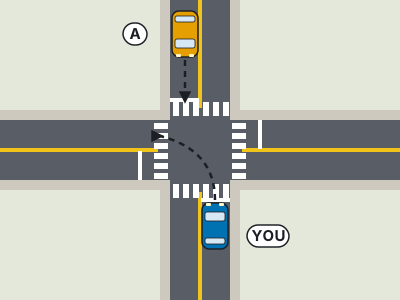
7. When making a left turn, what traffic must you yield to?
- No traffic because the turn signal gives priority
- Only vehicles that are already stopped
- Traffic behind you, but not vehicles approaching ahead
- All oncoming traffic, turning only when there is enough clear distance
Show answer
All oncoming traffic, turning only when there is enough clear distance. A left-turning vehicle crosses the path of approaching traffic, so the driver must wait for all oncoming traffic and proceed only when the gap is sufficient. The signal communicates intent, but it does not grant priority over vehicles coming toward the intersection. The stopped-only option overlooks moving traffic that may be close enough to be dangerous. Slow down before the turn, keep watching ahead, and do not begin crossing until the entire maneuver can be completed without interfering with approaching vehicles.
Study this in the handbook: Right of Way at Intersections
8. In Oklahoma, what does a yellow diamond warning sign tell a driver to expect?
- A law that applies only to commercial drivers
- A service station location
- A condition or hazard immediately ahead
- A route distance and exit name
Show answer
A condition or hazard immediately ahead. Yellow diamond signs are warnings rather than commands, service markers, or route guides. They alert the driver to a condition, change in direction, or other situation ahead. Because the message concerns what is coming, reduce speed as needed, scan for the pictured hazard, and prepare to stop or adjust position. The blue service choice belongs to facilities such as gas or food. Green signs provide travel information, while rectangular black and white signs regulate traffic and must be obeyed.
Study this in the handbook: Warning Signs
9. What does a flashing red traffic light require a driver to do before crossing the intersection?
- Wait for a green arrow before traveling straight
- Slow down without stopping if cross traffic appears distant
- Continue through because the signal gives priority to the driver
- Stop as at a stop sign, then proceed only when it is safe
Show answer
Stop as at a stop sign, then proceed only when it is safe. A flashing red light carries the same stopping requirement as a stop sign. The driver must stop, assess the intersection, and cross only when it is safe. Merely slowing down leaves the vehicle without the required full stop. Continuing because the road looks open treats the signal as a permission to roll through, and a green arrow is not needed for straight travel after the stop when the path is safe. The useful cue is the red flash: stop completely, yield as needed, and proceed cautiously.
Study this in the handbook: Traffic Signals
10. What driving condition does the skidding-car warning identify?

- A designated area where drivers may practice emergency braking
- A surface that may be slippery when wet, requiring extra caution
- A gravel-only roadway where pavement ends immediately
- A racing route where tires are expected to lose traction
Show answer
A surface that may be slippery when wet, requiring extra caution. The skidding-car symbol warns that wet pavement can become slick. The manual advises slowing down and using extra caution because rain can create a slippery film, while wet conditions also increase hydroplaning risk. The sign does not mark a practice area, announce that pavement ends, or authorize racing. Ease off the accelerator, avoid abrupt steering, and leave more room to stop when the surface is wet. The strongest cue is the car losing traction, which calls for gentler inputs and lower speed.
Study this in the handbook: Following Distance and Stopping
11. If a police officer directs traffic differently from a traffic signal, whose direction must a driver follow?
- The signal, because a green light always controls
- The traffic officer's direction
- The direction of the nearest driver in the intersection
- The lane marking, even when the officer signals a stop
Show answer
The traffic officer's direction. A traffic officer’s direction takes priority over the displayed signal. The driver must obey the officer at all times, even when the light appears to authorize movement. Following a green light into an officer directed stop can create a collision or interfere with traffic control. Another driver’s movement and a lane marking cannot replace the instruction of the person managing the intersection. The cue is the officer’s position and hand signal: reduce speed, watch for the command, and follow it until the officer releases the movement.
Study this in the handbook: Traffic Signals
12. When this keep-right symbol appears beside an obstruction, which path is indicated?
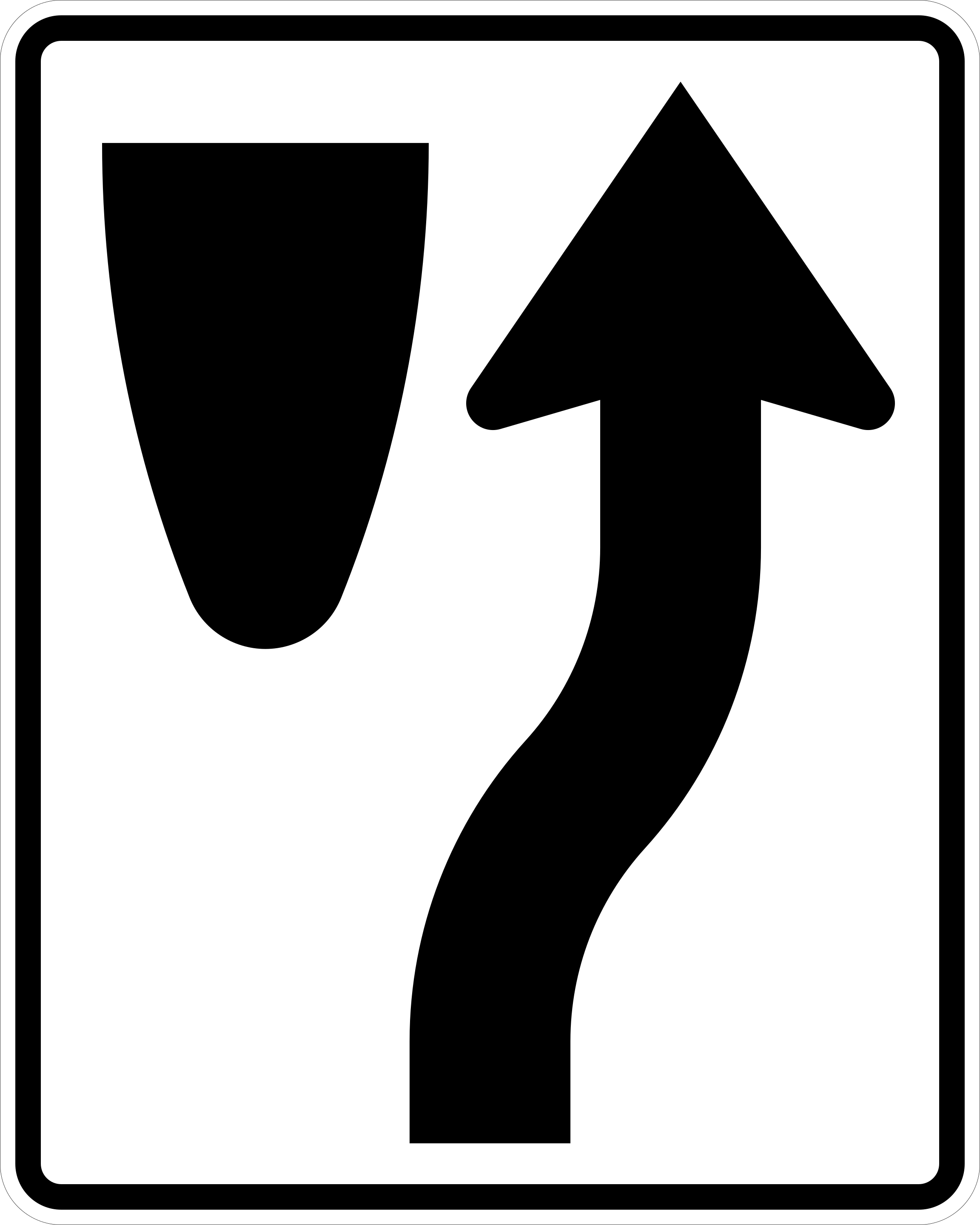
- Remain in the lane nearest the obstruction until it ends
- Use the left shoulder to pass every vehicle ahead
- Pass to the right of the object or center divider
- Turn right at the next intersection regardless of lane signs
Show answer
Pass to the right of the object or center divider. The arrow shows how traffic should get around the hazard. Keep the vehicle to the right of the object or center divider, leaving the opposing or restricted side alone. This is a routing instruction, not a general passing rule or an order to turn at the next intersection. Reduce speed as needed, watch for channeling devices and other road users, and return to the normal lane only after clearing the obstruction safely.
Study this in the handbook: Stop, Yield and Regulatory Signs
13. Can Oklahoma revoke a driver's license for a BAC of 0.08 or more without a court DUI conviction?
- No, a conviction is always required
- Yes, under the implied consent process
- Only after a second conviction
- Only when the driver is under 21
Show answer
Yes, under the implied consent process. Yes. Oklahoma's implied consent section says a BAC of 0.08 or more can lead to license revocation even if the driver is not convicted of DUI in court. That is an administrative consequence tied to the test result, separate from criminal penalties. The choice “No, a conviction is always required” wrongly makes revocation depend on conviction, and the remaining choices incorrectly restrict the rule to repeat offenses or younger drivers. Remember that refusal can also cause automatic revocation.
Study this in the handbook: Implied Consent and DUI Penalties
14. How often can an Oklahoma driver get the two point reduction for completing an approved defensive driving course?
- Once every 24 months
- Once every 6 months
- Once a year
- Only once in a lifetime
Show answer
Once every 24 months. Completing a Service Oklahoma approved Driver Compliance or Defensive Driving Course removes two points, and that credit can be given once every 24 months. Six months and once a year are more often than allowed, and the manual does not limit it to once in a lifetime. The point total also cannot go below zero, so a course taken with a clean record banks nothing.
Study this in the handbook: License Rules, Points and Penalties
15. Under Oklahoma's Zero Tolerance law, what is the fine range for a second or subsequent conviction?
- $100 to $1,000, or community service or treatment
- $25 to $50
- $5,000 minimum
- No fine, only revocation
Show answer
$100 to $1,000, or community service or treatment. A second or subsequent Zero Tolerance conviction carries a fine of $100 to $1,000, community service, a treatment program, or any combination of those. The first conviction range is $100 to $500. The $25 to $50 range is far too low, a $5,000 minimum is not in the Zero Tolerance fine schedule, and the fines come in addition to the mandatory revocation rather than instead of it.
Study this in the handbook: Zero Tolerance for Drivers Under 21
16. When must you remain stopped behind a school bus displaying flashing red lights?
- Until exactly 30 seconds have passed
- Until the bus moves, the driver signals you, or the red warning ends
- Until the vehicle behind you begins moving
- Until you can see no children in the roadway
Show answer
Until the bus moves, the driver signals you, or the red warning ends. Flashing red lights or a red stop sign on a school bus means children are getting on or off, so the driver must stop and remain stopped. Continue only after the bus starts moving, the driver motions you to proceed, or the red lights stop flashing and the sign is pulled back. A fixed 30-second wait is not the rule, and the movement of another vehicle does not release you. Waiting until children disappear from view is also unreliable. The cue is the bus signal, not a guessed time or visual estimate.
Study this in the handbook: Right of Way at Intersections
17. A farm tractor ahead displays a slow-moving vehicle emblem. What should you do before passing?
- Follow within one car length so the tractor cannot turn unexpectedly
- Keep a safe gap and wait until the roadway gives a clear, legal view
- Pass on the shoulder if the tractor is traveling below the speed limit
- Use the horn continuously and pass without checking oncoming traffic
Show answer
Keep a safe gap and wait until the roadway gives a clear, legal view. A slow-moving emblem identifies equipment that may be large, wide, and traveling below ordinary traffic speed. Before passing, remain far enough back to see the roadway and wait for a clear legal opportunity. Following one car length blocks your view and leaves little reaction time. The shoulder is not an automatic passing lane, and repeated horn use cannot substitute for checking opposing traffic. Keep watching the tractor because farm equipment may turn or occupy more than one lane while you plan the maneuver.
Study this in the handbook: Passing and Turning
18. In Oklahoma, how far from a stop sign or traffic signal at the side of the road must you park on the approach?
- At least 15 feet
- At least 20 feet
- At least 50 feet
- At least 30 feet
Show answer
At least 30 feet. Parking is prohibited within 30 feet upon approaching any flashing beacon, stop sign or traffic control signal located at the side of the roadway, so approaching drivers can see the control. Fifteen feet is the hydrant distance, 20 feet applies to crosswalks at intersections and fire station driveways, and 50 feet applies to the nearest rail of a railroad crossing.
Study this in the handbook: Parking Rules
19. Why does Oklahoma require drivers to move over or slow down around vehicles with flashing lights?
- To reserve the shoulder for buses
- To make the stopped vehicle leave sooner
- To prevent secondary crashes
- To avoid receiving a parking citation
Show answer
To prevent secondary crashes. The manual explains that moving over or slowing around roadside vehicles with flashing lights helps prevent secondary crashes. A secondary crash happens because another incident distracts a driver or creates a dangerous interaction with passing traffic. The rule is about protecting people and avoiding a new collision, not expediting the disabled vehicle, reserving the shoulder, or enforcing parking. The cue is incident scene equals focused attention, reduced risk, and no rubbernecking.
Study this in the handbook: Emergency Vehicles and the Move Over Law
20. What insurance document must be brought when taking the Oklahoma driving test?
- A vehicle repair estimate
- A homeowner insurance policy
- A health insurance card only
- Proof of auto liability insurance
Show answer
Proof of auto liability insurance. The checklist calls for valid proof of auto liability insurance when an applicant is taking the driving test. A health card, homeowner policy, or repair estimate does not show the required vehicle liability coverage. The document belongs with the test-day materials, alongside the vehicle and licensing paperwork. Use the cue that the state is checking financial responsibility for the automobile being tested, so the relevant proof is current auto liability insurance.
Study this in the handbook: Applying and the License Tests
QualitySpace is expanding to Oklahoma
We are a California-based independent insurance brokerage working on licensing in more states. We cannot help with Oklahoma insurance yet. Leave your email and we will let you know when we can.
Every question is written from the official Oklahoma Driver Manual. Need paper? Printable OK practice test with answer key.
Last verified 2026-10-05. How we check every question · Study all 218 as flashcards
Frequently asked questions
How many questions are on this Oklahoma practice test?
This fixed set has 20 questions. It is test 10 of 10 from the 218 question Oklahoma bank. The real OK exam asks 20 questions and you need 15 correct.
What is the passing score for the real Oklahoma test?
15 out of 20 questions correct to pass That figure comes from the official Oklahoma source cited on the DMV facts page.
How does this fixed test relate to the full Oklahoma bank?
Each numbered test is a fixed set of questions in a fixed order, so you can retake the same test later and compare. Every test mixes road signs and the other topics in about the same proportion as the full bank. Tests 1 to 10 together cover 200 of the 218 questions in the Oklahoma bank, each once. The full practice page mixes the whole bank at random.
Last verified 2026-10-05. See the Oklahoma DMV facts page for sourced state details.
Return to the full Oklahoma practice test · Study road signs