
Test 7 of 10 · 20 questions · Free 2026
OK Permit Practice Test 7
Jump to the test ↓A fixed 20 question set from the Oklahoma bank with answers and plain English explanations. The real OK exam is 20 questions, 75 percent to pass; take the full length version on the main practice page.
Question 1 of 20 · 0 right so far
All 20 questions in test 7
Every question below comes from the Oklahoma question bank on this page. Open a question to see the correct answer and the explanation. Nothing here is hidden behind a signup.
1. What information is commonly provided by blue service signs?
- Locations of facilities such as service stations, restaurants, and motels
- The maximum speed for the current road
- A warning that a curve is immediately ahead
- The number of tracks at a railroad crossing
Show answer
Locations of facilities such as service stations, restaurants, and motels. Blue service signs direct drivers to facilities and identify where practical roadside services are available. The manual lists service stations, restaurants, and motels as examples. A speed limit is a regulatory message, a curve warning uses the warning-sign system, and track counts appear with railroad crossing information. Blue does not mean that a facility is in the immediate lane or that a driver may stop wherever the sign appears. Use the information to plan a safe exit or stopping location.
Study this in the handbook: Work Zone, Guide and Service Signs
2. What general response does the Oklahoma manual recommend for warning signs of hazards near the roadway?

- Stop in every lane immediately, even when traffic is behind you
- Accelerate so the hazard is passed before it becomes visible
- Watch both sides of the road and be prepared to slow down or stop
- Ignore the warning if the sign is diamond-shaped
Show answer
Watch both sides of the road and be prepared to slow down or stop. Warning signs identify conditions or potential hazards near the roadway. The manual tells drivers to watch both sides of the road and be prepared to slow down or stop. That advice supports scanning and controlled speed, not accelerating toward a hazard or stopping abruptly in a live lane without regard for traffic. A diamond shape is a recognition cue, not a reason to ignore the message. Read the sign early, look beyond it for the condition described, and choose a speed that leaves room to react.
Study this in the handbook: Warning Signs
3. What should you anticipate when driving near rural farm areas?
- Farm equipment must always remain on the shoulder
- Slow-moving tractors and other farm equipment may use the highway
- Every rural tractor travels at the posted speed limit
- Rural roads are closed whenever farm equipment is present
Show answer
Slow-moving tractors and other farm equipment may use the highway. Rural roads may carry tractors, combines, and other farm equipment moving between fields. These vehicles can be large, occupy more than one lane, and travel below ordinary traffic speed, so a driver should look farther ahead and be ready to slow substantially. The shoulder-only choice is false because the equipment may use the highway, and not every tractor travels at the posted limit. A road closure is not the normal response. The practical cue is a hill crest or field entrance: expect a slow machine beyond it and leave room to react.
4. When does the Oklahoma manual say headlights must be on at night?
- From sunset to sunrise exactly
- One hour after sunset
- Beginning 30 minutes after sunset and until 30 minutes before sunrise
- Only when it is fully dark
Show answer
Beginning 30 minutes after sunset and until 30 minutes before sunrise. Oklahoma's headlight list says to use your headlights beginning 30 minutes after sunset and 30 minutes before sunrise, when a road sign states that headlights must be used, and with low beams in fog, rain, snow, adverse weather or where there are streetlights. Waiting for full darkness or an hour after sunset is too late, and exactly sunset to sunrise is not the stated window.
Study this in the handbook: Headlights, Night Driving and Distractions
5. Which movement is prohibited by the crossed U-shaped arrow?
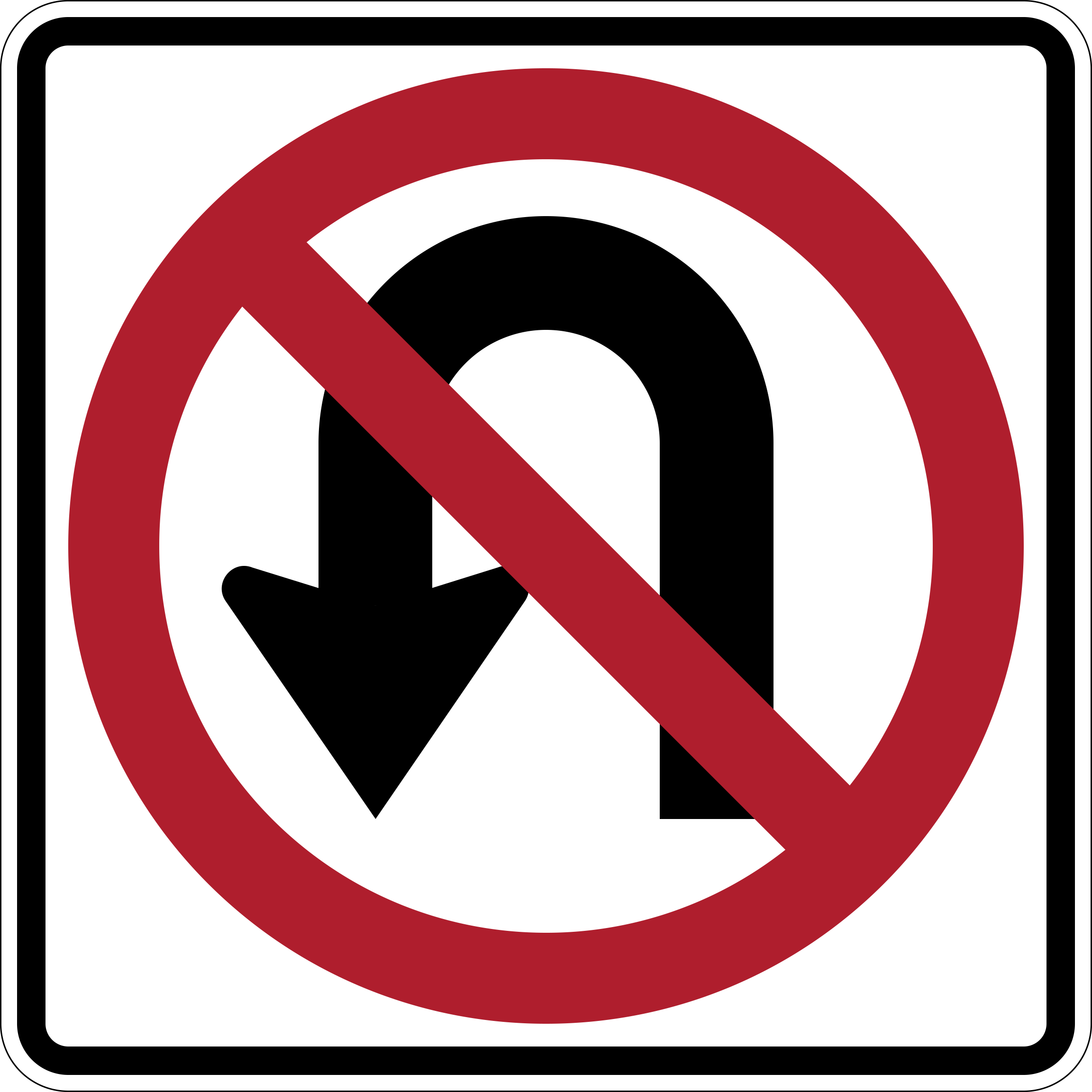
- Changing from a left lane to a right lane
- Turning around in the street or intersection
- Passing a slower vehicle on a divided highway
- Making a permitted right turn at a signal
Show answer
Turning around in the street or intersection. The pictured U-shaped movement is the key. A crossed version prohibits turning around in the street or at the intersection, even if the driver believes the maneuver would be convenient. Lane changes, passing, and an ordinary right turn are different actions and are not what this symbol depicts. The driver should continue to a location where a change of direction is allowed, following any additional lane and signal controls there.
Study this in the handbook: Stop, Yield and Regulatory Signs
6. How far before a turn should a driver generally begin signaling?
- Exactly 500 feet on every road
- At least 10 feet
- Only after entering the intersection
- At least 100 feet or one-third of a block
Show answer
At least 100 feet or one-third of a block. The manual says to signal for at least 100 feet, or one-third of a block, before turning, slowing down, or stopping. Early signaling gives other road users time to understand the plan and adjust their speed or position. Signaling only after entering the intersection gives no useful warning, while 10 feet is too late. An exact 500-foot requirement is not the stated general distance and may confuse drivers at different road layouts. The cue is to signal before the maneuver, then cancel it after the vehicle completes the movement.
Study this in the handbook: Passing and Turning
7. You suspect another driver is targeting you on an Oklahoma road. What does the manual say to do?
- Drive home as fast as possible
- Go to a safe place such as a police, fire, or gas station where there are people, call 911 if necessary, and do not drive home
- Pull over and confront the driver
- Flash your lights and honk
Show answer
Go to a safe place such as a police, fire, or gas station where there are people, call 911 if necessary, and do not drive home. When another driver seems to be targeting you, go to a safe place such as a police, fire or gas station where there are people, and call 911 immediately if necessary. The manual says in capitals not to drive home, so head for a busy public place with help nearby instead. Do not engage other drivers and keep your anger in check; confrontation and signaling only escalate road rage.
Study this in the handbook: Speed Limits and Expressway Speeds
8. How many behind-the-wheel training hours does Oklahoma parent-taught driver education require?
- 10 hours
- 55 hours, along with 30 hours of classroom training
- 20 hours
- 100 hours
Show answer
55 hours, along with 30 hours of classroom training. Parent taught driver education in Oklahoma requires 30 hours of classroom training and 55 hours of actual behind the wheel training, all programmed into the curriculum of approved providers. The manual adds that the program lets students work at their own pace but is not designed as a fast track way to finish driver education, and approved vendors charge a fee for the curriculum. Ten or 20 hours fall well short of the 55 hour requirement, and 100 hours overstates it.
Study this in the handbook: Learner Permits and the Graduated License
9. How does Oklahoma classify a second DUI offense within 10 years, and what imprisonment range applies?
- A felony, with imprisonment of 1 to 5 years
- A misdemeanor, with 10 days to 1 year
- A traffic infraction with a fine only
- A felony, with a mandatory life sentence
Show answer
A felony, with imprisonment of 1 to 5 years. A second DUI within 10 years is a felony carrying imprisonment of not less than 1 year and not more than 5 years, and a fine of up to $2,500. The misdemeanor range of 10 days to 1 year is for a first offense. A DUI is never just an infraction, and there is no life sentence. A third or subsequent offense raises the range to 1 to 10 years and a fine up to $5,000.
Study this in the handbook: Implied Consent and DUI Penalties
10. Which three tests are identified for a Class D Oklahoma license?
- Medical exam, road race, and emissions test
- Vision screening, written test, and driving test
- Written test, motorcycle test, and boat test
- Vehicle inspection, insurance test, and parking test
Show answer
Vision screening, written test, and driving test. The manual identifies three Class D testing components: a vision screening, a written test, and a driving test for cars and motorcycles. The applicant may not need to take all three in every circumstance, but those are the named tests. A vehicle emissions check or unrelated motorcycle and boat testing does not replace this list. The memory cue is to group the tests by seeing, knowing, and demonstrating safe control of the vehicle.
Study this in the handbook: Applying and the License Tests
11. What does the octagonal red shape of a damaged or snow covered sign tell a driver?
- It is a warning sign requiring a lane change
- It is a stop sign and the driver must stop
- It is a guide sign showing the nearest service area
- It is a yield sign that requires slowing without stopping
Show answer
It is a stop sign and the driver must stop. The octagonal shape and red color identify a stop sign even when dirt, snow, or damage hides some of its wording. The driver must make a complete stop and then proceed only after the required yielding and safety checks. A warning sign is diamond shaped, a guide sign supplies route or facility information, and a yield sign is a red and white triangle. The cue is the combination of eight sides and red color, which lets a driver recognize the rule before the lettering can be read.
Study this in the handbook: Stop, Yield and Regulatory Signs
12. What does a flashing red traffic light require before you proceed?
- Immediate acceleration through the intersection
- A slow roll without stopping
- A left turn only
- A complete stop, followed by movement when safe
Show answer
A complete stop, followed by movement when safe. A flashing red light has the same meaning as a stop sign. Come to a complete stop, then proceed only when it is safe to cross the intersection. A slow roll is not a complete stop, and the signal does not limit movement to a left turn. Accelerating immediately ignores cross traffic and pedestrians who may have priority. Stop before the crosswalk or intersection, scan both directions, and yield as needed. The cue is the word stop: flashing changes the light's appearance, not the basic duty to stop completely.
Study this in the handbook: Traffic Signals
13. What should a driver do when a police car, fire engine, or ambulance uses a siren or flashing warning lights?
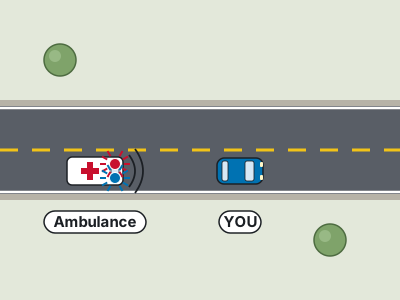
- Pull right, clear intersections, and stop until it has passed
- Keep the lane and let the emergency vehicle pass on either side
- Stop immediately in the intersection to make the path obvious
- Turn left into oncoming traffic if the right shoulder is occupied
Show answer
Pull right, clear intersections, and stop until it has passed. The driver must yield to the emergency vehicle by pulling to the right edge of the roadway, clearing intersections, and stopping until the vehicle passes. Remaining in the lane forces the responder to work around the driver. Stopping in an intersection blocks the very path that needs to remain open. A leftward escape into opposing traffic can create a head on collision. In heavy traffic, when moving right is impossible, the driver should clear a path. The cue is the siren or flashing warning lights, not the vehicle’s color.
Study this in the handbook: Emergency Vehicles and the Move Over Law
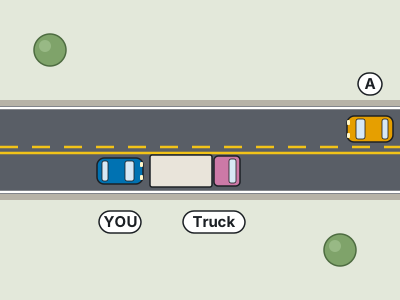
14. What does a solid yellow line on the driver's side of the centerline indicate?
- Only trucks may cross it to enter the shoulder
- Passing is encouraged whenever the opposing lane looks open
- The lane is reserved for vehicles making a U turn
- Crossing it for passing is dangerous and passing is not allowed
Show answer
Crossing it for passing is dangerous and passing is not allowed. A solid yellow line in the driver’s lane marks a no passing condition. The manual explains that crossing it exposes the vehicle to approaching traffic or median obstacles, although a driver may cross the line to make a left turn. The open appearance of the opposing lane does not cancel the marking. A U turn or truck exception is not created by the line. The cue is simple: if the solid yellow is on your side, remain behind the slower vehicle unless a permitted left turn requires crossing.
Study this in the handbook: Pavement Markings and Lanes
15. Under Oklahoma's implied consent law, what BAC level causes license revocation for an adult driver even without a DUI conviction?
- 0.05 or more
- 0.10 or more
- 0.08 or more
- Only a refusal causes revocation
Show answer
0.08 or more. For a driver who is not under 21, a BAC of 0.08 or more can trigger license revocation under implied consent even when a court has not entered a DUI conviction. The 0.05 figure is relevant evidence of impairment, but it is not the threshold described here. A 0.10 threshold is too high, and refusal is not the only route to revocation. The key cue is that the administrative action follows the test result separately from the criminal case.
Study this in the handbook: Implied Consent and DUI Penalties
16. If your vehicle is stuck on railroad tracks and warning lights have not activated, what should you do first?
- Get out and immediately dial 911 and the ENS number
- Stay inside and wait for a crossing worker
- Drive forward even if the path is blocked
- Call a friend before leaving the vehicle
Show answer
Get out and immediately dial 911 and the ENS number. A vehicle on the tracks is an immediate danger even when the crossing lights are still dark. Leave the vehicle and call 911 plus the Emergency Notification System number posted at the crossing. Give the crossing location, number if posted, and intersecting road, and say that a vehicle is on the tracks. Waiting inside leaves occupants exposed to a train, and calling a friend delays an emergency report. Driving forward is not a safe first step when the route may be blocked. The cue is the blue and white ENS sign near the rails or control box.
Study this in the handbook: School Buses and Railroad Crossings
17. What turning speed does the Oklahoma manual recommend as a general maximum?
- 10 mph or less
- 20 mph or less
- 30 mph or less
- The posted speed limit
Show answer
10 mph or less. The manual gives a general recommendation of 10 mph or less when turning. That low figure helps a driver maintain control, manage the curve, and respond to a person or vehicle that appears in the path. The 20 and 30 mph choices raise the recommended speed beyond the manual's guidance. Treating the posted limit as the turning speed is also poor judgment because a roadway limit describes the road generally, not the safest speed for every maneuver.
Study this in the handbook: Speed Limits and Expressway Speeds
18. After failing the Oklahoma written driver license test, how long must an applicant wait before retesting?
- No waiting period
- At least three days
- Thirty days
- At least one day
Show answer
At least one day. The manual says a person who fails the written test must wait at least one day before trying again. The rule is a minimum waiting period, not a same-day retest, and it is not the 30 day period offered by one distractor. The three day choice also adds time not stated in the manual. For a test question, focus on the words at least one day and separate the written retest rule from other licensing waiting periods.
Study this in the handbook: Applying and the License Tests
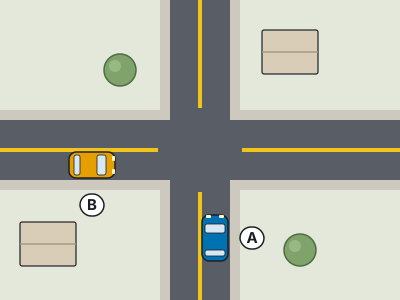
19. When two vehicles approach an uncontrolled intersection at the same time, which driver yields?
- The driver in the larger vehicle
- The driver on the right
- The driver on the left
- The driver traveling faster
Show answer
The driver on the left. At an intersection without stop signs or signals, the vehicle that entered first has priority. If two vehicles approach at the same time, the driver on the left yields to the driver on the right. Vehicle size and speed do not decide the issue. Look early enough to determine arrival order, and if that order is simultaneous, allow the vehicle on your right to proceed before entering.
Study this in the handbook: Right of Way at Intersections
20. An Oklahoma intermediate license holder completed driver education. How soon can the intermediate restriction be removed?
- After 30 days
- After 1 year
- After 6 months
- Only at age 21
Show answer
After 6 months. With driver education completed, the intermediate restriction can come off after 6 months. A teen who skipped driver education waits 1 year instead, which is why 1 year is the wrong pick here. Thirty days is far too short and age 21 has nothing to do with this step. Oklahoma also requires a Work Zone Safe completion certificate and at least 180 days on a learner permit before the intermediate license is issued.
Study this in the handbook: Learner Permits and the Graduated License
QualitySpace is expanding to Oklahoma
We are a California-based independent insurance brokerage working on licensing in more states. We cannot help with Oklahoma insurance yet. Leave your email and we will let you know when we can.
Every question is written from the official Oklahoma Driver Manual. Need paper? Printable OK practice test with answer key.
Last verified 2026-10-05. How we check every question · Study all 218 as flashcards
Frequently asked questions
How many questions are on this Oklahoma practice test?
This fixed set has 20 questions. It is test 7 of 10 from the 218 question Oklahoma bank. The real OK exam asks 20 questions and you need 15 correct.
What is the passing score for the real Oklahoma test?
15 out of 20 questions correct to pass That figure comes from the official Oklahoma source cited on the DMV facts page.
How does this fixed test relate to the full Oklahoma bank?
Each numbered test is a fixed set of questions in a fixed order, so you can retake the same test later and compare. Every test mixes road signs and the other topics in about the same proportion as the full bank. Tests 1 to 10 together cover 200 of the 218 questions in the Oklahoma bank, each once. The full practice page mixes the whole bank at random.
Last verified 2026-10-05. See the Oklahoma DMV facts page for sourced state details.
Return to the full Oklahoma practice test · Study road signs