
Test 18 of 25 · 20 questions · Free 2026
OK Permit Practice Test 18
Jump to the test ↓A fixed 20 question set from the Oklahoma bank with answers and plain English explanations. The real OK exam is 20 questions, 75 percent to pass; take the full length version on the main practice page.
Question 1 of 20 · 0 right so far
All 20 questions in test 18
Every question below comes from the Oklahoma question bank on this page. Open a question to see the correct answer and the explanation. Nothing here is hidden behind a signup.
1. A driver ahead has an arm and hand extended straight out the window. What is the driver signaling?
- A right turn ahead
- A left turn ahead
- Slowing or stopping
- Asking you to pass
Show answer
A left turn ahead. Oklahoma uses three hand-and-arm signals. An arm and hand extended straight out means a left turn. An arm and hand pointed upward means a right turn, and an arm and hand pointed down with the palm to the rear means slow down or stop. No arm signal asks you to pass. When the car ahead signals for a left turn, the manual says to slow down and prepare to stop.
Study this in the handbook: Passing and Turning
2. Along with its no-passing instruction, what does this white rectangular sign tell you about the road ahead?
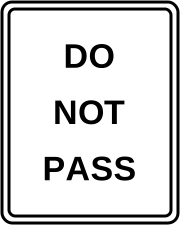
- The road ahead is closed to trucks
- You cannot see far enough ahead to pass safely
- A lane is added for slower traffic
- Oncoming traffic must yield to vehicles that are passing
Show answer
You cannot see far enough ahead to pass safely. The Oklahoma manual pictures the DO NOT PASS sign with a short caption: do not pass, do not cross yellow lines, and you cannot see far enough ahead to pass safely. The sign marks a stretch where sight distance is too short to finish a pass before meeting oncoming traffic, so stay in your lane behind slower vehicles until the restriction ends. It says nothing about trucks or an added lane, and it never gives a passing driver priority over oncoming traffic.
Study this in the handbook: Stop, Yield and Regulatory Signs
3. Late at night, the signal at an intersection is flashing yellow in your direction. How should you proceed?
- Stop completely, then go as at a stop sign
- Continue at your normal speed without slowing
- Wait until the light turns steady green
- Slow down, look both ways, and go carefully
Show answer
Slow down, look both ways, and go carefully. A flashing yellow signal is a caution light. The manual says to slow down, look in both directions, and drive slowly and carefully through the intersection, being prepared to stop. You do not need to stop first; that is the rule for a flashing red light, which works like a stop sign. Keeping full speed ignores the warning, and waiting for a steady green is unnecessary because a flashing yellow lets you go with care.
Study this in the handbook: Traffic Signals
4. A truck ahead of you signals a right turn and swings left, leaving an open space on its right side. What should you do?
- Stay out of that space and wait for the turn
- Use the space to pass the truck on the right
- Pull into the space and stop beside the cab
- Honk so the driver knows you are there
Show answer
Stay out of that space and wait for the turn. Trucks make wide right turns and often must leave an open space on the right side. The manual says not to move into that space or try to pass a truck that might be making a right turn. If you are between the truck and the curb, the driver may not be able to see you, and your car can be crunched or sideswiped. A horn does not make the space safe. Stay back and let the truck finish the turn.
Study this in the handbook: School Buses and Railroad Crossings
5. A railroad crossing is marked with a regular STOP sign. What must you do?
- Slow down and cross if no lights are flashing
- Stop only if you can see a train coming
- Stop completely and look both ways before crossing
- Yield as you would at a yield sign, then cross
Show answer
Stop completely and look both ways before crossing. Railroad crossings use several warning devices, and some have a stop sign. At those crossings, the manual says to stop completely and look both ways before driving across the tracks, whether or not a train is in sight. That is stricter than a crossbuck alone, which you treat like a yield sign by slowing and preparing to stop. Missing lights do not cancel the stop sign. After stopping and looking, cross only when you are sure no train is coming.
Study this in the handbook: School Buses and Railroad Crossings
6. What does the Oklahoma manual's safety tip say to do before you get into your car, especially a van or pickup?
- Start the engine to warm it before checking mirrors
- Honk once to warn anyone nearby that you are leaving
- Adjust the seat and mirrors from outside the door
- Check behind it for bikes and small children
Show answer
Check behind it for bikes and small children. The manual's safety tip is to always check behind your car for bikes, tricycles, and even small children before you get into it, and it stresses that this is especially important for vans and pickups. Once you are behind the wheel, the vehicle itself blocks part of your view to the rear. A honk, a warm engine, or adjusted mirrors do not show you what is right behind the car. Walk around and look before you climb in.
7. You see this sign before a long downgrade. What does the Oklahoma manual suggest you may want to do?

- Shift to neutral and coast down the hill
- Use a lower gear to help slow your vehicle
- Speed up to build momentum for the next hill
- Ride the brakes hard all the way down
Show answer
Use a lower gear to help slow your vehicle. This sign warns of a steep hill. The manual tells all drivers to approach with caution and says you may want to use a lower gear to slow your vehicle. Shifting into neutral to coast is not only unsafe; coasting on a downgrade in neutral is a violation of Oklahoma law. Building speed for the next hill and riding the brakes hard are not the manual's advice. Choose the lower gear before the descent begins rather than halfway down.
Study this in the handbook: Warning Signs
8. Another driver honks and gestures angrily at you. Which precautions does the Oklahoma manual list for situations like this?
- Brake hard to show the driver they are too close
- Pull alongside and talk it out at the next light
- Do not engage, and keep your anger in check
- Follow the driver to get the license plate number
Show answer
Do not engage, and keep your anger in check. The manual's road rage precautions are to avoid offending other drivers, not to engage other drivers, and to keep your anger in check. Braking hard, pulling alongside to argue, or following the other car all engage the driver and can escalate the situation into the dangerous behavior the manual warns about. If you suspect another driver is targeting you, go to a safe place with people, such as a police, fire, or gas station, call 911 if necessary, and do not drive home.
Study this in the handbook: Speed Limits and Expressway Speeds
9. Which Oklahoma road type has the highest unposted speed limit in the state chart, and what is it?
- Controlled access highways, 75 mph
- Undivided state highways, 70 mph
- Turnpikes, at 80 miles per hour
- Rural county roads, 65 mph
Show answer
Turnpikes, at 80 miles per hour. In Oklahoma's chart of speed limits that apply unless otherwise posted, turnpikes have the highest figure at 80 mph. Controlled-access highways are 75 mph, undivided state highways are 65 mph, and county roads are 55 mph. Posted signs can set different limits, and cities and towns may set their own. The Basic Speed Rule still requires slowing below these numbers when conditions are poor.
Study this in the handbook: Speed Limits and Expressway Speeds
10. You come up behind a slow truck on a two-lane road. The solid yellow line is on your side of the center. Can you pass?
- No, passing is prohibited when the solid yellow line is in your lane
- Yes, if you honk first and no cars are coming
- Yes, if the truck is going well under the speed limit
- Yes, if the line next to it is dashed
Show answer
No, passing is prohibited when the solid yellow line is in your lane. You must not pass when the solid yellow line is in your lane, whether there are two yellow lines or a single solid line beside a dashed line. What matters is the line on your own side of the road. Honking first, a slow truck ahead or an empty road does not change the marking. Stay in your lane behind the truck and wait until you reach a place where the line on your side no longer prohibits passing.
Study this in the handbook: Passing and Turning
11. At night on an unfamiliar road, you reach a low-water crossing closed by a barricade, but the water looks only a few inches deep. What should you do?
- Drive around the barricade slowly
- Turn around and find another route
- Cross if another car just made it
- Move the barricade and drive through
Show answer
Turn around and find another route. The manual says do not drive around barricades at low-water crossings, and be especially vigilant at night or on unfamiliar roads. Water depth is hard to judge, as little as 6 inches may make you lose control, and the roadbed beneath may have washed away. Another driver's crossing proves nothing about the road under the water. Follow the manual's rule for flooded roads: turn around, don't drown.
Study this in the handbook: Floods, Crashes and Roadside Emergencies
12. How close to the nearest rail of a railroad crossing may an Oklahoma driver park, and how far from a fire station driveway on the opposite side of the street?
- 15 feet and 20 feet
- 100 feet and 100 feet
- 50 feet from the rail, and 75 feet on the opposite side of a signposted fire station driveway
- 25 feet and 50 feet
Show answer
50 feet from the rail, and 75 feet on the opposite side of a signposted fire station driveway. Oklahoma bars parking within 50 feet of the nearest rail of a railroad crossing and within 20 feet of the driveway entrance to any fire station, or within 75 feet on the side of the street opposite the entrance when properly signposted. Vehicles near the rail block the view of the tracks, and the fire station zone keeps room for apparatus to swing out.
Study this in the handbook: Parking Rules
13. You are not sure whether a new medicine is safe to take before driving. What does the Oklahoma manual suggest?
- Take half the dose and see how you feel
- Drink some coffee with it so you stay alert
- Ask a pharmacist or doctor before driving
- Drive only on short trips the first day
Show answer
Ask a pharmacist or doctor before driving. Before you take any drug, the manual says to check the label for warnings about side effects such as drowsiness or nervousness. If you aren't sure whether it is safe to take the drug and drive, ask a pharmacist or doctor. Guessing with half a dose, relying on coffee, or limiting yourself to short trips does not tell you how the medicine will affect your driving. The manual also warns that many prescription drugs can be deadly when combined with alcohol.
Study this in the handbook: Implied Consent and DUI Penalties
14. Before you cross in front of another driver at an intersection, what does the Oklahoma manual tell you to do to be sure they know you are there?
- Make eye contact with the other driver
- Flash your high beams at them twice
- Speed up so they notice you sooner
- Switch on your hazard flashers first
Show answer
Make eye contact with the other driver. The manual's right-of-way section asks drivers to drive cautiously and defensively and to think of the right-of-way as something to be given, not taken. It also says to make sure the other driver sees you by making eye contact. Right-of-way should be decided by each driver before entering an intersection, and eye contact helps confirm that both of you agree on who goes. High beams, hazard flashers, and speeding up are not the manual's advice and can confuse other drivers.
Study this in the handbook: Right of Way at Intersections
15. Your friend took a cold medicine yesterday and felt fine driving. Can you expect the same drug to affect you the same way?
- Yes, the same amount affects everyone alike
- Yes, as long as you take the same dose
- Yes, if you are about the same age
- No, the same drug affects each person differently
Show answer
No, the same drug affects each person differently. The manual warns that you never know what will happen with drugs. The same drugs in the same amounts affect each person differently, and the same drug can even affect you more at one time than another. Weight, emotional state, heart and breathing rate, food, sleep, tolerance, and other factors all influence your reaction. A friend's experience, a matching dose, or a similar age tells you nothing certain about how you will react behind the wheel.
Study this in the handbook: Implied Consent and DUI Penalties
16. Thinking of the steering wheel as a clock, where does the Oklahoma manual say your hands should generally be?
- Left between 9 and 10:30, right between 2 and 4
- Both hands together at 12 o'clock
- Left hand at 6, right hand at 12 o'clock
- One hand at the bottom, near 6 o'clock
Show answer
Left between 9 and 10:30, right between 2 and 4. The manual calls for a solid, strong grip on the steering wheel, with at least one-third of the wheel between your hands so you have strong turning force with either hand. Thinking of the wheel as a clock, your left hand should generally be between 9:00 and 10:30 and your right hand between 2:00 and 4:00. Hands bunched together at the top, or one hand low on the wheel, give up that control. The manual also warns against driving with your elbow out the window.
Study this in the handbook: Floods, Crashes and Roadside Emergencies
17. You notice the gap between your car and the car ahead getting smaller. What does the Oklahoma manual say this means?
- It is a sure sign of danger ahead
- The car ahead is about to speed up
- You are at a safe following distance
- You should move to the left lane at once
Show answer
It is a sure sign of danger ahead. Rear-end collisions are a major driving problem, and the manual's rules for avoiding them include watching for shrinking distance between your car and the one ahead, which it calls a sure sign of danger. A closing gap means your safety cushion is disappearing, so ease off and be ready to brake. It does not mean the other driver is about to speed up, and it is not a sign your spacing is fine. Swerving into another lane without checking can create a second hazard.
Study this in the handbook: Following Distance and Stopping
18. To start parallel parking, where should you stop your car next to the vehicle parked in front of the empty space?
- Behind it, with your front bumper at its rear
- Ahead of it by one full car length
- Even with it, about 6 feet out from its side
- Even with it, and about 2 feet out from it
Show answer
Even with it, and about 2 feet out from it. The manual's parallel parking method begins by choosing a space large enough for your car, signaling, and driving up even with the car in front, about 2 feet out from it. Then you turn the front wheels all the way to the right and back slowly toward the curb. Starting too far out, such as 6 feet, keeps you from getting close enough to the curb, while starting too close or cutting the wheels too soon brings you near the other car's rear bumper.
Study this in the handbook: Parking Rules
19. You are driving on a gravel county road with no lane lines painted on it. What does the Oklahoma manual expect of you?
- Drive in the proper lane as if it were marked
- Drive in the center, since there are no lanes
- Use any part of the road that is smoothest
- Stay in the left lane to avoid soft shoulders
Show answer
Drive in the proper lane as if it were marked. A lane is the part of a roadway wide enough for one line of vehicles. On dirt or gravel roads, some rural roads, and private drives, the manual notes that lanes may not be marked, but they are there anyway, and you are expected to always drive in the proper lane. On a two-way road that means keeping to the right of the center. Driving down the middle or in the left half puts you in the path of oncoming vehicles, even when the road surface looks better there.
Study this in the handbook: Pavement Markings and Lanes
20. A parent wants to hold a baby on their lap in the front seat for a short trip. What does the Oklahoma manual say about this?
- It is acceptable as long as the parent is wearing a seat belt
- It is acceptable on city streets at low speeds
- It is acceptable if the trip lasts only a few minutes
- Holding the baby will not stop it from hitting the windshield
Show answer
Holding the baby will not stop it from hitting the windshield. The manual cites studies showing that an adult in the front seat who is holding an infant cannot prevent the baby from going through the windshield on impact. A seat belt on the parent, a short trip, or a slow city street does not change that outcome. Oklahoma requires a driver carrying a child under 8 to protect the child by properly using a child passenger restraint system, and the manual adds that no child should ride unrestrained, stand on the seat, or stand on the floor in front of the instrument panel.
Study this in the handbook: Insurance, Seat Belts and Child Restraints
Every question is written from the official Oklahoma Driver Manual. Need paper? Printable OK practice test with answer key.
Last verified 2026-10-05. How we check every question · Study all 500 as flashcards
Frequently asked questions
How many questions are on this Oklahoma practice test?
This fixed set has 20 questions. It is test 18 of 25 from the 500 question Oklahoma bank. The real OK exam asks 20 questions and you need 15 correct.
What is the passing score for the real Oklahoma test?
15 out of 20 questions correct to pass That figure comes from the official Oklahoma source cited on the DMV facts page.
How does this fixed test relate to the full Oklahoma bank?
Each numbered test is a fixed set of questions in a fixed order, so you can retake the same test later and compare. Every test mixes road signs and the other topics in about the same proportion as the full bank. Tests 1 to 25 together cover every question in the Oklahoma bank once. The full practice page mixes the whole bank at random.
Last verified 2026-10-05. See the Oklahoma DMV facts page for sourced state details.
Return to the full Oklahoma practice test · Study road signs