
Test 20 of 25 · 20 questions · Free 2026
OK Permit Practice Test 20
Jump to the test ↓A fixed 20 question set from the Oklahoma bank with answers and plain English explanations. The real OK exam is 20 questions, 75 percent to pass; take the full length version on the main practice page.
Question 1 of 20 · 0 right so far
All 20 questions in test 20
Every question below comes from the Oklahoma question bank on this page. Open a question to see the correct answer and the explanation. Nothing here is hidden behind a signup.
1. How far before an obstructed view does the manual prohibit passing?
- Within 500 feet
- Within 10 feet
- Within 100 feet
- Only at the exact point where the view disappears
Show answer
Within 100 feet. Passing is prohibited within 100 feet of an obstructed view because a driver may not see an approaching vehicle, pedestrian, or other conflict soon enough. The rule applies even if the road has no painted no-passing symbol at that exact location. Ten feet is too short to provide a meaningful safety margin, while 500 feet is not the stated threshold. Treat hills, curves, and listed crossing areas as places to wait rather than gamble on visibility.
Study this in the handbook: Passing and Turning
2. You are waiting to turn left at a green light. An oncoming car is close, and a gap will come after it. What should you do?
- Turn now, since you were waiting first
- Turn now, but speed up to beat the car
- Turn now, since a green light is yours
- Yield, then turn when there is enough room
Show answer
Yield, then turn when there is enough room. When making a left turn, the manual says to yield to all oncoming traffic, slow down and stop if you have to, and go only when there is enough clear distance to turn without interfering with oncoming traffic. Waiting first, having a green light, or accelerating hard does not change that. Keep your wheels straight while you wait, so a rear-end impact cannot push you into oncoming cars.
Study this in the handbook: Right of Way at Intersections
3. When leaving a private driveway, where must a driver stop before proceeding?
- Before the sidewalk or crosswalk, then proceed when it is safe
- At the edge of the public road after entering its traffic lane
- Only after a vehicle on the public road signals permission
- At the driveway entrance until the next traffic signal turns green
Show answer
Before the sidewalk or crosswalk, then proceed when it is safe. A driver leaving a private driveway must stop before reaching the sidewalk or crosswalk, then wait for a safe opportunity to enter or cross the public road. Reaching the traffic lane first is too late, and another driver’s signal is not the rule that controls this movement. A traffic signal at the distant intersection does not govern the driveway entrance. Stop at the pedestrian crossing point, check for people and vehicles, and continue only when the path is safe.
Study this in the handbook: Right of Way at Intersections
4. You find an open curb space whose front edge is about 10 feet from a fire hydrant. May you park there in Oklahoma?
- No, you must be at least 15 feet away
- Yes, as long as you stay inside the car
- Yes, the limit is only 5 feet
- Yes, if it is during daytime
Show answer
No, you must be at least 15 feet away. Oklahoma law lists places where it is illegal to stop, park, or leave a vehicle, and one is within 15 feet of a fire hydrant. Ten feet is inside that distance, so the space is off-limits. Staying in the car or parking only during the day does not create an exception, because the law applies at any hour. Look for a space at least 15 feet from the hydrant, and remember the separate 20-foot rule for crosswalks at intersections.
Study this in the handbook: Parking Rules
5. A raised traffic island splits the road ahead, and this sign stands at its tip. Which way should you go?
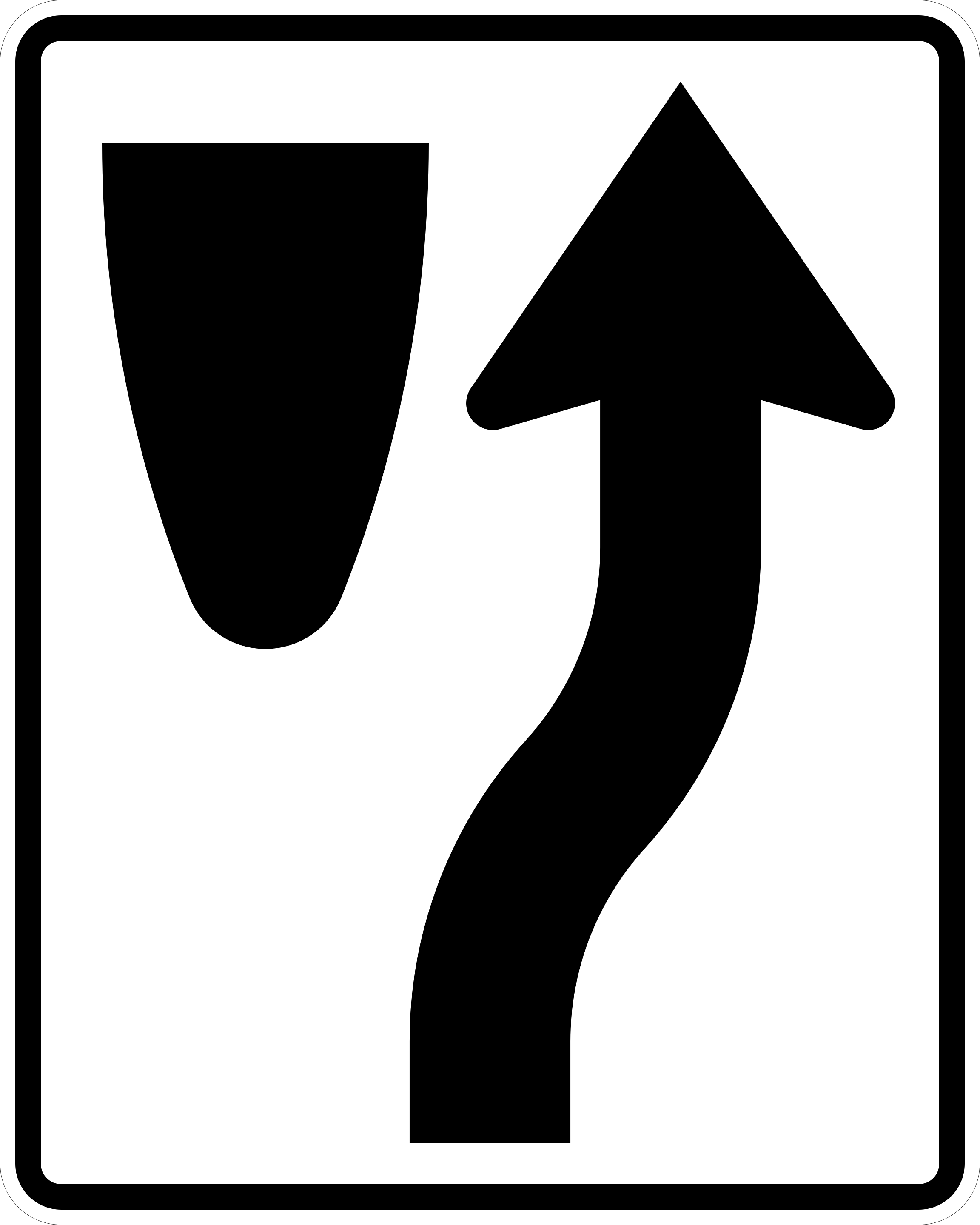
- To the left of the island, in the oncoming side
- Around the right side of the island
- Either side, whichever has less traffic
- Stop at the island and wait for a signal
Show answer
Around the right side of the island. This regulatory sign shows an arrow curving to the right of an obstruction, and the manual's meaning is to keep right of an object or center divider. Passing on the left side of the island would put you on the side meant for traffic coming the other way. The sign does not give you a choice of sides, and there is no need to stop. Regulatory signs like this one must be obeyed for everyone's safety.
Study this in the handbook: Stop, Yield and Regulatory Signs
6. On a dry, sunny afternoon with light traffic, you are on a two-lane state highway posted at 65 mph. Under the Basic Speed Rule, may you drive 65 mph?
- Yes, if conditions are ideal and it is safe
- No, the Basic Speed Rule caps all roads at 55
- No, two-lane roads always require 10 mph less
- Yes, and up to 70 since conditions are good
Show answer
Yes, if conditions are ideal and it is safe. The Basic Speed Rule does not set an exact speed limit; it means the speed you may drive is limited by current conditions. The posted limit is the highest speed allowed under ideal conditions, so on a dry, clear afternoon with light traffic you may drive up to 65 mph if it is safe. The same road at night in rain or fog would call for less. Good conditions never allow going over the posted limit.
Study this in the handbook: The Basic Speed Rule
7. A driver has had only one drink and plans to drive because the amount is small. What does the manual say about the effect of such a small amount?
- It wears off before the driver reaches the car
- Even a small amount reduces judgment and the ability to act quickly
- It affects only drivers who are under 21
- It matters only if the driver is over the legal limit
Show answer
Even a small amount reduces judgment and the ability to act quickly. The manual says that even a small amount of alcohol or drugs will reduce your ability to judge a driving situation, decide what to do and act quickly. In an emergency you need good judgment, coordination and quick reactions to avoid injury or damage. The effect does not wait until a legal limit is reached, is not limited to young drivers, and does not simply fade before you start the car.
Study this in the handbook: Implied Consent and DUI Penalties
8. An animal suddenly runs in front of your vehicle. What does the Oklahoma manual say?
- Swerve sharply into the other lane to miss it
- Do not swerve; that can cause a worse crash
- Swerve onto the shoulder, then brake hard
- Speed up so the animal has time to escape
Show answer
Do not swerve; that can cause a worse crash. If a deer or other animal darts into your path, the manual says not to swerve to avoid it, because swerving may result in a more serious crash than hitting the animal would. Swerving into another lane or onto the shoulder is the move the manual warns against, and speeding up does not help either. To lower the risk, use caution at dawn and dusk, slow down when an animal is standing near the roadway, and scan the sides of the road.
Study this in the handbook: Headlights, Night Driving and Distractions
9. Besides vehicles hauling explosives or flammable liquids, which vehicles are required by Oklahoma law to stop at railroad crossings?
- Pickup trucks and cars that are pulling a trailer
- Any truck with more than two axles
- Motorcycles and cars towing campers
- School buses, church buses, and motor coaches
Show answer
School buses, church buses, and motor coaches. Oklahoma law requires school buses, church buses, motor coaches, and any vehicles hauling explosives or flammable liquids to stop at railroad crossings. When you follow one of these vehicles, expect it to stop at the tracks even when no train is in sight, and be ready to stop behind it. Size alone does not trigger the rule, so a pickup with a trailer or a truck with extra axles is not on the list unless it carries one of those dangerous loads. Motorcycles are not on the list either.
Study this in the handbook: Warning Signs
10. You are on a one-way street and want to turn left onto another street. Which lane should you turn from?
- The right-hand lane, nearest the right curb
- The left-hand lane, nearest the left curb
- The middle lane, to leave room on both sides
- Any lane, as long as you signal first
Show answer
The left-hand lane, nearest the left curb. On one-way or divided streets, the manual says to always turn from the lane nearest the curb on the side you are turning toward. For a left turn on a one-way street, that is the lane along the left curb. When driving straight you may use any lane, but the extreme right and left lanes are the ones meant for turning. Turning from the middle lane or the far right crosses the path of drivers going straight, and signaling does not make a wrong-lane turn acceptable.
11. How does the Oklahoma manual describe black ice?
- A clear icy coating on the road that you can't see
- A thick dark layer of ice that forms on gravel roads
- Ice mixed with oil that turns the road black
- Frozen slush pushed to the edge by snowplows
Show answer
A clear icy coating on the road that you can't see. The manual calls icy roads dangerous and asks for extreme care, especially on black ice, which it describes as a clear icy coating on the road surface that you can't see. That is why the manual says to stay alert for black ice even on roads or spots that seem clear. It is not dark or thick, and it is not slush at the roadside. Since there is very little you can do once a skid starts, the manual calls prevention the best skid control.
Study this in the handbook: Braking, Skids and Wet Roads
12. You are approaching a crossing marked with a NO TRAIN HORN sign. Can a train engineer still sound the horn there?
- No, horns are switched off in a Quiet Zone
- Yes, engineers may still sound it when appropriate
- Only at night, between sunset and sunrise
- Only when the crossing has no gates or lights
Show answer
Yes, engineers may still sound it when appropriate. A NO TRAIN HORN sign marks an active Quiet Zone, where trains do not blow their horn during normal operation. The manual adds that train engineers still reserve the right to blow the horn when appropriate, such as in an emergency or for other safety reasons. A quiet crossing is not a promise of silence, and it is never a reason to listen less carefully or skip looking both ways. Quiet Zone crossings may also have extra safety features, but the time of day does not decide when a horn may sound.
Study this in the handbook: Work Zone, Guide and Service Signs
13. The main signal is red, but a green arrow pointing right is lit beside it. You want to turn right. What may you do?
- Turn right in the direction of the arrow
- Wait for the red light to turn green
- Go straight, since a green signal is lit
- Turn left, since any green arrow allows turns
Show answer
Turn right in the direction of the arrow. When a green arrow is lit, the manual says you may turn in the direction of the arrow, even when the red light is still on. A right green arrow therefore allows your right turn without waiting for the circular red to change. It does not allow you to go straight or to turn the other way; you can only make the turn the arrow shows unless signs say otherwise. Yield to pedestrians and vehicles still in the intersection.
Study this in the handbook: Traffic Signals
14. When a large truck approaches from the opposite direction on a two-lane road, what does the Oklahoma manual say about the wind turbulence between you?
- It sucks the vehicles together, so steer left
- It only matters if the truck is speeding
- It pushes vehicles apart, so keep to the right
- It is strongest when you drive near the shoulder
Show answer
It pushes vehicles apart, so keep to the right. When you meet a truck coming from the opposite direction, the manual says to keep as far to the right as possible, both to avoid being sideswiped and to reduce the wind turbulence between you and the truck. It also explains that the turbulence pushes vehicles apart; it does not suck them together. Steering toward the truck would be a mistake. Hold your lane firmly, stay right, and expect a push of air as the truck goes by.
Study this in the handbook: Bicycles, Motorcycles, Trucks and Farm Vehicles
15. You are in the right lane and pass this sign as another roadway joins from the right. Do you have to merge with the joining traffic?

- Yes, the two roads form one lane right away
- Yes, joining cars have the right-of-way
- No, but you must speed up to stay ahead
- No, a new lane is added; watch that lane
Show answer
No, a new lane is added; watch that lane. This sign shows two roadways coming together ahead with a new lane added for the joining road. The manual says you do not have to merge, or form one line, but you should watch for traffic in the new lane. That is different from a merge sign, where traffic moves into your lane and you must adjust to let it in. Keep your lane, check the added lane before any lane change, and do not race the joining cars.
Study this in the handbook: Warning Signs
16. To avoid carbon monoxide poisoning, what does the Oklahoma manual say to do with the fresh-air vent in congested traffic?
- Open it as wide as possible to pull in more air
- Switch it on and off every few minutes
- Leave it as it is; it makes no difference
- Close it while you are in congested traffic
Show answer
Close it while you are in congested traffic. The manual's tips for avoiding carbon monoxide include having your exhaust checked regularly, listening for any unusual roar from under the car, and never letting the engine run in a closed garage. In congested traffic, close the fresh-air vent, since you may be breathing exhaust from the cars around you; on highways in cold weather, open it. Opening the vent wide in a traffic jam would draw in more of those fumes. Because the setting matters, the manual gives advice for both situations.
Study this in the handbook: Floods, Crashes and Roadside Emergencies
17. What does the Oklahoma manual warn about driving with your elbow resting out the window?
- It is fine on long trips because it reduces tiredness
- It is allowed only when using arm signals
- You lack full control, and a sideswipe could injure it
- It helps other drivers see you are paying attention
Show answer
You lack full control, and a sideswipe could injure it. The manual's posture advice includes a firm warning: don't drive with your elbow out the window. In that position you don't have full control of the steering wheel, and a side-swipe collision could take off your arm. Comfort on a long trip is not a reason to do it, and resting an elbow outside is not the same as giving a brief arm signal. Keep both hands on the wheel with at least one-third of the wheel between them.
Study this in the handbook: Floods, Crashes and Roadside Emergencies
18. After stopping at a red light, you begin a legal right turn. Who must you yield to?
- Only the cars approaching from your left side
- Only pedestrians inside a marked crosswalk
- All pedestrians and vehicles, including bicycles
- No one, since you already stopped
Show answer
All pedestrians and vehicles, including bicycles. Oklahoma allows a right turn on red after a complete stop unless a sign forbids it, but the stop does not give you priority. The manual says that when you turn, you must yield to all pedestrians and vehicles using the intersection, including bicycles. Looking only to the left can miss a cyclist or a person crossing from the right, and people crossing in an unmarked crosswalk count too. Make the turn only after everyone using the intersection is clear of your path.
Study this in the handbook: Traffic Signals
19. You have checked your mirrors and signaled to change lanes. What should you do next before moving over?
- Look over your shoulder toward the lane you are entering
- Move over slowly, since the mirrors cover every angle
- Tap your brakes to warn the car behind you
- Speed up so you can move over more quickly
Show answer
Look over your shoulder toward the lane you are entering. The manual's lane change steps are to watch for clearance ahead and behind, check your rearview mirrors, signal, and then look over your shoulder in the direction you will be moving, followed by another look behind to both sides and a check of your blind spots. Mirrors leave blind spots, so relying on them alone can hide a car beside you. Braking or speeding up does not replace the head check. Never change lanes until you are sure it is safe.
Study this in the handbook: Pavement Markings and Lanes
20. Your light is green, but traffic is backed up through the intersection and there is no room on the other side. What should you do?
- Enter and wait in the intersection for space
- Go, since the green gives you the right-of-way
- Stop before the crosswalk until traffic moves
- Pull into the crosswalk so you can go first
Show answer
Stop before the crosswalk until traffic moves. When stopped traffic is blocking an intersection, the manual says to stop before reaching the crosswalk and wait for the traffic to move. A green light lets you go only when you can actually get through. Pulling into the intersection or the crosswalk would leave you stuck there, blocking cross traffic and people on foot when the light changes. Wait behind the crosswalk until there is room for your whole vehicle on the far side.
Study this in the handbook: Right of Way at Intersections
Every question is written from the official Oklahoma Driver Manual. Need paper? Printable OK practice test with answer key.
Last verified 2026-10-05. How we check every question · Study all 500 as flashcards
Frequently asked questions
How many questions are on this Oklahoma practice test?
This fixed set has 20 questions. It is test 20 of 25 from the 500 question Oklahoma bank. The real OK exam asks 20 questions and you need 15 correct.
What is the passing score for the real Oklahoma test?
15 out of 20 questions correct to pass That figure comes from the official Oklahoma source cited on the DMV facts page.
How does this fixed test relate to the full Oklahoma bank?
Each numbered test is a fixed set of questions in a fixed order, so you can retake the same test later and compare. Every test mixes road signs and the other topics in about the same proportion as the full bank. Tests 1 to 25 together cover every question in the Oklahoma bank once. The full practice page mixes the whole bank at random.
Last verified 2026-10-05. See the Oklahoma DMV facts page for sourced state details.
Return to the full Oklahoma practice test · Study road signs