
Test 8 of 10 · 20 questions · Free 2026
OK Permit Practice Test 8
Jump to the test ↓A fixed 20 question set from the Oklahoma bank with answers and plain English explanations. The real OK exam is 20 questions, 75 percent to pass; take the full length version on the main practice page.
Question 1 of 20 · 0 right so far

All 20 questions in test 8
Every question below comes from the Oklahoma question bank on this page. Open a question to see the correct answer and the explanation. Nothing here is hidden behind a signup.
1. How should you respond when a yellow merge warning appears?
- Assume your lane ends immediately and stop in the travel lane
- Expect other traffic may enter your lane and adjust speed or lane safely
- Accelerate without checking because merging traffic must always yield to you
- Turn at the next side street to avoid the joining roadway
Show answer
Expect other traffic may enter your lane and adjust speed or lane safely. A merge warning alerts you to traffic joining your lane, so cooperation is the useful response. Be ready to adjust speed and lane position while checking mirrors and surrounding vehicles. The sign does not automatically end your lane, authorize acceleration without observation, or require a turn onto another street. Leaving room and maintaining awareness gives the entering driver a safe path without creating a sudden conflict.
Study this in the handbook: Warning Signs
2. What may happen if proof of driver education completion is not presented for an Oklahoma license application?
- The applicant automatically receives an unrestricted license
- Additional restrictions may be imposed
- The written test is permanently waived
- The vehicle registration is canceled
Show answer
Additional restrictions may be imposed. The application checklist warns that failing to present proof of driver education completion may result in additional restrictions. It does not promise an unrestricted license, waive the written test, or cancel vehicle registration. The consequence concerns the driving privileges attached to the license, so the applicant should bring the approved completion certificate when one is required. A useful cue is that missing education proof affects restrictions, not ownership of the vehicle or the existence of the knowledge test.
Study this in the handbook: Learner Permits and the Graduated License
3. Which bicycle riders does the Oklahoma manual say to watch especially for turning without looking or signaling?
- Children
- Racing cyclists
- Commuters in bike lanes
- Riders wearing helmets
Show answer
Children. The manual tells drivers to watch for bicycle riders turning in front of them without looking or signaling, especially if the rider is a child. The manual lists this warning alongside its other advice for passing bicycle riders safely. Slow down near children on bicycles, leave at least 3 feet when passing, and be ready for a sudden turn. Helmets, bike lanes and experience are not the warning the manual gives.
Study this in the handbook: Bicycles, Motorcycles, Trucks and Farm Vehicles
4. Under Oklahoma's Zero Tolerance law, how long is the revocation for a driver under 21 on a second offense?
- 6 months
- 12 months
- Only 30 days
- Until age 25
Show answer
12 months. A first Zero Tolerance offense brings a six month revocation. A second conviction or offense, whether DUI, actual physical control, test refusal or any measurable BAC, brings a 12 month revocation. Six months is only the first offense period, 30 days is not in the Zero Tolerance rules, and age 25 is not a cutoff. If the driver is under 16, the cancellation is extended until the driver turns 16.
Study this in the handbook: Zero Tolerance for Drivers Under 21
5. An uninsured driver is in an Oklahoma collision. At what level of damage will Service Oklahoma suspend that driver's license?
- Only if someone is killed
- Property damage of $2,500 or more
- Any injury or property damage of $500 or more
- Only if the driver is found at fault in court
Show answer
Any injury or property damage of $500 or more. Service Oklahoma suspends the license of an uninsured driver or owner when the collision involves any injury or property damage of $500 or more. The threshold is not limited to deaths, it is well below $2,500, and the manual does not make it depend on a court finding of fault. The suspension follows from being uninsured in a qualifying crash, which is why carrying a current security verification form matters.
Study this in the handbook: Insurance, Seat Belts and Child Restraints
6. How long must an Oklahoma learner permit holder have the permit before taking the driving test?
- 30 days
- Three months
- At least six months
- One year
Show answer
At least six months. The Class D testing table says the applicant must be 16 and must have held the learner permit for at least six months before taking the driving test. Thirty days is the period shown for a different motorcycle category, while three months and one year are not the listed Class D requirement. Separate the permit's minimum age from the time it must be held, then check both conditions before scheduling the road test.
Study this in the handbook: Learner Permits and the Graduated License
7. Which tests are listed for a Class D Oklahoma license?
- Vision screening and road test only
- Written test only
- Driving test and vehicle inspection only
- Vision, written, and driving tests
Show answer
Vision, written, and driving tests. For a Class D license, the manual lists three tests: vision screening, written testing, and a driving test for cars and motorcycles. The phrase may not be required to take all three matters for some applicants, but it does not erase the three-part licensing framework. A written-only or vision-and-road-only answer leaves out one listed assessment. Remember the sequence as see, know, and demonstrate: vision, knowledge, then driving skills.
Study this in the handbook: Applying and the License Tests
8. What does a rectangular speed limit sign establish?
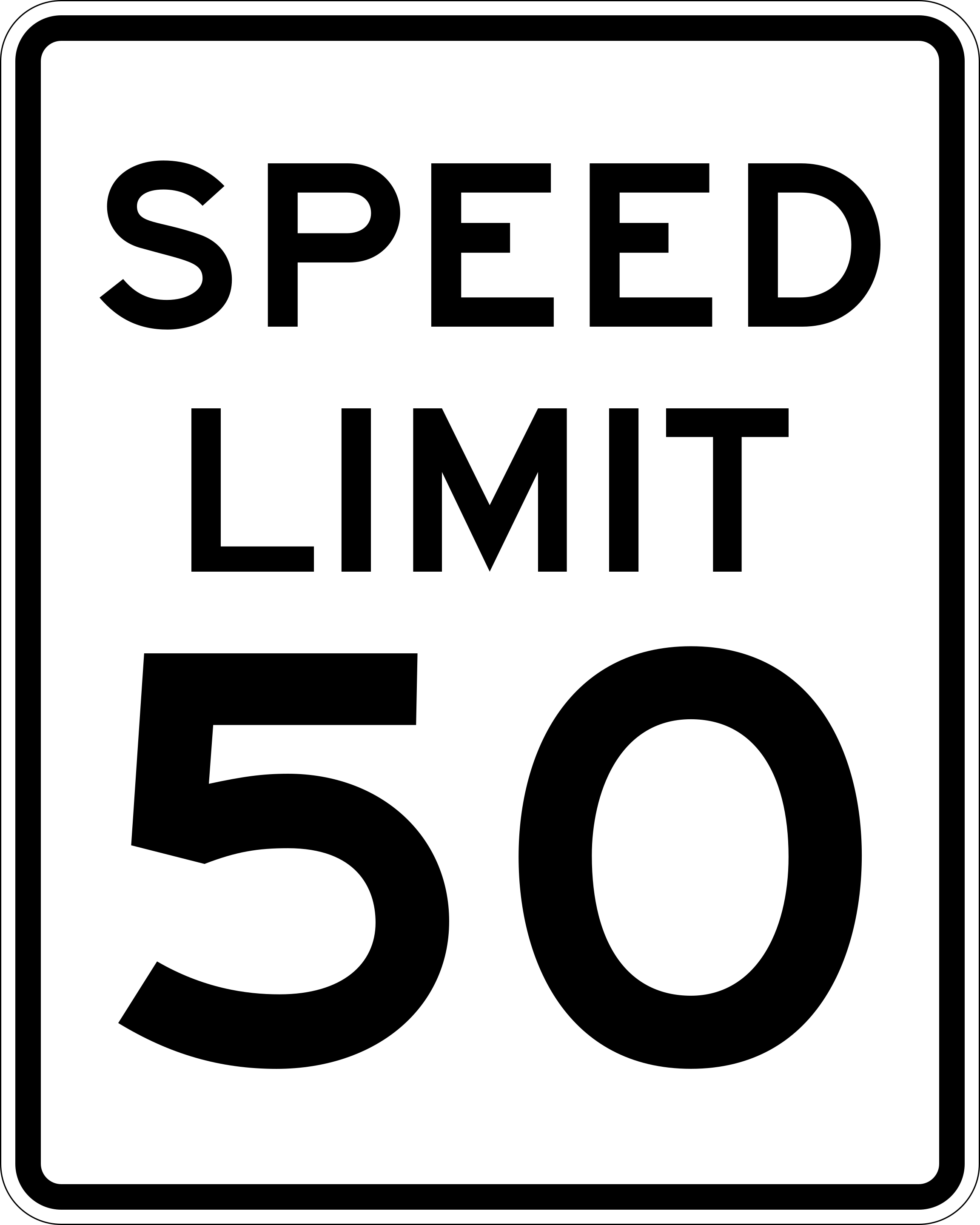
- The minimum speed required regardless of weather
- A suggested speed that may always be exceeded safely
- The highest lawful speed under ideal conditions
- A truck-only speed that does not apply to passenger cars
Show answer
The highest lawful speed under ideal conditions. Oklahoma treats the rectangular display as a regulatory instruction. Its number is the highest speed allowed when conditions are ideal, not a target that must be maintained in rain, fog, traffic, or poor visibility. The choice “A suggested speed that may always be exceeded safely” incorrectly makes the number optional, while the choice “The minimum speed required regardless of weather” ignores changing conditions. Drivers must reduce speed when the road or weather calls for it, even though the posted value remains unchanged.
Study this in the handbook: Stop, Yield and Regulatory Signs
9. A steady red signal is showing. Under what condition can you make a right turn?
- Only after the light changes to a green arrow
- Whenever the driver has waited five seconds
- Only after a police officer waves the driver through
- After a complete stop, when the turn is not forbidden and the intersection is yielded to safely
Show answer
After a complete stop, when the turn is not forbidden and the intersection is yielded to safely. A right turn at a steady red signal is permitted only after the vehicle comes to a complete stop. The driver must also confirm that no sign forbids the turn and yield to pedestrians and vehicles using the intersection. Waiting five seconds is not a legal substitute for stopping and yielding. A police gesture or green arrow is unnecessary when the movement is otherwise allowed. Stop before the crosswalk, scan the crossing path, and proceed only after the intersection is clear.
Study this in the handbook: Traffic Signals
10. When the yellow line on your side is broken, under what condition may you pass?
- Only when the vehicle ahead is stopped
- When passing can be done safely
- Never, because all yellow lines prohibit passing
- Whenever you are below the posted speed limit
Show answer
When passing can be done safely. A broken yellow center line separates opposing traffic but permits passing when the maneuver is safe. Before moving left, check for clear roadway, oncoming vehicles, hills, curves, intersections, and other hazards. The blanket prohibition confuses a broken line with a solid yellow line in your lane. Being below the speed limit is not enough by itself, because visibility and the distance needed to return to the lane still control the decision. Pass only with a clear view and adequate room.
Study this in the handbook: Pavement Markings and Lanes
11. What does the Oklahoma manual say about reaching for a phone while driving?
- Reach for it only at speeds under 30 mph
- Do not unbuckle your seat belt to reach for a phone
- Have a passenger unbuckle instead
- It is fine if the call is short
Show answer
Do not unbuckle your seat belt to reach for a phone. Among its phoning tips, the manual says not to unbuckle your seat belt to reach for a phone. An unbuckled driver stretching across the seat is unprotected and not steering. Use memory dial and voice activated dialing when possible, pull off the road before calling whenever you can, and keep calls short. Speed and call length do not make an unbelted reach safe.
Study this in the handbook: Headlights, Night Driving and Distractions
12. When backing a vehicle, what should the driver use instead of relying on the rearview mirror?
- Look directly through the rear window while checking both directions
- Use only the rearview mirror and keep both hands on the wheel
- Accelerate quickly so the vehicle spends less time in reverse
- Look only to the left because the rear window shows the main path
Show answer
Look directly through the rear window while checking both directions. Backing limits the driver’s view and makes speed and direction harder to control, so the driver should place the right arm on the seat, look directly through the rear window, and check in both directions for vehicles and pedestrians. The manual specifically says never to use the rearview mirror for backing up. Quick acceleration reduces reaction time, and looking only left leaves a blind area unchecked. The cue is the reverse gear: move slowly, look behind the vehicle, and continue checking until fully stopped.
13. What does an Oklahoma warning sign indicate when it appears before a roadway location?
- A permanent instruction that applies only to vehicles making a left turn
- A condition immediately ahead that calls for extra caution or a driving adjustment
- A service location where drivers may stop without checking surrounding traffic
- A speed authorization that permits the posted maximum in every weather condition
Show answer
A condition immediately ahead that calls for extra caution or a driving adjustment. A warning sign alerts a driver to something nearby, such as a hazard, a change in direction, or another roadway situation. Its diamond shape and yellow background help distinguish it from signs that regulate a required movement. The left-turn choice mistakes a general warning for a lane instruction, while the service-location choice confuses warning information with a place to stop. The speed choice is also unsafe because a warning sign never guarantees that ideal conditions exist. When one appears, scan farther ahead, reduce speed if needed, and be ready to change course or stop.
Study this in the handbook: Warning Signs
14. What does a yellow broken center line on a two-way road allow?
- No passing in either direction
- Passing only for trucks
- Passing when it is safe
- Crossing only to park on the shoulder
Show answer
Passing when it is safe. A yellow broken line separates traffic moving in opposite directions and indicates that passing is permitted when conditions make it safe and legal. It does not reserve passing for trucks, and it does not create a blanket prohibition in both directions. The shoulder is not the purpose of the marking. Before crossing the line, check visibility, oncoming traffic, signs, and the space needed to return safely. A simple cue is the combination of a broken yellow line and a clear view ahead. A solid yellow line in your lane carries the opposite message: do not pass.
Study this in the handbook: Pavement Markings and Lanes
15. How should a driver approach an active Traffic Incident Management scene?
- Stay alert, move over if possible, slow down, and follow responder directions
- Rubberneck from the adjacent lane to identify the collision
- Maintain normal speed so the scene clears faster
- Stop in the activity area to ask responders what happened
Show answer
Stay alert, move over if possible, slow down, and follow responder directions. A TIM scene contains responders and equipment working around a roadway incident, so passing traffic creates a serious secondary-crash risk. Drivers should stay alert, change lanes away from the scene when possible, slow down, and obey directions from emergency responders. Looking at the crash distracts attention, normal speed leaves less time to react, and stopping in the activity area puts the driver among the people trying to manage the incident. Focus on the lane ahead, create separation, and continue only at a speed suited to the changing scene.
Study this in the handbook: Emergency Vehicles and the Move Over Law
16. Where does the Oklahoma manual say to use low beams rather than high beams?
- On any two lane road
- Only in city limits
- Where there are streetlights, fog, rain, snow or adverse weather conditions
- Whenever the speed limit is under 45 mph
Show answer
Where there are streetlights, fog, rain, snow or adverse weather conditions. The Oklahoma manual says to use low beams where there are streetlights, fog, rain, snow or adverse weather conditions. It says high beams belong in open country when there are no other cars nearby, and it adds that night speed should be slower than daytime speed. The choice depends on lighting and weather, not on whether the road has two lanes, whether you are inside city limits, or whether the posted limit is under 45 mph.
Study this in the handbook: Headlights, Night Driving and Distractions
17. What alcohol condition violates Oklahoma's Zero Tolerance Law for a driver under 21?
- Only alcohol combined with a traffic collision
- Only a BAC of 0.02 or higher
- Only a BAC of 0.08 or higher
- Any measurable quantity in the blood or breath
Show answer
Any measurable quantity in the blood or breath. Oklahoma's under 21 rule prohibits driving, operating, or being in actual physical control with any measurable quantity of alcohol in the person's blood or breath when tested. It does not wait for 0.02 or 0.08, and a collision is not required. The word measurable is the exam cue: a small detected amount is enough for this special rule, even though adult criminal and administrative thresholds use different figures.
Study this in the handbook: Zero Tolerance for Drivers Under 21
18. What must motorists do when a funeral procession enters an Oklahoma intersection?
- Yield and avoid driving between procession vehicles
- Pass the procession on the left
- Enter the procession behind the lead vehicle
- Proceed first if the light is green
Show answer
Yield and avoid driving between procession vehicles. Motorists must yield to a funeral procession. Once its lead vehicle enters an intersection, the vehicles following it may continue through regardless of traffic control devices, so another driver should not cut between them. Passing on the left or joining the line creates interference. A green light does not cancel the procession rule. Watch for headlights on the procession vehicles, which the manual identifies as a signal to other drivers.
Study this in the handbook: Pedestrians, Blind Persons and Funeral Processions
19. What information do Oklahoma guide signs commonly provide?
- Required tire pressure
- Only temporary work-zone penalties
- The driver's BAC result
- Highway routes, distances, and exits
Show answer
Highway routes, distances, and exits. Guide signs provide travel information. The manual says they identify highways, show distances, mark exits, and point toward parks and recreation areas. Work-zone penalties, an alcohol result, and tire pressure are not guide-sign functions. When reading a green, white, or brown guide sign, use it to understand where the roadway leads and which lane or exit may serve the planned route. The cue is navigation information rather than a command or vehicle measurement.
Study this in the handbook: Work Zone, Guide and Service Signs
20. What does Oklahoma's Basic Speed Rule require when road or weather conditions change?
- Match the speed of the fastest vehicle
- Always drive exactly the posted limit
- Use the highest speed allowed for the road
- Drive at a speed that is reasonable and proper for the conditions
Show answer
Drive at a speed that is reasonable and proper for the conditions. The Basic Speed Rule requires a driver to choose a speed that is reasonable and proper for the conditions. That means the driver must account for traffic, visibility, weather, pavement, road width, and nearby pedestrians rather than treating the posted number as an automatic target. The choice requiring the exact posted limit ignores the rule when conditions make that speed unsafe. The fastest vehicle may be traveling too quickly, and the highest road category limit may not fit the roadway. Recheck the scene ahead and adjust speed so the vehicle remains controlled and can stop safely.
Study this in the handbook: The Basic Speed Rule
QualitySpace is expanding to Oklahoma
We are a California-based independent insurance brokerage working on licensing in more states. We cannot help with Oklahoma insurance yet. Leave your email and we will let you know when we can.
Every question is written from the official Oklahoma Driver Manual. Need paper? Printable OK practice test with answer key.
Last verified 2026-10-05. How we check every question · Study all 218 as flashcards
Frequently asked questions
How many questions are on this Oklahoma practice test?
This fixed set has 20 questions. It is test 8 of 10 from the 218 question Oklahoma bank. The real OK exam asks 20 questions and you need 15 correct.
What is the passing score for the real Oklahoma test?
15 out of 20 questions correct to pass That figure comes from the official Oklahoma source cited on the DMV facts page.
How does this fixed test relate to the full Oklahoma bank?
Each numbered test is a fixed set of questions in a fixed order, so you can retake the same test later and compare. Every test mixes road signs and the other topics in about the same proportion as the full bank. Tests 1 to 10 together cover 200 of the 218 questions in the Oklahoma bank, each once. The full practice page mixes the whole bank at random.
Last verified 2026-10-05. See the Oklahoma DMV facts page for sourced state details.
Return to the full Oklahoma practice test · Study road signs