
Test 9 of 10 · 20 questions · Free 2026
OK Permit Practice Test 9
Jump to the test ↓A fixed 20 question set from the Oklahoma bank with answers and plain English explanations. The real OK exam is 20 questions, 75 percent to pass; take the full length version on the main practice page.
Question 1 of 20 · 0 right so far
All 20 questions in test 9
Every question below comes from the Oklahoma question bank on this page. Open a question to see the correct answer and the explanation. Nothing here is hidden behind a signup.
1. What should an Oklahoma driver expect from speed limits set by cities and towns?
- They can be ignored outside school hours
- They must match the statewide table everywhere
- They apply only on turnpikes
- They may differ by local zone and posted signs must be obeyed
Show answer
They may differ by local zone and posted signs must be obeyed. Oklahoma cities and towns can set their own speed limits, and the manual directs drivers to watch and obey signs in business, residential, and school zones. The statewide table is not the only source of a lawful limit. Local limits are not limited to turnpikes, and school-zone signs do not become optional outside a particular hour unless the sign says so. The practical cue is to read the posted sign for the zone you are entering.
Study this in the handbook: Speed Limits and Expressway Speeds
2. What is the penalty in Oklahoma for failing to obey construction and maintenance zone signs, signals and markings?
- A fixed $50 fine
- Two points, but no fine
- A mandatory one year license revocation
- A fine between $100 and $1,000, up to 30 days in jail, or both
Show answer
A fine between $100 and $1,000, up to 30 days in jail, or both. Disobeying work zone signs, signals or markings is a misdemeanor punishable by a fine between $100 and $1,000 and up to 30 days in jail, plus liability for property damage, injury or death caused. A fixed $50 fine and a points only penalty understate it, and the manual does not list an automatic one year revocation for this offense. Separately, speeding fines double in work zones when workers or equipment are present.
Study this in the handbook: Work Zone, Guide and Service Signs
3. What should you do at an intersection controlled by a flashing yellow light?
- Stop and remain stopped until the light turns green
- Slow down, check both directions, and be prepared to stop
- Accelerate so you clear the intersection before cross traffic arrives
- Turn only if a green arrow appears
Show answer
Slow down, check both directions, and be prepared to stop. A flashing yellow light calls for caution, not an automatic stop. Reduce speed, check in both directions, and move through only while watching for a hazard that could require a stop. The choice requiring you to wait for green treats the signal like a steady red, which is not what this warning means. A driver approaching a flashing yellow should cover the brake, scan the intersection, and be ready to yield or stop if another road user creates a conflict.
Study this in the handbook: Traffic Signals
4. What speed should drivers follow in an active construction or maintenance zone?
- A fixed 25 mph on every road
- The normal highway speed if workers are visible
- The speed of the fastest nearby vehicle
- The posted work-zone speed
Show answer
The posted work-zone speed. Construction sites change the roadway and may place workers, machinery, cones, or flagpersons close to moving traffic. Drivers must slow to the speed posted for the work zone, then remain alert for instructions, lane changes, and sudden stops. A familiar highway speed does not override a temporary limit, and Oklahoma does not set every work zone at 25 mph. Begin reducing speed before entering the activity area so braking and lane decisions stay controlled.
Study this in the handbook: Work Zone, Guide and Service Signs
5. What is required when any vehicle is stopped on the side of an Oklahoma highway with hazard lights flashing?
- Move to the left lane or slow down
- Stop in the same lane beside it
- Pass at the posted speed without changing position
- Turn around before reaching the vehicle
Show answer
Move to the left lane or slow down. The roadside response is to move left when possible or slow down, giving the stopped vehicle and its occupants more room. The rule covers more than police, fire, or ambulance units; it also includes maintenance workers and cars displaying hazard lights. Passing at normal speed leaves the roadside exposed to close traffic. Check mirrors early, signal a lane change, and reduce speed if another vehicle prevents a safe move left.
Study this in the handbook: Right of Way at Intersections
6. What does a solid white line between same-direction lanes indicate?
- Changing lanes may be hazardous
- The lanes carry opposing traffic
- A driver must cross it immediately
- Passing is required before the next intersection
Show answer
Changing lanes may be hazardous. A solid white line separates lanes moving in the same direction, but it marks a place where changing lanes is hazardous. The driver should remain in the lane unless a safe, necessary movement can be made. It is not an opposing-traffic boundary, which is marked with yellow. Nor does it require an immediate crossing or a passing maneuver. Watch for intersections, merge areas, and other conditions that explain why the roadway designer has discouraged a lane change at that point.
Study this in the handbook: Pavement Markings and Lanes
7. After a first Zero Tolerance conviction or offense, how long is the Oklahoma license revocation period?
- 30 days
- Six months
- Twelve months
- Two years
Show answer
Six months. The first listed Zero Tolerance revocation period is six months. Twelve months belongs to the second conviction or offense, while two years is not the first-offense period in this section. Thirty days appears elsewhere in the manual as a suspension period in another alcohol-related context, so it is an especially tempting mix-up. When studying this chart, connect first offense with six months and second offense with twelve months.
Study this in the handbook: Zero Tolerance for Drivers Under 21
8. How should a driver respond to a blind person crossing the street with a cane or guide dog?
- Stop immediately and let the person pass
- Proceed if the crosswalk is unmarked
- Sound the horn and continue
- Stop only after entering the crosswalk
Show answer
Stop immediately and let the person pass. Drivers must give the right of way to a blind person crossing the street. The manual says to stop immediately and let the person pass, stopping outside the crosswalk rather than in it. An unmarked crossing does not remove the protection, and a horn is not a substitute for yielding. The manual also gives a 15 foot stopping distance from a blind person in the roadway or at an intersection, a useful safety cue.
Study this in the handbook: Pedestrians, Blind Persons and Funeral Processions
9. Why does Oklahoma prohibit parking in specified locations such as near a fire hydrant?
- To increase the number of paid spaces
- To reserve curb space for deliveries
- To protect people and vehicles from preventable danger
- To keep streets visually uniform
Show answer
To protect people and vehicles from preventable danger. The manual explains that laws are made to protect us from dangers we may cause to other people and dangers others may cause us, and that parking laws are intended to keep your car from being hit and to keep your vehicle from endangering others. The list of illegal places that follows includes within 15 feet of a fire hydrant, on a crosswalk, and within 50 feet of a railroad crossing. Delivery convenience, paid spaces, and appearance are not the reason this section gives.
Study this in the handbook: Parking Rules
10. An Oklahoma driver has two earlier DUI or drug related revocations within 10 years and is convicted again. How long is the license suspended?
- 180 days
- 1 year
- 2 years
- 10 years
Show answer
2 years. With two or more DUI or drug related revocations within 10 years, the suspension is 2 years. One prior within 10 years gives 1 year, and a first revocation is 180 days, so those choices describe drivers with shorter histories. Ten years is the look back window, not the suspension length. The manual also lists an alcohol and drug assessment and an ignition interlock device among the added costs of an arrest.
Study this in the handbook: Implied Consent and DUI Penalties
11. What does the color orange mean on Oklahoma construction and maintenance signs?
- A hospital or fuel service is ahead
- You are nearing or in a work zone
- A recreational route begins
- A permanent speed limit is ending
Show answer
You are nearing or in a work zone. Orange signals that a driver is nearing or in a work zone. The manual connects that color with signs, barricades, and channeling devices used to guide traffic and protect workers and flagpersons. Blue service signs identify facilities, while recreational and speed information use different sign purposes. The right response is to slow as posted, watch for lane changes, and follow directions. Treat orange as a temporary roadway danger cue, not as a destination marker.
Study this in the handbook: Work Zone, Guide and Service Signs
12. Unless otherwise posted, what speed limit applies to highways within Oklahoma state parks or wildlife refuges?
- 25 mph
- 45 mph
- 35 mph
- 55 mph
Show answer
35 mph. The state speed table assigns 35 mph to highways within state parks or wildlife refuges under normal conditions. The 25 mph option is the listed figure for properly marked school zones outside municipalities. Forty five mph is not the manual's default for this setting, and 55 mph is associated with county roads. Before relying on the table, check for a posted limit and consider weather, traffic, visibility, and road surface under the Basic Speed Rule.
Study this in the handbook: Speed Limits and Expressway Speeds
13. What action is required at an Oklahoma railroad advance warning sign?
- Slow down and be prepared to stop within 15 to 50 feet of the first track
- Accelerate to clear the tracks
- Stop 100 feet beyond the crossing
- Turn around before reaching the sign
Show answer
Slow down and be prepared to stop within 15 to 50 feet of the first track. The railroad advance warning instruction is to slow down and be ready to stop within 15 to 50 feet of the first track. The sign gives advance notice, so accelerating or waiting until after the crossing defeats its purpose. The 100-foot distance is not the manual's stated stopping range. Use the sign as a cue to scan the tracks, listen, and prepare for a full stop before the crossing if a train or signal requires it.
Study this in the handbook: Warning Signs
14. You pass the written test in Oklahoma and go straight for a Class D license, but fail the driving test three times. What must you do before retesting?
- Wait one day and try again
- Hold a valid Oklahoma learner permit for 30 days
- Retake the written test only
- Wait one full year
Show answer
Hold a valid Oklahoma learner permit for 30 days. After three failed driving tests, you must hold a valid Oklahoma learner permit for 30 days before you are eligible to retest, and then you may test once every 30 days. The one day wait is the rule for a failed written test, not for the third driving failure. Retaking the written test does not satisfy the requirement, and a one year wait is not in the manual.
Study this in the handbook: Learner Permits and the Graduated License
15. How can you apply the Oklahoma manual's three-second following rule?
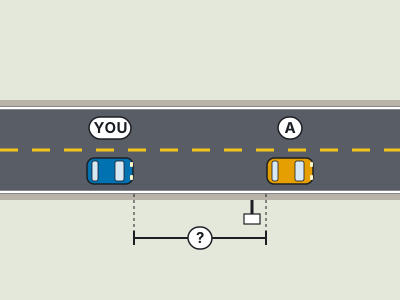
- Use one car length for every five miles per hour in all weather
- Stay one second behind for every five miles per hour
- Count three seconds after the vehicle ahead passes a fixed object
- Count three vehicle lengths instead of using a roadside reference
Show answer
Count three seconds after the vehicle ahead passes a fixed object. Choose a fixed object such as a pole or sign and begin counting after the vehicle ahead passes it. Reaching that object after at least three seconds gives a basic safety cushion, and poor weather calls for increasing the count to four seconds. The one-second-per-five-mile choice changes the manual's method. The manual's separate car-length option is one length for every 10 mph, not every five, and three vehicle lengths is not the stated timing test. Recheck the gap whenever speed, traffic, or pavement conditions change.
Study this in the handbook: Following Distance and Stopping
16. What does a solid yellow line on the left side of your lane generally tell you?
- Traffic on both sides is traveling in the same direction
- Passing is required before the next intersection
- You are on the proper side, but crossing it can expose you to opposing hazards
- The centerline may be crossed whenever you signal
Show answer
You are on the proper side, but crossing it can expose you to opposing hazards. A solid yellow line separates opposing traffic. When it is on the driver's left, the vehicle is on the proper side of the road, but crossing the line can put it near approaching vehicles or a median obstruction. The marking means no passing, although the manual allows crossing to turn left when appropriate. Passing is not required, and the same-direction choice describes white markings. Signaling alone does not make a crossing safe. Read the line together with traffic and roadway layout before turning or changing position.
Study this in the handbook: Pavement Markings and Lanes
17. What does the Oklahoma manual say about barricades at low-water crossings?
- Drive around them slowly if the water looks shallow
- Do not drive around them
- They apply only to trucks
- They may be moved if no one is watching
Show answer
Do not drive around them. Do not drive around barricades at low water crossings; they are placed because the crossing is unsafe. The manual adds to be especially vigilant at night or on unfamiliar roads, where a flooded dip is hard to see. Most vehicles float in two feet of water or less, so water that looks shallow can still carry a car away. Turn around and find another route.
Study this in the handbook: Floods, Crashes and Roadside Emergencies
18. How should a driver approach a railroad crossing marked by a crossbuck?
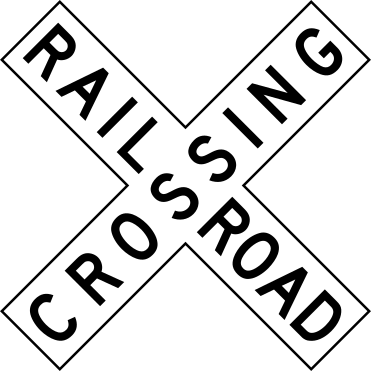
- Slow down, look, listen, and be prepared to yield to an approaching train
- Maintain speed because the crossbuck only identifies a nearby station
- Stop on the tracks so the driver can inspect both directions
- Proceed first because trains must yield to vehicles at the crossing
Show answer
Slow down, look, listen, and be prepared to yield to an approaching train. The crossbuck marks the crossing and demands a train-focused approach. Slow down, use both sight and hearing, and be prepared to yield the right-of-way to the train. The station choice gives the sign the wrong purpose, and stopping on the rails creates a dangerous obstruction. Look for additional track information, keep the vehicle clear of the crossing, and cross only when the route is safe.
Study this in the handbook: Warning Signs
19. What does the crossed right-turn arrow forbid at this location?
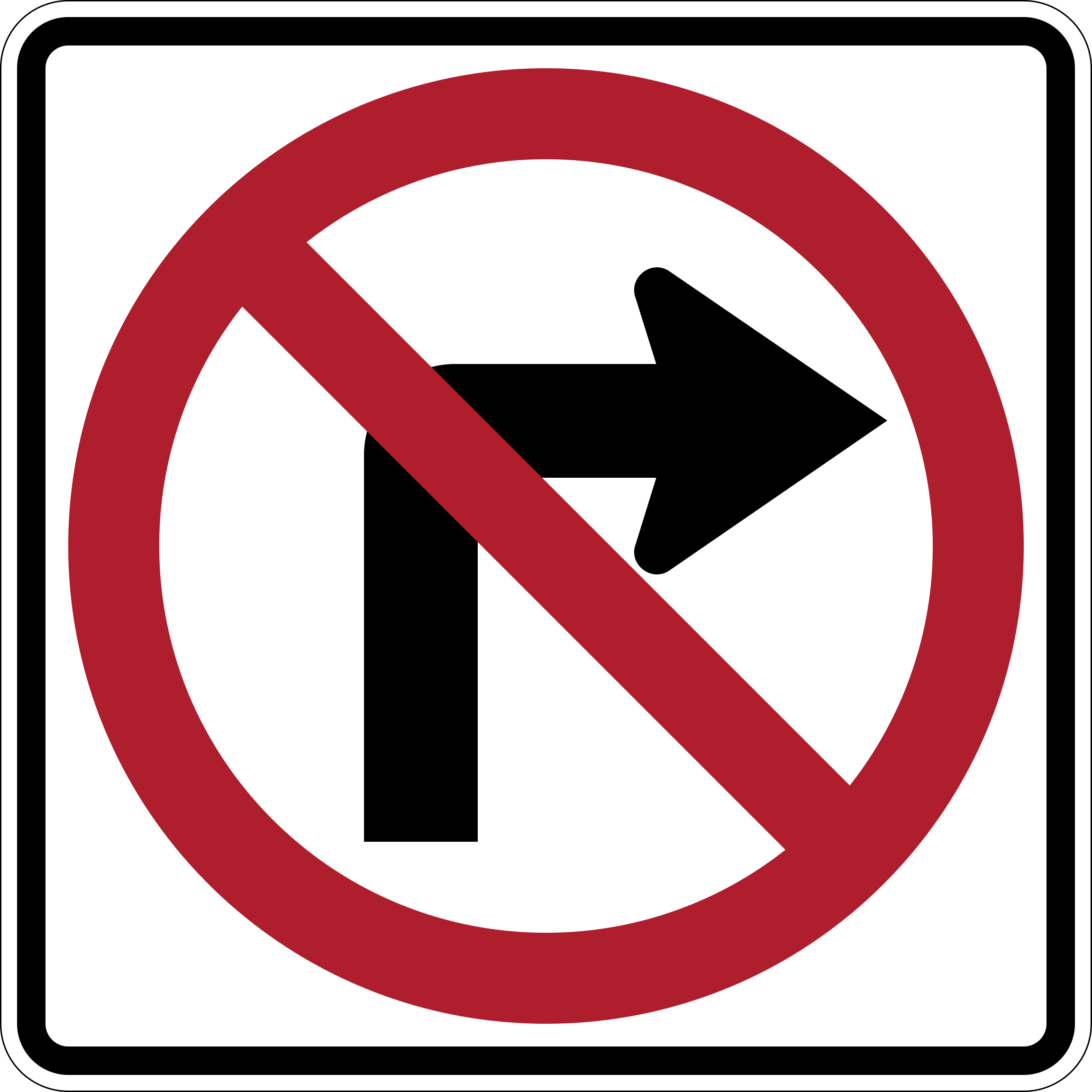
- Turning left from the nearest marked lane
- Parking beside the curb after completing a turn
- Driving straight when the signal permits it
- Turning right from this approach
Show answer
Turning right from this approach. The Oklahoma manual explains that a red circle with a line through it means do not or not allowed, so the prohibited action is the arrow’s movement: a right turn from this approach. A driver must not treat a clear signal or an empty cross street as permission to make that turn. The sign does not by itself outlaw a left turn, straight travel, or curbside parking, though each of those actions can have separate controls. Read the symbol together with lane markings and the traffic signal before proceeding.
Study this in the handbook: Stop, Yield and Regulatory Signs
20. What is the general steering response when a vehicle begins to skid?
- Lock the brakes and keep the steering wheel straight
- Accelerate sharply and steer opposite the skid every time
- Take your foot off the brake and steer in the direction of the skid when safe
- Use the clutch and turn toward oncoming traffic
Show answer
Take your foot off the brake and steer in the direction of the skid when safe. The manual treats skid control as a prevention issue first: slow down and maintain traction before the tires lose grip. Once a skid starts, the general response is to release the brake and steer in the skid direction, but only if that path avoids leaving the road, striking an object, or entering oncoming traffic. The absolute opposite-steering choice ignores the surrounding danger. On ice or loose surfaces, sudden braking can worsen the slide, so smooth inputs and a clear escape path are essential.
Study this in the handbook: Braking, Skids and Wet Roads
QualitySpace is expanding to Oklahoma
We are a California-based independent insurance brokerage working on licensing in more states. We cannot help with Oklahoma insurance yet. Leave your email and we will let you know when we can.
Every question is written from the official Oklahoma Driver Manual. Need paper? Printable OK practice test with answer key.
Last verified 2026-10-05. How we check every question · Study all 218 as flashcards
Frequently asked questions
How many questions are on this Oklahoma practice test?
This fixed set has 20 questions. It is test 9 of 10 from the 218 question Oklahoma bank. The real OK exam asks 20 questions and you need 15 correct.
What is the passing score for the real Oklahoma test?
15 out of 20 questions correct to pass That figure comes from the official Oklahoma source cited on the DMV facts page.
How does this fixed test relate to the full Oklahoma bank?
Each numbered test is a fixed set of questions in a fixed order, so you can retake the same test later and compare. Every test mixes road signs and the other topics in about the same proportion as the full bank. Tests 1 to 10 together cover 200 of the 218 questions in the Oklahoma bank, each once. The full practice page mixes the whole bank at random.
Last verified 2026-10-05. See the Oklahoma DMV facts page for sourced state details.
Return to the full Oklahoma practice test · Study road signs