
Test 22 of 25 · 20 questions · Free 2026
OK Permit Practice Test 22
Jump to the test ↓A fixed 20 question set from the Oklahoma bank with answers and plain English explanations. The real OK exam is 20 questions, 75 percent to pass; take the full length version on the main practice page.
Question 1 of 20 · 0 right so far
All 20 questions in test 22
Every question below comes from the Oklahoma question bank on this page. Open a question to see the correct answer and the explanation. Nothing here is hidden behind a signup.
1. When backing up, which way should you steer to move the rear of your car?
- Opposite to the way you want the rear to go
- Hard to the left, then straighten quickly
- Slightly toward where the rear should move
- Keep the wheel straight and use the brakes
Show answer
Slightly toward where the rear should move. Backing is harder than driving forward because the car blocks part of your view and it is harder to control speed and direction. The manual says your vehicle is much harder to steer in reverse, so accelerate gently, keep the speed slow, and steer slightly in the direction the rear of the vehicle should move. Steering the opposite way sends the rear where you do not want it. Keep looking to the rear until you come to a complete stop.
2. You reach a highway work zone where a sign shows a reduced speed limit and workers are standing close to the lane. Which speed should you drive?
- The usual highway speed, since the road ahead looks open
- The speed of the traffic around you
- The speed posted for the work zone
- Five mph under the usual highway speed
Show answer
The speed posted for the work zone. The manual says you must slow down to the posted speed in a work zone. Workers, machinery, cones and flagpersons can be close to moving traffic there, so the temporary limit replaces the normal one. Following the cars around you is not a safe guide, because they may be going too fast, and picking your own small reduction can still leave you above what the sign allows.
Study this in the handbook: Work Zone, Guide and Service Signs
3. You are going straight at a steady red light. Where must you stop, and how long must you wait?
- Stop at the crosswalk, then go when no traffic is coming
- Stop past the crosswalk, then wait for the yellow light
- Slow down, then go if the intersection looks clear
- Stop before the crosswalk and stay stopped until green
Show answer
Stop before the crosswalk and stay stopped until green. A steady red light means come to a complete stop before entering the crosswalk or the intersection, and remain stopped until the light turns green. That is different from a flashing red light, which works like a stop sign and lets you go once it is safe. Stopping past the crosswalk blocks people on foot, and slowing without stopping breaks the law even on an empty street. The only turns allowed against a steady red are a right turn, or a left from a one-way street into a one-way street, each after a complete stop and unless a sign forbids it.
Study this in the handbook: Traffic Signals
4. Your car stalls on the tracks and the crossing lights begin to flash. A passenger says you have a few minutes to restart it. What does the manual warn?
- You may have only about 20 seconds before the train arrives
- You have about 2 minutes, which is enough to try again
- You have about 5 minutes until the gates come down
- You have about 60 seconds, which is enough to restart it
Show answer
You may have only about 20 seconds before the train arrives. If your vehicle is physically on the tracks at a grade crossing and the lights begin to flash, the manual warns that you may have only 20 seconds to escape before the train reaches you. That is too little time to keep working on a stalled engine, so get out of the vehicle right away. A few minutes or even a full minute is longer than the manual says you can count on.
Study this in the handbook: School Buses and Railroad Crossings
5. At a railroad crossing marked only with this sign, which other traffic sign does the Oklahoma manual say to treat it like?
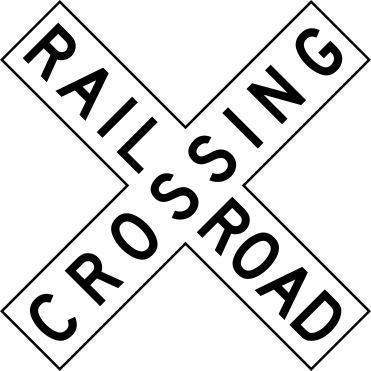
- A YIELD sign at an intersection
- A STOP sign at an intersection
- A 25 mph speed limit sign
- A NO PASSING ZONE sign
Show answer
A YIELD sign at an intersection. Crossbucks are found at most public crossings, and the manual says to treat them the same as a YIELD sign: slow down and prepare to stop if you see or hear a train approaching. A crossbuck alone does not require a full stop every time, which is what a stop sign at a crossing demands. It does not set a speed limit, although you should never pass at a highway-rail crossing. A sign below it shows the number of tracks if there is more than one.
Study this in the handbook: School Buses and Railroad Crossings
6. You want to park on the right side of a street just before a stop sign at the next corner. How far back from the sign must you be?
- At least 15 feet
- At least 30 feet
- At least 50 feet
- At least 10 feet
Show answer
At least 30 feet. It is illegal to park within 30 feet upon approaching any flashing beacon, stop sign, or traffic control signal located at the side of the roadway. So on the approach to a stop sign, park at least 30 feet back. Fifteen feet is the fire hydrant distance, 20 feet applies to crosswalks at intersections, and 50 feet is the distance from the nearest rail of a railroad crossing. Check for each rule before you leave the car.
Study this in the handbook: Parking Rules
7. How can a driver with a standard transmission use the gearshift while approaching a stop?
- Shift down to a lower gear after signaling the vehicle behind
- Select neutral and turn off the engine
- Shift into a higher gear to increase engine speed
- Release the clutch suddenly to stop the wheels
Show answer
Shift down to a lower gear after signaling the vehicle behind. With a manual transmission, shifting down lets the engine help reduce the car's speed before the stop. The manual also recommends flashing the brake lights first so the driver behind receives an early warning. Selecting a higher gear works against controlled slowing, while switching off the engine or releasing the clutch abruptly can reduce control. Use the gearshift as a supplement to smooth braking, not as a substitute for watching traffic and applying the brake.
Study this in the handbook: Braking, Skids and Wet Roads
8. Your light turns green, but a funeral procession with headlights on is still going through the intersection in front of you. What should you do?
- Wait and yield until the whole procession passes
- Go, since you have a green light now
- Cut in after the hearse goes through
- Honk so the procession lets you through
Show answer
Wait and yield until the whole procession passes. Motorists must yield the right-of-way to a funeral procession. Once the lead vehicle enters an intersection, the remaining vehicles may follow through regardless of traffic control devices, so your green light does not give you the right to cut in. Vehicles in the procession use their headlights as a signal not to drive between them or interfere. Wait until the last car has passed before you proceed through the intersection.
Study this in the handbook: Right of Way at Intersections
9. A driver with an Oklahoma medical cannabis license used cannabis the night before and feels fine. What does the manual say about driving with cannabis in the system?
- It is legal for medical license holders
- It is legal if 12 hours have passed
- It is legal if the driver feels unimpaired
- Any detectable level makes driving illegal
Show answer
Any detectable level makes driving illegal. Oklahoma has legalized cannabis for some medical purposes, but the manual says it impairs driving performance and that it is illegal for anyone to drive with any detectable level of cannabis in their system. A medical license does not create an exception, no waiting period is listed, and feeling fine does not change the law. Research cited in the manual shows marijuana users make more driving mistakes and have more trouble adjusting to glare.
Study this in the handbook: Implied Consent and DUI Penalties
10. On a road divided into four or more lanes, what does Oklahoma law say about driving in the left lane?
- You may stay there at any speed if you obey the limit
- You may not impede the normal flow of traffic there
- Only trucks are banned from the left lane
- It is reserved for emergency vehicles only
Show answer
You may not impede the normal flow of traffic there. On a roadway divided into four or more lanes, a vehicle cannot impede the normal flow of traffic by driving in the left lane. The manual notes you are not prohibited from using other lanes when traffic conditions, flow, or road features such as merging traffic make that necessary. Keeping to the speed limit does not give you the right to block faster traffic in the left lane. The rule applies to all vehicles, and the left lane is not reserved for emergency vehicles.
Study this in the handbook: Passing and Turning
11. When should you begin slowing down to leave an expressway?
- On the expressway, well before the exit ramp
- As soon as you see the first exit sign
- Only after reaching the end of the ramp
- After you move into the deceleration lane
Show answer
After you move into the deceleration lane. The manual says to maintain your speed at the flow of traffic until you reach the exit, then slow down in the deceleration lane or exit ramp and keep slowing until you reach the posted speed limit. Its diagram labels the main lanes before the exit with the words do not slow down here. Slowing as soon as you see an exit sign, or on the expressway itself, breaks that advice, and waiting until the end of the ramp ignores the posted ramp speed. Check your speedometer as you slow.
Study this in the handbook: Expressway Driving
12. On a two-way street, where should you position your car as you prepare to turn left?
- Near the right curb, to give oncoming cars room
- Across the centerline, in the oncoming lane
- Close to the centerline without crossing it
- In the middle of the street, straddling both lanes
Show answer
Close to the centerline without crossing it. The manual's left turn steps start well ahead of the turn: look for following cars, signal, and move over close to the centerline. It sums this up as keeping close to the centerline but not crossing it. Waiting near the right curb is the setup for a right turn, and crossing the centerline puts you in the oncoming lane. Signal and begin slowing at least 100 feet from the corner, then enter the new street just to the right of its center.
Study this in the handbook: Passing and Turning
13. A yellow warning sign shows a T shape, and the road you are on ends just ahead at a crossing road. What must you do there?
- Continue straight across into the driveway ahead
- Stop only if a car is coming from the right
- Expect the road to keep going after a curve
- Turn right or left, ready to yield
Show answer
Turn right or left, ready to yield. A T intersection warning means the road you are on ends at a crossing road ahead. The manual says you must turn right or left there and be prepared to yield to traffic on the through road. There is no straight path to continue on, and the road does not curve onward. Slow down early so you can choose your turn, signal at least 100 feet ahead, and yield to vehicles and pedestrians before turning.
Study this in the handbook: Warning Signs
14. A blind pedestrian with a white cane is crossing at an intersection ahead. Where should you stop your car?
- In the crosswalk, as close as possible to the curb
- Outside the crosswalk, never inside it
- Just past the person, once they reach the center line
- Beside the person, so you can guide them across
Show answer
Outside the crosswalk, never inside it. When a blind person is crossing, the manual says to stop immediately and let the person pass, and to stop outside the crosswalk, not in it. A car sitting in the crosswalk blocks the path the person is following with a cane or guide dog. The law also requires a vehicle to stop 15 feet from a blind person in the roadway or at an intersection. Pulling up beside the person or moving ahead once they reach the middle crowds them, so wait until they have fully passed.
Study this in the handbook: Right of Way at Intersections
15. According to the Oklahoma manual, where should you slow down because children may be present?
- In posted school zones during school hours
- Near schools, playgrounds, and residential areas
- Only where a crossing guard is on duty
- Only on streets with a posted speed under 30 mph
Show answer
Near schools, playgrounds, and residential areas. Children play in streets where there may be no nearby parks, and they will not always put safety ahead of a runaway puppy or a bouncing ball. The manual makes drivers responsible for extreme caution when children are present and says to slow down near schools and playgrounds and in residential areas. That duty is not limited to posted school zones, school hours, or places with a crossing guard. Children on bicycles may also forget to slow down before an intersection or look behind before they turn.
Study this in the handbook: Right of Way at Intersections
16. On a road with lane-control signals mounted over each lane, the signal above your lane shows a steady yellow X. What should you do?
- Keep driving in the lane at a lower speed
- Stop under the signal until it turns green
- Use the lane only to pass slower traffic
- Clear the lane by moving out of it safely
Show answer
Clear the lane by moving out of it safely. Lane-control signals hang over individual lanes and tell you whether you may use each one. A red signal means do not use the lane, and a green signal means the lane is open for traffic. A steady yellow X means clear the lane, so signal and move out of it safely. If the yellow X is flashing, the manual says a left turn is permitted from that lane. Stopping under the signal or using the lane to pass keeps you in a lane you have been told to leave.
Study this in the handbook: Traffic Signals
17. As you near a crossing, the red lights start flashing but the gate arm has not begun to come down yet. What should you do?
- Hurry across before the gate is lowered
- Cross slowly, since the gate is still up
- Stop now, before the gate comes down
- Drive around the gate after it lowers
Show answer
Stop now, before the gate comes down. At a crossing with flashing lights and a gate, the manual says to stop when the lights begin flashing and before the gate comes down, then remain stopped until the gates are raised and the lights stop flashing. The flashing lights are the signal to stop; you do not wait for the gate to drop. Racing the gate or creeping across while it is still up puts you in front of a train, and driving around a lowered gate is against the law.
Study this in the handbook: Work Zone, Guide and Service Signs
18. A motorcycle is riding near the left side of its lane. Is it okay to drive alongside it in the same lane?
- No, do not try to share a lane with a motorcycle
- Yes, if the rider stays to one side
- Yes, on roads with a speed limit of 45 or less
- Yes, if you signal before moving beside it
Show answer
No, do not try to share a lane with a motorcycle. Motorcycles have the right to use the lane, and the manual explains that riders need the lane's full width to handle hazards such as potholes, shifting traffic, and strong winds or blasts of air from passing vehicles. You should not try to share a lane with a motorcycle, and you should respect its space and position in traffic. A rider's position on one side of the lane is not an invitation to pull alongside; motorcyclists change lane position for many reasons.
Study this in the handbook: Bicycles, Motorcycles, Trucks and Farm Vehicles
19. Your truck stalls on a railroad crossing and the warning lights have not activated. A passenger wants to stay inside and keep trying to restart it. What does the manual tell you to do?
- Stay in the truck and wait for the lights to begin flashing
- Call a friend and ask for help before leaving the vehicle
- Get out and immediately dial 911 and the ENS number
- Keep restarting the engine until the truck moves forward
Show answer
Get out and immediately dial 911 and the ENS number. If you are stuck on the tracks and the warning lights have not activated yet, the manual says to get out of your vehicle and immediately dial 911 and the Emergency Notification System number. A train can come at any time, and a vehicle on the tracks is in danger even before the lights start flashing. Waiting inside, calling a friend or trying to restart the engine all delay the report and keep people near the tracks.
Study this in the handbook: School Buses and Railroad Crossings
20. A traffic signal at a rural crossroads is flashing red for your road. You see no cars at all. What must you do?
- Slow down and roll through carefully
- Continue, since no cross traffic is present
- Stop completely, then go when it is safe
- Wait until the light changes to green
Show answer
Stop completely, then go when it is safe. A flashing red light means the same as a stop sign. You must come to a complete stop, then go only when it is safe to cross the intersection. An empty road does not change that requirement, and rolling through is not a stop. There is no need to wait for a green light; once you have stopped and the way is clear, you may go. Look carefully, because crossing traffic at these intersections may or may not have to stop.
Study this in the handbook: Traffic Signals
Every question is written from the official Oklahoma Driver Manual. Need paper? Printable OK practice test with answer key.
Last verified 2026-10-05. How we check every question · Study all 500 as flashcards
Frequently asked questions
How many questions are on this Oklahoma practice test?
This fixed set has 20 questions. It is test 22 of 25 from the 500 question Oklahoma bank. The real OK exam asks 20 questions and you need 15 correct.
What is the passing score for the real Oklahoma test?
15 out of 20 questions correct to pass That figure comes from the official Oklahoma source cited on the DMV facts page.
How does this fixed test relate to the full Oklahoma bank?
Each numbered test is a fixed set of questions in a fixed order, so you can retake the same test later and compare. Every test mixes road signs and the other topics in about the same proportion as the full bank. Tests 1 to 25 together cover every question in the Oklahoma bank once. The full practice page mixes the whole bank at random.
Last verified 2026-10-05. See the Oklahoma DMV facts page for sourced state details.
Return to the full Oklahoma practice test · Study road signs