
Test 21 of 25 · 20 questions · Free 2026
OK Permit Practice Test 21
Jump to the test ↓A fixed 20 question set from the Oklahoma bank with answers and plain English explanations. The real OK exam is 20 questions, 75 percent to pass; take the full length version on the main practice page.
Question 1 of 20 · 0 right so far
All 20 questions in test 21
Every question below comes from the Oklahoma question bank on this page. Open a question to see the correct answer and the explanation. Nothing here is hidden behind a signup.
1. You are parallel parking near the corner of an intersection with a marked crosswalk. How close to that crosswalk may you park?
- No closer than 5 feet
- No closer than 10 feet
- No closer than 15 feet
- No closer than 20 feet
Show answer
No closer than 20 feet. Oklahoma law makes it illegal to park on a crosswalk or within 20 feet of a crosswalk at an intersection. So when parking near a corner, keep your car at least 20 feet from the crosswalk. Fifteen feet is the fire hydrant rule, and 30 feet applies on the approach to a stop sign or signal at the side of the road. You also may not park within an intersection or on a sidewalk.
Study this in the handbook: Parking Rules
2. You are stopped at a red light on a two-way street and want to turn left onto a one-way street. May you turn left on red?
- Yes, after a full stop, like a right on red
- Yes, if no oncoming traffic is in sight
- No, left on red is only from one-way into one-way
- Yes, whenever no sign forbids it
Show answer
No, left on red is only from one-way into one-way. After coming to a complete stop, Oklahoma allows a left turn on red only from a one-way street into a one-way street, unless signs forbid it. Starting from a two-way street, a left turn crosses lanes of oncoming traffic, and the rule does not cover it. Wait for a green light or a green arrow. A right turn on red is a separate rule with its own conditions, so it does not carry over to this left turn.
Study this in the handbook: Traffic Signals
3. What following gap is suggested for an expressway in bad weather?
- At least four seconds behind the vehicle ahead
- One second, because expressways have wide lanes
- Two car lengths regardless of speed or weather
- No gap if the driver is traveling below the maximum limit
Show answer
At least four seconds behind the vehicle ahead. Expressway guidance calls for three seconds behind the vehicle ahead in ordinary conditions and four seconds in bad weather. The extra second accounts for reduced traction, spray, and longer braking distance. Wide lanes do not make a one-second gap safe, and a fixed two-car-length measure changes with speed and can be far too short. Staying below the maximum limit does not remove the need for space. Use a visible roadside object to time the gap, then lengthen it whenever rain, snow, or other conditions reduce control.
Study this in the handbook: Expressway Driving
4. A driver compares a distant car on the shoulder with a sign or pole beside the road. What is the driver trying to find out?
- How wide the shoulder is
- Whether the car's lights are working
- How far away the car is in feet
- Whether the car ahead is moving or stopped
Show answer
Whether the car ahead is moving or stopped. The manual warns drivers to watch for stopped vehicles on the shoulder ahead, because it is sometimes hard to tell whether a car in the distance is moving or stopped. Its tip is to compare the car to a fixed object, such as a sign or pole, to see whether it is changing position. The comparison does not measure the shoulder, the lights or an exact distance. Once you know, slow down or move over as needed.
Study this in the handbook: Following Distance and Stopping
5. This sign is posted on a road you are driving in thick fog. What does the Oklahoma manual say the number means?

- The speed you must hold whatever the weather
- The highest speed allowed under ideal conditions
- The lowest speed allowed in any weather
- A suggested speed that you may exceed by 5 mph
Show answer
The highest speed allowed under ideal conditions. The manual describes the speed limit sign as showing the highest speed you can travel under ideal conditions. Thick fog is far from ideal, so the Basic Speed Rule requires a slower speed that lets you stop within the distance you can see. The posted number is not a minimum and not a target to hold in bad weather, and it gives no permission to go 5 mph over. Slow down and use low beams in fog.
Study this in the handbook: Stop, Yield and Regulatory Signs
6. A person tapping a white cane steps into the roadway in the middle of the block ahead of you. How far from the person must your vehicle stop?
- 15 feet
- 5 feet
- 50 feet
- 100 feet
Show answer
15 feet. Drivers must give the right-of-way to any blind person crossing the street, and the manual says a vehicle must stop 15 feet from a blind person in the roadway or at an intersection. The rule applies wherever the person is in the road, not only in a crosswalk. Stopping 5 feet away crowds the person, and there is no requirement to stop as far back as 50 or 100 feet. Stay stopped and let the person pass completely.
Study this in the handbook: Right of Way at Intersections
7. In a work zone at night, a large flashing arrow panel ahead points to the left. What is it telling you?
- Move into the lane to the left as directed
- A left turn is allowed at the next corner
- Pull onto the left shoulder and stop
- Workers are on the left, so move right
Show answer
Move into the lane to the left as directed. Flashing arrow panels are used in work zones to guide you into the proper traffic lane. An arrow pointing left means traffic should move into the lane to the left. Signal, check your mirrors and blind spot, and merge smoothly well before the closed area. The panel is not a turn signal for the next corner and does not tell you to stop. Expect workers and equipment nearby, and slow to the posted work zone speed.
Study this in the handbook: Work Zone, Guide and Service Signs
8. A truck is preparing to back into a loading dock and is blocking the road. What should you do?
- Drive behind it quickly before it starts moving
- Wait patiently and give the driver plenty of room
- Pass close behind it while honking your horn
- Back up and drive around it on the sidewalk
Show answer
Wait patiently and give the driver plenty of room. When a truck is backing into a loading dock, there may be no choice except to block the roadway for a short time. The manual says never to try to cross behind a truck when it is preparing to back up, because you will be in the driver's blind spot, making it a high-collision situation. Give the driver plenty of room and wait patiently for the few minutes the maneuver takes. Honking or rushing behind it does not make you visible.
Study this in the handbook: School Buses and Railroad Crossings
9. A bicyclist ahead moves from the right edge into the middle of the lane as you near an intersection. Which reason in the Oklahoma manual allows this?
- The rider is getting in place for a left turn
- Bicycles may ride anywhere at any time
- The rider wants to slow cars on purpose
- Cyclists must ride in the center of every lane
Show answer
The rider is getting in place for a left turn. Bicycle riders must stay as far right as possible only when the lane can be safely shared side by side, and even then there are times a bike can take the full lane. The manual's list includes when the rider is passing another vehicle going the same direction, getting in place for a left turn at an intersection or into a driveway, avoiding unsafe conditions, or riding in a lane too narrow to share. Give the rider room and expect the turn.
10. You need to turn around on a city street. What does the Oklahoma manual say about backing into an intersection to do it?
- Never do it; driving around the block is safer
- It is fine if you use your hazard flashers
- It is allowed when no cars are in sight
- It is fine at night when traffic is light
Show answer
Never do it; driving around the block is safer. The manual's backing rules end with a clear warning: never back into an intersection to turn around, because it is much safer to drive around the block. Backing is already harder than driving forward, since the car blocks part of your view and speed and direction are harder to control. Hazard flashers, light traffic, or an empty-looking street do not make reversing into an intersection a safe choice. Plan a route that lets you loop around instead.
11. This sign is mounted below a crossbuck. Why does the Oklahoma manual say it matters to know what it shows?
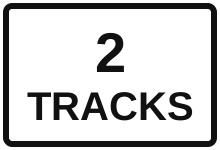
- It tells you the speed trains travel there
- It shows how many minutes until the next train
- It means the crossing has no gates or lights
- It helps you know when to wait and when to go
Show answer
It helps you know when to wait and when to go. When a crossing has more than one track, a sign below the crossbuck shows the number of tracks. The manual says knowing that number is important for knowing when to wait and when to go. After one train passes, another may be coming on a second track from either direction, so you should not move until you are sure every track is clear. The sign does not show train speed or timing, and it says nothing about whether the crossing has gates or lights.
Study this in the handbook: School Buses and Railroad Crossings
12. As the amount of alcohol in your body increases, what does the Oklahoma manual say happens to your driving?
- Your reaction time gets faster
- Your night vision improves
- Your judgment stays the same
- You misjudge distances and speeds
Show answer
You misjudge distances and speeds. Alcohol slows your reflexes and reaction time, reduces your ability to see clearly, and makes you less alert. The manual says that the more alcohol you have in your body, the more your judgment worsens and your driving skill decreases, and you will have trouble judging distances, speeds, and the movement of other vehicles, as well as controlling your vehicle. Reaction time does not improve, vision does not sharpen, and judgment does not hold steady as you drink more.
Study this in the handbook: Implied Consent and DUI Penalties
13. Your signal turns green, but a pedestrian is still in the crosswalk and a car is finishing its turn through the intersection. What must you do?
- Go, since the green light gives you the right-of-way
- Honk to warn them, then go ahead carefully
- Yield to both before entering the intersection
- Go, but yield only to the pedestrian
Show answer
Yield to both before entering the intersection. A green light lets you go, but it does not clear the intersection for you. The manual tells drivers to enter cautiously and to yield to pedestrians in the crosswalk and to other vehicles legally in the intersection, such as a car that entered on its own green and is finishing a turn. Honking does not change who must yield, and yielding to the pedestrian alone still leaves you in the turning car's path. Wait for both to clear, then proceed.
Study this in the handbook: Traffic Signals
14. On an Oklahoma expressway, what minimum speed limit does the manual say is usual?
- 20 mph
- 30 mph
- 50 mph
- 40 mph
Show answer
40 mph. On controlled-access highways, the manual tells drivers to stay between the minimum speed, usually 40 mph, and the maximum, which ranges from 55 to 75 mph. It adds that driving too slowly is against the law because it is dangerous. If your car cannot keep up with the minimum, or you do not want to, the manual says not to use the expressway at all. You should still drive at a safe speed for traffic flow, rain, snow, and other conditions within that range.
Study this in the handbook: Pavement Markings and Lanes
15. You are following a large truck on wet pavement at highway speed. What does the Oklahoma manual say about the truck's stopping ability?
- It always needs more distance to stop than your car
- It may have better traction and stop more quickly
- It cannot brake at all on wet pavement
- It stops at exactly the same distance as your car
Show answer
It may have better traction and stop more quickly. Trucks generally take longer to stop than cars because of their size. The manual adds an important exception: at higher speeds or on wet pavement, a truck may have better traction and be able to stop more quickly than a car. If you are following too closely, you may not be able to stop in time to avoid rear-ending the truck. Assuming the truck will always need more room than you is the trap. Keep a generous following distance behind any truck.
Study this in the handbook: Following Distance and Stopping
16. On a two-lane undivided road, a school bus coming toward you stops and shows flashing red lights. Must you stop?
- No, only drivers behind the bus must stop
- No, if you are in the opposite lane
- Yes, you must stop because the road is undivided
- Yes, but you may pass slowly at 10 mph
Show answer
Yes, you must stop because the road is undivided. When you approach a bus with flashing red lights or a red stop sign, children are getting on or off, and you must stop. On an undivided road that applies to drivers coming from the front as well as from behind; the manual's diagram is labeled both cars must stop. Only on a divided highway is approaching traffic not required to stop. Rolling slowly past is not stopping. Remain stopped until the bus moves, the driver motions you on, or the red lights go off.
Study this in the handbook: Right of Way at Intersections
17. At a low-water crossing, how much water does the Oklahoma manual say may be enough to make you lose control of your vehicle?
- 2 feet
- 1 foot
- 6 inches
- 3 feet
Show answer
6 inches. The manual's flood safety rules tell you to observe any water level indicators at low-water crossings and remember that 6 inches of water may be enough to make you lose control of your vehicle. At 2 feet, most vehicles float, and running water less than 2 feet deep can sweep most vehicles away. Do not drive into or try to cross flowing water, and never drive around barricades at a low-water crossing. If you meet a flooded roadway, turn around, don't drown.
Study this in the handbook: Floods, Crashes and Roadside Emergencies
18. You are driving with a friend in the passenger seat when your phone rings. Which phone safety tip from the Oklahoma manual fits best?
- Ask your passenger to handle the call
- Answer on speaker and hold the phone low
- Hand the phone between you so both can talk
- Check the screen often so you know who called
Show answer
Ask your passenger to handle the call. Oklahoma law requires drivers to give their full attention to the road. Among the manual's safety tips for phones are to pull off the road before calling whenever possible, keep calls short, and ask your passenger to handle all phone calls for you. With a passenger along, letting them take the call keeps your eyes, hands, and mind on driving. Holding the phone low, passing it back and forth, or glancing at the screen still distracts you from the road.
Study this in the handbook: Headlights, Night Driving and Distractions
19. The driver in the lane ahead of you turns on a signal to move into your lane. What should you do?
- Speed up to close the gap so they wait
- Honk to warn them that you are there
- Slow down and leave space for the change
- Change lanes yourself to get out of the way
Show answer
Slow down and leave space for the change. When a driver ahead of you signals a lane change, the manual says to slow down and leave space for the change. Closing the gap to block the move can force a sideswipe or a sudden stop. A horn does not create room, and swerving into another lane yourself may cut off traffic you have not checked. Easing off the accelerator lets the other driver move over smoothly and keeps a safe cushion of space between your car and theirs.
Study this in the handbook: Pavement Markings and Lanes
20. You are stopped at a flashing red light. What does the Oklahoma manual warn about the cross traffic at these intersections?
- Cross traffic always has a steady red and must stop
- Cross traffic may or may not have to stop
- Cross traffic must yield to you after you stop
- Cross traffic will stop when you start moving
Show answer
Cross traffic may or may not have to stop. The manual explains that flashing red lights are used at dangerous intersections where the crossing traffic may or may not stop. That is why a flashing red means the same as a stop sign: you stop fully, then go only when it is safe to cross. Do not assume drivers on the other road must stop for you, because they may not have to. Stopping first does not give you the right to pull out in front of them, so look carefully in both directions before you go.
Study this in the handbook: Traffic Signals
Every question is written from the official Oklahoma Driver Manual. Need paper? Printable OK practice test with answer key.
Last verified 2026-10-05. How we check every question · Study all 500 as flashcards
Frequently asked questions
How many questions are on this Oklahoma practice test?
This fixed set has 20 questions. It is test 21 of 25 from the 500 question Oklahoma bank. The real OK exam asks 20 questions and you need 15 correct.
What is the passing score for the real Oklahoma test?
15 out of 20 questions correct to pass That figure comes from the official Oklahoma source cited on the DMV facts page.
How does this fixed test relate to the full Oklahoma bank?
Each numbered test is a fixed set of questions in a fixed order, so you can retake the same test later and compare. Every test mixes road signs and the other topics in about the same proportion as the full bank. Tests 1 to 25 together cover every question in the Oklahoma bank once. The full practice page mixes the whole bank at random.
Last verified 2026-10-05. See the Oklahoma DMV facts page for sourced state details.
Return to the full Oklahoma practice test · Study road signs