
Test 3 of 10 · 20 questions · Free 2026
OK Permit Practice Test 3
Jump to the test ↓A fixed 20 question set from the Oklahoma bank with answers and plain English explanations. The real OK exam is 20 questions, 75 percent to pass; take the full length version on the main practice page.
Question 1 of 20 · 0 right so far
All 20 questions in test 3
Every question below comes from the Oklahoma question bank on this page. Open a question to see the correct answer and the explanation. Nothing here is hidden behind a signup.
1. At an intersection without traffic signs or signals, what must a driver do before entering?
- Enter first because the larger road has priority
- Wait only for pedestrians
- Accelerate to make other traffic yield
- Stop and yield to approaching traffic
Show answer
Stop and yield to approaching traffic. When entering or crossing a highway without signs or signals, the manual directs the driver to stop and yield to approaching traffic, proceeding only when it is safe. Road size does not create an automatic privilege, and accelerating to force a gap is unsafe. Watching only for pedestrians misses the vehicles the rule specifically addresses. Use the sequence stop, yield, then go when the path is clear as the practical intersection cue.
Study this in the handbook: Right of Way at Intersections
2. At a stop sign, where must you stop when a pedestrian crosswalk is present?
- After entering the intersection
- Before the crosswalk
- Beside the stop sign post
- Only when a pedestrian is visible
Show answer
Before the crosswalk. A stop sign requires a complete stop before the pedestrian crosswalk, even when the paint is difficult to see. Stopping beyond it places the front of the vehicle in the space pedestrians need and may also reduce the driver's view. The signpost is not the stopping reference, and the duty does not depend on spotting a person first. Stop before the crossing, yield as required, and remain stopped until the route through the intersection is clear.
Study this in the handbook: Stop, Yield and Regulatory Signs
3. For a rider under 16 with the motorcycle-only restriction, what engine-size limit applies?
- At least 500cc
- No more than 50cc
- No more than 300cc
- Any size if a helmet is worn
Show answer
No more than 300cc. The motorcycle-only restriction for riders under 16 limits the motor scooter or motorcycle to a piston displacement of no more than 300cc. Wearing a helmet is separately required for anyone under 18, but protective equipment does not remove the engine-size limit. A 50cc ceiling is not the figure given here, and larger engines do not become permitted simply because the rider is cautious. Check both the restriction and the vehicle before riding.
4. What speed limit is listed for a properly marked school zone on a highway outside a municipality, unless another limit is posted?
- 25 mph
- 15 mph
- 35 mph
- 45 mph
Show answer
25 mph. The chart lists 25 mph for school zones on any highway outside a municipality when the zone is properly marked, unless a different limit is posted. The 35 mph choice belongs to highways within state parks or wildlife refuges, not this school-zone entry. Drivers should watch for the marked zone and obey the posted limit. A practical cue is to connect school zones with children, reduced speed, and readiness to stop rather than with the general rural-road number.
Study this in the handbook: Speed Limits and Expressway Speeds
5. If your license is revoked under Oklahoma's Implied Consent Law, how long can the revocation last?
- 30 days to 90 days
- From 180 days to 2 years, depending on your record
- Exactly 1 year for everyone
- Permanently
Show answer
From 180 days to 2 years, depending on your record. An Implied Consent revocation runs from 180 days to 2 years, and where it falls depends on the driver's previous record. Thirty to ninety days is too short, a flat one year for everyone ignores the range, and the manual does not describe a permanent revocation. This revocation is administrative: it can happen for refusing the test or for a BAC of 0.08 or more, even without a DUI conviction in court.
Study this in the handbook: Implied Consent and DUI Penalties
6. You move to a new address in Oklahoma. How long do you have to notify Service Oklahoma?
- 30 days
- 10 days
- 60 days
- Until your license renews
Show answer
10 days. Oklahoma law requires you to report a new address within 10 days, in person at a licensed operator, online, or by mail. Thirty and sixty days are longer than the law allows, and waiting until renewal could take years. Keeping the address current matters because legal notices go by first class mail to the address on file; a missed notice can lead to a suspension you never hear about.
Study this in the handbook: License Rules, Points and Penalties
7. Who must wear a helmet on a motorcycle in Oklahoma, according to the driver manual?
- Everyone, at every age
- Only riders under 16
- Only passengers
- Anyone under 18 years of age
Show answer
Anyone under 18 years of age. Oklahoma requires a helmet for anyone under 18. The requirement does not stop at 16, when the under 16 riding limits are lifted, so "only riders under 16" is too narrow. The manual does not extend the mandate to every adult, and it is not limited to passengers. Riders under 18 must also complete a certified, state approved motorcycle basic rider course before licensing.
Study this in the handbook: Learner Permits and the Graduated License
8. An Oklahoma court notifies Service Oklahoma that a 17 year old committed an alcohol related offense. What cancellation periods may the court choose?
- 30 days only
- 6 months, 1 year, or 2 years or until age 21, whichever is longer
- Only until the 18th birthday
- No cancellation, because the driver is a minor
Show answer
6 months, 1 year, or 2 years or until age 21, whichever is longer. For drivers under 18, courts must report any alcohol or drug offense, and Service Oklahoma must then cancel or deny the license. At the court's discretion the period is 6 months, 1 year, or 2 years or until the person turns 21, whichever is longer. Thirty days is not an option, the cancellation is not capped at 18, and being a minor makes the rule stricter rather than excusing the driver.
Study this in the handbook: Zero Tolerance for Drivers Under 21
9. What movement do traffic signals control at intersections?
- Only pedestrians outside crosswalks
- Only the movement of commercial vehicles
- The movement of vehicles and pedestrians
- Only vehicles entering from private roads
Show answer
The movement of vehicles and pedestrians. Traffic signals organize the movement of both vehicles and pedestrians at intersections. They remove guesswork about who may proceed, although a driver must still enter cautiously and yield when needed to prevent a collision. The commercial-vehicle choice is too narrow because the signals govern ordinary motorists as well. The pedestrian-only choice ignores vehicle movements, and private-road traffic is only one possible approach. Watch the signal, crosswalk, and intersection together, then follow an officer's direction if an officer is controlling traffic.
Study this in the handbook: Traffic Signals
10. What spacing should vehicles maintain in a funeral procession outside a business or residential area?
- No more than 10 feet
- At least 200 feet between vehicles
- Exactly one car length
- A full mile between vehicles
Show answer
At least 200 feet between vehicles. The manual says vehicles in a caravan or motorcade, including a funeral procession, should leave at least 200 feet between each vehicle outside a business or residential area. That gap allows other cars and trucks to enter the line safely. A 10-foot gap or one car length is too small for that purpose, while a full mile is not the stated spacing. This rule works alongside the instruction to yield to a funeral procession and avoid interfering with it. The cue is the setting: the 200-foot guidance applies outside business or residential areas.
Study this in the handbook: Following Distance and Stopping
11. What does a center lane bordered by solid yellow lines serve?
- Parking during a brief stop at an intersection
- Passing in either direction when traffic is light
- Left turns only, not passing
- Traveling straight when the outside lanes are busy
Show answer
Left turns only, not passing. On a three-lane highway, the center lane is shared by traffic from both directions for left turns. Drivers must not use it as a passing lane, because an opposing vehicle may enter for the same turning purpose. Light traffic does not change that restriction, and parking or straight travel would create an unexpected obstruction. The safe cue is the pair of solid yellow lines and the lane's location between opposing flows. Enter it only when preparing for a left turn, then leave it promptly when the turn is complete.
Study this in the handbook: Pavement Markings and Lanes
12. Why might a driver need to travel below the posted speed during rain or fog?
- Rain automatically changes every posted limit to 25 mph
- Posted limits apply only when the road is dry and empty
- The Basic Speed Rule requires a speed suitable for current conditions
- Fog permits only emergency vehicles to use the roadway
Show answer
The Basic Speed Rule requires a speed suitable for current conditions. Oklahoma's Basic Speed Rule is tied to the conditions present now, not just the number on a sign. Rain, fog, darkness, traffic, surface, and visibility can make the posted speed unsafe, so the driver must choose a speed that allows stopping within the clear distance ahead. The dry-road choice overstates the rule, and rain does not automatically create a universal 25 mph limit. Fog also does not ban ordinary traffic. The cue is limited visibility: if you cannot see far enough to stop, reduce speed before the hazard reaches you.
Study this in the handbook: The Basic Speed Rule
13. What following-distance method does the Oklahoma manual recommend for ordinary driving conditions?
- Exactly 200 feet at all speeds
- One car length at every 25 mph
- A one-second count
- The three-second rule
Show answer
The three-second rule. The manual recommends a three-second cushion in normal conditions. Choose a fixed object, wait until the vehicle ahead passes it, and count one thousand one, one thousand two, one thousand three before reaching that same object. The one-second count leaves too little time for perception, reaction, and braking. A fixed 200-foot gap ignores changing speed, while the one-car-length choice gives a different measurement than the stated recommendation. In rain or poor road conditions, extend the count to four seconds. A useful cue is to begin counting at a roadside sign after the lead vehicle clears it.
Study this in the handbook: Following Distance and Stopping
14. How far from a blind person in the roadway must an Oklahoma vehicle stop?
- Fifteen feet
- Five feet
- Twenty five feet
- Only at the next marked stop line
Show answer
Fifteen feet. A vehicle must stop 15 feet from a blind person in the roadway or at an intersection. The driver should stop outside the crosswalk and allow the person to pass. Five feet leaves too little space, while 25 feet changes the stated distance and may unnecessarily hold traffic far back. A marked stop line is not the controlling condition when a blind pedestrian is crossing. The cue may be a guide dog or a white cane, including one with a red tip, so drivers should scan crossings and stop promptly at the required distance.
Study this in the handbook: Right of Way at Intersections
15. In how much water does the Oklahoma manual say most vehicles will become buoyant?
- 6 feet
- 2 feet, or 24 inches, of water or less
- 4 feet
- Only when the water reaches the windows
Show answer
2 feet, or 24 inches, of water or less. Do not try to cross a flooded road or stream in your vehicle. The manual states in capitals that most vehicles will become buoyant in 2 feet, 24 inches, of water or less, and says most vehicles will float in just 2 feet of water, even SUVs. It explains why: for each foot the water rises, 500 pounds of lateral force are applied to the car and the car displaces 1,500 pounds of water. Cars can easily stall in the water and be carried away in any current.
Study this in the handbook: Floods, Crashes and Roadside Emergencies
16. What roadway feature is shown by arrows separating around a center strip?

- A divided highway ahead, with traffic required to keep right of the median
- A three-way intersection where every driver must turn left
- An open median where U-turns are always permitted
- A two-way bridge with no separation between opposing vehicles
Show answer
A divided highway ahead, with traffic required to keep right of the median. The split arrows represent a median separating the directions of a divided highway. Traffic should remain on the right side of that center strip rather than crossing it or treating the space as an unrestricted turnaround. The three-way junction and bridge choices describe different road layouts. As the separation begins, follow lane markings and keep a steady path that protects the vehicle from opposing traffic.
Study this in the handbook: Warning Signs
17. Why should drivers learn the shapes and colors used on traffic signs?
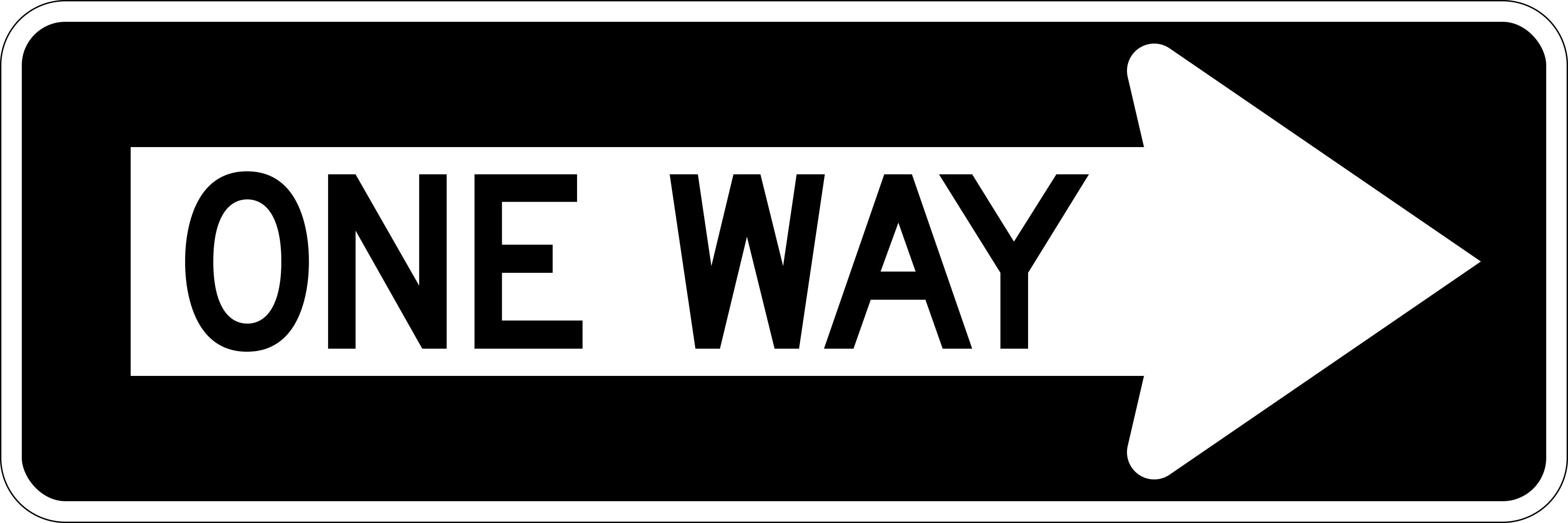
- They can recognize a sign’s meaning immediately, even from a distance
- Vehicles must turn at the next block regardless of their destination
- The right lane is reserved for passing traffic
- A driver may reverse direction whenever the arrow is visible
Show answer
They can recognize a sign’s meaning immediately, even from a distance. Shape and color provide an early visual shortcut when a driver has not yet read every word on a sign. The manual says those features have specific meanings and should be recognizable immediately, even at a distance. The other choices turn that recognition skill into a movement command, a lane assignment, or a reversal rule. A driver should identify the sign first, then obey its displayed instruction along with nearby markings and signals.
Study this in the handbook: Stop, Yield and Regulatory Signs
18. What should a driver do on approaching this red and white triangle?
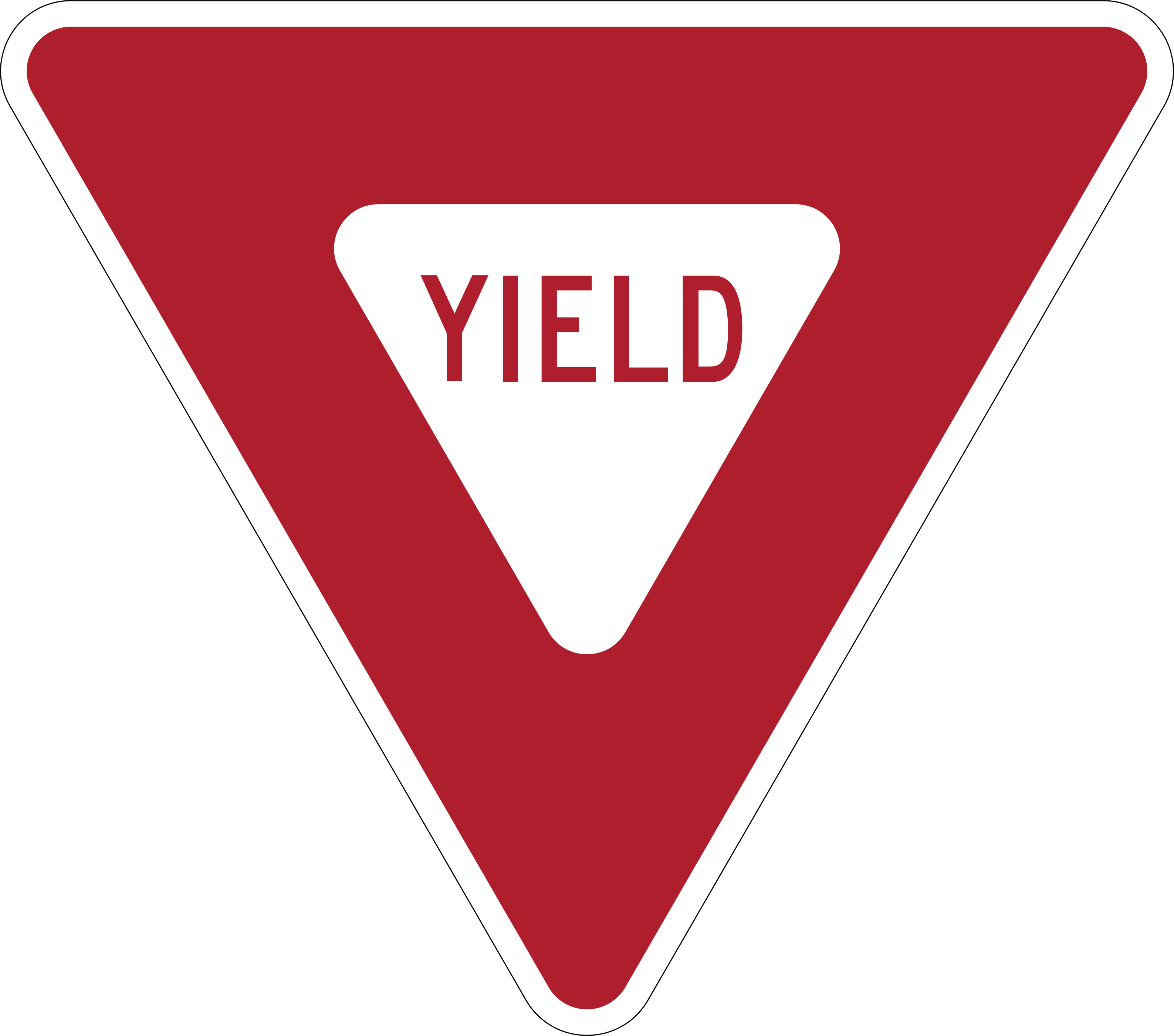
- Accelerate so the driver can enter the traffic stream before other vehicles
- Enter immediately because the triangle grants priority over approaching traffic
- Stop at the sign every time, even when the intersection is empty
- Slow down, be ready to stop, and let oncoming vehicles pass first
Show answer
Slow down, be ready to stop, and let oncoming vehicles pass first. A yield sign calls for controlled caution rather than an automatic stop. Reduce speed enough to evaluate vehicles and pedestrians, and be prepared to stop if the opening is not safe. The choice “Slow down, be ready to stop, and let oncoming vehicles pass first” also recognizes that oncoming traffic must be allowed through before you cross or join its path. A complete stop can be needed, but the sign does not require one when the way is plainly clear.
Study this in the handbook: Stop, Yield and Regulatory Signs
19. You are following another vehicle at night in Oklahoma with your high beams on. How close can you get before you must dim to low beams?
- Within 300 feet
- Within 1,000 feet
- Within 600 feet
- Within 1,500 feet
Show answer
Within 600 feet. Oklahoma requires low beams within 600 feet of a vehicle you are following and within 1,000 feet of an oncoming vehicle. The 1,000 foot figure is for oncoming traffic, so it is the wrong distance when you are behind someone. Three hundred feet is too close, and 1,500 feet is not a headlight rule. High beams from behind glare in the other driver's mirrors and can blind them.
Study this in the handbook: Headlights, Night Driving and Distractions
20. Under Oklahoma's Mandatory Point System, how many points within what period lead to a license suspension?
- 6 points within 1 year
- 12 points within 2 years
- 15 points within 10 years
- 10 or more points within 5 years
Show answer
10 or more points within 5 years. Everyone starts with a clean record. Each conviction of a pointable violation adds points, and accumulating 10 or more points within 5 years leads to suspension. The other combinations are not the Oklahoma threshold. For scale, most moving violations such as speeding, following too closely, or failing to yield are 2 points, speeding more than 25 mph over the limit is 3, and reckless driving or passing a stopped school bus is 4.
Study this in the handbook: License Rules, Points and Penalties
QualitySpace is expanding to Oklahoma
We are a California-based independent insurance brokerage working on licensing in more states. We cannot help with Oklahoma insurance yet. Leave your email and we will let you know when we can.
Every question is written from the official Oklahoma Driver Manual. Need paper? Printable OK practice test with answer key.
Last verified 2026-10-05. How we check every question · Study all 218 as flashcards
Frequently asked questions
How many questions are on this Oklahoma practice test?
This fixed set has 20 questions. It is test 3 of 10 from the 218 question Oklahoma bank. The real OK exam asks 20 questions and you need 15 correct.
What is the passing score for the real Oklahoma test?
15 out of 20 questions correct to pass That figure comes from the official Oklahoma source cited on the DMV facts page.
How does this fixed test relate to the full Oklahoma bank?
Each numbered test is a fixed set of questions in a fixed order, so you can retake the same test later and compare. Every test mixes road signs and the other topics in about the same proportion as the full bank. Tests 1 to 10 together cover 200 of the 218 questions in the Oklahoma bank, each once. The full practice page mixes the whole bank at random.
Last verified 2026-10-05. See the Oklahoma DMV facts page for sourced state details.
Return to the full Oklahoma practice test · Study road signs