
Test 9 of 25 · 20 questions · Free 2026
FL Permit Practice Test 9
Jump to the test ↓A fixed 20 question set from the Florida bank with answers and plain English explanations. The real FL exam is 50 questions, 80 percent to pass; take the full length version on the main practice page.
Question 1 of 20 · 0 right so far
All 20 questions in test 9
Every question below comes from the Florida question bank on this page. Open a question to see the correct answer and the explanation. Nothing here is hidden behind a signup.
1. How should you handle the car while backing?
- Back up fast
- Use only mirrors
- Turn the wheel sharply
- Back slowly; steering is harder in reverse
Show answer
Back slowly; steering is harder in reverse. Reverse gear steers differently: back up slowly, because the vehicle is harder to steer while backing. Fast reversing, mirror-only guidance, and sharp wheel cranks each overdrive a maneuver with inverted steering feel and narrow sight lines. Slow speed buys time to correct the trailer-like swing of the front end. When possible add a helper outside the car, keep the foot covering the brake, and stop the instant anything uncertain appears.
2. Where must a driver stop when a stop line is marked at a red light or stop sign?
- At least one car length beyond the marked line
- After the crosswalk so the front bumper reaches the corner
- At the stop line before entering the intersection
- Only beside the traffic signal pole
Show answer
At the stop line before entering the intersection. The handbook identifies stop lines as the point showing where a driver must stop for a stop sign or red light. Stopping beyond the line can place the vehicle in the crosswalk or too close to crossing traffic. The answer that waits past the crosswalk defeats the purpose of the marking, while a fixed car-length rule is not stated. Approach slowly enough to stop precisely at the line, then check pedestrians, bicyclists, and traffic before making any permitted movement.
Study this in the handbook: Pavement markings
3. What intersection practice is required when yielding to an emergency vehicle?
- Stop in the center of the intersection until the vehicle passes
- Pull to the closest edge, stop, and do not block intersections
- Reverse into the intersection entrance to make room
- Continue through without yielding because another vehicle entered first
Show answer
Pull to the closest edge, stop, and do not block intersections. Florida's emergency vehicle rule requires road users to pull to the closest edge, stop until the emergency vehicle passes, and avoid blocking intersections. Stopping in the center can obstruct the responding vehicle and cross traffic. Reversing creates another conflict, while entering first does not cancel the duty to yield. Look for a safe path to the roadway edge, keep the intersection open, and remain stopped until the emergency vehicle has passed. The key cue is to make room without creating a new obstruction.
Study this in the handbook: Right of way at intersections and roundabouts
4. Which lane should you choose before entering a Florida multi-lane roundabout if you plan to turn right?
- The left lane
- Either lane after entering and changing as needed
- The shoulder or truck apron
- The right lane
Show answer
The right lane. At a multi-lane roundabout, Florida assigns the right lane to drivers going straight or turning right, and the left lane to drivers going straight, turning left, or making a U-turn. A right turn therefore belongs in the right lane, and the choice must be made before entering because changing lanes inside the roundabout is not allowed. The shoulder or truck apron is not a travel lane to pick. Approach slowly, yield to traffic already circulating and to pedestrians in the crosswalks, and signal before exiting.
Study this in the handbook: Right of way at intersections and roundabouts
5. Why should you avoid tailgating a commercial motor vehicle?
- The truck must automatically move into your lane
- You may be in its rear blind spot and could collide with it if it stops unexpectedly
- Following closely improves your view around the truck
- A truck’s rear lights cannot be seen from behind
Show answer
You may be in its rear blind spot and could collide with it if it stops unexpectedly. Florida warns motorists not to tailgate a commercial motor vehicle because a following car can remain in the truck’s rear blind spot and may collide with it if the truck stops unexpectedly. The truck is not required to move for a close follower, and the large vehicle blocks rather than improves your view. Its rear lights are designed to be seen. Leave enough space to see the roadway, increase that gap when conditions are poor, and wait until you can see the truck’s front in your mirror before moving back into its lane.
Study this in the handbook: Bicycles, trucks, motorcycles and pedestrians
6. What must be displayed to use disabled-reserved spaces?
- Nothing, if the driver looks disabled
- Display a disabled permit or plate
- Pay double the meter rate
- Leave a doctor's note on the dash
Show answer
Display a disabled permit or plate. Reserved spaces demand proof on the car: a disabled parking permit or plate must be displayed to park in the designated spaces. Appearances prove nothing, double payment buys no right, and a dashboard note is not a permit. The display rule lets enforcement verify eligibility at a glance and keeps the closest spaces genuinely available. Borrowing or faking the credential is a second degree misdemeanor with a $500 fine or jail time, plus towing and confiscation.
Study this in the handbook: Learner's license, practice hours and teen curfews
7. What happens to speeding fines in Florida school zones and construction zones?
- Fines are waived for first offenses
- Fines stay the same as elsewhere
- Only points double, not fines
- Fines double, plus possible course and penalties up to $1,000
Show answer
Fines double, plus possible course and penalties up to $1,000. Speeding where workers or children are present is punished more severely: fines double when the infraction occurs within a school zone or construction zone. The enhancement can also bring civil penalties up to $1,000 and a required driving course. Florida marks these areas with Speeding Fines Doubled signs so no driver can claim surprise. The doubling rule is one reason to watch for orange construction signs and flashing school signals and to shed speed early before entering either zone.
Study this in the handbook: Points, suspensions and school buses
8. What fine range applies to a first DUI conviction in Florida when the BAL is under .15 and no minor is in the vehicle?
- $500 to $1,000
- $100 to $250
- $2,000 to $5,000
- $5,000 to $10,000
Show answer
$500 to $1,000. A first Florida DUI conviction carries a fine of $500 to $1,000. When the BAL is .15 or higher or a minor is in the vehicle, the range rises to $1,000 to $2,000. One hundred to two hundred fifty dollars is far too low. Two thousand to five thousand dollars is the third conviction range, and $5,000 to $10,000 is not in the DUI table. The first conviction also brings 50 hours of community service and probation of up to one year.
Study this in the handbook: DUI, implied consent and zero tolerance
9. You get a Florida ticket for going 35 mph over the limit. Can you elect a basic driver improvement course instead of points?
- Yes, the course is always available
- No, the election is not available above 30 mph over the limit
- Yes, but only if you pay double
- No, the course is only for commercial drivers
Show answer
No, the election is not available above 30 mph over the limit. Florida lets drivers with a non criminal moving violation elect a basic driver improvement course instead of points, but not when charged with exceeding the speed limit by more than 30 mph, so 35 over does not qualify. The option is not always available. It does not cost double; electing the course actually brings an 18 percent reduction toward the civil penalty. It is not limited to commercial drivers; in fact it is unavailable for violations in a commercial vehicle or by CDL holders.
Study this in the handbook: Learner's license, practice hours and teen curfews
10. What movement is prohibited by a NO U-TURN sign?
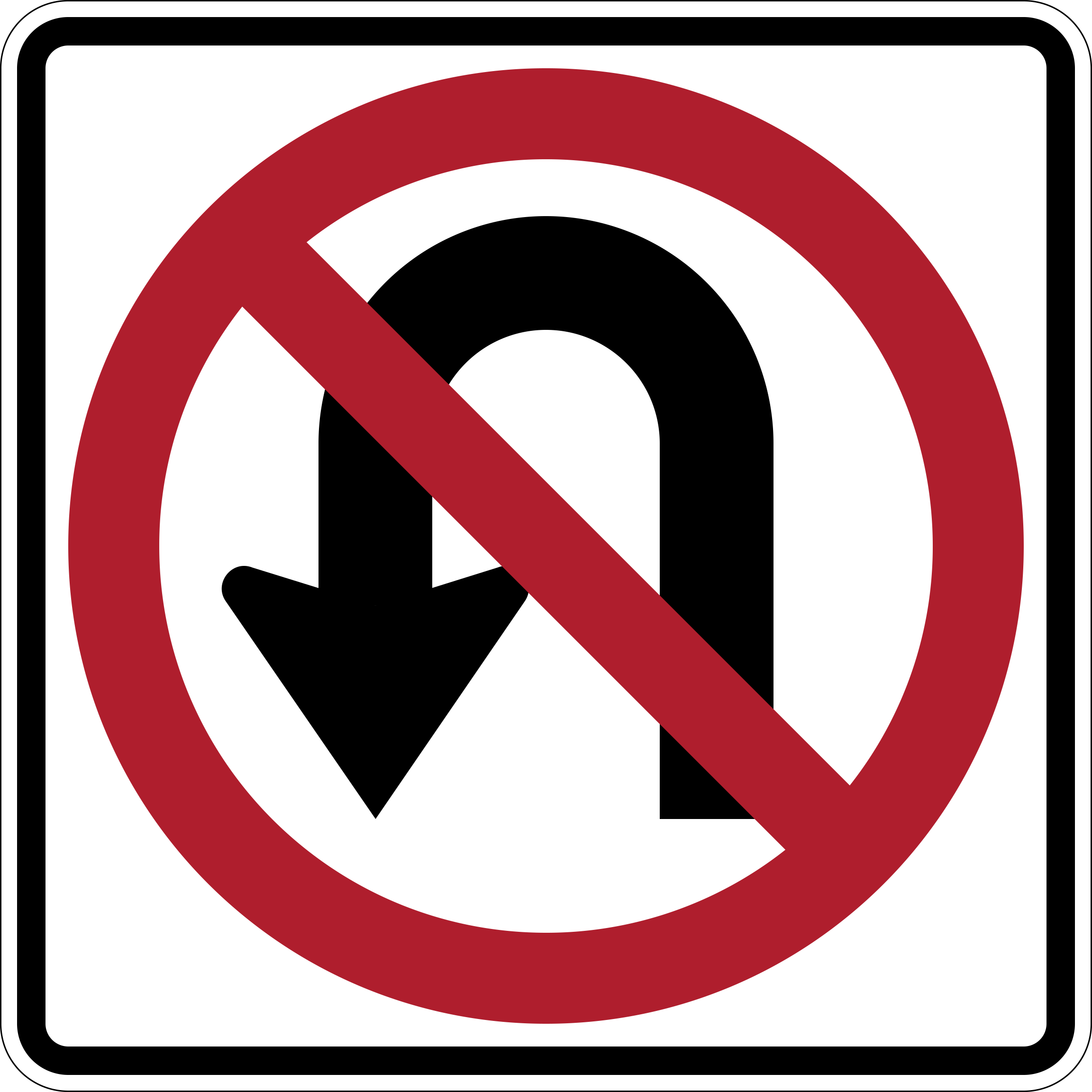
- Making a complete turn to travel in the opposite direction
- Turning left into a side street
- Passing another vehicle on a two-lane road
- Turning right at the next intersection
Show answer
Making a complete turn to travel in the opposite direction. NO U-TURN prohibits the maneuver that reverses the vehicle’s direction through a complete turn. It does not automatically ban every left turn, passing movement, or right turn. The left-turn distractor is attractive because both maneuvers use steering toward the left, but the sign targets the full reversal, not an ordinary turn into another road. Identify whether the intended path returns the vehicle in the opposite direction. If so, choose another legal route or intersection.
11. Where does Florida prohibit using a wireless communications device in a handheld manner?
- Any road with a speed limit below 55 MPH
- A designated school crossing, school zone, or work zone
- Only a limited access highway
- Only a residential street after dark
Show answer
A designated school crossing, school zone, or work zone. Florida prohibits handheld wireless-device use in a designated school crossing, school zone, or work zone. The restriction is tied to those protected locations, not to a road's speed limit, highway classification, or time of day. Texting while driving is separately illegal. When approaching one of the named zones, put the device down completely rather than assuming a permitted call is safe because traffic is moving slowly.
Study this in the handbook: Seat belts, child seats and speeding
12. What does orange mean on traffic signs?
- Construction and maintenance warning
- Stop signs
- School zones
- Guide information
Show answer
Construction and maintenance warning. Orange warns of work zones: the color signals construction and maintenance warnings, from road-work-ahead diamonds to flagger and detour signs. Stop belongs to red, schools to fluorescent yellow-green, and guidance to green. Orange also dresses the channeling drums, cones, and barricades that steer traffic through the site. Slow down, obey every orange instruction, and remember that fines double where the work is active.
Study this in the handbook: Pavement markings
13. What must you do when railroad crossing lights flash?
- Slow slightly
- Honk through
- Stop immediately; a train is coming
- Speed up to beat it
Show answer
Stop immediately; a train is coming. Flashing red at the rails means steel is near: when the crossbuck lights begin to flash, stop immediately, because a train is approaching. Slight slowing, honking through, and racing the gates each gamble against a vehicle that cannot stop or swerve. The bells and flashers trigger well before the train arrives, and the gates follow. Stop behind the line, never on the tracks or within fifteen feet, and cross only after the signals fully stop.
Study this in the handbook: Traffic signals, pedestrian signals and railroad crossings
14. When parking downhill with a curb, which way should the wheels point?
- Away from the curb
- Straight ahead
- Toward the curb
- Toward the center line
Show answer
Toward the curb. Parking downhill aims the front wheels at the curb so a brake failure rolls the car into the curb instead of into traffic. The curb becomes a backstop that chocks the rolling tire within inches. Turning away or straight lets a runaway car gather speed down the grade and into the roadway, and the center line is the worst possible target. Pair the wheel direction with the parking brake and the proper gear, and the downhill car is held three ways against gravity.
Study this in the handbook: Passing, turning and parking
15. What should you do with speed on a highway entrance ramp?
- Stop on the ramp
- Slow to a crawl
- Hold ramp speed onto the highway
- Increase speed as the ramp straightens
Show answer
Increase speed as the ramp straightens. Entrance ramps end in acceleration lanes for a reason: you are expected to increase speed as the ramp straightens into the lane, matching highway traffic before merging. Stopping on the ramp or crawling onto a 70 MPH highway forces a lethal speed mismatch with traffic that cannot stop for you. Holding a slow ramp speed onto the mainline is nearly as bad. Signal early, build speed in the acceleration lane, adjust to a gap, and merge without stopping unless traffic leaves no space at all.
Study this in the handbook: Right of way at intersections and roundabouts
16. May you put water on a gasoline or diesel fire?
- Never; water spreads fuel fires
- Always use water first
- Use water on large fires
- Use water on diesel only
Show answer
Never; water spreads fuel fires. Water and burning fuel are enemies of the firefighter: never apply water to a gasoline or diesel fire. Water sinks under floating fuel, flashes to steam, and scatters the burning liquid wider instead of smothering it. Always-water, large-fire-water, and diesel-only-water readings each prescribe the dangerous mistake. Smother small fires with a proper portable extinguisher, and for anything beyond that, evacuate upwind and call 911 while the fumes stay downwind of you.
Study this in the handbook: After a crash and vehicle emergencies
17. What must an under-21 driver with BAL .02-.05 complete for hardship return?
- Complete a TLSAE course for hardship reinstatement
- Nothing further is needed
- Retake the road test only
- Pay a $10 fee only
Show answer
Complete a TLSAE course for hardship reinstatement. Young drivers caught in the .02 to .05 window face a coursework path back: complete a Traffic Law and Substance Abuse Education course to reinstate on a hardship basis. The TLSAE mandate sits between the six-month zero-tolerance suspension and full reinstatement, teaching what the next drink-and-drive costs. Nothing-further, road-test-only, and ten-dollar readings all trivialize a suspension that also notifies parents for drivers under nineteen. Higher BALs and refusals trigger harsher tracks with longer suspensions and more school.
Study this in the handbook: Learner's license, practice hours and teen curfews
18. How long must you stay stopped for a school bus stop signal?
- Until the bus driver waves
- Until traffic behind honks
- Until the signal is withdrawn and children are clear
- For exactly 60 seconds
Show answer
Until the signal is withdrawn and children are clear. Stopping for the bus is only half the duty; the wait lasts until the stop signal is withdrawn and all children are clear of the roadway. Children cross unpredictably and may double back, so the signal plus a clear road are both required before anyone moves. Driver waves and horn honks from behind are not release signals, and no fixed timer applies. The same remain-stopped rule binds traffic in both directions on undivided roads and same-direction traffic always.
Study this in the handbook: Points, suspensions and school buses
19. Between sunset and sunrise, what lighting must a Florida bicycle have on the front?
- An amber reflector only
- A white light visible from 500 feet
- A red light visible from 600 feet
- No light if the rider wears reflective clothing
Show answer
A white light visible from 500 feet. Florida requires a bicyclist riding between sunset and sunrise to have a white light on the front visible from 500 feet, plus a red reflector and a red light visible from 600 feet on the rear. Knowing this helps drivers recognize a bicycle at night: white ahead, red behind. An amber reflector alone does not meet the front lighting rule, the red 600 foot light belongs on the rear, and reflective clothing does not replace the required lights.
Study this in the handbook: Bicycles, trucks, motorcycles and pedestrians
20. In which direction does traffic travel around a Florida roundabout?
- One way, counter-clockwise
- Two ways, depending on the exit
- One way, clockwise
- Straight through the center island
Show answer
One way, counter-clockwise. Traffic in a roundabout moves in one direction, counter-clockwise, around the central island. It does not circulate clockwise, reverse direction for a particular exit, or cross through the island. Entering drivers must still yield to vehicles already circulating, and they should not stop inside the circle. Choose the needed lane before entry, maintain a steady path, and signal before leaving so other road users can predict the exit movement.
Study this in the handbook: Right of way at intersections and roundabouts
QualitySpace is expanding to Florida
We are a California-based independent insurance brokerage working on licensing in more states. We cannot help with Florida insurance yet. Leave your email and we will let you know when we can.
Every question is written from the official Official Florida Driver License Handbook. Need paper? Printable FL practice test with answer key.
Last verified 2026-10-05. How we check every question · Study all 500 as flashcards
Frequently asked questions
How many questions are on this Florida practice test?
This fixed set has 20 questions. It is test 9 of 25 from the 500 question Florida bank. The real FL exam asks 50 questions and you need 40 correct.
What is the passing score for the real Florida test?
40 out of 50 (80 percent) That figure comes from the official Florida source cited on the DMV facts page.
How does this fixed test relate to the full Florida bank?
Each numbered test is a fixed set of questions in a fixed order, so you can retake the same test later and compare. Every test mixes road signs and the other topics in about the same proportion as the full bank. Tests 1 to 25 together cover every question in the Florida bank once. The full practice page mixes the whole bank at random.
Last verified 2026-10-05. See the Florida DMV facts page for sourced state details.