
Printable FL Permit Practice Test
50 questions in the real FL exam format, 80 percent (40 of 50) to pass. Answer key on the last page. Last verified 2026-09-05 against the official Florida driver manual.
1. How close to a fire hydrant may you park in Florida?
- No closer than 5 feet
- No closer than 10 feet
- No closer than 15 feet
- No closer than 25 feet
2. Why keep extra following distance behind a motorcycle?
- Follow closer than behind cars
- Keep extra distance; bikes stop quicker
- Match their speed exactly
- Follow in their tire track
3. Which record of offenses within a 5-year period requires Florida to revoke a driver license?
- Two speeding tickets
- Any single parking ticket
- Three major offenses or 15 offenses for which points are given
- Five offenses of any kind
4. How may a bicyclist signal a right turn by hand?
- Left arm only always
- Right hand and arm out horizontally for a right turn
- No signals are allowed
- Feet signals only
5. What should a driver expect after seeing the two-way traffic warning sign?
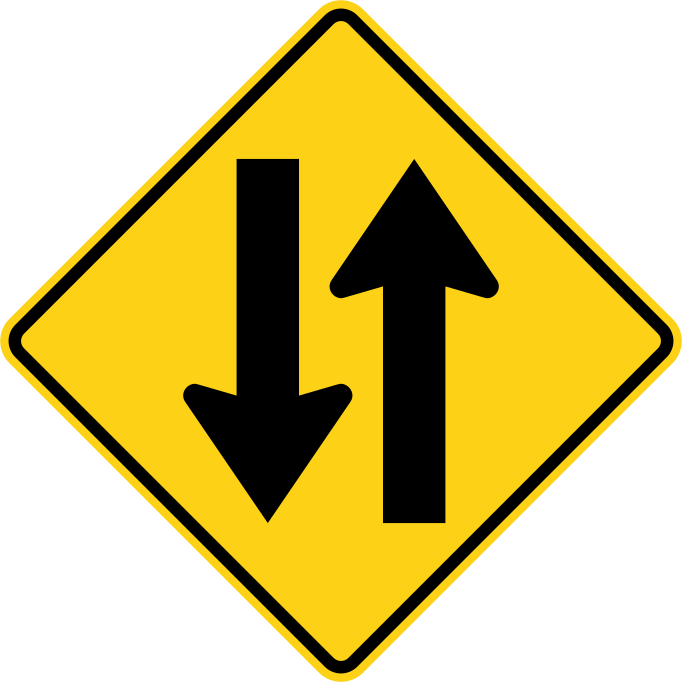
- The divided highway will continue with no opposing traffic
- The roadway will change to two-way traffic with oncoming vehicles
- All passing will be allowed in both directions
- The next lane will be reserved for emergency vehicles
6. Why can't you rely on a motorcycle's brake light?
- They always brake early
- Their brake lights are brighter
- They may slow without any brake light
- They never slow on highways
7. When must a Florida driver attend a Traffic Collision Avoidance Course after a crash?
- After any crash, even with no damage
- Only after a DUI crash
- Only when the other driver asks for it
- When found at fault in a crash where someone was taken for medical treatment, or after a second crash in two years
8. What medical steps should older drivers take?
- Skip checkups entirely
- Regular exams and ask how meds affect driving
- Drive only when sick
- Double all medications
9. How should you handle the car while backing?
- Back up fast
- Use only mirrors
- Turn the wheel sharply
- Back slowly; steering is harder in reverse
10. What should older drivers avoid?
- No sunglasses in dim light; avoid dusk, bad weather, rush, fast highways
- Sunglasses always
- Night driving only
- Rush hour preferred
11. What kind of divider excuses opposite traffic from stopping for a bus?
- Any painted line excuses opposite traffic
- Only a raised barrier or 5+ foot unpaved median excuses it
- Any median, even 1 foot, excuses it
- Opposite traffic never stops
12. A pedestrian is already in a crosswalk when the raised hand begins flashing. What action is required?
- Stand still until the hand becomes a walking person
- Turn around immediately
- Finish crossing quickly
- Start a new crossing from the nearest curb
13. Where must you not stop at a railroad crossing?
- Never stop on the tracks or within 15 feet
- Stop on the tracks to look
- Stop 5 feet from the rails
- Park beside the crossing
14. When a pedestrian countdown begins and the hand symbol is flashing, who may enter the crosswalk?
- Anyone who can reach the other side before zero
- Only people accompanied by an adult
- Drivers turning across the crosswalk
- Only pedestrians already in the crosswalk
15. What may you do on a WALK signal?
- Never cross there
- Wait for green
- Run across quickly
- Begin crossing the street
16. How many points does a Florida driver get for going 16 mph or more over the speed limit?
- 2 points
- 3 points
- 4 points
- 6 points
17. When the slippery surface warning sign appears, which response follows the handbook?

- Accelerate firmly so the tires clear the wet surface
- Use hard braking before every curve to test traction
- Drive slowly in wet weather and avoid speeding or quick braking
- Treat the sign as notice of a gravel-only roadway
18. What do Florida interstate mile markers indicate?
- The legal speed limit for the next county
- The number of lanes available at the next interchange
- The distance to the nearest service station
- The driver's location on an interstate and the matching exit number
19. When is passing on the right legal in Florida?
- Only with 2+ same-direction lanes or a left-turning car ahead
- Whenever traffic is slow
- On any narrow shoulder
- Across a solid line anytime
20. During a power outage, the traffic signals at a Florida intersection are dark. Two vehicles approaching from perpendicular roads arrive at the same time. Which driver must yield?
- The driver with the smaller vehicle
- The driver on the right
- The driver traveling straight
- The driver on the left
21. What should you do when a hill/downgrade sign warns of a downhill road?
- Speed up to climb faster
- Shift to neutral to coast
- Slow down and shift lower to control speed
- Turn off the engine downhill
22. What area or activity does the five-sided school sign identify?

- An adult pedestrian-only recreation area
- A railroad station crossing
- A public park with no special traffic rule
- A school area where drivers should watch for children
23. Without a work or adult-passenger exception, during what hours may a 17-year-old Florida licensed driver drive?
- 5 a.m. to 1 a.m.
- 4 a.m. to midnight
- 6 a.m. to 11 p.m.
- 7 a.m. to 10 p.m.
24. What must a Florida driver adjust driving speed to?
- The speed of surrounding traffic only
- Weather, roadway, and traffic conditions
- The posted limit plus 10 MPH
- Fuel economy and tire wear
25. What should you expect behind buses or trucks at railroad crossings?
- Speed past them
- Be prepared to stop behind them
- Honk them through
- Pass on the shoulder
26. What should a driver do before pulling away from a parked position?
- Make sure the roadway is clear, signal, and yield to traffic
- Open the door into traffic to check the lane
- Back into the roadway without signaling
- Pull out immediately because parked vehicles have priority
27. Who draws the mandatory DUI blood test?
- Any bystander may draw it
- The driver draws it personally
- A medical professional; unconscious drivers included
- Only a judge may order it
28. What roadway condition is announced by a MERGING TRAFFIC warning sign?

- Another traffic lane joins the lane you are using
- Your lane is reserved for buses only
- All traffic must stop before changing lanes
- The roadway ahead prohibits any merge
29. What should you do when a LANE ENDS sign warns that your lane will disappear?

- Continue in the ending lane until the pavement stops
- Stop immediately in the lane and wait for a gap
- Merge into the remaining lane when safe
- Use the shoulder as the new travel lane
30. What does defensive driving mean?
- Alter driving to weather, feelings, and others' actions
- Drive the same way always
- Copy the fastest driver
- Ignore conditions
31. How far can high beams reveal objects, and at what speeds are they most effective?
- At least 450 feet, best above 25 MPH
- About 200 feet at any speed
- About 1,000 feet below 25 MPH
- Only 100 feet on curves
32. During what hours does Florida law require headlights?
- Between sunset and sunrise
- Only after midnight in areas without streetlights
- Only when driving on a limited access highway
- Only when another vehicle flashes its headlights
33. Your Florida insurance lapses and you do not send FLHSMV proof of new coverage. How long can your license and plate be suspended?
- Up to 30 days
- Up to six months
- They cannot be suspended for a lapse
- Up to three years
34. Where must a driver stop when a stop line is marked at a red light or stop sign?
- At least one car length beyond the marked line
- After the crosswalk so the front bumper reaches the corner
- At the stop line before entering the intersection
- Only beside the traffic signal pole
35. What fine applies when passing a stopped school bus results in serious injury or death?
- No fine if the bus is on a divided highway
- A $265 fine
- A $465 fine
- A $1,500 fine
36. Can you fully rely on backup cameras and alarms?
- Never fully; they miss small children and animals
- Yes, completely always
- Cameras replace all checks
- Alarms see everything
37. What does a white and black regulatory sign do?
- It identifies scenic areas and cultural sites
- It warns about unexpected roadway conditions
- It controls traffic, sets limits, or gives commands
- It directs drivers to gas, food, motels, and hospitals
38. What information must drivers exchange after a crash?
- First names only
- Full vehicle, witness, and driver details
- Nothing until court
- Insurance cards only
39. How should you manage sleepiness on long trips?
- Push through to arrive faster
- Drink coffee and speed up
- Break every 100 miles or 2 hours; nap and buddy up
- Open the window only
40. What should you do at a Yield Ahead sign?

- Speed up to the yield
- Stop immediately where you are
- Slow down and prepare to stop or adjust to traffic
- Ignore it until the yield
41. What does Florida prohibit when a fire truck is responding to an emergency?
- Following the fire truck too closely
- Watching for hazards ahead
- Allowing it to use the left lane
- Giving it room to maneuver
42. What lights must a bicycle carry at night?
- No lights are needed
- White front 500 feet, red rear 600 feet plus reflector
- Flashlight in hand only
- Rear light only
43. Within what distance must you dim behind another vehicle?
- 100 feet
- 300 feet
- 500 feet
- Never dim
44. During a rainstorm, how should a Florida driver adjust speed?
- Slow down because wet roads become slick
- Drive exactly at the posted speed limit
- Drive 10 MPH above the posted speed limit
- Match the fastest traffic regardless of conditions
45. What is the center lane of a three- or five-lane highway for?
- Turning left only
- Passing slower cars
- Parking briefly
- Driving straight through
46. Unless posted otherwise, what is Florida's standard speed limit in school zones?
- 15 MPH
- 20 MPH
- 25 MPH
- 30 MPH
47. Passing a stopped school bus in Florida causes a serious injury. What community service does the driver face?
- 120 hours in a trauma center or hospital
- 10 hours at any charity
- 50 hours of roadside litter pickup
- None, because the $1,500 fine replaces it
48. Your Florida renewal application arrives after midnight on your birthday, when the license expired. What extra charge applies?
- No extra charge if you renew within a year
- A $50 late fee
- A $15 late fee
- A $5 late fee
49. A Florida driver is convicted of possessing marijuana. What happens to the driver license?
- It must be suspended
- Nothing, if no car was involved
- A warning is added to the record
- Two points are added
50. Who is charged for an unrestrained passenger?
- No one is charged
- Only the car owner
- Only the youngest passenger
- Drivers for under-18s; adults for themselves
Answer key
- 1. C
- 2. B
- 3. C
- 4. B
- 5. B
- 6. C
- 7. D
- 8. B
- 9. D
- 10. A
- 11. B
- 12. C
- 13. A
- 14. D
- 15. D
- 16. C
- 17. C
- 18. D
- 19. A
- 20. D
- 21. C
- 22. D
- 23. A
- 24. B
- 25. B
- 26. A
- 27. C
- 28. A
- 29. C
- 30. A
- 31. A
- 32. A
- 33. D
- 34. C
- 35. D
- 36. A
- 37. C
- 38. B
- 39. C
- 40. C
- 41. A
- 42. B
- 43. B
- 44. A
- 45. A
- 46. B
- 47. A
- 48. C
- 49. A
- 50. D