
Test 11 of 25 · 20 questions · Free 2026
FL Permit Practice Test 11
Jump to the test ↓A fixed 20 question set from the Florida bank with answers and plain English explanations. The real FL exam is 50 questions, 80 percent to pass; take the full length version on the main practice page.
Question 1 of 20 · 0 right so far
All 20 questions in test 11
Every question below comes from the Florida question bank on this page. Open a question to see the correct answer and the explanation. Nothing here is hidden behind a signup.
1. What kind of divider excuses opposite traffic from stopping for a bus?
- Any painted line excuses opposite traffic
- Only a raised barrier or 5+ foot unpaved median excuses it
- Any median, even 1 foot, excuses it
- Opposite traffic never stops
Show answer
Only a raised barrier or 5+ foot unpaved median excuses it. The divided-road exception is narrow: opposite-direction drivers are excused only where the highway is divided by a raised barrier or an unpaved median at least five feet wide. Painted lines and pavement markings are explicitly not barriers, so a five-lane painted road still requires everyone to stop. One-foot medians fail the width test, and same-direction traffic must always stop regardless. When the true barrier exists, opposite traffic proceeds with caution rather than stopping.
2. Can you fully rely on backup cameras and alarms?
- Never fully; they miss small children and animals
- Yes, completely always
- Cameras replace all checks
- Alarms see everything
Show answer
Never fully; they miss small children and animals. Backup technology assists but never certifies: do not completely rely on cameras or alarms, because they do not always detect small children and animals. Complete trust, check-replacement, and see-everything readings each overstate sensors with blind zones, dirty lenses, and silent gaps. Use the camera as one more eye alongside the walkaround, the mirrors, and the look-back through the glass. Technology reports; the driver remains responsible for what rolls behind.
3. When may a driver cross a single broken yellow line?
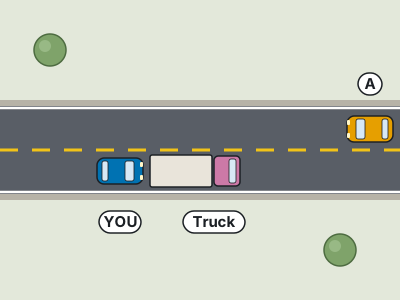
- Whenever the driver wants to use the opposing lane
- To pass a car ahead when it is safe to do so
- Only to park on the other side of the roadway
- Only after a traffic signal turns green
Show answer
To pass a car ahead when it is safe to do so. A single broken yellow line separates traffic moving in opposite directions. Florida instructs the driver to stay to the right of it, but permits crossing to pass a car ahead when the pass is safe. That requires checking for oncoming traffic, adequate visibility, and enough space to return. The unrestricted choice treats a permission as a guarantee. Do not cross merely because the line is broken. Confirm that the road ahead is clear and complete the maneuver without exceeding the speed limit.
4. How do you recover from a skid?
- Brake hard at once
- Turn against the skid
- Ease off gas, avoid brakes, steer where you want to go
- Close your eyes and hold on
Show answer
Ease off gas, avoid brakes, steer where you want to go. Skids recover with smooth hands: take your foot off the gas, avoid the brakes if possible, and turn the front tires in the direction you want to go, steering into the skid. Hard braking locks the slide, counter-steering whips the tail the other way, and freezing surrenders the car. Easing off transfers weight back to the gripping tires while directional steering points the recovery. If a collision becomes unavoidable, switch to emergency braking and aim for the softest, slowest target available.
5. What is the greatest danger on limited access highways?
- Head-on collisions
- Rollovers
- Side impacts
- Rear-end collisions
Show answer
Rear-end collisions. On limited access highways, where everyone travels the same direction at high speed, the greatest danger is the rear-end collision from following too closely. Small speed differences between lanes and sudden slowdowns punish tailgaters who leave no cushion. Head-on crashes are rare on divided facilities, and rollovers and side impacts trail rear-enders in frequency. The defense is the four-second following minimum, lengthened in rain, darkness, heavy loads, and congestion, plus full attention on the traffic far ahead.
6. If a Florida applicant is under 18, how long must the learner’s license be held before a Class E license, unless the applicant turns 18 sooner?
- Until age 21 regardless of when the license was issued
- 6 months in every case
- 12 months or until the 18th birthday, whichever comes first
- Only until the applicant passes the vision exam
Show answer
12 months or until the 18th birthday, whichever comes first. An applicant under 18 must hold the learner’s license for 12 months or until reaching the 18th birthday, whichever comes first. That means turning 18 can end the waiting period before a full year has elapsed. Six months is shorter than the stated period, and age 21 is unrelated to this licensing step. Passing the vision exam is an exam requirement, not a substitute for the holding period. When reading a question about a minor applicant, check both parts of the rule: the 12-month period and the earlier birthday cutoff.
7. What action does a STOP sign require of a Florida driver?

- Slow down and continue if no traffic is visible
- Stop only when a pedestrian is waiting
- Bring the vehicle to a complete halt before the stop line or crosswalk
- Yield without stopping unless cross traffic is present
Show answer
Bring the vehicle to a complete halt before the stop line or crosswalk. Florida lists the STOP sign among its regulatory signs, which are enforceable by law, and says the driver must bring the vehicle to a complete halt. Stop before the stop line, or if there is no line, before the crosswalk or intersection at a point where approaching traffic can be seen. Slowing and continuing is a rolling stop, not a halt, and yielding without stopping describes the YIELD sign instead. The stop is required every time, not only when a pedestrian is waiting, so halt fully, look, and then proceed when it is safe.
8. What does a No Passing sign instruct a driver not to do?
- Pass another vehicle
- Stop at the next intersection
- Turn around at the shoulder
- Use the right lane
Show answer
Pass another vehicle. A No Passing sign prohibits overtaking another vehicle in that area. It does not direct every driver to stop, leave the right lane, or make a U-turn. Continue in your lane at a safe speed and wait until passing is permitted by the roadway markings and signs. Treat the sign as a regulatory instruction, not as a suggestion based only on whether the road looks clear, because sight distance and hidden traffic can make an attempted pass dangerous.
9. An average driver needs about how long to react and hit the brakes after recognizing a hazard?
- About 3/4 second to 1 second
- About 3 seconds
- About 1/10 of a second
- About 5 seconds
Show answer
About 3/4 second to 1 second. Florida breaks stopping distance into perception, reaction and braking. The average driver has a reaction time of about 3/4 second to 1 second, the gap between seeing the hazard and physically hitting the brakes. At 50 MPH that alone accounts for about 55 feet traveled before braking begins, and braking itself can take about 158 more feet on dry pavement. A tenth of a second is unrealistically fast, while three or five seconds describe following distance ideas rather than reaction time.
10. A Florida driver refuses a breath, urine or blood test for the second time. What results?
- A 90 day suspension
- An 18 month suspension and a first degree misdemeanor
- A one year suspension with no other penalty
- A warning letter from FLHSMV
Show answer
An 18 month suspension and a first degree misdemeanor. Under Florida's implied consent law, a first refusal brings an automatic one year suspension. A second refusal is treated more harshly: an 18 month suspension and a first degree misdemeanor. A 90 day suspension and a warning letter understate the consequence, and a one year suspension without a criminal charge describes the first refusal, not the second. In DUI cases involving death or serious injury, a blood test can be required with or without consent.
11. Under Florida law, when must you turn on your headlights during the day?
- Only after sunset
- Only in a tunnel
- When you turn on your windshield wipers
- Only on the interstate
Show answer
When you turn on your windshield wipers. Florida's fog and rain guidance is simple: turn on your headlights when you turn on your windshield wipers. Headlights are also required between sunset and sunrise, and the handbook bars driving with only parking lights in place of headlights. Wipers and defrosters keep the windshield clear, and the right edge line and center line serve as visual guides in fog. Tunnels and interstates are not the trigger the handbook names.
12. After a DUI conviction, what minimum bodily injury and property damage coverage must a Florida driver carry?
- $10,000 PIP and $10,000 PDL
- $30,000 combined single limit
- $100,000 per person, $300,000 per crash, and $50,000 PDL
- $25,000 per person and $50,000 per crash
Show answer
$100,000 per person, $300,000 per crash, and $50,000 PDL. A DUI conviction raises Florida's insurance requirement to at least $100,000 bodily injury liability for one person, $300,000 for two or more people, and $50,000 property damage liability, kept in effect for three years after the conviction. The $10,000 PIP and PDL is the ordinary minimum for every owner. The $30,000 combined single limit is an option after a points suspension or Habitual Traffic Offender revocation, not after DUI. The $25,000 and $50,000 pairing is not in the handbook.
13. What must you leave after hitting unattended property?
- Leave a note with name, contact, and plate number
- Drive away silently
- Wait one hour then leave
- Remove the damaged property
Show answer
Leave a note with name, contact, and plate number. Unfound owners still get notified: if you cannot locate the property owner after every attempt plus notifying law enforcement, leave a note with your name, contact information, and license plate number. Silent departure is a hit and run, one-hour waits satisfy no rule, and removing property compounds the wrong. The note plus the police notification preserve your legal standing and give the owner everything needed to reach you. Photograph the scene and the note for your own records.
14. When should you designate a sober driver?
- After the third drink
- The next morning
- When police arrive
- Before drinking starts
Show answer
Before drinking starts. The sober ride must be arranged while everyone is still sober: designate a sober driver before drinking begins. Third-drink, next-morning, and police-arrival timing each arrive after judgment has failed, which is exactly when the plan is needed most. The designated driver then drinks nothing at all, since one drink is one too many. Friends complete the system by refusing to let impaired friends drive, taking keys, and helping secure a safe ride home.
15. How far onto a roadside shoulder should you pull when parking?
- Pull as far onto it as you can
- Park in the travel lane instead
- Straddle the edge line
- Stop in the median
Show answer
Pull as far onto it as you can. A roadside shoulder is the overflow refuge for parked cars: pull as far onto it as you can. Maximum separation from the travel lane protects the parked car from sideswipes and preserves full lane width for moving traffic. Staying in the lane, straddling the edge line, or stopping in the median all leave the car exposed where fast traffic runs. Once fully on the shoulder, complete the sequence: brake, gear, engine off, locked, keys out.
16. Which property access is it against the law to park in front of?
- Marked spaces
- In front of driveways
- Rest areas
- Shoulders
Show answer
In front of driveways. Parking in front of a driveway traps the residents' cars and forces them to back blindly around the obstruction or miss work entirely. Florida lists driveways among the places parking is against the law, alongside crosswalks, sidewalks, and hydrants. Marked spaces, rest areas, and shoulders are where the car should go instead. The rule protects every property's right of access: a driveway is a doorway for cars, and blocking it is the vehicular equivalent of standing in someone's front door.
17. What can Florida speeding citations result in?
- A warning only
- Fines and points on your record
- Immediate license revocation
- Vehicle impoundment only
Show answer
Fines and points on your record. A Florida speeding citation carries two consequences that follow the driver: a monetary fine and points assessed against the driving record. Points accumulate toward suspension thresholds, so repeated speeding can cost the license itself. The handbook states this plainly to dispel any idea that speeding is a pay-and-forget infraction. Revocation and impoundment are not the standard first-consequence for ordinary speeding, though extreme cases such as 50 MPH over the limit carry heavier fines and possible course requirements.
18. What is an open intersection in Florida?
- An intersection controlled by a green arrow
- A railroad crossing with flashing lights
- A private driveway entering a highway
- An intersection without traffic control signs or signals
Show answer
An intersection without traffic control signs or signals. Florida defines an open intersection as one without traffic control signs or signals. That definition distinguishes it from a location controlled by a stop sign, traffic signal, or other posted device. A green arrow controls a permitted movement, and flashing railroad signals warn and control a crossing rather than creating an open intersection. A private driveway is an access point, not the handbook’s definition of an intersection. When approaching an uncontrolled junction, slow enough to identify vehicles, pedestrians, and roadway conditions before entering, because separate yielding rules still apply even when no sign or signal is present.
19. How many points does Florida assess for leaving the scene of a crash with property damage over $50?
- 2 points
- 3 points
- 4 points
- 6 points
Show answer
6 points. Leaving the scene of a crash that caused more than $50 in property damage costs 6 points on a Florida record, the same as unlawful speed resulting in a crash. Three points is the value for texting while driving or speeding 15 mph or less over. Four points is the value for violating a traffic signal, reckless driving, or passing a stopped school bus. Two points is not assigned for this offense. Always stop and exchange information after a crash.
20. What must you do at railroad crossing gates?
- Stop before it lowers; never drive around or under
- Drive around lowered gates
- Lift the gate yourself
- Follow the car ahead through
Show answer
Stop before it lowers; never drive around or under. Gates command absolute respect: stop when the lights begin to flash and before the gate lowers across your lane, and never drive around or under a gate, whether down or moving. Weaving around, lifting the arm, or tailgating through each enter the train's path against a direct legal ban. Lowered gates sometimes guard a second track with a second train, which is why the prohibition covers gates in every position. Wait behind the line until the gates fully rise and the lights die.
QualitySpace is expanding to Florida
We are a California-based independent insurance brokerage working on licensing in more states. We cannot help with Florida insurance yet. Leave your email and we will let you know when we can.
Every question is written from the official Official Florida Driver License Handbook. Need paper? Printable FL practice test with answer key.
Last verified 2026-09-07. How we check every question · Study all 500 as flashcards
Frequently asked questions
How many questions are on this Florida practice test?
This fixed set has 20 questions. It is test 11 of 25 from the 500 question Florida bank. The real FL exam asks 50 questions and you need 40 correct.
What is the passing score for the real Florida test?
40 out of 50 (80 percent) That figure comes from the official Florida source cited on the DMV facts page.
How does this fixed test relate to the full Florida bank?
Each numbered test is a fixed set of 20 questions in a fixed order, so you can retake the same test later and compare. Every test mixes road signs and the other topics in about the same proportion as the full bank. Tests 1 to 25 together cover every question in the Florida bank once. The full practice page mixes the whole bank at random.
Last verified 2026-09-07. See the Florida DMV facts page for sourced state details.