
Test 23 of 25 · 20 questions · Free 2026
FL Permit Practice Test 23
Jump to the test ↓A fixed 20 question set from the Florida bank with answers and plain English explanations. The real FL exam is 50 questions, 80 percent to pass; take the full length version on the main practice page.
Question 1 of 20 · 0 right so far
All 20 questions in test 23
Every question below comes from the Florida question bank on this page. Open a question to see the correct answer and the explanation. Nothing here is hidden behind a signup.
1. Without a work or adult-passenger exception, during what hours may a 17-year-old Florida licensed driver drive?
- 5 a.m. to 1 a.m.
- 4 a.m. to midnight
- 6 a.m. to 11 p.m.
- 7 a.m. to 10 p.m.
Show answer
5 a.m. to 1 a.m.. For a 17-year-old licensed driver, Florida prohibits driving between 1 a.m. and 5 a.m. unless the trip is to or from work or the driver is accompanied by a licensed driver age 21 or older. That leaves the ordinary driving period from 5 a.m. to 1 a.m. The 6 a.m. to 11 p.m. window is the rule for a 16-year-old, and the other ranges are not listed. Compare the driver's age before choosing the permitted hours.
2. Your Florida renewal application arrives after midnight on your birthday, when the license expired. What extra charge applies?
- No extra charge if you renew within a year
- A $50 late fee
- A $15 late fee
- A $5 late fee
Show answer
A $15 late fee. A Florida license expires at midnight on your birthday, and a renewal application received after that point requires a $15 late fee. There is no one year grace period without a charge, and the handbook sets the late fee at $15, not $5 or $50. Renewing before your birthday avoids the fee entirely. Drivers 80 or older must also pass a vision exam when they renew, which can be done at a service center or by their own eye doctor or physician.
3. What do white lane lines separate?
- Opposite directions
- The same direction
- Parking rows
- Sidewalks
Show answer
The same direction. White paint means same-way traffic: white lane lines separate lanes moving in the same direction. Opposite-direction separation belongs to yellow, parking rows use stall markings rather than lane lines, and sidewalks are not lanes at all. Within white-lined lanes, broken lines invite changes when safe, single solid lines discourage crossing, and double solid lines forbid it. Read the color first for direction, then the pattern for permission.
4. What does overdriving your headlights mean?
- Drive faster than you can see
- Never outdrive your headlights' range
- Use only parking lights
- Close one eye
Show answer
Never outdrive your headlights' range. Night speed must fit night sight: never overdrive your lights by going too fast for what you can see. Outrunning the beams means the stopping distance exceeds the visible road, so obstacles appear too late. Parking-only lighting shrinks vision further, and one-eye tricks help nothing. High beams reach about four-fifty feet and suit speeds above twenty-five; below that or in traffic, lows plus restraint keep the visible road longer than the needed stop.
5. Unless posted otherwise, what is Florida's standard speed limit on limited access highways?
- 60 MPH
- 65 MPH
- 70 MPH
- 75 MPH
Show answer
70 MPH. Florida's standard speed table sets limited access highways, such as interstates and expressways built for uninterrupted high-speed travel, at 70 MPH. That is also the highest speed limit found anywhere in the state, since the handbook states the limit will never be higher than 70 MPH. Lower classes of road carry lower defaults: 55 MPH on other streets and highways and 30 MPH in municipal, business, or residential areas. Drivers must still obey any lower posted limit and adjust for weather, traffic, and roadway conditions.
6. What almost always causes rear-end collisions?
- Bad brakes
- Wet roads alone
- Speeding alone
- Drivers following too closely
Show answer
Drivers following too closely. Rear-end collisions are almost always caused by drivers following too closely, in the Florida handbook's judgment. The finding puts the blame on spacing discipline rather than equipment or weather alone: with a proper four-second cushion, most lead-vehicle slowdowns can be absorbed without contact. Brakes, rain, and speed all contribute, but they turn fatal mainly when the gap is already gone. Keeping distance is therefore the single most effective habit against the most common urban crash type.
7. What hill parking must you demonstrate on the Florida skills test?
- Parking only on flat ground
- Parking uphill and downhill, with and without a curb
- Parking without using the brake
- Parking while on the phone
Show answer
Parking uphill and downhill, with and without a curb. The Florida driving skills test grades hill parking in all four combinations: correctly parking uphill and downhill, with and without a curb. Examiners watch wheel direction above all: to the curb downhill, away from the curb uphill with one, and to the right uphill without one, always with brake set and gear secured. Flat-ground-only parking dodges the skill, skipping the brake fails the secure sequence, and phone use fails everything. Practice each combination until the wheel direction is automatic.
8. How should you scan an intersection before turning right?
- Look left only
- Look both ways, and right before a right turn
- Look at the signal only
- Look behind only
Show answer
Look both ways, and right before a right turn. Intersections mix every road user, so the scan must cover them: always look both ways for pedestrians or bicyclists, and remember to look right before making a right turn. The extra rightward glance catches cyclists and walkers approaching on the near side who disappear into the turn's blind spot. Left-only, signal-only, and mirror-only scans each miss the most vulnerable users. Make the both-ways sweep a habit at every intersection, controlled or open, before every turn and every straight crossing.
9. How long does the interlock run after a second DUI conviction?
- 6 months
- 6 weeks
- At least one continuous year
- No interlock applies
Show answer
At least one continuous year. The second conviction locks the ignition for at least one continuous year, doubling the six-month aggravated first-offense term. The device demands a passing breath sample at every start, physically preventing impaired operation for the full year. Six months belongs to the first-offense aggravator, six weeks matches nothing, and no-interlock readings skip a mandatory penalty. A third conviction doubles the term again to two continuous years, tracking the driver's escalating record.
10. What is the jail maximum for a second DUI conviction?
- Not more than 30 days
- Not more than 6 months
- Not more than 5 years
- Not more than 9 months
Show answer
Not more than 9 months. Second-offense jail time caps at not more than nine months, up from six for the first conviction. The extra quarter-year reflects the legislature's shrinking patience with drivers who reoffend after a full first sentence. Thirty days and six months belong to lesser tiers, while five years overshoots into felony ranges the handbook does not assign here. Nine months of custody plus the doubled fine, longer school, revocation, and year-long interlock make the second conviction dramatically costlier than the first.
11. What makes the best child car seat?
- One that fits the child, the car, and correct use every time
- The most expensive seat
- Any used seat
- The largest seat
Show answer
One that fits the child, the car, and correct use every time. Fit beats price in child seats: the best seat is the one that fits your child, fits your car, and that you can use correctly every time. Expensive, random used, and oversized seats each miss the three-fit test that actually protects. Read both the seat manual and the vehicle owner's car-seat section before installing, and visit a fitting station where certified technicians check the install free in most cases. A correctly used mid-price seat outperforms a misused premium one.
12. What is the purpose of Florida regulatory signs?
- They show distances between interstate exits
- They identify scenic areas and cultural sites
- They warn only about weather conditions
- They control traffic by setting limits or giving commands
Show answer
They control traffic by setting limits or giving commands. Regulatory signs control traffic. They set limits or instruct drivers what they should or should not do, and the handbook says those directions are enforceable by law. Scenic and cultural destinations use brown guide signs, while warnings use a different sign family. Exit distances are guide information, not the defining role of a regulatory sign. Treat a regulatory message as a legal traffic instruction, not a suggestion.
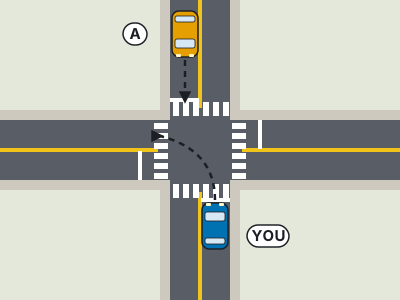
13. When turning left at an intersection, which traffic must you yield to?
- Only vehicles behind your car
- No one if your turn signal is on
- Only vehicles traveling in the same direction
- Vehicles and bicycles approaching from the opposite direction
Show answer
Vehicles and bicycles approaching from the opposite direction. A left turn crosses the path of traffic coming from the opposite direction, so yield to those vehicles and bicycles and complete the movement only when the gap is safe. A signal communicates intent but does not grant priority. Traffic behind you is not the principal conflict created by the turn, and same-direction vehicles are not the opposing stream named in this rule. Slow before entering, keep the wheels controlled, and check the crosswalk for pedestrians as well.
14. How must a driver treat a flashing red traffic signal in Florida?
- Like a stop sign, stopping and proceeding when safe
- Like a yellow light, stopping only if traffic appears
- Like a railroad gate, turning around immediately
- Like a green light, continuing without slowing
Show answer
Like a stop sign, stopping and proceeding when safe. Florida says a flashing red light is used at dangerous intersections and must be treated like a stop sign. The driver must stop, then proceed when it is safe. Continuing without stopping ignores the red indication, and the yellow-light option understates the required action. Look for cross traffic and pedestrians after the full stop, just as you would at a posted STOP sign.
15. Which enclosed roadway is it against the law to park in?
- Parking garages
- Marked lots
- Tunnels
- Park-and-ride lots
Show answer
Tunnels. Tunnels are the most unforgiving place to leave a car: dark, narrow, with no shoulder and traffic that cannot swerve around an obstacle. Florida bans parking in tunnels outright, alongside bridges and overpasses. Garages, marked lots, and rest areas are the lawful places to stop. If a vehicle fails inside a tunnel, the priorities are warning traffic with flashers, getting the car as far right as it will roll, and getting people out and away from the travel lanes.
16. Which structure is it against the law to park on?
- Bridges
- Parking garages
- Marked lots
- Rest areas
Show answer
Bridges. Bridges leave no escape room: narrow shoulders, high rails, and nowhere to pull clear make a parked car a deadly fixed obstacle in fast traffic. Florida therefore makes parking on bridges against the law, along with overpasses and tunnels that share the same trapped geometry. Garages, marked lots, and rest areas are built to hold stopped cars safely away from traffic. If a breakdown forces a stop on a bridge, get as far right as possible, signal distress, and leave the danger zone on foot.
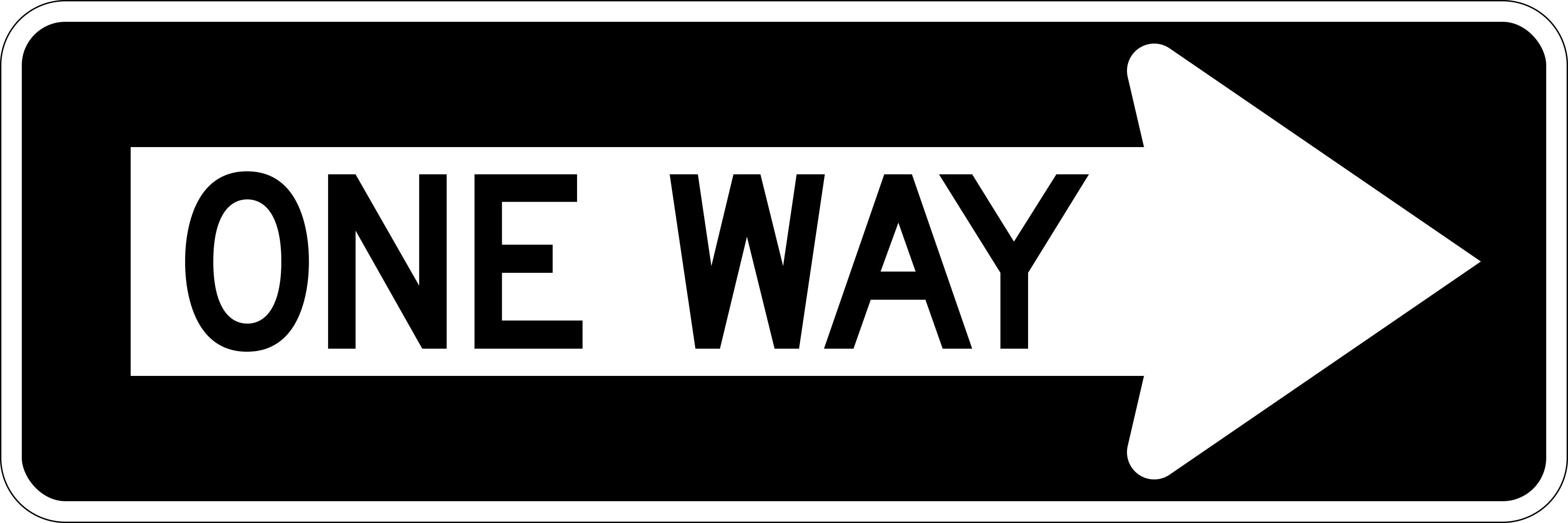
17. What direction must traffic follow when this ONE WAY sign is posted?
- Either direction, provided the driver stays in the right lane
- The opposite direction during off-peak hours
- Only the direction shown by the arrow
- Only buses may follow the arrow
Show answer
Only the direction shown by the arrow. A ONE WAY sign limits travel to the direction indicated by its arrow. It is a legal direction control, so a driver cannot reverse direction simply because traffic is light or because the opposite lane appears open. The right-lane choice confuses lane position with roadway direction, and the bus choice invents a vehicle exception. Before entering, compare the arrow with the intended route. If the route does not match, continue to a legal place to turn around rather than entering against traffic.
18. How much clearance must you give a bicyclist?
- One foot is enough
- At least three feet, with caution and slow speed
- Six inches at low speed
- No clearance is required
Show answer
At least three feet, with caution and slow speed. Bicycles get a statutory bubble: Florida law requires at least three feet of clearance when driving next to or passing a bicyclist, plus caution and slow speed. A foot or a few inches leaves no room for wobbles, gusts, pothole dodges, or open car doors. On two-lane roads the handbook adds technique: pass a bike as you would a slow-moving vehicle, and only when safe. Measure the three feet from your mirror to their handlebar, and give more whenever conditions urge it.
19. What emergency sign stands at every rail crossing?
- The blue ENS sign with railroad emergency contacts
- A restaurant guide sign
- A mileage marker
- A speed limit sign
Show answer
The blue ENS sign with railroad emergency contacts. Every highway-rail crossing posts its lifeline: a blue Emergency Notification System sign carrying the critical contact information to reach the responsible railroad when something blocks the tracks or a problem strikes the crossing. Food, mileage, and speed signs serve other needs and summon no one. In a stall or a stuck gate, the ENS number reaches the dispatcher who can stop the trains, making it the call to make alongside 911 and *FHP.
20. On a multi-lane Florida roadway, what must you do when approaching a stationary authorized vehicle displaying warning lights?
- Vacate the lane closest to it, or slow 20 MPH below the posted limit if moving over is unsafe
- Stop in the lane immediately beside it
- Pass without changing lanes if your speed is already safe
- Move into the closest lane and maintain the posted limit
Show answer
Vacate the lane closest to it, or slow 20 MPH below the posted limit if moving over is unsafe. Florida's Move Over rule requires a driver on a multi-lane roadway to vacate the lane closest to the stationary covered vehicle. If changing lanes cannot be done safely, the alternative is to slow to 20 MPH below the posted speed limit. Stopping beside the vehicle is not the stated response, and passing at the existing limit ignores the protection required for people working or stranded at the roadside.
QualitySpace is expanding to Florida
We are a California-based independent insurance brokerage working on licensing in more states. We cannot help with Florida insurance yet. Leave your email and we will let you know when we can.
Every question is written from the official Official Florida Driver License Handbook. Need paper? Printable FL practice test with answer key.
Last verified 2026-09-07. How we check every question · Study all 500 as flashcards
Frequently asked questions
How many questions are on this Florida practice test?
This fixed set has 20 questions. It is test 23 of 25 from the 500 question Florida bank. The real FL exam asks 50 questions and you need 40 correct.
What is the passing score for the real Florida test?
40 out of 50 (80 percent) That figure comes from the official Florida source cited on the DMV facts page.
How does this fixed test relate to the full Florida bank?
Each numbered test is a fixed set of 20 questions in a fixed order, so you can retake the same test later and compare. Every test mixes road signs and the other topics in about the same proportion as the full bank. Tests 1 to 25 together cover every question in the Florida bank once. The full practice page mixes the whole bank at random.
Last verified 2026-09-07. See the Florida DMV facts page for sourced state details.