
Test 5 of 25 · 20 questions · Free 2026
FL Permit Practice Test 5
Jump to the test ↓A fixed 20 question set from the Florida bank with answers and plain English explanations. The real FL exam is 50 questions, 80 percent to pass; take the full length version on the main practice page.
Question 1 of 20 · 0 right so far
All 20 questions in test 5
Every question below comes from the Florida question bank on this page. Open a question to see the correct answer and the explanation. Nothing here is hidden behind a signup.
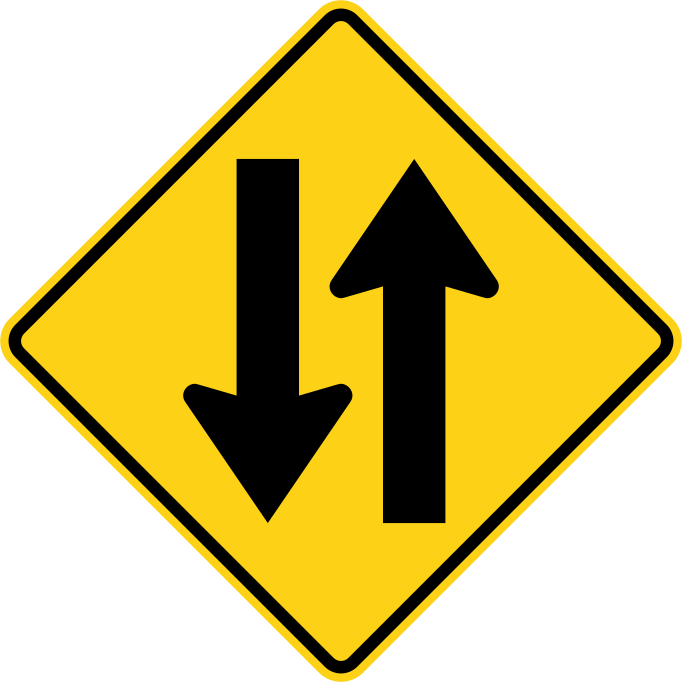
1. What should a driver expect after seeing the two-way traffic warning sign?
- The divided highway will continue with no opposing traffic
- The roadway will change to two-way traffic with oncoming vehicles
- All passing will be allowed in both directions
- The next lane will be reserved for emergency vehicles
Show answer
The roadway will change to two-way traffic with oncoming vehicles. This warning marks a change from one-way or separated travel to a roadway where vehicles approach from the opposite direction. A driver should reduce speed, keep right, and scan ahead for oncoming traffic before considering any maneuver. The divided-highway choice reverses the sign's message because separation is ending or absent. The passing choice is unsafe because the warning says nothing about permission to pass, and the emergency-lane choice invents a restriction unrelated to the symbol. Think of the opposing arrows as a preview of traffic coming toward you in the same roadway.
2. What does defensive driving mean?
- Alter driving to weather, feelings, and others' actions
- Drive the same way always
- Copy the fastest driver
- Ignore conditions
Show answer
Alter driving to weather, feelings, and others' actions. Defensive driving is active adaptation: use safe strategies to prevent crashes by altering your driving to fit the weather conditions, the way you feel, and the actions of other motorists, bicyclists, and pedestrians. Fixed-style, copycat, and ignore-it driving each surrender the adjustments that prevent collisions. Scan for danger, anticipate the aggressive lane-changer behind you, and guard intersections above all. The defensive driver assumes everyone else may err and keeps an escape ready.
Study this in the handbook: Move Over Law and emergency vehicles
3. From which side must hand signals be given?
- From the right side
- Through the sunroof
- With your feet
- From the left side
Show answer
From the left side. Hand signals speak from the driver's window: they must be given from the left side of the vehicle, where following and oncoming drivers can see the arm. Right-side signals hide behind the car, sunroof and foot signals exist nowhere in law. The left-side rule holds for stops, turns, and slow-downs alike whenever the electric lamps fail or the vehicle lacks them. Bicyclists get the one exception, extending the right arm horizontally for a right turn.
Study this in the handbook: Passing, turning and parking
4. How should you secure a car you are leaving parked?
- Leave it in neutral with no brake
- Idle in drive with the door open
- Set the brake and shift to Park or Reverse
- Turn the wheels uphill always
Show answer
Set the brake and shift to Park or Reverse. A parked car must be immobilized twice: set the parking brake and shift to Park in an automatic or Reverse in a manual. The brake holds the wheels while the gear locks the drivetrain, so a failure of one still leaves the other. Neutral with no brake lets the car roll, idling in drive invites a lurch into traffic, and wheel direction depends on the grade rather than a fixed uphill rule. Finish the sequence by turning off the engine, locking the vehicle, and taking the keys as Florida law requires.
Study this in the handbook: Passing, turning and parking
5. What must school districts do where speed detection systems operate?
- They may hide all cameras
- They must post signage warning where detection is used
- They must close the school zone
- They must double the speed limit
Show answer
They must post signage warning where detection is used. The school-zone speed camera law balances enforcement with fair warning: school districts using the detection technology must post signage telling drivers where speed detection systems are operating. The signs give every motorist a chance to comply before the camera does its work, which is the point since the goal is slower zones, not ticket revenue. Hidden enforcement, zone closures, and limit changes are not part of the law. When you see the warning signs, treat the zone as actively monitored and hold the school-zone speed.
6. In a Florida multi-lane roundabout, what must drivers do before entering or exiting?
- Stop inside the circle before every exit
- Change lanes after entering to choose a turn
- Sound the horn instead of yielding
- Yield to pedestrians in the crosswalks
Show answer
Yield to pedestrians in the crosswalks. Multi-lane roundabouts keep the ordinary roundabout rules and add a pedestrian requirement at the entry and exit points. Drivers must yield to pedestrians in the crosswalks before entering or leaving. Stopping inside the circle is prohibited, and changing lanes there is also prohibited. A horn does not replace a required yield. Choose the proper lane before entering, maintain a controlled path through the circle, and watch the crosswalk at both ends of the maneuver.
Study this in the handbook: Right of way at intersections and roundabouts
7. As a motorist, may you share a lane with a motorcycle?
- No, the rider owns the whole lane
- Yes, always
- Yes, on wide lanes
- Yes, at low speed only
Show answer
No, the rider owns the whole lane. Lane sharing with motorcycles is forbidden: you must not attempt to share a lane with a motorcycle, and the motorcyclist is entitled to the entire lane. A bike needs the full lane width to dodge potholes, debris, and gusts, and a car squeezing alongside leaves no escape room. Wide lanes and low speeds create no exception. Pass a motorcycle only with a full lane change, generous clearance, and a signal, treating the single headlight as a full vehicle.
Study this in the handbook: Bicycles, trucks, motorcycles and pedestrians
8. What does an End School Zone sign mark?
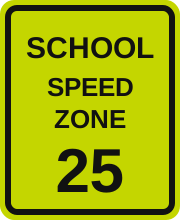
- The reduced-speed school zone ends here
- The school zone begins
- Stop for children here
- The speed limit drops further
Show answer
The reduced-speed school zone ends here. School zones release as clearly as they bind: the End School Zone sign marks the end of the reduced-speed zone, and normal limits resume past it. Begin readings confuse it with the zone's start, child-stop readings invent a halt the sign never orders, and further-drop readings invert the release. The matching Begin sign, flashing lights, and posted times activate the twenty-mile school limit; the End sign stands it down. Resume lawful speed only after passing the marker.
9. What do ramp signals do?
- They decorate the roadway
- They replace all signs
- They mark parking spaces
- They meter expressway entry; wait for green
Show answer
They meter expressway entry; wait for green. Ramp meters pace the merge: ramp signals control the rate of vehicles entering an expressway, alternating between red and green, and drivers must wait for the green signal before entering. Decoration, sign-replacement, and parking readings miss the metering mission that prevents mainline breakdown. One car per green keeps expressway flow smooth at rush hour. Treat the ramp light like any red: stop, wait, and launch only on green into an available gap.
Study this in the handbook: Traffic signals, pedestrian signals and railroad crossings
10. What does an advisory speed sign show?
- The fastest safe speed for the coming curve
- The minimum curve speed
- The fine for curving
- The curve's length
Show answer
The fastest safe speed for the coming curve. Advisory speeds recommend survival pace: the sign shows the fastest safe speed for the curve ahead, usable with any warning sign. Minimum, fine, and length readings miss guidance tuned to the bend's radius and banking. Advisory figures are not enforceable limits, but exceeding them forfeits the safety margin engineers measured for the curve. Slow to the advisory before the bend, hold your lane through it, and resume only on the straight.
11. How many points within 12 months bring a 30 day suspension of a Florida driver license?
- 18 points
- 6 points
- 12 points
- 24 points
Show answer
12 points. Florida's point system suspends a license at three thresholds: 12 points within a 12 month period brings a 30 day suspension, 18 points within 18 months brings a 3 month suspension, and 24 points within 36 months brings a 1 year suspension. Points for out of state or federal court convictions count the same. Six points matters only for drivers under 18, who are automatically restricted to business purposes at 6 points in 12 months.
Study this in the handbook: Points, suspensions and school buses
12. Without a work or adult-passenger exception, during what hours may a 16-year-old Florida licensed driver drive?
- 5 a.m. to 1 a.m.
- 7 a.m. to 10 p.m.
- 6 a.m. to 11 p.m.
- Any time after the learner's license is held for 12 months
Show answer
6 a.m. to 11 p.m.. A 16-year-old Florida licensed driver may not drive between 11 p.m. and 6 a.m. unless traveling to or from work or accompanied by a licensed driver age 21 or older. Therefore the ordinary unsupervised window is 6 a.m. through 11 p.m. The 5 a.m. to 1 a.m. range belongs to the 17-year-old rule, while the 7 a.m. to 10 p.m. option is narrower than the handbook restriction. Holding a learner's license does not erase these clock limits.
Study this in the handbook: Learner's license, practice hours and teen curfews
13. May you drive across a highway median?
- Yes, to make U-turns
- No, never
- Yes, when traffic is light
- Yes, for emergency vehicles only
Show answer
No, never. The median divider is inviolable for ordinary drivers: never drive across the median. Crossing it to make a U-turn, dodge congestion, or reach the other side pits the car against opposing high-speed traffic with no protection. Light traffic does not grant permission, and even emergency vehicles use crossovers and judgment rather than a blanket right. Official median openings and intersections are the lawful ways across; everywhere else the median must stay unbroken.
14. What should a driver do first after a tire blowout?
- Turn the wheel sharply toward traffic
- Accelerate to keep the tire rotating
- Take the foot off the gas and avoid the brakes
- Stop in the travel lane and exit immediately
Show answer
Take the foot off the gas and avoid the brakes. A blowout can make the vehicle unstable, so the first response is to stop adding power and preserve steering control. Florida instructs the driver to take the foot off the gas and not use the brakes at that stage. A sharp turn toward traffic creates a new collision path, and acceleration adds force when control is already compromised. Stopping in the travel lane exposes the vehicle to passing traffic. Keep the car pointed safely, slow gradually, brake softly only under control, and pull fully off the pavement.
Study this in the handbook: After a crash and vehicle emergencies
15. If a train is coming while a car is stalled at a railroad crossing, which direction should occupants run?
- Straight along the tracks away from the train
- At a 90-degree angle toward the nearest road
- At a 45-degree angle away from the tracks, toward the train
- Back toward the stalled vehicle
Show answer
At a 45-degree angle away from the tracks, toward the train. When a train is coming, occupants should run away from the tracks at a 45-degree angle, moving in the direction toward the train. That path reduces the chance of being struck by the stalled vehicle or debris thrown by the collision. Running straight along the tracks can keep a person in the train’s path, while a right-angle route and returning toward the car do not follow the handbook’s stated escape direction. Leave the car immediately, move decisively to safety, and call 911 or FHP after reaching a safe location.
Study this in the handbook: After a crash and vehicle emergencies
16. How many points does reckless driving carry in Florida?
- 2 points
- 3 points
- 6 points
- 4 points
Show answer
4 points. Reckless driving carries 4 points in Florida's violation table, the same value as running a signal or passing a stopped school bus. The 4-point figure places recklessness well above minor speeding at 3 points but below crash outcomes at 6. Because points stack toward suspension thresholds, a reckless driving conviction plus any other moving violation can quickly endanger the license. The handbook also notes that forfeiting bail to dodge a reckless driving conviction counts the same as being convicted.
17. What is the minimum revocation for a third DUI conviction?
- 30 days
- Minimum 180 days
- 3 years minimum
- No revocation applies
Show answer
Minimum 180 days. Like the first two convictions, the third costs the license for a minimum of 180 days. The revocation floor holds steady across all three tiers even as fines, jail, school, and interlock escalate around it. Thirty days understates every tier, three years overstates the floor, and no-revocation readings ignore a certain penalty. Minimum means minimum: courts and the department can extend the loss, and reinstatement demands fees, courses, and proof of compliance.
Study this in the handbook: DUI, implied consent and zero tolerance
18. How many hours of DUI school follow a third DUI conviction?
- 21 hours
- 12 hours
- 4 hours
- No school is required
Show answer
21 hours. Third-time offenders repeat the twenty-one-hour DUI school level set for the second conviction, nearly double the twelve hours of the first. The extended curriculum confronts drivers whose earlier courses failed, pairing classroom work with the mandatory addiction-treatment evaluation. Twelve hours belongs to the first tier, four matches nothing, and no-school readings skip a certain penalty. By the third conviction the school is less education than intervention, documenting the habit for the court's next decision.
Study this in the handbook: DUI, implied consent and zero tolerance
19. What should far-lane drivers do when others move over for an emergency?
- Speed up to block gaps
- Make room for vehicles moving over
- Honk movers back
- Tailgate the movers
Show answer
Make room for vehicles moving over. Drivers already in the far lane share Move Over duty: be prepared to allow vehicles about to move over into your lane. The vacating driver needs a gap, and blocking, honking, or tailgating them shut steals it at the critical moment. Easing off and opening space costs a second and completes the lane-wide cooperation the law envisions. Everyone shifts one lane of generosity outward, and the roadside workers get their buffer without a sideswipe.
Study this in the handbook: Passing, turning and parking
20. What is your legal duty after a crash with injury or damage?
- Give information and render aid
- Leave immediately
- Move the injured first
- Call your insurer first
Show answer
Give information and render aid. Crash involvement creates a legal duty pair: give information and render aid to anyone affected, staying calm throughout. Leaving the scene is a crime with felony tiers for injury and death, moving the injured risks spinal damage, and insurer calls wait behind human needs. Information means the full exchange of vehicle, witness, and driver details; aid means immediate help for the hurt within your ability. The duty binds every involved driver in any crash with death, injury, or property damage.
Study this in the handbook: After a crash and vehicle emergencies
QualitySpace is expanding to Florida
We are a California-based independent insurance brokerage working on licensing in more states. We cannot help with Florida insurance yet. Leave your email and we will let you know when we can.
Every question is written from the official Official Florida Driver License Handbook. Need paper? Printable FL practice test with answer key.
Last verified 2026-10-05. How we check every question · Study all 500 as flashcards
Frequently asked questions
How many questions are on this Florida practice test?
This fixed set has 20 questions. It is test 5 of 25 from the 500 question Florida bank. The real FL exam asks 50 questions and you need 40 correct.
What is the passing score for the real Florida test?
40 out of 50 (80 percent) That figure comes from the official Florida source cited on the DMV facts page.
How does this fixed test relate to the full Florida bank?
Each numbered test is a fixed set of questions in a fixed order, so you can retake the same test later and compare. Every test mixes road signs and the other topics in about the same proportion as the full bank. Tests 1 to 25 together cover every question in the Florida bank once. The full practice page mixes the whole bank at random.
Last verified 2026-10-05. See the Florida DMV facts page for sourced state details.