
Test 10 of 25 · 20 questions · Free 2026
FL Permit Practice Test 10
Jump to the test ↓A fixed 20 question set from the Florida bank with answers and plain English explanations. The real FL exam is 50 questions, 80 percent to pass; take the full length version on the main practice page.
Question 1 of 20 · 0 right so far
All 20 questions in test 10
Every question below comes from the Florida question bank on this page. Open a question to see the correct answer and the explanation. Nothing here is hidden behind a signup.
1. What should older drivers avoid?
- No sunglasses in dim light; avoid dusk, bad weather, rush, fast highways
- Sunglasses always
- Night driving only
- Rush hour preferred
Show answer
No sunglasses in dim light; avoid dusk, bad weather, rush, fast highways. Older eyes choose their battles: avoid sunglasses in dim or dark conditions, and avoid risky times including dusk, dawn, and nighttime, bad weather, rush-hour traffic, and fast-paced highways. Always-sunglasses darken already dim scenes, night-only inverts the safe schedule, and rush-hour preference seeks the densest conflicts. Daylight off-peak trips on familiar slower roads keep aging drivers mobile longest, backed by the Safe Mobility for Life program's resources.
2. What fine applies when passing a stopped school bus results in serious injury or death?
- No fine if the bus is on a divided highway
- A $265 fine
- A $465 fine
- A $1,500 fine
Show answer
A $1,500 fine. Passing a stopped school bus that results in serious injury or death carries a $1,500 fine under the Florida handbook. The $265 amount is the minimum fine listed for an ordinary school bus passing violation, while $465 applies when passing on the side where children enter and exit. The divided-highway choice does not remove the serious-injury penalty. Treat a stopped bus with its signal displayed as a complete stop requirement, and never resume until the bus has withdrawn its warning or the roadway is clearly safe under the applicable rule.
Study this in the handbook: Insurance, registration and vehicle equipment
3. What duty does every driver who obtains a license have?
- Avoid all roads with pedestrians
- Drive only during daylight hours
- Yield every time another vehicle signals
- Drive safely to keep the license
Show answer
Drive safely to keep the license. Florida places an ongoing safety duty on every licensed driver. Driving safely is not limited to the skills test or the first year after licensing. Daylight restrictions do not apply to every driver, and a signal from another vehicle does not automatically decide every yield situation. Avoiding roads with pedestrians is impossible and would not replace careful driving. Keep control, follow traffic laws, watch for changing conditions, and treat the license as authorization paired with responsibility. The practical cue is that safe driving is expected whenever the license is being used.
4. What does a red X lane control signal mean to a Florida driver?
- Never drive in a lane under the red X
- The lane is about to open
- Slow down in that lane
- The lane is closed to trucks only
Show answer
Never drive in a lane under the red X. Lane control signals hang over lanes where the flow of traffic changes during the day, at toll booths, and where lanes open and close. A red X means never drive in the lane under it. A yellow X warns that the lane signal is about to turn red, and a green arrow means you may use the lane while still obeying all other signs and signals. The signal applies to every vehicle, not only trucks.
Study this in the handbook: Traffic signals, pedestrian signals and railroad crossings
5. What information do green guide signs provide?
- Construction work-zone warnings
- Rules that set speed limits
- Directions and distances
- Locations of disabled parking spaces
Show answer
Directions and distances. Green guide signs provide directional information, including directions and distances. They help a driver understand where a route leads and how far away a destination or point may be. Orange signs warn about construction and maintenance, while white and black signs regulate traffic and set limits. Blue can provide driver guidance and identify disabled parking spaces, so it is not the color described here. Read the route information early, confirm your intended direction, and make lane decisions before the last moment.
Study this in the handbook: Pavement markings
6. When can you be charged with DUI in Florida?
- Only while moving
- While driving or in physical control
- Only on highways
- Only after a crash
Show answer
While driving or in physical control. DUI reaches beyond rolling wheels: you can be charged while driving or in physical control of a motor vehicle under the influence. Sitting behind the wheel with the engine running, or even positioned to drive, counts as control even if the car never moves. The rule closes the parked-but-ready loophole that impaired drivers might claim. Highways, crashes, and motion are not required elements. If you are impaired, stay out of the driver's seat entirely and let a sober driver, rideshare, or transit get you home.
Study this in the handbook: Learner's license, practice hours and teen curfews
7. If a crash cannot be avoided, which impact is preferable to a collision with an oncoming vehicle?
- Swerving into opposing traffic
- Stopping in your lane and waiting for the impact
- Hitting a stationary object
- Turning across a pedestrian path
Show answer
Hitting a stationary object. Florida lists several choices for when a crash is unavoidable. It says it is better to hit something that is not moving instead of a vehicle moving toward you, better to swerve off the road than into oncoming traffic, and better to hit a soft object like a hedge than a solid one like a tree. Swerving into opposing traffic is the outcome the handbook ranks worst, and simply stopping to wait for the impact or turning across a pedestrian path is not among its recommended choices. Stay calm, keep control, and pick the least harmful path.
Study this in the handbook: Move Over Law and emergency vehicles
8. Where should a driver stop for a Florida STOP sign?
- After entering the crosswalk
- Before the stop line, or before the crosswalk if there is no line
- Only after crossing the intersection
- At any point beyond the sign with a clear view
Show answer
Before the stop line, or before the crosswalk if there is no line. A Florida STOP sign requires a complete halt before the stop line. If no stop line exists, stop before the crosswalk or, if there is no crosswalk, at a point near the intersecting roadway that gives a clear view of approaching traffic. Stopping after entering the crosswalk can endanger pedestrians, and waiting beyond the intersection is too late. Look for the marked stopping point before rolling forward.
Study this in the handbook: Road sign colors and regulatory signs
9. Above what speeding threshold can a Florida driver NOT elect a basic driver improvement course in lieu of points?
- 10 MPH over
- More than 30 MPH over
- 5 MPH over
- Any speeding at all
Show answer
More than 30 MPH over. Florida normally lets a cited driver elect a basic driver improvement course in lieu of points, with an 18 percent reduction of the civil penalty. But that option closes for serious speeding: a driver charged with exceeding the limit by more than 30 MPH may not elect the course. The points then land on the record and count toward suspension thresholds. The cutoff separates minor lapses, where education can substitute for punishment, from dangerous speeding that must leave a mark on the driving history.
Study this in the handbook: Learner's license, practice hours and teen curfews
10. What follows 24 points within 36 months?
- 30-day suspension
- 3-month suspension
- 1-year suspension
- Lifetime revocation
Show answer
1-year suspension. Twenty-four points in three years costs a full year: the top adult point threshold brings a one-year suspension. Thirty-day and three-month terms belong to the twelve- and eighteen-point tiers below, while lifetime revocation exceeds the point table into habitual-offender territory. Federal and out-of-state convictions pile onto the same total. The only exit runs through time, courses, fees, and a point-free record afterward.
Study this in the handbook: Points, suspensions and school buses
11. What does a steady red light require?
- Slow and roll through
- Stop at the line and wait for green
- Stop then go when clear
- Honk and proceed
Show answer
Stop at the line and wait for green. Red means stop and stay: come to a complete stop at the stop line and remain stopped until the light turns green. Rolling through, treating red as a yield, or honking past all violate the plain command. Limited turns after stopping are the only movement red allows: right on red where permitted, or left from one-way to one-way, each only after yielding to pedestrians and oncoming traffic. Running the red is separately called out as illegal and extremely dangerous.
Study this in the handbook: Traffic signals, pedestrian signals and railroad crossings
12. A non-resident takes a job in Florida. How long does the person have to get a Florida driver license?
- 30 days
- 10 days
- 90 days
- Six months
Show answer
30 days. A non-resident who takes a job, engages in a trade or profession, or enrolls a child in a Florida public school must get a Florida driver license within 30 days to keep driving. Ten days is too short. Ninety days is the vehicle insurance trigger, and six months is part of the definition of a resident, so both belong to other rules. Migrant and seasonal farm workers are exempt from this requirement.
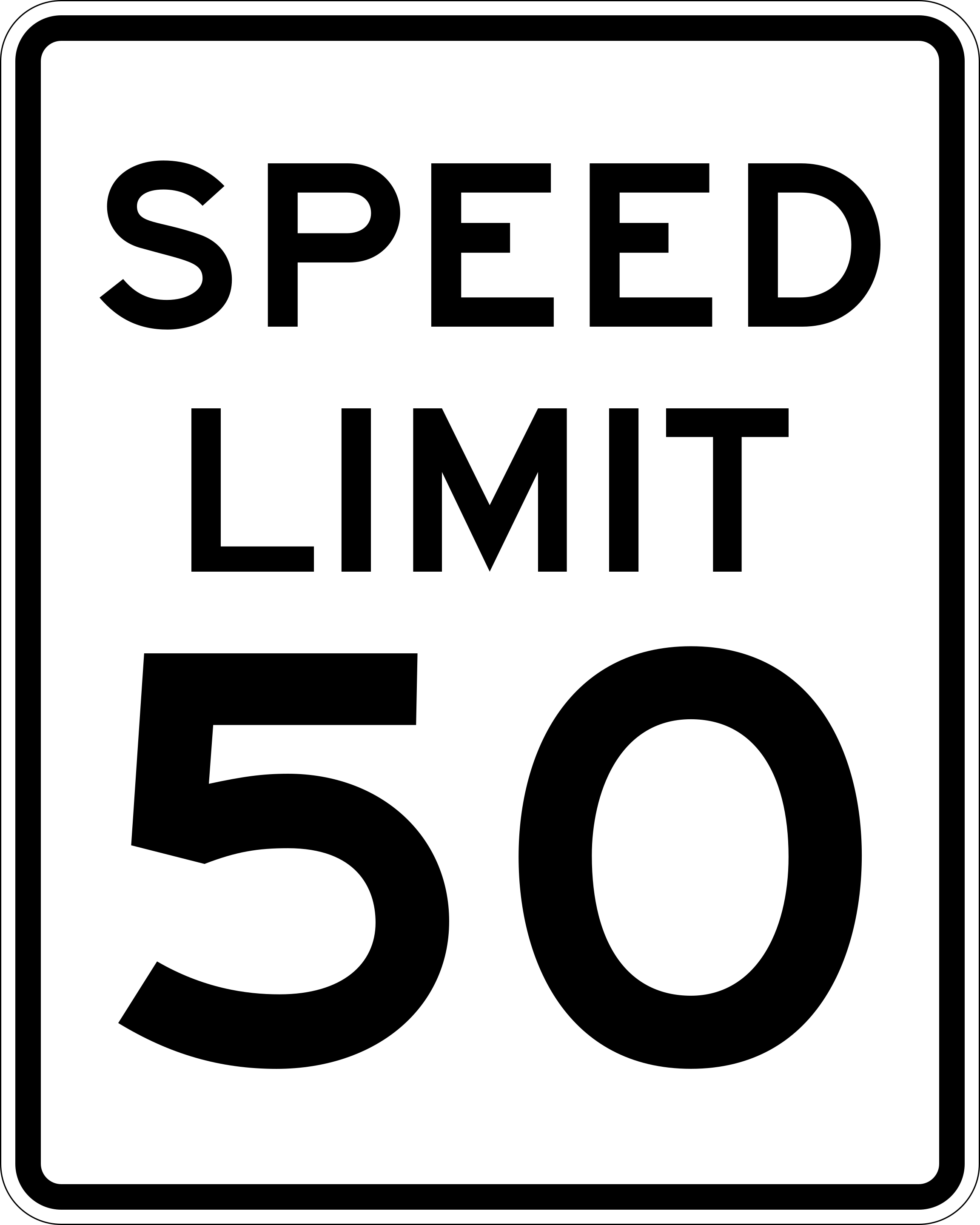
13. What does a posted Speed Limit sign tell a Florida driver?
- The number is only a suggested speed for clear weather
- The driver may exceed it while passing another vehicle
- The sign applies only to commercial vehicles
- The vehicle must not exceed the posted speed in that area
Show answer
The vehicle must not exceed the posted speed in that area. A Speed Limit sign gives the maximum lawful speed for the area. It is not merely advice for favorable weather, and passing does not create permission to exceed it. The commercial-vehicle choice wrongly narrows a rule that applies to drivers generally. Road, weather, visibility, and traffic may require an even lower speed, but none of those conditions raise the posted maximum. Read the number as a ceiling, then reduce speed whenever conditions make that ceiling unsafe.
Study this in the handbook: Road sign colors and regulatory signs
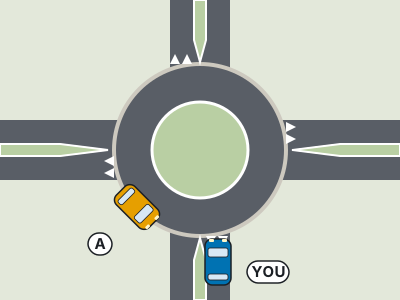
14. When entering a Florida roundabout, whom must the entering driver yield to?
- Vehicles waiting behind the entrance
- The fastest approaching vehicle outside
- Traffic already in the roundabout
- No traffic, because entering vehicles have priority
Show answer
Traffic already in the roundabout. Traffic already circulating has priority over a driver approaching the roundabout entrance. The entering driver must slow, assess the circle, and wait for a safe opening. Vehicles behind the entrance are not the controlling traffic, and speed does not create a right of way for a vehicle outside the circle. Entering vehicles never hold priority over circulating traffic; the handbook lets a driver enter without yielding only when there is no traffic in the roundabout. A simple visual cue is to yield to the circulating lane before joining its one-way flow.
Study this in the handbook: Right of way at intersections and roundabouts
15. When may you shut off the engine for a stuck pedal?
- Shut it off immediately
- Only if neutral and braking fail; shutdown kills steering
- Never under any circumstance
- Only at high speed
Show answer
Only if neutral and braking fail; shutdown kills steering. The ignition is the last resort, not the first: do not shut off the engine unless taking your foot off and shifting to neutral fail to slow the vehicle, because shutdown kills the ability to steer the car. Immediate shutdowns trade a fast car for an unsteerable one, never-ever readings remove the last resort, and high-speed-only gates misunderstand the rule. Neutral first, measured braking second, steering throughout, and the key only when nothing else answers.
Study this in the handbook: After a crash and vehicle emergencies
16. What must you do for sidewalk pedestrians at alleys and driveways?
- Stop for pedestrians on the sidewalk
- Roll through slowly
- Honk and proceed
- Yield only to cars
Show answer
Stop for pedestrians on the sidewalk. Sidewalks keep their protection where driveways cross them: when entering or leaving an alley, driveway, or private road, you must stop for pedestrians on the sidewalk. Walkers on the path have no reason to expect a car cutting across, and children and dog-walkers are hard to see over hedges and fences. Rolling through, honking through, or watching only for cars each abandons the pedestrian check. Stop before the sidewalk, scan both directions on foot traffic, then enter the roadway only when clear.
Study this in the handbook: Right of way at intersections and roundabouts
17. What is the first-DUI jail maximum with BAL .15+ or a minor aboard?
- Still 6 months
- Still 30 days
- No jail at all
- Not more than 9 months
Show answer
Not more than 9 months. High BAL and young passengers aggravate the first offense: with a BAL of .15 or higher or a minor in the vehicle, first-DUI imprisonment rises to not more than nine months. The enhancement adds three months to the six-month base, mirroring the fine doubling to $1,000-$2,000 and the mandatory six-month interlock. Unchanged, trivial, and zero readings all miss the aggravator the legislature wrote for the most dangerous first offenses. Blowing .15 or endangering a child converts leniency into real time.
Study this in the handbook: DUI, implied consent and zero tolerance
18. Where should your car sit when parking on a public road?
- Move as far away from traffic as possible
- Park in the travel lane
- Park facing oncoming traffic
- Park with wheels on the center line
Show answer
Move as far away from traffic as possible. The first rule of roadside parking is separation: when parking on a public road, move as far away from traffic as possible. A car hugging the travel lane narrows the road and invites sideswipes, especially at night or in bad weather. Parking in the lane, facing the wrong way, or straddling the center line all multiply the hazard and violate the parking rules. Where a shoulder exists, pull fully onto it; then set the brake, secure the transmission, kill the engine, lock up, and take the keys.
Study this in the handbook: Passing, turning and parking
19. When may you stop on highway pavement, shoulders, or ramps?
- Only in an emergency
- Whenever traffic is slow
- To check a map
- To answer the phone
Show answer
Only in an emergency. Highway pavement, shoulders, and connecting ramps must stay clear for moving traffic: never stop on them except in an emergency. Slow traffic, map checks, and phone calls are not emergencies; the next exit or rest area serves those needs. A stopped car on fast pavement becomes a fixed obstacle that approaching drivers may not recognize in time. Genuine breakdowns must move completely off the pavement, and even then the stay is strictly time-limited.
20. At 50 MPH on dry pavement with good brakes, about how far does braking alone take?
- About 50 feet
- About 158 feet
- About 250 feet
- About 100 feet
Show answer
About 158 feet. Braking distance is the pavement a vehicle covers while the brakes are actually engaged. Under those ideal textbook conditions, Florida's handbook puts that figure at about 158 feet, and that comes on top of the 55 feet traveled during reaction time. Wet roads, worn tires, weak brakes, and heavier loads all stretch the number further. The combined reaction-plus-braking total is the real stopping distance, which is why high speeds and tailgating together are so deadly.
Study this in the handbook: Following distance, stopping and speed limits
QualitySpace is expanding to Florida
We are a California-based independent insurance brokerage working on licensing in more states. We cannot help with Florida insurance yet. Leave your email and we will let you know when we can.
Every question is written from the official Official Florida Driver License Handbook. Need paper? Printable FL practice test with answer key.
Last verified 2026-10-05. How we check every question · Study all 500 as flashcards
Frequently asked questions
How many questions are on this Florida practice test?
This fixed set has 20 questions. It is test 10 of 25 from the 500 question Florida bank. The real FL exam asks 50 questions and you need 40 correct.
What is the passing score for the real Florida test?
40 out of 50 (80 percent) That figure comes from the official Florida source cited on the DMV facts page.
How does this fixed test relate to the full Florida bank?
Each numbered test is a fixed set of questions in a fixed order, so you can retake the same test later and compare. Every test mixes road signs and the other topics in about the same proportion as the full bank. Tests 1 to 25 together cover every question in the Florida bank once. The full practice page mixes the whole bank at random.
Last verified 2026-10-05. See the Florida DMV facts page for sourced state details.