
Test 13 of 25 · 20 questions · Free 2026
FL Permit Practice Test 13
Jump to the test ↓A fixed 20 question set from the Florida bank with answers and plain English explanations. The real FL exam is 50 questions, 80 percent to pass; take the full length version on the main practice page.
Question 1 of 20 · 0 right so far
All 20 questions in test 13
Every question below comes from the Florida question bank on this page. Open a question to see the correct answer and the explanation. Nothing here is hidden behind a signup.
1. Where must you not stop at a railroad crossing?
- Never stop on the tracks or within 15 feet
- Stop on the tracks to look
- Stop 5 feet from the rails
- Park beside the crossing
Show answer
Never stop on the tracks or within 15 feet. Trains overhang the rails and cannot swerve: never stop on the tracks or within 15 feet of the crossing. The 15-foot envelope keeps the car clear of the train's swept path and leaves room to escape if traffic ahead halts. Stopping on the rails to look, creeping to five feet, or parking beside the crossing all put the vehicle inside the strike zone. In heavy traffic, wait before the crossing until room exists for the whole car on the far side.
2. What information must drivers exchange after a crash?
- First names only
- Full vehicle, witness, and driver details
- Nothing until court
- Insurance cards only
Show answer
Full vehicle, witness, and driver details. The crash exchange is comprehensive: swap vehicle, witness, and driver information including names, addresses, phone numbers, plate numbers, driver licenses, and insurance. First-names-only withholds the identifiers claims and reports need, courtroom-only silence violates the immediate duty, and insurance-alone omits the people and vehicles involved. Collect witnesses too, since neutral accounts decide disputed claims. Write everything down at the scene; memory fades faster than paint dries.
3. Where must tires stay off to protect pedestrians?
- Marked spaces
- Sidewalks
- Marked curbside spaces
- Shoulders
Show answer
Sidewalks. Sidewalks belong to pedestrians, and parking on them is against the law. A car across the walk forces walkers, wheelchairs, and strollers into the street or the landscaping, and it punishes exactly the careful pedestrians who stayed on the path. Marked spaces, rest areas, and shoulders are the lawful alternatives depending on the setting. The rule applies whether the sidewalk runs along a street or crosses a driveway apron: keep tires off the concrete meant for feet.
4. Which conflict point is it against the law to park in?
- Marked lots
- Designated parking lots
- Shoulders
- Intersections
Show answer
Intersections. Parking in an intersection is against the law, and the ban extends 20 feet out from it. An intersection is the busiest conflict point on the road system: signals, turns, crosswalks, and crossing traffic all compete for the same pavement. A parked car there blocks sight lines, covers crosswalks, and can gridlock the entire crossing. Marked lots, rest areas, and shoulders are where stopped cars belong. Keep intersections and their approaches completely clear, whether parking or pausing.
5. How do you measure a four-second following distance?
- Estimate car lengths by eye
- Count one-thousand-one through one-thousand-four
- Time with a stopwatch
- Guess from engine sound
Show answer
Count one-thousand-one through one-thousand-four. Florida teaches a simple roadside clock: when the rear of the vehicle ahead passes a stationary marker such as a sign or light pole, count the seconds to reach the same marker by saying one-thousand-one through one-thousand-four. Each spoken phrase lasts about a second, so reaching the marker before finishing the count means the gap is under four seconds. Car-length guessing fails because car lengths shrink with speed in time terms, and stopwatches and engine sounds are impractical or meaningless while driving.
6. How many hours of community service come with a first DUI conviction in Florida?
- 10 hours
- 120 hours
- 200 hours
- 50 hours
Show answer
50 hours. Florida lists 50 hours of community service for a first DUI conviction, along with probation of up to one year. Ten hours understates it. One hundred twenty hours is the community service required when passing a stopped school bus causes serious injury or death, served in a trauma center or hospital. Two hundred hours is not in the handbook. A first DUI also brings a fine, possible jail, a 12 hour DUI school, and a license revocation.
7. How are East-West and North-South routes numbered on Florida green guide signs?
- East-West routes always have odd numbers, while North-South routes have even numbers
- East-West routes have even numbers, while North-South routes have odd numbers
- Both route directions use only numbers ending in zero
- Route numbers identify the nearest hospital rather than direction
Show answer
East-West routes have even numbers, while North-South routes have odd numbers. Florida's green guide sign information uses route-number patterns as well as destinations and distances. East-West routes have even numbers, while North-South routes have odd numbers. Reversing those patterns gives the wrong directional cue, and route numbers are not limited to numbers ending in zero. They also do not identify the nearest hospital. When planning a route, compare the displayed number with the compass direction and the roadway signs around it. The parity pattern can help confirm whether the route matches the direction you intend to travel.
8. What does a Roundabout Circle warning sign tell a Florida driver to prepare for?

- Stop before the circle in every case
- Slow down and possibly yield to traffic already in the roundabout
- Drive clockwise around the circle
- Speed up to merge ahead of circulating traffic
Show answer
Slow down and possibly yield to traffic already in the roundabout. The Roundabout Circle sign provides advance notice of a roundabout ahead. Prepare to slow down and possibly yield to traffic in the roundabout, because vehicles already circulating have the right of way. Entry is a yield rather than a mandatory stop, and traffic moves counterclockwise. The nearby Divided Highway Ahead and Divided Highway Ends signs warn of a median beginning and of two way traffic returning 350 to 500 feet ahead.
9. How far before a turn must a driver give a turn signal?
- At least 100 feet
- At least 25 feet
- Only after entering the intersection
- Exactly 500 feet
Show answer
At least 100 feet. Florida requires a driver to signal at least 100 feet before making a turn. That advance notice gives nearby drivers, bicyclists, and pedestrians time to understand the planned movement. Signaling only after entering the intersection is too late, while 25 feet does not meet the stated minimum and 500 feet is not the rule. Activate the signal before the final approach, maintain a safe speed, and cancel it after completing the turn so it does not mislead others.
10. What should you do before backing up?
- Just start and go
- Check behind first; kids and objects hide there
- Rely only on mirrors
- Back up fast
Show answer
Check behind first; kids and objects hide there. Backing starts before boarding: check behind the vehicle before you get in, because children and small objects cannot be seen from the driver's seat. Start-and-go skips the walkaround that spots the tricycle, mirror-only backing cannot see directly behind, and fast reversing multiplies every blind risk. Crouch to a child's height during the check; what you can see standing may vanish seated. Then board, belt, arm over the seat, and look straight back through the glass.
11. Who is charged with a safety belt violation when an adult passenger age 18 or older fails to buckle up?
- The vehicle owner, even if absent
- The driver in every case
- The adult passenger
- No one because adult passengers are exempt
Show answer
The adult passenger. For a passenger who is 18 or older, the passenger is charged when that person fails to wear a safety belt required by law. The driver is charged when a passenger under 18 is not properly restrained, so applying that rule to every adult is too broad. Adult passengers are not automatically exempt from buckling. A useful age check is to separate the under-18 responsibility rule from the 18-or-older passenger responsibility rule before deciding who receives the violation.
12. Several vehicles stop at a Florida intersection, arriving at different times. Which vehicle proceeds through first?
- The vehicle turning left
- The vehicle with the larger engine
- The vehicle that arrived first
- The vehicle that sounds its horn first
Show answer
The vehicle that arrived first. Florida says vehicles proceed through an intersection in the order they arrived, so the first vehicle to reach it should move forward first. The left-turn choice does not create priority, and engine size has no bearing on right-of-way. A horn also cannot establish legal precedence. If vehicles arrive at approximately the same time, the handbook directs each driver to yield to the driver on the right, which is a separate tie rule. On a test question, identify arrival order first, then use the right-side rule only when the arrivals are effectively simultaneous.
13. How should you emergency-brake with ABS?
- Press hard, hold, and steer out of danger
- Pump the brakes
- Release and reapply rapidly
- Brake with the left foot only
Show answer
Press hard, hold, and steer out of danger. ABS rewards commitment: press down hard on the brake pedal, hold it, and steer out of danger. The computer modulates pressure per wheel far faster than pumping feet, preserving steering while stopping hardest. Pumping an ABS pedal fights the system and can disengage it, rapid reapplication does the same, and foot choice is irrelevant to the technique. Expect pulsing and noise from the pedal; hold through it and steer where you want to survive.
14. What is the jail maximum for a third DUI conviction?
- Not more than 6 months
- Not more than 9 months
- Not more than 30 days
- Not more than 12 months
Show answer
Not more than 12 months. The third conviction triples the first-offense custody ceiling: imprisonment of not more than twelve months. Six and nine months belong to the first and second tiers, and thirty days matches no DUI jail figure. A year behind bars plus the $2,000-$5,000 fine, revocation, school, evaluation, and two-year interlock make the third sentence a life event, not a traffic ticket. The progression from six to nine to twelve months is the legislature's countdown for drivers who will not stop.
15. What fine follows an aggravated second DUI conviction?
- Not less than $2,000 or more than $4,000
- $500 to $1,000
- $100 to $500
- No fine applies
Show answer
Not less than $2,000 or more than $4,000. The second offense doubles the money and the aggravator doubles it again: with BAL .15 or higher or a minor in the vehicle, the second-DUI fine runs from not less than $2,000 to not more than $4,000. The unenhanced second range is $1,000-$2,000, itself double the first-offense base. First-offense figures, hundred-dollar figures, and no-fine readings all understate a penalty built to hurt repeat offenders. Fines join longer jail, school, revocation, and interlock in the escalating second sentence.
16. What restraint does Florida law require for a child under age 4?
- A safety belt alone
- A booster seat or a safety belt
- No restraint in the back seat
- A safety seat
Show answer
A safety seat. Florida requires children under 4 to ride in a safety seat. Children 4 and 5 may use either a safety seat or a booster seat, so the booster option belongs to the older group. A safety belt alone is allowed for a 4 or 5 year old only in narrow cases, such as when the driver is not immediate family and is transporting the child as a favor or in an emergency, and never for a child under 4. Every passenger under 18 must be restrained, and the driver is charged if one is not.
17. What does a speed limit show in Florida?
- The fastest speed under favorable conditions
- The minimum speed in bad weather
- The average speed of traffic
- A suggested speed for new drivers
Show answer
The fastest speed under favorable conditions. Florida defines speed limits as the fastest speed you may drive under favorable conditions. That definition matters because it makes the posted number a ceiling for good conditions, not a floor or a target for bad ones. When weather, roadway, or traffic conditions deteriorate, the safe and legal choice is to drop below the posted figure. Treating the limit as a minimum, copying the average flow, or dismissing it as a suggestion for novices all misread the rule and invite citations or crashes.
18. A 16-year-old Florida driver is cited for driving during restricted hours. How many points are added?
- 3 points
- 1 point
- 6 points
- No points, because it is a curfew matter
Show answer
3 points. Florida adds 3 points for driving during restricted hours, the same value as using a handheld device in a school crossing, school zone, or work zone. The curfew is enforced through the point system, so no points is wrong. One point does not appear in the handbook's point table, and 6 points is reserved for offenses like leaving the scene with property damage over $50. For a teen, 6 points in 12 months triggers a one year Business Purposes Only restriction, so two curfew tickets would do it.
19. During a left turn at a green light, whom must the driver yield to?
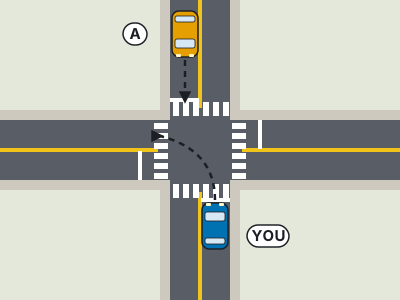
- Only vehicles behind the turning car
- No one, because a green light gives the turning car priority
- Oncoming traffic and pedestrians
- Only large vehicles, while bicycles may be ignored
Show answer
Oncoming traffic and pedestrians. A green light allows movement only when the intersection is clear. For a left turn, the handbook specifically requires yielding to oncoming traffic and pedestrians, whose paths cross the turn. Traffic behind the car is not the concern, and a green signal does not create an unconditional priority. Vehicle size is irrelevant, so bicycles and smaller road users cannot be dismissed. Approach at a speed that lets you slow if the light changes, scan the opposing approach and crosswalk, and turn only after those users have been given room.
20. Within what distance must you dim for oncoming traffic?
- 100 feet
- 300 feet
- 500 feet
- 1,000 feet
Show answer
500 feet. Oncoming high beams blind at distance: dim to low beams within five hundred feet of an approaching vehicle. One hundred feet blinds far too long, three hundred belongs to the follow rule rather than the meeting rule, and a thousand overstates the mandate. The five-hundred-foot courtesy keeps both drivers' night vision intact through the pass. Watch for the first glow of oncoming lamps over hills and around curves, and dim early rather than late.
QualitySpace is expanding to Florida
We are a California-based independent insurance brokerage working on licensing in more states. We cannot help with Florida insurance yet. Leave your email and we will let you know when we can.
Every question is written from the official Official Florida Driver License Handbook. Need paper? Printable FL practice test with answer key.
Last verified 2026-09-07. How we check every question · Study all 500 as flashcards
Frequently asked questions
How many questions are on this Florida practice test?
This fixed set has 20 questions. It is test 13 of 25 from the 500 question Florida bank. The real FL exam asks 50 questions and you need 40 correct.
What is the passing score for the real Florida test?
40 out of 50 (80 percent) That figure comes from the official Florida source cited on the DMV facts page.
How does this fixed test relate to the full Florida bank?
Each numbered test is a fixed set of 20 questions in a fixed order, so you can retake the same test later and compare. Every test mixes road signs and the other topics in about the same proportion as the full bank. Tests 1 to 25 together cover every question in the Florida bank once. The full practice page mixes the whole bank at random.
Last verified 2026-09-07. See the Florida DMV facts page for sourced state details.