
Test 6 of 25 · 20 questions · Free 2026
FL Permit Practice Test 6
Jump to the test ↓A fixed 20 question set from the Florida bank with answers and plain English explanations. The real FL exam is 50 questions, 80 percent to pass; take the full length version on the main practice page.
Question 1 of 20 · 0 right so far
All 20 questions in test 6
Every question below comes from the Florida question bank on this page. Open a question to see the correct answer and the explanation. Nothing here is hidden behind a signup.
1. Why can't you rely on a motorcycle's brake light?
- They always brake early
- Their brake lights are brighter
- They may slow without any brake light
- They never slow on highways
Show answer
They may slow without any brake light. Motorcycle slowdowns can be silent: riders often slow by down-shifting or rolling off the throttle, which does not activate the brake light. A car driver waiting for the red glow gets no warning before the gap collapses. Early braking and brighter lights describe the opposite of the hazard, and highway immunity is fantasy. Watch the bike's speed and spacing directly rather than its lamp, keep the four-second-plus buffer, and expect deceleration anywhere, especially before curves and exits.
Study this in the handbook: Bicycles, trucks, motorcycles and pedestrians
2. How far can high beams reveal objects, and at what speeds are they most effective?
- At least 450 feet, best above 25 MPH
- About 200 feet at any speed
- About 1,000 feet below 25 MPH
- Only 100 feet on curves
Show answer
At least 450 feet, best above 25 MPH. High beams are the night driver's long-range eyes: they can reveal objects at least 450 feet ahead and work best at speeds faster than 25 MPH. Below that speed low beams usually suffice, but faster night travel outruns low-beam range. The 450-foot figure also sets the overdriving limit: at speeds whose stopping distance exceeds sight distance, obstacles appear too late. Oncoming glare can shrink effective vision further, which is another reason to moderate night speed even with high beams on.
3. At 50 MPH, how far does a car travel during the average driver's reaction time?
- 55 feet
- 25 feet
- 110 feet
- 158 feet
Show answer
55 feet. Reaction time is the gap between seeing a hazard and physically hitting the brakes, and the average driver needs three-quarters of a second to a full second. At 50 MPH that delay alone consumes 55 feet of travel before braking even begins. This is why following distance and attention matter as much as brake quality: no brakes can recover the pavement covered while the foot is still moving. Distraction, fatigue, and impairment stretch reaction time further, adding even more feet to every stop.
Study this in the handbook: Following distance, stopping and speed limits
4. When parking uphill with no curb, which way should the wheels point?
- To the left
- Straight ahead
- Toward the curb
- To the right
Show answer
To the right. Without a curb to catch a runaway, uphill parking turns the wheels to the right so a rolling car leaves the roadway onto the shoulder instead of backing into traffic. Left or straight positions aim the rollback at the travel lane, and no curb exists to aim at. The rightward rule is the curbless counterpart of turning away from the curb: both keep a gravity-driven roll off the pavement and away from moving vehicles. Set the brake and gear as always, since wheel direction is only the last line of defense.
Study this in the handbook: Passing, turning and parking
5. What must you do at a red drawbridge signal?
- Stop at the line; the road is closed to all traffic
- Slow and drive through
- Honk and proceed
- Stop only for boats
Show answer
Stop at the line; the road is closed to all traffic. A red drawbridge signal seals the road: come to a complete stop at the marked stop line, because the bridge is in operation and the roadway is closed to all pedestrian and motor vehicle traffic. Slow-throughs, honk-throughs, and boat-only stops each enter a roadway that may be rising, split, or swinging. The span serves marine traffic first while red; motorists wait behind the line until green releases them with caution.
6. How should you handle oncoming headlight glare?
- Stare at them
- Look down at your lap
- Look away; guide on lane lines, glance over
- Cover your eyes
Show answer
Look away; guide on lane lines, glance over. Oncoming brights demand averted eyes: do not look directly at oncoming headlights, but use the lane lines as visual guides while glancing quickly to check the other vehicle's position every few seconds. Staring burns out night vision for seconds after the pass, lap-looking abandons the road, and eye-covering blinds completely. The right-edge line is the steadiest guide; track it through the glare and reclaim the lane center once the lights pass.
Study this in the handbook: Night driving and headlights
7. What restraint does Florida require for a child who is four or five years old?
- An adult lap belt only
- A rear-facing seat in the front passenger position
- No restraint if the trip is under one mile
- A safety seat or booster seat
Show answer
A safety seat or booster seat. Florida requires children ages four and five to use either a safety seat or a booster seat. Children under age four must be in a safety seat, so an adult belt alone is not the handbook's rule for this age group. The handbook says never to place a rear-facing car seat in front of an airbag and to secure young children in the rear seat, and trip length does not create an exemption. Remember the age split: under four, safety seat; four or five, safety seat or booster.
Study this in the handbook: Seat belts, child seats and speeding
8. At night, above what speed are high beam headlights most effective, according to the Florida handbook?
- Faster than 10 MPH
- Faster than 25 MPH
- Faster than 55 MPH
- Faster than 70 MPH
Show answer
Faster than 25 MPH. High beam headlights can reveal objects at least 450 feet away, and the Florida handbook says they are most effective at speeds faster than 25 MPH, where you need that extra sight distance to stop in time. You must still switch to low beams within 500 feet of an oncoming vehicle and within 300 feet of a vehicle you are following. Ten MPH is far too slow to need them, and 55 or 70 MPH set the bar much higher than the handbook does.
9. When a flashing yellow signal appears at a drawbridge, what should a driver expect?
- The drawbridge is in operation, so the driver should slow down and prepare to stop
- The roadway has priority over marine traffic and vehicles should accelerate
- The signal authorizes drivers to pass through without checking for other hazards
- The bridge is closed permanently and traffic must turn around immediately
Show answer
The drawbridge is in operation, so the driver should slow down and prepare to stop. At a drawbridge, a flashing yellow signal means the bridge is in operation. A driver should slow down and prepare to stop because the roadway may soon be unavailable. The choice saying the bridge is permanently closed invents a condition that the signal does not convey. Accelerating because roadway traffic supposedly has priority is unsafe, and the signal never grants permission to ignore hazards. Watch the bridge equipment, gates, and any additional lights, then stop as required before entering the closed area.
10. A Florida driver's license and plate have been suspended for 30 days or more. What can an officer do at a traffic stop?
- Only issue a warning
- Seize the license plate on the spot
- Seize the plate only after a court hearing
- Nothing, if the driver shows an old insurance card
Show answer
Seize the license plate on the spot. Once a driver license and license plate have been suspended for 30 days or more, a Florida officer can seize the plate immediately, and the driver may also be taken to jail for driving with a suspended license. A warning understates the response, and no court hearing is needed before the seizure. An old insurance card does not help: showing a card you know was cancelled can lead to arrest for a second degree misdemeanor. A driver suspended for having no insurance cannot get a temporary license for any reason, not even for work.
Study this in the handbook: Insurance, registration and vehicle equipment
11. What happens when a Florida driver under 21 has a BAL of .02 or higher?
- The driver receives only a warning
- The driving privilege is automatically suspended for six months
- The license is suspended for 30 days
- The driver must complete a road test immediately
Show answer
The driving privilege is automatically suspended for six months. Florida’s zero tolerance rule automatically suspends the driving privilege for six months when a driver under 21 is stopped by law enforcement with a BAL of .02 or higher. A warning alone understates the consequence, and a 30-day suspension is not the period stated for this trigger. The road test choice confuses a license consequence with a testing requirement. On an exam question, first check the driver’s age, then match the .02 threshold to the six-month suspension. A separate .05 threshold requires a substance abuse course, so do not combine the two penalties.
Study this in the handbook: DUI, implied consent and zero tolerance
12. Why slow down when rain starts after a dry spell?
- Slow down; oil buildup makes early rain slickest
- Speed up to pass the storm
- Brake hard in the rain
- Drive normally
Show answer
Slow down; oil buildup makes early rain slickest. First rain floats old oil: slow down, because roads turn slick in rainstorms and especially when it has not rained in a while as oil builds up on the highway. Speeding through, hard braking on the film, or driving normally each ignore the compounded slick of water plus petroleum. Wet conditions also stretch braking and stopping distance, demanding extra following space. Treat the first fifteen minutes of any shower after a dry spell as the slipperiest driving of the week.
13. How closely may a truck follow another truck outside cities?
- 100 feet
- 300 feet
- 500 feet
- 50 feet
Show answer
300 feet. Heavy combinations need extra room: a truck or any vehicle towing another must not follow within 300 feet of another truck or vehicle in tow. The rule gives air-brake rigs and trailers the stopping cushion their mass demands. It exempts overtaking and passing, where closing is the point, and driving within cities or towns, where blocks are shorter than the rule. One hundred feet is the passing-zone figure, 500 belongs to fire trucks and hill sight, and 50 to railroad parking.
Study this in the handbook: Right of way at intersections and roundabouts
14. Which posted zones are off limits for ordinary parking?
- Marked spaces
- Rest areas
- Shoulders
- NO PARKING or DISABLED PERMIT ONLY zones
Show answer
NO PARKING or DISABLED PERMIT ONLY zones. Posted zones close the question: parking in NO PARKING or DISABLED PERMIT ONLY zones is against the law. NO PARKING signs mark clearance, safety, or operational needs, while DISABLED PERMIT ONLY spaces are reserved for vehicles displaying a disabled permit or plate and actually transporting the permit owner. Marked spaces, rest areas, and shoulders are the lawful alternatives. Misusing a disabled space or someone else's permit adds misdemeanor penalties, towing, and confiscation on top of the parking violation.
Study this in the handbook: Passing, turning and parking
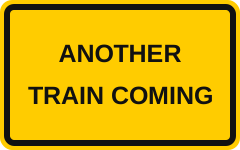
15. What does the sign below a crossbuck show?
- The train's speed
- The crossing's name
- The number of tracks
- The gate's weight
Show answer
The number of tracks. Multi-track crossings label themselves: a sign below the crossbuck shows the number of tracks where more than one exists. Speed, names, and gate weights appear nowhere on the assembly. The count matters because a passing train can hide a second train coming on the next track, which is why drivers must check every track before crossing. Crossbuck means yield to trains; the number plate tells how many yields to verify.
Study this in the handbook: Traffic signals, pedestrian signals and railroad crossings
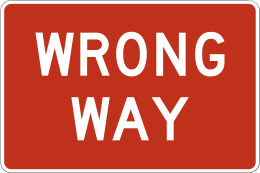
16. If a WRONG WAY sign is facing you, what does it tell you about your vehicle's direction?
- Trucks must use a different lane ahead
- The roadway ahead has a rough surface
- You are traveling against the permitted direction and should turn around immediately
- A legal passing zone is beginning
Show answer
You are traveling against the permitted direction and should turn around immediately. A WRONG WAY sign means the vehicle has entered a roadway in the prohibited direction. The handbook directs the driver to turn around immediately, but that maneuver must still be made safely and legally. The rough-surface choice confuses a directional command with a roadway warning, and the truck choice has no connection to the sign. Seeing this red message is an urgent cue to stop following the route and correct direction before meeting opposing traffic.
Study this in the handbook: Road sign colors and regulatory signs
17. How dangerous does Florida describe drowsy driving as being?
- It is safer than driving after a full night of sleep
- It affects only fuel consumption
- It improves alertness during long trips
- It can be just as dangerous as drunk driving
Show answer
It can be just as dangerous as drunk driving. Florida warns that drowsy driving can be just as dangerous as drunk driving. Fatigue can slow thought processes and reaction time, affect judgment and vision, impair the senses, and cause a driver to nod off or fall completely asleep. The other choices minimize or reverse those risks. If sleepiness appears, stop in a safe place for a nap, take a break, or switch drivers. On long trips the handbook also suggests a break every 100 miles or 2 hours, and it says not to drive at times when you would normally be asleep.
Study this in the handbook: DUI, implied consent and zero tolerance
18. When emergency lights appear behind a driver, what should the driver and passengers do?
- Leave the vehicle immediately without direction
- Turn off all lights and continue driving
- Stay calm and cooperate
- Argue with the approaching officer
Show answer
Stay calm and cooperate. Florida advises the driver and passengers to stay calm and cooperate when emergency lights appear behind the vehicle. Leaving without direction can create danger near traffic, and turning off lights or continuing to drive ignores the need to respond safely. Arguing does not help the stop. Activate the turn signal, pull to the side as soon as it is safe, turn off the engine and audio devices, and keep hands visible. The cue is calm cooperation followed by a controlled stop, not sudden movement or confrontation.
Study this in the handbook: Move Over Law and emergency vehicles
19. How many hours of DUI school follow a first DUI conviction?
- 4 hours
- 12 hours
- 40 hours
- No school is required
Show answer
12 hours. First-time DUI offenders return to the classroom for twelve hours of DUI school, learning what alcohol does to driving and what the next conviction costs. The twelve-hour level rises to twenty-one for second and third offenses. Four hours understates the mandate, forty invents one, and no-school readings skip a listed penalty. School pairs with the addiction-treatment evaluation: education for the mind, assessment for the habit, both aimed at making the first conviction the last.
Study this in the handbook: DUI, implied consent and zero tolerance
20. What action does a Florida YIELD sign require?
- Slow down and give vehicles crossing your path the right-of-way
- Accelerate to enter before other traffic
- Stop every time even when the way is clear
- Turn around before reaching the intersection
Show answer
Slow down and give vehicles crossing your path the right-of-way. A YIELD sign requires the driver to slow down and give right-of-way to vehicles crossing the intended path. If the way is clear, the handbook permits moving forward slowly without stopping, so a complete stop is not automatic. Accelerating would reverse the sign's purpose, and turning around is unrelated. Scan across the path first, then proceed only when the crossing traffic has been given priority.
Study this in the handbook: Road sign colors and regulatory signs
QualitySpace is expanding to Florida
We are a California-based independent insurance brokerage working on licensing in more states. We cannot help with Florida insurance yet. Leave your email and we will let you know when we can.
Every question is written from the official Official Florida Driver License Handbook. Need paper? Printable FL practice test with answer key.
Last verified 2026-10-05. How we check every question · Study all 500 as flashcards
Frequently asked questions
How many questions are on this Florida practice test?
This fixed set has 20 questions. It is test 6 of 25 from the 500 question Florida bank. The real FL exam asks 50 questions and you need 40 correct.
What is the passing score for the real Florida test?
40 out of 50 (80 percent) That figure comes from the official Florida source cited on the DMV facts page.
How does this fixed test relate to the full Florida bank?
Each numbered test is a fixed set of questions in a fixed order, so you can retake the same test later and compare. Every test mixes road signs and the other topics in about the same proportion as the full bank. Tests 1 to 25 together cover every question in the Florida bank once. The full practice page mixes the whole bank at random.
Last verified 2026-10-05. See the Florida DMV facts page for sourced state details.