
Test 1 of 25 · 20 questions · Free 2026
FL Permit Practice Test 1
Jump to the test ↓A fixed 20 question set from the Florida bank with answers and plain English explanations. The real FL exam is 50 questions, 80 percent to pass; take the full length version on the main practice page.
Question 1 of 20 · 0 right so far
All 20 questions in test 1
Every question below comes from the Florida question bank on this page. Open a question to see the correct answer and the explanation. Nothing here is hidden behind a signup.
1. How close to a fire hydrant may you park in Florida?
- No closer than 5 feet
- No closer than 10 feet
- No closer than 15 feet
- No closer than 25 feet
Show answer
No closer than 15 feet. Florida bars parking within 15 feet of a fire hydrant. The same list bars parking within 20 feet of an intersection and within 20 feet of the entrance to a fire, ambulance, or rescue station. Five and 10 feet are too close, and 25 feet is not a distance on the list. Other limits include 30 feet from a flashing signal, stop sign, or traffic signal, and 50 feet from a railroad crossing.
Study this in the handbook: Passing, turning and parking
2. What should a driver do before pulling away from a parked position?
- Make sure the roadway is clear, signal, and yield to traffic
- Open the door into traffic to check the lane
- Back into the roadway without signaling
- Pull out immediately because parked vehicles have priority
Show answer
Make sure the roadway is clear, signal, and yield to traffic. Florida requires a driver leaving a parked position to make sure the roadway is clear, give the proper turn signal, and yield to other traffic before pulling away from the curb. A parked vehicle does not have priority over moving traffic. Opening a door into the lane can endanger bicyclists and passing vehicles, while backing without signaling gives other road users no useful warning. Check mirrors and blind spots, signal early, and enter the lane only after the path is safe.
Study this in the handbook: Passing, turning and parking
3. How dangerous is drowsy driving?
- Safer than drunk driving
- As dangerous as drunk driving; don't drive tired
- Only risky after midnight
- Never a real danger
Show answer
As dangerous as drunk driving; don't drive tired. Fatigue impairs like alcohol: drowsy driving can be just as dangerous as drunk driving, so do not drive when you are tired. Safer-than-drunk, after-midnight-only, and never-dangerous readings each deny the equivalence the handbook states. Sleepiness slows thought and reaction, dims judgment and vision, dulls senses, and can switch the brain off into micro-sleep at the wheel. Treat heavy eyelids like a failed sobriety test: park it, nap, or hand over the keys.
Study this in the handbook: DUI, implied consent and zero tolerance
4. How should you alert a driver you are passing?
- Stay silent to surprise them
- Slam the brakes beside them
- Tap the horn by day, flash headlights by night
- Shout through the window
Show answer
Tap the horn by day, flash headlights by night. The driver being passed deserves notice: tap your horn during the day or flash your headlights at night to announce the pass. The audible or visual cue prevents the other driver from drifting left or starting their own pass just as you draw alongside. Silence surrenders that protection, braking beside them creates a side-by-side trap, and shouting is useless at speed with windows closed. Announce, pass decisively without exceeding the limit, and return only when the passed vehicle's tires show in your mirror.
Study this in the handbook: Passing, turning and parking
5. When may you return to the right lane after passing?
- As soon as your hood clears
- When you see their tires in your mirror, then signal
- Immediately after honking
- Whenever you feel like it
Show answer
When you see their tires in your mirror, then signal. The safe return cue is visual: do not come back right until you can see the tires of the passed vehicle in your rear-view mirror, then signal the return to your lane. The tires-in-mirror check guarantees a full car length of clearance before cutting back. Returning on hood clearance alone slices off the other driver's front bumper, honking marks the pass rather than its end, and feeling is no measurement. Complete the pass with the same discipline it started with: clearance verified, signal on, smooth return.
Study this in the handbook: Passing, turning and parking
6. What must you check before crossing tracks in heavy traffic?
- Wait until room exists for your car past the tracks
- Creep onto the tracks and wait
- Follow the car ahead closely
- Stop between the rails
Show answer
Wait until room exists for your car past the tracks. Heavy traffic must never trap you on the rails: before crossing, make sure room exists for your entire vehicle on the far side of the track. Creeping out and hoping the queue moves strands the car where a train cannot stop, and tailgating the leader guarantees sharing their trap. Between the rails is the worst possible waiting room. The same logic bans stopping within 15 feet of the crossing: keep the whole envelope, rails plus margins, completely clear until the exit is certain.
7. When a KEEP RIGHT sign marks a divider, where should you drive?
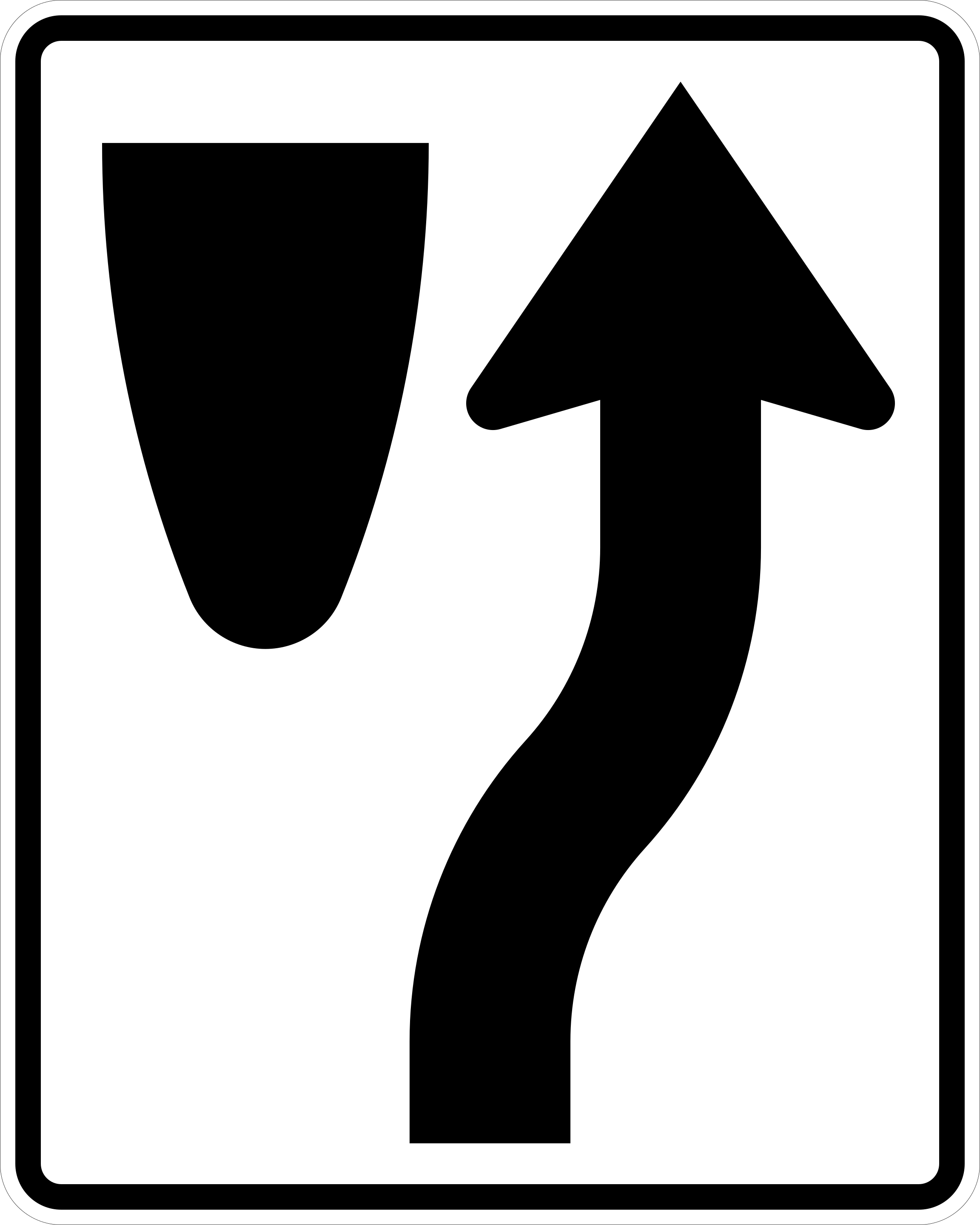
- To the left of the divider unless passing
- Across the divider when traffic is light
- In the shoulder beside the divider
- To the right of the divider
Show answer
To the right of the divider. KEEP RIGHT directs the driver to remain on the right side of the divider. The divider may separate traffic or mark an obstruction, so crossing it defeats the sign’s purpose and can put the vehicle into a conflicting path. The passing choice treats a fixed traffic control as a temporary lane preference. Reduce speed if needed, identify the divider early, and guide the vehicle around its right side while staying in the designated travel lane.
8. What must you do with a minor-crash car blocking traffic?
- Leave it blocking traffic
- Wait hours for a tow
- Push it into the ditch
- Move it or have it moved
Show answer
Move it or have it moved. Minor crashes must not freeze traffic: if the crash is minor and your vehicle blocks the flow, you must move it or have it moved. Staying put to preserve the scene, waiting hours roadside, or ditching the car each violate the clearance duty and invite secondary crashes. Photograph or sketch positions first if you safely can, then clear the lanes to the shoulder. Serious crashes with injuries override the rule: protect victims and the scene, and let responders direct the clearance.
Study this in the handbook: After a crash and vehicle emergencies
9. You move to a new home in Florida. How soon must you get a driver license showing the new address?
- At your next renewal
- Within 30 calendar days
- Within 10 days
- Within 90 days
Show answer
Within 30 calendar days. Florida requires a new driver license within 30 calendar days of any change to your mailing or residential address. You can make the change online through MyDMVPortal or at a driver license service center or tax collector's office, and you must destroy the old license once the new one arrives. Waiting for renewal is too late, and a stale address can mean you never receive renewal notices or notices of possible sanctions. Ten days and 90 days are not the deadline the handbook gives.
10. What documentation must a person keep while driving or riding in Florida to use a medical safety belt exemption?
- A written note from any adult passenger
- A verbal explanation given to an officer
- A vehicle inspection receipt
- A copy of certification from a physician
Show answer
A copy of certification from a physician. The medical exemption requires certification by a physician stating that belt use is inappropriate or dangerous for the person's condition. The handbook also says to keep a copy of that certification while driving or riding in a motor vehicle. A family note, verbal explanation, or inspection document cannot replace the physician's certification. If an exemption is being relied upon, the practical cue is simple: carry the paper copy with you rather than assuming the exemption can be proved later.
Study this in the handbook: Seat belts, child seats and speeding
11. What suspension follows a driver's first refusal to take a breath, urine, or blood test in Florida?
- One year
- Six months
- Two years
- 90 days
Show answer
One year. Florida's implied consent rule makes a first refusal an automatic one-year license suspension. A second refusal increases the suspension to 18 months and is also a first degree misdemeanor. Six months is associated with the under-21 suspension for a BAL of .02 or higher, not with a first test refusal. The practical cue is simple: first refusal equals one year, while the second refusal adds six months to reach 18 months.
Study this in the handbook: DUI, implied consent and zero tolerance
12. How does alcohol reach the brain after drinking?
- It stays in the stomach for hours
- Stomach lining to blood to brain within minutes
- It never enters the blood
- It absorbs only the next day
Show answer
Stomach lining to blood to brain within minutes. Alcohol moves fast: absorbed into the stomach lining, passed directly into the bloodstream, and delivered to the brain within minutes of consumption. There is no hours-long staging in the stomach, no blood-bypass, and no next-day delay. Food can slow the curve slightly but never stops it, which is why impairment begins with the first drink rather than the fifth. Understanding the speed of absorption explains why waiting a few minutes after drinking accomplishes nothing toward sobriety.
Study this in the handbook: DUI, implied consent and zero tolerance
13. Which state agency produces the Official Florida Driver License Handbook?
- Florida Department of Transportation
- Florida Department of Revenue
- Florida Department of Highway Safety and Motor Vehicles
- Florida Department of Law Enforcement
Show answer
Florida Department of Highway Safety and Motor Vehicles. The handbook opens by stating that it is produced by the Florida Department of Highway Safety and Motor Vehicles, abbreviated FLHSMV. The same agency appears throughout the handbook as the office that receives medical reports before a driver license is issued and runs the online virtual office. The Departments of Transportation, Revenue, and Law Enforcement are real state agencies, but none is named as the producer of the driver license handbook. Remember the HSMV portion of the name as the clue: highway safety and motor vehicles.
14. What must you do at a flashing yellow arrow?
- Stop and wait for green
- Turn without yielding
- Turn but yield to oncoming green traffic and pedestrians
- U-turn only
Show answer
Turn but yield to oncoming green traffic and pedestrians. Flashing yellow arrows permit with a price: turns are allowed in the arrow's direction, but oncoming traffic holds a green light, so yield to oncoming vehicles and pedestrians. Stop-and-wait wastes a permitted movement, unyielding turns cut off green-holding traffic, and U-turn-only invents a limit. Treat the flashing yellow arrow like a yield sign for that turn: creep, scan oncoming gaps and crosswalks, and complete the turn only when the way is truly clear.
Study this in the handbook: Traffic signals, pedestrian signals and railroad crossings
15. What does a Restricted Lane Ahead sign mean?
- A lane reserved for certain vehicles or purposes
- A lane closed to all
- A parking lane
- A lane for speeding
Show answer
A lane reserved for certain vehicles or purposes. Restricted lanes ration pavement: the Restricted Lane Ahead sign warns that a lane is reserved for certain purposes or certain vehicles, such as buses or carpool vehicles during rush hours, and the marking also appears in bike lanes. Closed-to-all, parking, and speeding readings miss reservation's point of moving more people per lane. Enter a restricted lane only if your vehicle and purpose qualify; otherwise stay out for the posted times. Violations steal the priority the lane was built to give.
16. What should you do after failing the four-second following test?
- Maintain speed and hope
- Reduce speed and count again at another point
- Flash headlights at the leader
- Change lanes without signaling
Show answer
Reduce speed and count again at another point. Failing the four-second test calls for a specific fix: reduce speed, then count again at another stationary point, and repeat until the gap reaches no closer than four seconds. Slowing opens the cushion while recounting verifies it, turning a vague sense of tailgating into a measured correction. Maintaining speed preserves the hazard, flashing headlights communicates nothing useful, and unsignaled lane changes add a second risk. The handbook's loop of slow down and retest is the disciplined way to rebuild a safe gap.
Study this in the handbook: Following distance, stopping and speed limits
17. How does higher speed change a vehicle's striking power in a crash?
- It stays roughly the same
- It falls as momentum stabilizes
- It grows with greater striking power
- It matters less than braking distance
Show answer
It grows with greater striking power. Florida's handbook warns that the faster you drive, the greater the impact or striking power of your vehicle. Speed adds destructive energy to any collision: doubling speed quadruples impact force, and tripling it multiplies force nine times. That physics is why obeying the limit reduces both the probability and the severity of crashes. Braking distance matters too, but the striking-power point is about what happens when avoidance fails. Slower speeds keep collision forces closer to what bodies and vehicle structures can survive.
Study this in the handbook: Following distance, stopping and speed limits
18. What should a driver do after seeing a pedestrian crossing warning sign?

- Speed up before pedestrians reach the roadway
- Continue without changing speed because the sign bans pedestrians
- Move into the opposing lane to avoid the crossing
- Slow down and stop to yield for pedestrians when necessary
Show answer
Slow down and stop to yield for pedestrians when necessary. A pedestrian crossing warning calls for attention to people crossing the street. Slow down and be prepared to stop so pedestrians can receive the right-of-way when necessary. The sign does not prohibit pedestrians, and speeding toward the crossing increases risk. Moving into opposing traffic creates a separate danger and is not the prescribed response. Look for people near the roadway, cover the brake, and leave enough space to stop smoothly rather than relying on the warning sign to clear the crossing for you.
19. What should you do about a vehicle approaching in your lane?
- Horn, high beams, hard brakes, then steer aside
- Speed up to pass
- Close your eyes
- Swerve into oncoming traffic
Show answer
Horn, high beams, hard brakes, then steer aside. A car in your lane triggers a three-step alarm: sound the horn and flash the high beams, brake hard, then steer to the side of the road. The noise and light may wake the drifting driver while your braking buys separation and the final steer clears the lane. Speeding up shortens survival time, eye-closing surrenders control, and oncoming-lane swerves trade one head-on risk for another. Shoulder over pavement when a choice exists, since stationary roadside objects beat moving steel.
Study this in the handbook: After a crash and vehicle emergencies
20. What do single broken white lines permit?
- Cross to change lanes when safe
- Never cross them
- Cross only at night
- Cross only to speed
Show answer
Cross to change lanes when safe. Broken white lines invite movement: you may cross them to change lanes whenever it is safe to do so. Never-cross readings confuse broken with double solid, night-only and speed-only gates invent limits the marking does not state. Signal the intent, check mirrors and the blind spot, and glide across when the gap allows. The broken pattern is permission; the driver's judgment of safety completes it.
Study this in the handbook: Pavement markings
QualitySpace is expanding to Florida
We are a California-based independent insurance brokerage working on licensing in more states. We cannot help with Florida insurance yet. Leave your email and we will let you know when we can.
Every question is written from the official Official Florida Driver License Handbook. Need paper? Printable FL practice test with answer key.
Last verified 2026-10-05. How we check every question · Study all 500 as flashcards
Frequently asked questions
How many questions are on this Florida practice test?
This fixed set has 20 questions. It is test 1 of 25 from the 500 question Florida bank. The real FL exam asks 50 questions and you need 40 correct.
What is the passing score for the real Florida test?
40 out of 50 (80 percent) That figure comes from the official Florida source cited on the DMV facts page.
How does this fixed test relate to the full Florida bank?
Each numbered test is a fixed set of questions in a fixed order, so you can retake the same test later and compare. Every test mixes road signs and the other topics in about the same proportion as the full bank. Tests 1 to 25 together cover every question in the Florida bank once. The full practice page mixes the whole bank at random.
Last verified 2026-10-05. See the Florida DMV facts page for sourced state details.