
Test 2 of 25 · 20 questions · Free 2026
FL Permit Practice Test 2
Jump to the test ↓A fixed 20 question set from the Florida bank with answers and plain English explanations. The real FL exam is 50 questions, 80 percent to pass; take the full length version on the main practice page.
Question 1 of 20 · 0 right so far
All 20 questions in test 2
Every question below comes from the Florida question bank on this page. Open a question to see the correct answer and the explanation. Nothing here is hidden behind a signup.
1. Why keep extra following distance behind a motorcycle?
- Follow closer than behind cars
- Keep extra distance; bikes stop quicker
- Match their speed exactly
- Follow in their tire track
Show answer
Keep extra distance; bikes stop quicker. Motorcycles out-brake cars: do not follow too closely behind a motorcycle because they can stop more quickly than other vehicles. A car-length gap calibrated for car brakes becomes a collision when the bike halts in half the distance. Closer following, exact speed matching, and tire-track riding all erase the margin. The handbook reinforces the point with a buffer rule: maintain more than a four-second zone behind motorcyclists, and stretch it further in bad weather, wind, wet roads, and rough surfaces.
Study this in the handbook: Bicycles, trucks, motorcycles and pedestrians
2. Who draws the mandatory DUI blood test?
- Any bystander may draw it
- The driver draws it personally
- A medical professional; unconscious drivers included
- Only a judge may order it
Show answer
A medical professional; unconscious drivers included. Mandatory DUI blood draws stay in medical hands: the blood must be drawn by a doctor, nurse, or other health professional, and it may be drawn even if you are unconscious. Bystanders and self-draws satisfy neither sterility nor chain of custody, and no separate judicial order is required beyond the statute itself. The unconsciousness clause matters most after serious crashes, where the driver's condition cannot pause the evidence clock. Refusal rights simply do not apply to this draw.
Study this in the handbook: DUI, implied consent and zero tolerance
3. What is the first rule in a submerged car?
- Call 911 first from inside
- Escape first, then call; unbuckle and open the window
- Wait for the car to fill
- Open the door at once
Show answer
Escape first, then call; unbuckle and open the window. Submerged cars allow no phone calls first: get out of the vehicle immediately and do not call 911 until you are out. Unbuckle the belt, roll the window down before the car sinks, and escape through it; forcing the door early floods the car instantly. Waiting to fill wastes the thirty to sixty floating seconds, and door-first opening drowns the exit. If the window will not roll, kick out a side window. Escape, surface, and only then summon help.
Study this in the handbook: After a crash and vehicle emergencies
4. When may slow farm vehicles operate on Florida public highways?
- Daylight only, unless equipped for night driving
- Anytime without restriction
- Only on interstates
- Only with a police escort
Show answer
Daylight only, unless equipped for night driving. Slow farm vehicles built for speeds under 25 MPH may use public highways outside limited access roads, but Florida confines them to daylight hours unless they carry the proper lights and reflectors for night driving. They must also display the slow-moving-vehicle sign on the rear. The daylight rule protects both the slow operator, who is hard to see after dark, and faster motorists who can close on a 20 MPH vehicle with shocking speed. Interstates are off limits to these vehicles, with or without an escort.
Study this in the handbook: Points, suspensions and school buses
5. Who is responsible for knowing the speed limit while driving in Florida?
- Learn each limit and obey posted speed signs
- Assume 55 MPH on every road
- Follow the fastest nearby driver
- Obey only limits that flash
Show answer
Learn each limit and obey posted speed signs. Florida law makes every driver responsible for knowing the speed limit on the road being driven and requires drivers to observe and obey posted speed limit signs. Ignorance of the limit is not a defense, which is why the handbook stresses watching for signs at transitions such as school zones, work zones, and municipal boundaries. Assuming a default, copying other drivers, or obeying only flashing signs all abdicate that personal duty. Knowing the limit is part of keeping complete control of the vehicle and avoiding collisions.
Study this in the handbook: Following distance, stopping and speed limits
6. How close to a railroad crossing may you park in Florida?
- No closer than 15 feet
- No closer than 50 feet
- No closer than 20 feet
- No closer than 30 feet
Show answer
No closer than 50 feet. Florida's no parking list includes parking within 50 feet of a railroad crossing, so 50 feet is the closest you may park. The smaller distances belong to other items on the same list: 15 feet from a fire hydrant, 20 feet from an intersection or a fire station entrance, and 30 feet from a flashing signal, stop sign or traffic signal. Keeping cars well back from a crossing protects sight lines for drivers watching for trains and keeps the tracks clear.
Study this in the handbook: Passing, turning and parking
7. Who may display red front or blue lights?
- Allowed for everyone
- Allowed at night
- Allowed with a permit
- Emergency and law enforcement vehicles only
Show answer
Emergency and law enforcement vehicles only. Colored warning lights are reserved professions: red lights visible from the front and blue lights belong to emergency and law enforcement vehicles only. Everyone, nighttime, and permit readings invent permissions the equipment ban never grants. The same prohibited list bars extra spotlights, sirens, bells, whistles, window stickers, and straight-pipe mufflers. Civilian cars signal with amber, white, and red in their lawful positions and leave the emergency colors alone.
Study this in the handbook: Insurance, registration and vehicle equipment
8. What must you do before proceeding through an intersection on a green light?
- Enter immediately without checking cross traffic
- Stop until the signal turns yellow
- Confirm the intersection is clear and yield as required
- Yield only to vehicles behind you
Show answer
Confirm the intersection is clear and yield as required. A green light permits movement only when the intersection is clear. Drivers must still yield to pedestrians in the crosswalk and vehicles already in the intersection. Entering without checking can trap your vehicle in a conflict, and stopping for every green signal is not the rule. Traffic behind you does not replace the need to watch the crossing area. Approach at a speed that allows you to slow if conditions change, especially when making a left turn.
Study this in the handbook: Traffic signals, pedestrian signals and railroad crossings
9. What does a yellow X lane signal mean?
- Speed up in the lane
- Prepare to leave; it is about to turn red
- Stop immediately in the lane
- Ignore it
Show answer
Prepare to leave; it is about to turn red. The yellow X is an eviction notice: the lane signal is about to turn red, so prepare to leave the lane safely. Speeding up to beat it, panic-stopping under it, or ignoring it each risk being caught in the lane when the red X appears. Reversible lanes, toll lanes, and closures use these signals to move traffic between configurations. Merge out smoothly at the yellow X and never enter on red.
Study this in the handbook: Traffic signals, pedestrian signals and railroad crossings
10. What does a Divided Highway Ends sign warn?
- The road widens ahead
- A new lane opens
- Two-way traffic resumes in 350 to 500 feet; keep right
- The highway ends
Show answer
Two-way traffic resumes in 350 to 500 feet; keep right. Divided protection is ending: the Divided Highway Ends sign warns that the median stops in three-fifty to five hundred feet, returning the road to two-way traffic where drivers must keep right. Widening, new-lane, and highway-end readings miss the critical change from separated to shared pavement. Oncoming cars will soon occupy the lane beside yours with paint alone between. Drift right, dim expectations of solitude, and treat the center line as a wall.
11. What is a defensive-driving response when another driver approaches from behind and may change lanes aggressively?
- Accelerate to prevent the other driver from passing
- Block the adjacent lane deliberately
- Anticipate the other driver’s move and adjust appropriately
- Ignore the mirrors until the driver is beside you
Show answer
Anticipate the other driver’s move and adjust appropriately. Florida’s defensive-driving guidance says to anticipate what another driver might do and make appropriate adjustments. When a vehicle approaches from behind aggressively, a safer response is to create space, avoid competing for the same lane, and be ready to brake if necessary. Accelerating to block a pass can intensify the conflict, and deliberately occupying another lane is unsafe. Ignoring the mirrors removes useful warning time. Stay calm, monitor the approaching vehicle, and leave an escape path so a sudden lane change does not trap you.
Study this in the handbook: Move Over Law and emergency vehicles
12. When following a motorcycle, which condition calls for more space than the usual four-second buffer?
- A clean, dry road with no traffic
- A motorcycle traveling in the opposite direction
- A straight roadway with a clear shoulder
- Gusty winds or wet roads
Show answer
Gusty winds or wet roads. The handbook calls for a larger buffer around a motorcyclist when conditions can make control or stopping more difficult, including gusty winds and wet or icy pavement. A dry, open road does not create that particular need, and an oncoming motorcycle is not a reason to follow it. Keep the motorcycle in view, avoid crowding its lane, and add space whenever weather, potholes, gravel, or tracks could change its path or braking distance.
Study this in the handbook: Bicycles, trucks, motorcycles and pedestrians
13. On a divided highway with a raised barrier, when may traffic traveling opposite a stopped school bus proceed?
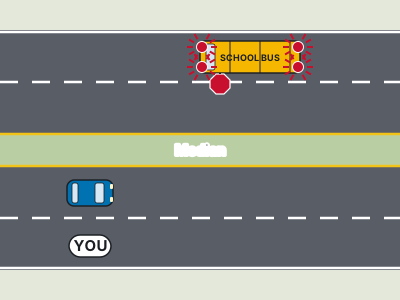
- It must stop until the bus withdraws its signal and all children are clear
- It must reverse to the previous intersection
- It may pass only after the bus driver waves it through
- It may proceed with caution if it is moving opposite the bus
Show answer
It may proceed with caution if it is moving opposite the bus. A raised barrier separates the opposing directions strongly enough that drivers traveling opposite the stopped bus do not have to stop. They must still proceed with caution because children and traffic conditions remain nearby. Vehicles moving in the same direction as the bus must always stop and remain stopped until the stop signal is withdrawn. The option requiring every opposing vehicle to wait applies the undivided-road rule too broadly. Identify the physical median, not painted pavement alone, before deciding which duty applies.
Study this in the handbook: Points, suspensions and school buses
14. Which vehicle does Florida's Move Over Law protect when it is stopped along a roadway with warning lights?
- A vehicle parked legally at a shopping center
- A disabled motor vehicle displaying warning or hazard lights
- A moving vehicle approaching from behind
- A private vehicle stopped at a traffic signal
Show answer
A disabled motor vehicle displaying warning or hazard lights. Florida's Move Over Law also protects disabled motor vehicles stopped along a roadway when they display warning lights or hazard lights, use emergency flares or signage, or have a visibly present person. A car merely parked at a shopping center is not the roadside situation described. The rule is designed for people and vehicles exposed to passing traffic. When warning lights appear on a disabled vehicle ahead, reduce your approach speed, look for a safe lane change, and create as much room as roadway conditions allow.
15. What right-of-way rule applies at the railroad crossing marked by a crossbuck?
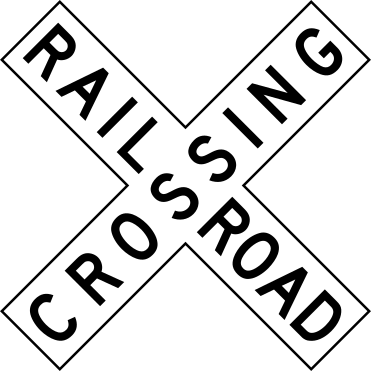
- Yield the right-of-way to trains
- Proceed first if the train is still far away
- Stop only when a gate is lowered
- Treat the sign as a lane-direction marker
Show answer
Yield the right-of-way to trains. A railroad crossbuck functions as a yield sign for trains. Slow down, look for approaching rail traffic, and be ready to stop so the train receives priority. The gate-only option misses crossings that use a crossbuck without a lowered gate, while distance is not a license to race across the tracks. Scan both directions and make sure the route beyond the rails is open before proceeding. The X shape identifies the crossing, but the required action is yielding to the train.
Study this in the handbook: Traffic signals, pedestrian signals and railroad crossings
16. What action is recommended at a right curve warning sign?

- Slow your speed and do not pass other vehicles
- Turn only at the next intersection
- Increase speed before entering the bend
- Move onto the shoulder to complete the curve
Show answer
Slow your speed and do not pass other vehicles. A right curve warning describes the road's path and gives the driver time to prepare. The handbook specifically pairs this sign with slowing down and refraining from passing, since sight distance and control can be limited through the bend. Increasing speed reduces the margin for steering or braking. The intersection choice treats a curve as a junction, and using the shoulder is neither a normal lane choice nor a safe response. Reduce speed before the curve so the vehicle remains stable while following the roadway.
17. When is a disabled parking permit valid for a parked car?
- Any family member may borrow it
- It works on any car anytime
- It covers friends running errands
- The vehicle must be transporting the permit owner
Show answer
The vehicle must be transporting the permit owner. The permit travels with the person, not the car: the vehicle must actually be transporting the person with the disability who owns the permit or registration. Family errands, friend favors, and solo trips in a permitted car all fail the test when the owner stays home. Anyone who obtains or uses a permit that does not belong to them faces a second degree misdemeanor, a $500 fine or up to six months in jail, plus towing and confiscation. Display the credential only when its owner is aboard.
Study this in the handbook: Learner's license, practice hours and teen curfews
18. What does an ignition interlock device do?
- A device that locks the ignition without a sober driver
- A louder horn
- A speed governor
- A mileage tracker
Show answer
A device that locks the ignition without a sober driver. The interlock on a restricted license is a sobriety gate: the driver may operate only a vehicle fitted with a device that locks the ignition. Each start requires proof of sobriety, so an impaired driver cannot get the car running at all. Horns, governors, and trackers serve other purposes and satisfy nothing in the DUI sentence. First offenses earn the device by court order or aggravation, while second and third convictions mandate it for one and two continuous years respectively.
19. How do you drive relative to a broken yellow line?
- Stay right; cross only to pass when safe
- Drive on the line
- Stay left of it
- Cross anytime freely
Show answer
Stay right; cross only to pass when safe. Broken yellow lines keep you right with a passing privilege: stay to the right of the line, crossing only to pass a car ahead when it is safe. Line-riding, left-side cruising, and free crossing each abuse a marking that separates you from oncoming traffic. The pass must complete with full return before opposing traffic arrives, respecting the hills, curves, zones, and sight rules that further limit passing. Right is home; left is a brief, careful visit.
Study this in the handbook: Pavement markings
20. A Florida driver under 18 accumulates 6 or more points within 12 months. What happens?
- Nothing until 12 points
- The license is revoked for one year
- The license is automatically restricted to business purposes only
- A $500 fine is assessed
Show answer
The license is automatically restricted to business purposes only. Florida's mandatory restriction for minors says any driver under 18 who accumulates 6 or more points within a 12 month period is automatically restricted to business purposes only for one year. Adult thresholds start at 12 points. The restriction is a limit on when and why the minor may drive, not a revocation or a fine, and each additional point extends the restriction by 90 days.
Study this in the handbook: Learner's license, practice hours and teen curfews
QualitySpace is expanding to Florida
We are a California-based independent insurance brokerage working on licensing in more states. We cannot help with Florida insurance yet. Leave your email and we will let you know when we can.
Every question is written from the official Official Florida Driver License Handbook. Need paper? Printable FL practice test with answer key.
Last verified 2026-10-05. How we check every question · Study all 500 as flashcards
Frequently asked questions
How many questions are on this Florida practice test?
This fixed set has 20 questions. It is test 2 of 25 from the 500 question Florida bank. The real FL exam asks 50 questions and you need 40 correct.
What is the passing score for the real Florida test?
40 out of 50 (80 percent) That figure comes from the official Florida source cited on the DMV facts page.
How does this fixed test relate to the full Florida bank?
Each numbered test is a fixed set of questions in a fixed order, so you can retake the same test later and compare. Every test mixes road signs and the other topics in about the same proportion as the full bank. Tests 1 to 25 together cover every question in the Florida bank once. The full practice page mixes the whole bank at random.
Last verified 2026-10-05. See the Florida DMV facts page for sourced state details.