
Test 24 of 25 · 20 questions · Free 2026
FL Permit Practice Test 24
Jump to the test ↓A fixed 20 question set from the Florida bank with answers and plain English explanations. The real FL exam is 50 questions, 80 percent to pass; take the full length version on the main practice page.
Question 1 of 20 · 0 right so far
All 20 questions in test 24
Every question below comes from the Florida question bank on this page. Open a question to see the correct answer and the explanation. Nothing here is hidden behind a signup.
1. What must a Florida driver adjust driving speed to?
- The speed of surrounding traffic only
- Weather, roadway, and traffic conditions
- The posted limit plus 10 MPH
- Fuel economy and tire wear
Show answer
Weather, roadway, and traffic conditions. Florida places a continuing duty on drivers to adjust speed to three things: the weather, the roadway, and the traffic conditions. A posted limit only shows the fastest speed allowed under favorable conditions, so rain, fog, congestion, construction, or a rough surface all call for slowing down. The handbook gives storms as an example: during a storm you should drive slower than the posted limit. A driver who holds the posted speed into deteriorating conditions is violating the basic duty to keep complete control of the vehicle.
2. A Florida driver is convicted of possessing marijuana. What happens to the driver license?
- It must be suspended
- Nothing, if no car was involved
- A warning is added to the record
- Two points are added
Show answer
It must be suspended. Florida requires suspension of the driver license when a person is convicted of possessing, selling, or trafficking drugs, and the handbook names marijuana specifically. The conviction does not have to involve a car, so the claim that nothing happens without a car is wrong. A warning or a point entry is not the stated consequence. If drugs are in a vehicle being used to transport, sell, or distribute them, the car itself may also be seized and forfeited to the arresting agency.
3. What does it mean if you pass the marker before counting to one-thousand-four?
- You are following too closely
- Your speed is perfect
- The marker is misplaced
- You should speed up
Show answer
You are following too closely. The four-second test has a clear verdict: if you pass the stationary marker before finishing the one-thousand count to four, you are following too closely. The remedy is to reduce speed and count again at another stationary point, repeating until the gap reaches no closer than four seconds. Treating an early arrival as proof of perfect speed, blaming the marker, or speeding up all invert the lesson. Tailgating causes most rear-end collisions, and this self-test is the driver's best tool against it.
4. After an alcohol stop, a Florida driver under 21 goes through an evaluation. When are parents or legal guardians notified of the results?
- Never, because the driver's records are private
- When the driver is under 19
- Only when the driver is under 16
- Only when the driver requests it
Show answer
When the driver is under 19. Under Florida's zero tolerance rules, an evaluation is completed and parents or legal guardians are told the results for every driver under 19. The results are not kept from parents at that age, and the cutoff is 19, not 16. Notification does not depend on the young driver asking for it. The same section sets a six month suspension for a BAL of .02 or higher under 21 and requires a substance abuse course at .05 or higher.
5. During the Florida driving skills test, how must you back up the vehicle?
- About 10 feet using only the rear-view camera
- 50 feet at a slow speed while looking to the rear
- 100 feet using the mirrors
- Backing is not part of the Florida test
Show answer
50 feet at a slow speed while looking to the rear. One of the required maneuvers on the Florida driving skills test is backing up a distance of 50 feet at a slow speed while looking to the rear. The handbook specifically says not to use the rear-view mirror or the rear-view camera monitor for this maneuver, so turn and look over your shoulder. Ten feet and 100 feet are not the distance the test uses, and relying on the camera or mirrors breaks the instruction. Backing is a scored part of the exam, not optional.
6. Where should a driver park on a public road unless it is a one-way street?
- On the right side of the road
- On the left side facing traffic
- Across the nearest crosswalk
- In the center turn lane
Show answer
On the right side of the road. Florida says to park on the right side of the road unless the street is one-way. The vehicle should also be parallel to the curb in the direction of traffic, with its right wheels close to the curb or roadway edge. Parking on the left while facing opposing traffic creates a hazard, and a crosswalk or center turn lane is not a parking place. Before leaving the vehicle, set the brake, secure the transmission, turn off the engine, lock the vehicle, and remove the keys.
7. May you turn right on a red arrow?
- Never turn on a red arrow
- Turn right after stop if permitted and clear
- Always turn without stopping
- Turn left from any street
Show answer
Turn right after stop if permitted and clear. Red arrows bend like red balls for right turns: after stopping, you may turn right if no NO TURN ON RED sign prohibits it and the way is clear. Never-turn readings miss the exception, no-stop turns skip the required halt, and any-street lefts ignore the one-way-to-one-way limit. Pedestrians in the crosswalk and oncoming traffic keep their priority through the maneuver. The arrow otherwise holds its movement until green appears.
8. How should you brake with a jammed gas pedal?
- Slam the brakes hard
- Turn the engine off at once
- Press, don't slam, the brakes, then steer safe
- Shift into park
Show answer
Press, don't slam, the brakes, then steer safe. A stuck accelerator still answers to measured braking: if necessary, press, don't slam, the brakes to slow the vehicle, then carefully steer to a safe place to stop. Slamming at full throttle can lock the wheels and spin the car, instant engine shutdowns kill power steering, and park at speed destroys the transmission without stopping sooner. First lift off the gas and shift to neutral or clutch in; brakes then work against a disconnected engine. Stop fully before investigating the pedal.
9. Which painted lane is it against the law to park in?
- Bicycle lanes
- Travel lanes
- Turn lanes
- Median lanes
Show answer
Bicycle lanes. Bicycle lanes are travel lanes for bikes, and parking in them is against the law. A car in the bike lane forces cyclists to swerve into motor traffic, often without a safe gap, and destroys the separation the lane was painted to provide. Travel and turn lanes are obviously no-parking areas too, and medians are doubly prohibited, but the bike lane is the trap: it looks like spare pavement to a hurried driver. Treat the bike symbol as a no-parking sign and keep the lane clear end to end.
10. A Florida learner gets one moving violation in the first 12 months, but adjudication is withheld. Can the teen still move up to a driver license after 12 months?
- No, any violation resets the 12 months
- No, the teen must wait until 18
- Yes, up to three violations are allowed
- Yes, one violation with adjudication withheld is allowed
Show answer
Yes, one violation with adjudication withheld is allowed. A Florida learner under 18 must go 12 months from the learner's license issue date without a moving violation conviction. The handbook allows one exception: a single moving violation within those 12 months is acceptable if adjudication is withheld. Saying any violation resets the clock ignores that exception, and nothing forces the teen to wait until 18. Three violations is far beyond the one allowed. The 50 supervised hours, 10 at night, are still required.
11. Who yields when vehicles arrive at an intersection at the same time?
- The left driver goes first
- The larger vehicle goes first
- Each driver yields to the right
- All proceed together
Show answer
Each driver yields to the right. Simultaneous arrival needs a tiebreaker, and the rule is the right hand: when vehicles reach an intersection at approximately the same time, each driver must yield to the drivers on their right. The rightmost vehicle therefore moves first and the order unwraps from there. Left-first, size-first, and all-together departures all manufacture collisions from confusion. Note the pairing rule for staggered arrivals: vehicles proceed in the order they arrived, first arrival first.
12. What must you do before moving left to pass?
- Signal before moving into the left lane
- Swerve out without warning
- Flash high beams only
- Honk after passing
Show answer
Signal before moving into the left lane. Every pass starts with communication: activate your signal before moving into the left lane so surrounding drivers know you are about to change lanes to pass. The signal warns the driver ahead, oncoming traffic, and anyone in your blind spot that your car is leaving its lane. Swerving without warning, flashing beams alone, or honking after the fact all skip the required announcement. Signaling is step one of the handbook's six-step passing procedure, followed by spacing, blind-spot checks, audible warning, and a careful return.
13. When may you briefly cross left of center?
- Never share the road
- Honk them off the road
- Pass without care
- Briefly cross center to pass bikes, e-bikes, or walkers
Show answer
Briefly cross center to pass bikes, e-bikes, or walkers. Slow road users earn a careful exception: drivers may safely and briefly drive left of center to overtake a bicycle, other non-motorized vehicle, electric bicycle, or pedestrian. Never-share, honk-off, and careless-pass readings each deny the room the law explicitly grants. The exception stays narrow: safe, brief, and only where sight distance and oncoming traffic allow, with full return to the right after. Give bikes the three-foot minimum while passing under this rule.
14. A Florida driver dumps more than 15 pounds of litter onto a roadway. Which penalty can follow?
- Only a warning for a first offense
- A first-degree misdemeanor, a fine up to $1,000 and 3 points
- A civil fine with no points
- A one year license revocation
Show answer
A first-degree misdemeanor, a fine up to $1,000 and 3 points. Florida treats dumping litter from a vehicle as a crime in any amount, and the penalty grows with the load. For more than 15 pounds, you can be charged with a first-degree misdemeanor, fined up to $1,000 and receive 3 points on your driving record, and a court may also order you to pick up litter along roadways. A warning is not what the handbook describes. A fine without points fits small amounts, not this heavier load, and license revocation is not the listed penalty.
15. If a vehicle stalls on railroad tracks and a train is coming, what should occupants do first?
- Remain inside with the doors locked until the crossing clears
- Push the vehicle from the tracks while standing beside the rails
- Get everyone out immediately and move away from the car
- Call for help before allowing anyone to leave the vehicle
Show answer
Get everyone out immediately and move away from the car. A stalled vehicle on tracks creates an immediate life-threatening hazard. The handbook directs everyone to exit immediately and get away from the car, rather than treating the vehicle as shelter or spending the first moments trying to move it. Calling for help is important, but it follows the urgent evacuation when a train is approaching. Staying beside the rails while pushing also leaves people in the danger area. The cue is the combination of stalled car and train: leave first, move clear, then contact emergency services.
16. Where must a rear-facing car seat never go?
- In the front seat always
- Anywhere convenient
- Never in front of an airbag
- On the driver's lap
Show answer
Never in front of an airbag. Rear-facing seats and front airbags are a lethal combination: never place a rear-facing car seat in front of an airbag. The deploying bag strikes the seat's back with explosive force exactly where the infant's head rests. Front-seat, anywhere-convenient, and lap placements each invite the same catastrophe. Children under thirteen belong secured in the rear seat, where airbags cannot reach them and the cabin's safest rows protect them.
17. How do you reduce glare and improve visibility?
- Keep windshield and headlights clean
- Let grime build up
- Remove the mirrors
- Tint everything dark
Show answer
Keep windshield and headlights clean. Clean glass fights glare: keep the windshield and headlights clean to reduce glare and increase visibility. Grime scatters oncoming light into a blinding halo, mirror removal deletes rear vision, and dark-everything tints strangle lawful light. Wash inside and out, since interior film glares as badly as exterior dirt, and restore cloudy headlight lenses before they halve your beams. Night rewards the clean-car driver with earlier hazard pickup.
18. What does a red circle with a red slash over a symbol tell a driver?
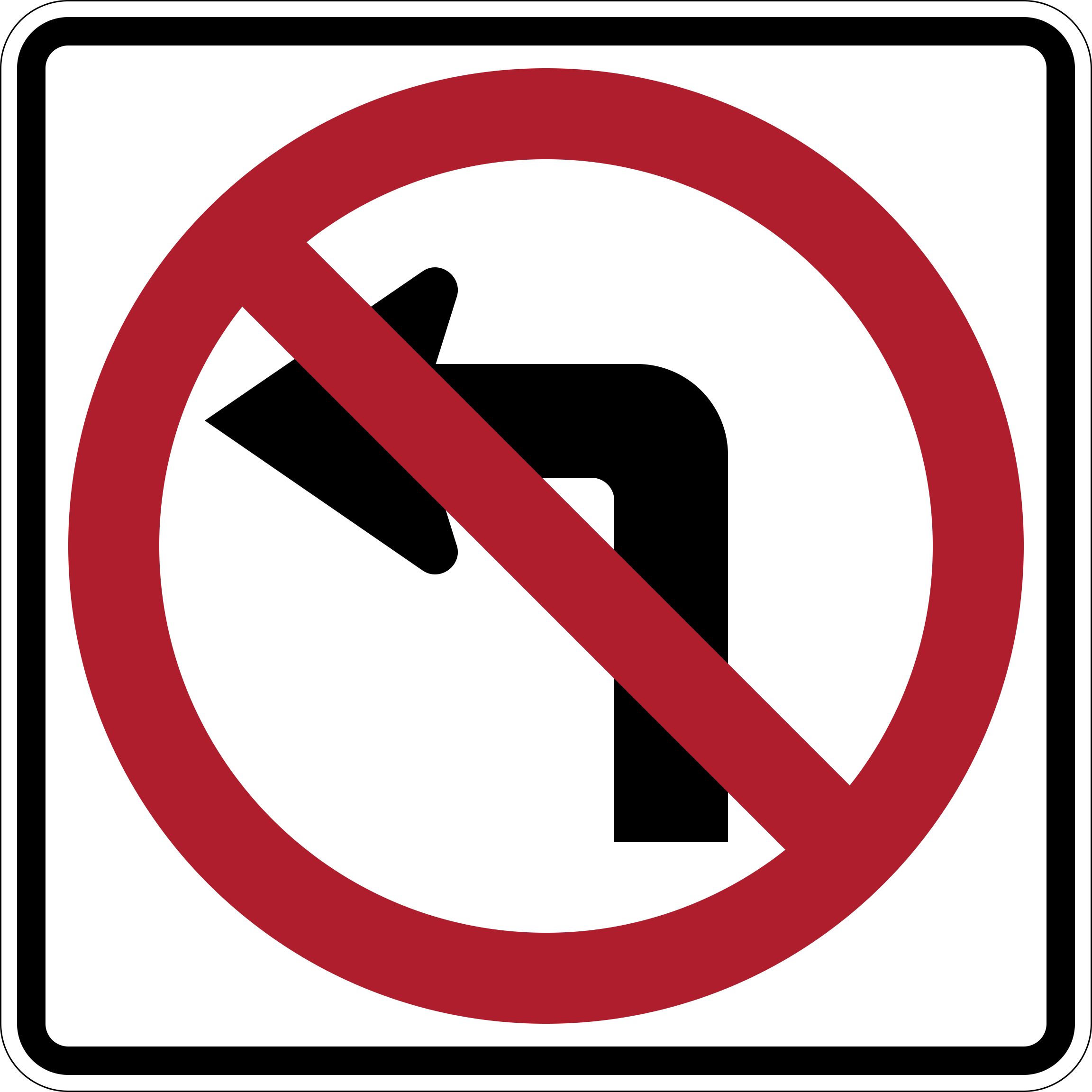
- The symbol identifies a service available ahead
- The action shown is recommended when traffic is light
- The action shown by the symbol is not allowed
- The symbol warns that the action may become necessary
Show answer
The action shown by the symbol is not allowed. A red circle with a slash marks the action or movement shown as prohibited. That means a driver must not perform the pictured maneuver, such as making a prohibited turn. The recommendation choice reverses the message, because the symbol is not permission even when traffic is light. A service sign would direct you to an amenity, and a warning symbol would describe a condition or hazard rather than ban a movement. The visual cue is the slash itself: see the symbol underneath, then read the entire combination as no action of that type.
19. What destination information is provided by a blue and white service sign?
- A maximum speed for an exit ramp
- A warning about construction and maintenance
- A restriction on turning or passing
- Services such as gas, food, motels, and hospitals
Show answer
Services such as gas, food, motels, and hospitals. Blue and white service signs guide motorists to useful facilities, including gas, food, motels, and hospitals. The exit-ramp speed choice describes a regulatory speed message, not a service location. Construction and maintenance warnings use orange, and turning or passing restrictions are conveyed by regulatory signs. A good roadside cue is to read blue and white signs as help finding a needed stop, especially when looking for fuel, a meal, lodging, or medical care. Their purpose is driver guidance to services rather than control of vehicle movement.
20. What signal habit most helps motorcyclists stay safe?
- Never signal near bikes
- Signal only at night
- Signal only on highways
- Always signal before changing lanes
Show answer
Always signal before changing lanes. Signals save riders: use your turn signals before changing lanes, which the handbook calls one of the most important actions you can take to help motorcyclists stay safe. Bikes hide in blind spots and judge car intentions from lamps, so an unsignaled drift can sideswipe a rider the driver never saw. Night-only or highway-only signaling abandons riders everywhere else. Signal every lane change, check mirrors and blind spots for the small silhouette, then move smoothly without cutting across the bike's path.
QualitySpace is expanding to Florida
We are a California-based independent insurance brokerage working on licensing in more states. We cannot help with Florida insurance yet. Leave your email and we will let you know when we can.
Every question is written from the official Official Florida Driver License Handbook. Need paper? Printable FL practice test with answer key.
Last verified 2026-09-07. How we check every question · Study all 500 as flashcards
Frequently asked questions
How many questions are on this Florida practice test?
This fixed set has 20 questions. It is test 24 of 25 from the 500 question Florida bank. The real FL exam asks 50 questions and you need 40 correct.
What is the passing score for the real Florida test?
40 out of 50 (80 percent) That figure comes from the official Florida source cited on the DMV facts page.
How does this fixed test relate to the full Florida bank?
Each numbered test is a fixed set of 20 questions in a fixed order, so you can retake the same test later and compare. Every test mixes road signs and the other topics in about the same proportion as the full bank. Tests 1 to 25 together cover every question in the Florida bank once. The full practice page mixes the whole bank at random.
Last verified 2026-09-07. See the Florida DMV facts page for sourced state details.