
Test 12 of 25 · 20 questions · Free 2026
FL Permit Practice Test 12
Jump to the test ↓A fixed 20 question set from the Florida bank with answers and plain English explanations. The real FL exam is 50 questions, 80 percent to pass; take the full length version on the main practice page.
Question 1 of 20 · 0 right so far
All 20 questions in test 12
Every question below comes from the Florida question bank on this page. Open a question to see the correct answer and the explanation. Nothing here is hidden behind a signup.
1. A pedestrian is already in a crosswalk when the raised hand begins flashing. What action is required?
- Stand still until the hand becomes a walking person
- Turn around immediately
- Finish crossing quickly
- Start a new crossing from the nearest curb
Show answer
Finish crossing quickly. A person who has entered the crosswalk may complete the crossing when the raised hand starts flashing. The signal change warns people who have not begun to cross that they should stay out of the crosswalk. Turning around or standing in traffic creates a less predictable movement, while starting over would add unnecessary exposure. Once in the roadway, keep moving promptly and watch for turning vehicles while reaching the opposite side.
2. What does a white and black regulatory sign do?
- It identifies scenic areas and cultural sites
- It warns about unexpected roadway conditions
- It controls traffic, sets limits, or gives commands
- It directs drivers to gas, food, motels, and hospitals
Show answer
It controls traffic, sets limits, or gives commands. White and black signs identify rules that control traffic, establish limits, or give commands, so a posted speed limit belongs in this group. The scenic-area choice describes brown and white signs, while the roadway-condition choice points to yellow warnings. The service choice belongs to blue and white signs that guide drivers toward amenities. A useful cue is to connect the neutral white and black color scheme with enforceable instructions rather than a destination or hazard. When a sign tells you how fast to travel or what movement to make, treat its message as a rule that governs your driving.
3. Besides a fine, what else follows a Florida conviction for passing a stopped school bus?
- Only a fine, with no points
- Four points and a required basic driver improvement course
- Two points and a warning letter
- Automatic license revocation for five years
Show answer
Four points and a required basic driver improvement course. Passing a stopped school bus in Florida is a moving violation that adds four points to the license and requires a basic driver improvement course, on top of a minimum fine of $265, or $465 on the side where children enter and exit. The penalty is more than a fine alone, and two points is too few. Five year revocation is not listed. If the passing causes serious injury or death, the points rise to six and the license is suspended for at least one year.
4. Before entering a Florida street from a private driveway, to whom must the driver yield?
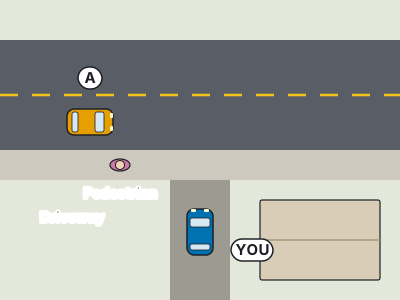
- Only vehicles approaching from the left
- Vehicles on the main road, plus pedestrians and bicyclists on the sidewalk or in bike lanes
- Only the largest vehicle on the road
- No one, because driveway traffic enters first
Show answer
Vehicles on the main road, plus pedestrians and bicyclists on the sidewalk or in bike lanes. A driveway is an entry point onto an already established road, so the driver coming out must wait for traffic using the main road. Florida also requires attention to pedestrians and bicyclists on the sidewalk or in bike lanes beside that road. The left-only choice ignores traffic from the other direction, and the largest-vehicle and enter-first choices have no support in the rule. Before moving from a driveway, scan the roadway and its edges, yield to the people and vehicles already there, and enter only after the path is clear.
5. What happens to speeding fines in a school zone or construction zone?
- They are doubled
- They are waived for the first offense
- They are reduced by half
- They are replaced with a warning
Show answer
They are doubled. Florida doubles speeding fines when the infraction occurs within a school zone or construction zone. The location increases the consequence because children, workers, and changing traffic patterns create greater exposure to harm. A first offense is not automatically waived, and the handbook does not reduce the fine or replace it with a warning under this rule. Slow before entering the marked area, watch for workers and pedestrians, and treat the doubled fine as a reminder that ordinary speed control is not enough in a sensitive zone.
6. May you park in a marked fire lane?
- Yes, briefly
- Yes, at night
- Yes, with flashers
- No, it is illegal
Show answer
No, it is illegal. Pavement markings designating fire lanes or safety zones carry the force of law: parking in them or driving through them is illegal. Fire lanes keep apparatus access open to buildings, and safety zones shelter pedestrians or separate conflicting flows. Brief stops, darkness, and flashing hazard lights change nothing about the prohibition. Respect the painted boundary the same as a NO PARKING sign, because the marking is the sign.
7. What is the fine for a second offense of exceeding the Florida speed limit by more than 50 MPH?
- $2,500
- $1,000
- $500
- $750
Show answer
$2,500. Florida punishes extreme speeding on an escalating scale. Exceeding the limit by more than 50 MPH brings a $1,000 fine for the first offense and jumps to $2,500 for the second offense. The steep second-offense figure reflects the legislature's view that repeat extreme speeders are among the most dangerous drivers on the road. These amounts sit far above ordinary speeding fines and can be paired with course requirements. The lesson is simple: the first $1,000 ticket should be the last of its kind.
8. Who yields when a pedestrian crosses outside a crosswalk?
- Vehicles always yield to them
- They must yield to vehicles
- They may cross anywhere freely
- Signals never apply to them
Show answer
They must yield to vehicles. Crosswalks divide the duty: pedestrians crossing anywhere other than within a crosswalk must yield the right-of-way to vehicles. Outside the marked or unmarked crossing at an intersection, the pedestrian is the intruder into the traffic stream and bears the yield. Vehicles do not gain a license to strike; the universal avoid-a-crash duty still binds every driver. But the legal priority flips from the crosswalk rule, where drivers stop for walkers, to the jaywalking rule, where walkers wait for a safe gap.
9. Which side should passengers exit a broken-down car?
- Keep them in the car
- Exit on the traffic side
- Stand in front of the car
- Exit on the side away from traffic
Show answer
Exit on the side away from traffic. Passengers leave toward safety, not toward speed: get everyone out of the car on the side away from traffic. Staying belted inside a roadside car risks a secondary strike, traffic-side exits step into the strike zone, and front-standing offers no protection from drifters. Move the group behind the guardrail or well off the shoulder, keep children controlled, and wait for the tow or patrol car with hazards flashing and the hood raised as distress signals.
10. Which workers does the Move Over Law protect?
- Police, emergency, tow, sanitation, utility, and road crews with warning lights
- Only police cars
- Only ambulances
- Only fire trucks
Show answer
Police, emergency, tow, sanitation, utility, and road crews with warning lights. The Move Over umbrella is wide: law enforcement officers, emergency workers, tow truck drivers, sanitation workers, utility workers, and road and bridge maintenance or construction vehicles displaying warning lights, all stopped and working roadside. Police-only, ambulance-only, and fire-only readings abandon the tow operators, garbage crews, linemen, and cone crews the expansion added. Disabled motor vehicles showing warnings, flares, signage, or a present person join the protected list too. Vacate the lane or slow twenty below for every one of them.
11. When may a new learner's license holder drive?
- Anytime, day or night
- Daylight only for the first 3 months
- Only after midnight
- Only on weekends
Show answer
Daylight only for the first 3 months. New learners earn nighttime gradually: during the first three months the learner's license allows daylight driving only, and only after three months may the holder drive until ten in the evening. Anytime, midnight-only, and weekend-only readings each miss the staged privilege that pairs early experience with maximum visibility. Fifty supervised hours with ten at night, a violation-free year, and a licensed twenty-one-plus companion complete the path to the road test.
12. Who must obey traffic signals, and what overrides them?
- Obey signals unless an officer directs traffic
- Signals are optional advice
- Officers never override signals
- Only drivers must obey
Show answer
Obey signals unless an officer directs traffic. Signal obedience is universal with one exception: drivers, pedestrians, and bicycle riders must obey traffic signals except when an officer is directing traffic. A live officer's gestures override every lamp, because human direction handles situations the signal cycle cannot. Optional-advice, never-override, and drivers-only readings each miss the rule's scope or its exception. When no officer is present and a signal is out of order, treat the intersection as a four-way stop.
13. Why is texting while driving so dangerous?
- It is the safest habit
- It uses one category only
- It uses all three distraction types at once
- It is legal everywhere
Show answer
It uses all three distraction types at once. Texting triples the danger: it involves visual, manual, and cognitive distraction all at once, taking eyes off the road, hands off the wheel, and mind off driving together. Safest-habit, single-category, and legal-everywhere readings each deny the compounding the handbook condemns. That triple load makes texting one of the most dangerous distracted behaviors, illegal to do while operating in Florida. Stow the phone before starting; no message outranks the crash it can cause.
14. How long must an ignition interlock device be installed after a third DUI conviction in Florida?
- Six continuous months
- Two continuous years
- Five calendar years
- One continuous year
Show answer
Two continuous years. Florida's third DUI offense table requires an ignition interlock device for at least two continuous years. Six months appears in the enhanced first-conviction rule, and one year appears in the second-conviction rule. Five years is not the period listed for this DUI category. The word continuous is useful: the handbook describes an uninterrupted minimum installation period rather than occasional use or a short testing interval.
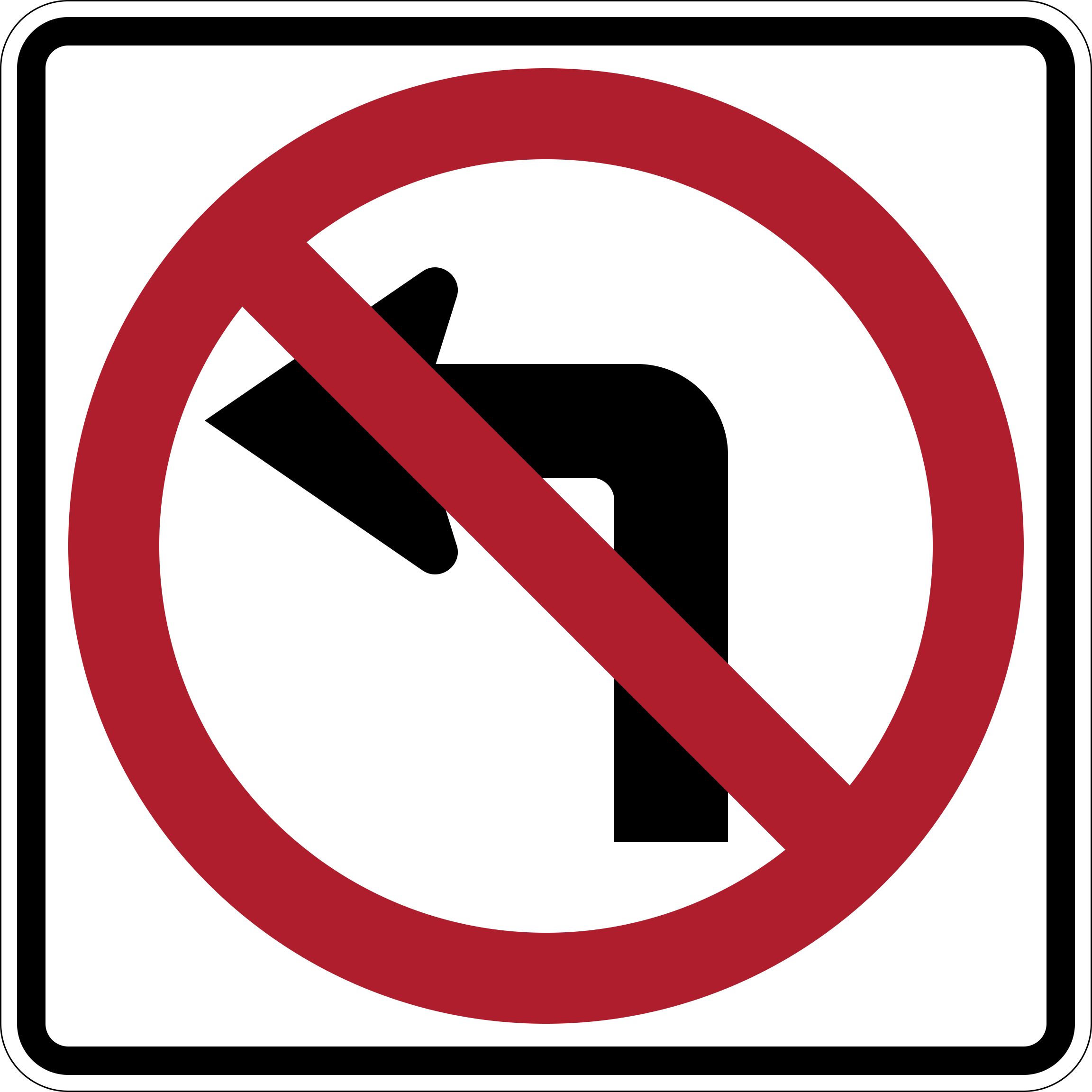
15. What maneuver is banned by the NO LEFT TURN sign?
- Making a U-turn at any later intersection
- Continuing straight through the intersection
- Turning right after yielding to pedestrians
- Turning left at that intersection
Show answer
Turning left at that intersection. The red slash over a left-turn symbol prohibits the left-turn movement at that location. It does not by itself prohibit going straight, turning right, or making a U-turn somewhere else where that movement is lawful. The U-turn option changes both the maneuver and the location, which is why it does not answer the sign. Trace the pictured arrow in your mind: when it points left and is crossed out, do not steer into the left-turn path. Follow another permitted movement instead.
16. At a steady red light, when may a driver turn right?
- Without stopping whenever no vehicle is approaching
- Whenever the driver has a green signal in another lane
- Only after waiting for the next full signal cycle
- After a complete stop, if no NO TURN ON RED sign applies and the way is clear
Show answer
After a complete stop, if no NO TURN ON RED sign applies and the way is clear. Florida permits a right turn after stopping at a red light when there is no NO TURN ON RED sign and the way is clear. The stop is mandatory even when the intersection appears empty, and the driver still must yield to pedestrians in the crosswalk and other traffic. Waiting through every cycle is more restrictive than the handbook requires. A signal in another lane does not authorize movement from this lane. Stop at the line, check the sign and crossing users, then turn only when safe.
17. Which pedestrian area is it against the law to park on?
- Mid-block alleys
- Marked lots
- Crosswalks
- Driveway aprons
Show answer
Crosswalks. Parking on a crosswalk is against the law because it forces pedestrians into the travel lane to get around the car. Crosswalks mark the protected path across the street, and a parked vehicle sitting on the stripes blinds crossing pedestrians to traffic and traffic to them. Marked lots exist for parking, alleys are not crosswalks, and driveway aprons are a separate prohibition of their own. Keep every stripe clear: stop before the crosswalk line, never on it, whether parking or waiting at a signal.
18. What should you do when you reach the end of the acceleration lane?
- Adjust speed to merge safely at the lane's end
- Stop at the lane's end always
- Merge without looking
- Accelerate past all traffic first
Show answer
Adjust speed to merge safely at the lane's end. The acceleration lane ends, and so does your run-up: Florida instructs drivers to adjust speed to merge safely into traffic when reaching the end of the acceleration lane. That means matching the flow's pace and slipping into a gap while yielding to highway traffic, which holds the right-of-way. Always stopping at the lane's end is wrong except when traffic is too heavy to allow any merge. Unlooked merges and full-throttle passes ignore the yield duty and the surrounding vehicles' stopping limits.
19. How does alcohol change reflexes, sight, and alertness?
- Reflexes sharpen
- Reflexes and reaction slow, sight and alertness drop
- Only hearing fades
- Nothing changes below .08
Show answer
Reflexes and reaction slow, sight and alertness drop. Alcohol dulls the senses that driving demands: it slows reflexes and reaction time, reduces the ability to see clearly, and makes the driver less alert. Sharpening claims invert reality, hearing-only losses miss the visual and cognitive collapse, and sub-.08 immunity contradicts the one-drink rule. Slower reactions stretch every stop, blurred sight hides hazards, and fading alertness misses them entirely. Together they explain why impaired drivers drift, brake late, and misread the road.
20. Which substances can support a Florida DUI charge?
- Alcohol, controlled substances, prescriptions, and OTC drugs
- Alcohol only
- Illegal drugs only
- Alcohol and illegal drugs only
Show answer
Alcohol, controlled substances, prescriptions, and OTC drugs. Florida DUI covers the whole medicine cabinet: alcoholic beverages, controlled substances, prescriptions, and over-the-counter medications can all support the charge. A valid prescription or a legal OTC purchase is no defense when the substance leaves the driver under the influence behind the wheel. Alcohol-only, illegal-only, and alcohol-plus-illegal readings each miss covered categories. Before driving on any drug, legal or not, check its impairment warnings and choose a sober ride if there is any doubt.
QualitySpace is expanding to Florida
We are a California-based independent insurance brokerage working on licensing in more states. We cannot help with Florida insurance yet. Leave your email and we will let you know when we can.
Every question is written from the official Official Florida Driver License Handbook. Need paper? Printable FL practice test with answer key.
Last verified 2026-09-07. How we check every question · Study all 500 as flashcards
Frequently asked questions
How many questions are on this Florida practice test?
This fixed set has 20 questions. It is test 12 of 25 from the 500 question Florida bank. The real FL exam asks 50 questions and you need 40 correct.
What is the passing score for the real Florida test?
40 out of 50 (80 percent) That figure comes from the official Florida source cited on the DMV facts page.
How does this fixed test relate to the full Florida bank?
Each numbered test is a fixed set of 20 questions in a fixed order, so you can retake the same test later and compare. Every test mixes road signs and the other topics in about the same proportion as the full bank. Tests 1 to 25 together cover every question in the Florida bank once. The full practice page mixes the whole bank at random.
Last verified 2026-09-07. See the Florida DMV facts page for sourced state details.