
Test 20 of 25 · 20 questions · Free 2026
FL Permit Practice Test 20
Jump to the test ↓A fixed 20 question set from the Florida bank with answers and plain English explanations. The real FL exam is 50 questions, 80 percent to pass; take the full length version on the main practice page.
Question 1 of 20 · 0 right so far
All 20 questions in test 20
Every question below comes from the Florida question bank on this page. Open a question to see the correct answer and the explanation. Nothing here is hidden behind a signup.
1. During a power outage, the traffic signals at a Florida intersection are dark. Two vehicles approaching from perpendicular roads arrive at the same time. Which driver must yield?
- The driver with the smaller vehicle
- The driver on the right
- The driver traveling straight
- The driver on the left
Show answer
The driver on the left. When the power is out and the signals are dark, Florida drivers treat the intersection like a four way stop. Vehicles go in the order they arrived, but when two arrive at the same time, the driver on the left yields to the driver on the right. Vehicle size and going straight do not change who yields in a tie. The driver on the right goes first after checking the path is clear. Stop fully, look right, and let that driver go first.
2. What is the center lane of a three- or five-lane highway for?
- Turning left only
- Passing slower cars
- Parking briefly
- Driving straight through
Show answer
Turning left only. The center lane of a three-lane or five-lane highway has exactly one job: turning left. It stages left-turning cars out of the through lanes so they can wait for a gap without blocking traffic. Passing in it courts a head-on meeting with an opposite-direction turner, parking in it blocks the turners it serves, and cruising straight through it misuses a lane reserved for turns. Enter it only to prepare a left turn, yield to oncoming traffic, and complete the turn promptly.
3. What does an Exit Speed sign tell you?
- The minimum ramp speed
- The maximum safe ramp speed; slow to it
- The fine for exiting
- The exit's distance
Show answer
The maximum safe ramp speed; slow to it. Exit ramps post their own physics: the Exit Speed sign lists the maximum safe speed for the ramp, and drivers must slow to the posted figure before entering it. Minimum-speed, fine, and distance readings miss a warning about the tight curve and short pavement ahead. Ramps shed expressway speed in hundreds of feet, and entering at mainline pace guarantees a lane departure. Brake on the straight, enter at the posted speed, and hold it through the curve.
4. What chemical tests may an officer request for suspected DUI?
- Only a breath test
- Only a blood test
- Blood, urine, or breath test on reasonable cause
- No tests may be requested
Show answer
Blood, urine, or breath test on reasonable cause. Reasonable cause opens three test doors: an officer who reasonably believes you are driving under the influence of alcohol or drugs may ask for a blood test, a urine test, or a breath test. No single test is exclusive, and the request is lawful backed by the implied consent you gave when signing your license. Refusing triggers automatic suspension of one year for a first refusal and eighteen months plus a misdemeanor for a second. The tests supply the chemical evidence behind the BAL thresholds.
5. Where should a window escape tool be kept?
- In the trunk under luggage
- Within reach in the car
- At home in a drawer
- Lent to a neighbor
Show answer
Within reach in the car. Escape tools only work if graspable: window-breaking tools that free you from a sinking or burning car must be kept within reach inside the vehicle in case of emergency. Trunk burial, home drawers, and neighbor loans each put the tool where drowning or trapped hands cannot find it. Clip it to the visor, console, or keychain alongside the belt cutter, and show every regular passenger where it rides. Seconds decide submerged and fire escapes.
6. What penalty follows a camera-caught school bus pass?
- $25
- $200 civil penalty
- $25,000
- No penalty
Show answer
$200 civil penalty. Bus cameras bill the owner: the registered owner of a vehicle caught by a school-bus infraction detection system faces a two-hundred-dollar civil penalty for passing a bus displaying its stop signal, whether straight past or on the children's boarding side. Twenty-five dollars is the separate add-on dedicated to safe schools, twenty-five thousand invents a felony, and no-penalty ignores the camera law. Camera buses announce themselves with stop-signal words, camera-enforced plates, and camera symbols.
7. What does Florida call the belief that a driver may travel 10 MPH over the posted limit without a citation?
- A minimum-speed rule
- A safe passing allowance
- A weather exception
- A speeding buffer myth
Show answer
A speeding buffer myth. Florida calls the idea of a ten-MPH cushion a myth. The handbook says drivers are not allowed to drive up to 10 MPH over the speed limit and may receive a speeding citation. A posted limit is not a starting point for adding extra speed, and neither passing nor clear weather creates the supposed allowance. Keep the vehicle at or below the posted maximum, then slow further when traffic, roadway, or weather conditions require it. Seeing an open road does not change the legal limit or create a buffer.
8. How should a driver respond to a STOP SIGN AHEAD warning?

- Stop immediately beside the warning sign
- Slow down and be ready to stop at the upcoming stop sign
- Ignore it if the intersection appears empty
- Turn around before reaching the intersection
Show answer
Slow down and be ready to stop at the upcoming stop sign. STOP SIGN AHEAD warns of a stop sign farther along the roadway. Slow down early and prepare to make the complete stop at that upcoming control. Stopping beside the warning sign may block traffic and does not satisfy the later stop requirement, while an empty intersection does not cancel a stop sign. Use the warning to locate the next control, release speed gradually, and arrive able to stop at the line, crosswalk, or proper stopping point.
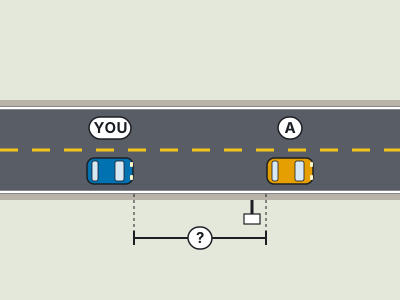
9. What minimum following distance does the Florida handbook recommend in favorable weather and traffic?
- Four seconds
- Two seconds
- Three seconds
- Eight seconds
Show answer
Four seconds. In favorable weather and traffic, Florida recommends a minimum following distance of four seconds. The handbook says to increase that distance when weather or traffic is unfavorable, including rain, low visibility, a heavy load, or a trailer. Two and three seconds fall short of that stated minimum, and eight seconds is not the handbook figure. Use a fixed roadside marker and count until your vehicle reaches it.
10. How close to an intersection may you park in Florida?
- 5 feet
- 20 feet
- 50 feet
- 100 feet
Show answer
20 feet. The intersection ban reaches 20 feet out: parking within 20 feet of an intersection is against the law. The buffer keeps corner sight lines open so turning drivers can see cross traffic and pedestrians, and it keeps crosswalks and signal approaches clear of parked obstructions. Five feet would barely clear the curb return, while 50 and 100 feet belong to railroad crossings and passing sight distances, not intersection corners. Measure from the intersection's edge and keep the whole corner zone empty.
11. When must the owner of a vehicle kept in Florida carry Florida PIP and PDL insurance?
- Once the vehicle has been in the state 90 days, consecutive or not, during the last 365 days
- Only after one full year of residency
- Only if the owner has a Florida driver license
- Once the vehicle has been in the state 30 consecutive days
Show answer
Once the vehicle has been in the state 90 days, consecutive or not, during the last 365 days. The trigger is 90 days in Florida within the last 365 days, and the days do not have to be consecutive. A full year of residency is not required, and the rule attaches to the vehicle, not to whether the owner has a Florida license. Thirty consecutive days is the wrong number and wrongly requires the days to run together. Failing to keep proper insurance can lead to suspension of the driver license and license plate registration.
12. What fine range applies to a second DUI conviction in Florida, without the .15 BAL or minor enhancement?
- $500 to $1,000
- $2,000 to $5,000
- $250 to $500
- $1,000 to $2,000
Show answer
$1,000 to $2,000. A second DUI conviction in Florida carries a fine of $1,000 to $2,000, rising to $2,000 to $4,000 with a BAL of .15 or higher or a minor in the vehicle. Five hundred to one thousand dollars is the first conviction range. Two thousand to five thousand is the third conviction range. Two hundred fifty to five hundred dollars is not in the table. The second conviction also brings up to 9 months in jail and an ignition interlock for at least one continuous year.
13. What is the first steering and braking response when your vehicle begins to skid?
- Press the brake pedal fully and turn sharply
- Accelerate until the tires regain traction
- Release the accelerator and avoid using the brakes if possible
- Turn opposite the direction you want the vehicle to go
Show answer
Release the accelerator and avoid using the brakes if possible. During a skid or hydroplane, take your foot off the accelerator and avoid braking if possible. Reducing power helps the tires regain traction, while hard braking can worsen the loss of control. Accelerating adds force to the tires that are already slipping, and a sharp opposite turn can send the vehicle farther from the intended path. Look where you want to travel, steer the front tires in that direction, and make smooth inputs until grip returns.
14. What makes slow driving against Florida law?
- Blocking or delaying traffic at normal, safe speeds
- Driving 5 MPH under any limit
- Using the right lane on hills
- Slowing for school zones
Show answer
Blocking or delaying traffic at normal, safe speeds. Slow driving becomes unlawful when it blocks or delays traffic moving at normal, safe speeds. Florida draws the line at the effect on others: a cautious pace that holds up lawful traffic is against the law, while slowing for genuine hazards such as school zones is required. Driving slightly under the limit or using the right lane on hills harms no one and violates nothing. The remedy for a slow driver is to keep right so others may pass, or to pull off where the roadway allows it.
15. Can driving too slowly violate Florida law?
- Yes, if it blocks or delays traffic moving at normal, safe speeds
- Yes, but only in a school zone
- No, unless the vehicle is on a limited access highway
- No, slow driving is always legal
Show answer
Yes, if it blocks or delays traffic moving at normal, safe speeds. Florida treats unreasonable slow driving as a traffic problem when it blocks or delays traffic moving at normal, safe speeds. The rule does not make every low speed illegal, because weather, roadway design, traffic, and vehicle control still matter. The no-slow-driving option ignores the handbook's warning, while the school-zone and limited-access choices add restrictions that the rule does not contain. If traveling below the flow, keep right so others may pass safely, and never use a guessed minimum speed as permission to obstruct traffic.
16. Where are a large truck's No Zone blind spots?
- Only directly behind
- Only at night
- Front, behind, and both sides
- Only on the left side
Show answer
Front, behind, and both sides. A commercial motor vehicle's No Zone surrounds it: large blind spots in front, behind, and on both sides of the vehicle. Even with banks of mirrors, a truck driver cannot see cars sitting in these zones, which is why the handbook's first truck rule is to stay out of them. Limiting the danger to the rear, to darkness, or to one side misses most of the hidden area. Assume you are invisible near a truck unless you can see the driver's face in their mirror.
17. What should you do at a flooded roadway?
- Drive through slowly
- Test the depth on foot
- Turn around; never drive through
- Follow the car ahead through
Show answer
Turn around; never drive through. Flooded pavement is a no-go zone: turn around and find another route, never attempting to drive through the water. Depth and current cannot be judged from the driver's seat, and the car can float, submerge, or wash away in inches more than expected. Slow testing, wading checks, and follow-the-leader all gamble with the same hidden hydrology. Six inches of rushing water moves adults; a foot floats cars. Detour pride aside and detour.
18. When may you try to extinguish a vehicle fire?
- Always fight any fire
- Only with a portable extinguisher on a small fire
- Only with water
- Only after it spreads
Show answer
Only with a portable extinguisher on a small fire. Car fires allow one narrow exception to evacuation: attempt to extinguish only with a portable extinguisher and only while the fire is still small. Always-fight orders ignore toxic fumes and explosion risk, water on fuel fires spreads the flames, and waiting to grow forfeits the small-fire window. Exit first, call 911, then judge from a safe distance whether the extinguisher can win. If it cannot, get away from the vehicle and let professionals handle the burn.
19. What do red reflectors on lane lines mean?
- You face oncoming traffic the wrong way
- You are in the correct lane
- You found the exit
- You may speed up
Show answer
You face oncoming traffic the wrong way. Red on the lane lines is a wrong-way alarm: red reflectors always mean you face traffic the wrong way with head-on collision ahead. Correct-lane, exit-found, and speed-up readings invert a warning that demands immediate correction. Turn around or get into the proper lane at once; on ramps, red edge reflectors order the same fix. The reflectors are engineered to show red only to wrong-way eyes, so seeing red is proof of the error.
20. What does a single solid yellow line mark on a divided highway or one-way street in Florida?
- A lane reserved for parking
- A crosswalk stopping point
- The right edge of the roadway
- The left edge of the roadway
Show answer
The left edge of the roadway. A single solid yellow line marks the left edge of the roadway on divided highways and one-way streets. A single solid white line marks the right edge, so confusing the two colors reverses the road-edge meaning. The line is not a parking designation or a crosswalk boundary. Use the color and location together: yellow at the left edge, white at the right edge.
QualitySpace is expanding to Florida
We are a California-based independent insurance brokerage working on licensing in more states. We cannot help with Florida insurance yet. Leave your email and we will let you know when we can.
Every question is written from the official Official Florida Driver License Handbook. Need paper? Printable FL practice test with answer key.
Last verified 2026-09-07. How we check every question · Study all 500 as flashcards
Frequently asked questions
How many questions are on this Florida practice test?
This fixed set has 20 questions. It is test 20 of 25 from the 500 question Florida bank. The real FL exam asks 50 questions and you need 40 correct.
What is the passing score for the real Florida test?
40 out of 50 (80 percent) That figure comes from the official Florida source cited on the DMV facts page.
How does this fixed test relate to the full Florida bank?
Each numbered test is a fixed set of 20 questions in a fixed order, so you can retake the same test later and compare. Every test mixes road signs and the other topics in about the same proportion as the full bank. Tests 1 to 25 together cover every question in the Florida bank once. The full practice page mixes the whole bank at random.
Last verified 2026-09-07. See the Florida DMV facts page for sourced state details.