
Test 17 of 25 · 20 questions · Free 2026
FL Permit Practice Test 17
Jump to the test ↓A fixed 20 question set from the Florida bank with answers and plain English explanations. The real FL exam is 50 questions, 80 percent to pass; take the full length version on the main practice page.
Question 1 of 20 · 0 right so far

All 20 questions in test 17
Every question below comes from the Florida question bank on this page. Open a question to see the correct answer and the explanation. Nothing here is hidden behind a signup.
1. When the slippery surface warning sign appears, which response follows the handbook?
- Accelerate firmly so the tires clear the wet surface
- Use hard braking before every curve to test traction
- Drive slowly in wet weather and avoid speeding or quick braking
- Treat the sign as notice of a gravel-only roadway
Show answer
Drive slowly in wet weather and avoid speeding or quick braking. The skidding vehicle warns that wet pavement can reduce traction. The handbook advises a slow speed and cautions against accelerating or braking quickly, so the driver has more time to respond smoothly. Acceleration can increase the chance of a skid, and hard braking is the opposite of the gentle control needed on a slick surface. The gravel-road choice confuses this warning with a pavement-ends condition. A useful cue is to pair the sign with rain: ease off the accelerator, leave room, and make turns slowly.
2. What lights must a bicycle carry at night?
- No lights are needed
- White front 500 feet, red rear 600 feet plus reflector
- Flashlight in hand only
- Rear light only
Show answer
White front 500 feet, red rear 600 feet plus reflector. Night bicycles must shine both ways between sunset and sunrise: a white light visible five hundred feet ahead plus a red reflector and red light visible six hundred feet behind. No-lights riding is illegal and nearly invisible, handheld flashlights satisfy nothing mounted, and rear-only leaves the front dark to crossing traffic. The asymmetric distances match the threats: head-on seeing needs five hundred feet while overtaking drivers need six hundred to react. Check both lamps before every night ride.
3. What must you tell an officer about a vehicle weapon?
- Hide it and stay silent
- Declare it upon first contact
- Show it to the officer
- Leave it on the seat
Show answer
Declare it upon first contact. Weapons demand immediate honesty: let the officer know upon first contact if you have a weapon in the vehicle. Silence risks a tragic discovery mid-stop, brandishing it to show looks like an attack, and seat-display normalizes a threat display. First-contact declaration lets the officer control the stop's safety plan with full information. Pair the declaration with frozen visible hands and exact compliance with the officer's next instructions, moving only when told and narrating every reach.
4. How closely may you follow a bicyclist?
- Tailgate to hurry them
- Follow at one second
- Flash high beams at them
- Keep a safe distance behind them
Show answer
Keep a safe distance behind them. Bicycles brake and swerve without warning lights, so crowding them is reckless: do not follow a bicyclist too closely. Tailgating to hurry them along, one-second gaps, and headlight harassment all pressure a rider who has no protection and few escape options. The same handbook breath that bans close following also bans high beams at approaching cyclists at night. Hang back, wait for a safe three-foot passing opportunity, and overtake as you would any slow vehicle.
5. Unless posted otherwise, what is Florida's maximum speed in a municipal, business, or residential area?
- 20 mph
- 30 mph
- 25 mph
- 55 mph
Show answer
30 mph. Florida lists 30 MPH as the maximum speed in a municipal, business, or residential area, except where another limit is posted. Twenty MPH is the standard school zone limit. Twenty five MPH is not in Florida's standard table. Fifty five MPH is the default for other streets and highways, and limited access highways allow 70 MPH. The handbook also reminds drivers that the speeding buffer is a myth: you are not allowed to drive up to 10 MPH over the limit and may receive a citation for speeding.
6. When is it safe to cut back in after passing a large truck?
- Cut in as soon as you clear the bumper
- Wait until you see the cab in your mirror
- Cut in while honking
- Cut in at night only
Show answer
Wait until you see the cab in your mirror. Trucks cannot stop as quickly as cars, so cutting in too soon after passing one invites disaster if traffic slows. The handbook's clearance test is the cab: complete the pass only when you can see the truck's cab in your rear-view mirror. Bumper clearance alone leaves no braking margin, honking communicates nothing about space, and night changes nothing about physics. Some truckers flash their headlights to signal it is safe to return; accept the courtesy and merge smoothly.
7. According to the Florida handbook, what is the minimum total stopping distance at 50 mph?
- 268 feet
- 55 feet
- 158 feet
- 100 feet
Show answer
268 feet. Total stopping distance adds perception distance, reaction distance, and braking distance, and Florida says a car at 50 mph travels at least 268 feet before stopping, nearly a football field. Fifty five feet is only the reaction distance at 50 mph. One hundred fifty eight feet is only the braking distance on dry pavement with good brakes. One hundred feet is far too short. Doubling your speed makes the braking distance and impact four times greater.
8. What does red mean on traffic signs?
- Go and guide
- Construction zones
- Stop, do not enter, wrong way
- School zones
Show answer
Stop, do not enter, wrong way. Red commands obedience: the color means stop, do not enter, and wrong way on the signs that carry it. Go-and-guide belongs to green, construction to orange, and schools to fluorescent yellow-green. Stop signs, do-not-enter signs, wrong-way signs, and yield signs all wear red because each orders immediate compliance. Seeing red on any sign is the cue to obey first and question nothing until safely stopped or turned.
9. How must a projecting load be lit at night?
- Two red lamps visible 500 feet to the rear
- No lights needed
- A single candle
- Headlights on the load
Show answer
Two red lamps visible 500 feet to the rear. Night loads must glow red behind: from sunset to sunrise and in rain, smoke, or fog, projecting loads need two red lamps on the back visible at least five hundred feet to the rear, plus red reflectors. No-lights, candle, and headlight-on-load readings miss the specification that keeps overtaking drivers from striking the overhang. Daylight uses eighteen-inch-square red flags on the extremities instead. Mark every foot beyond four feet past the rear.
10. Your vehicle breaks down and cannot be moved far. Where should you try to stop it?
- Just past the crest of a hill
- In the left lane so others pass on the right
- Where it can be seen for 200 feet in each direction
- On a curve where traffic will slow down
Show answer
Where it can be seen for 200 feet in each direction. Florida's breakdown steps start with getting all four wheels out of the traffic lanes as soon as possible. If possible, park where the disabled vehicle can be seen for 200 feet in each direction, then turn on your hazard lights and get passengers out on the side away from traffic. A hill crest or a curve hides the vehicle from approaching drivers until they are too close to react. Stopping in the left lane leaves the car in the path of traffic.
11. The Florida handbook explains how speed affects crash force. If you double a car's speed, what happens to its force of impact?
- It doubles
- It increases nine times
- It increases four times
- It stays about the same if you brake
Show answer
It increases four times. Crash energy grows much faster than speed. The Florida handbook says that when you double the speed of a car, you increase its force of impact four times, and when you triple the speed, the force of impact increases nine times. So doubling speed does not merely double the force, and nine times is the figure for tripling. Braking cannot be counted on to cancel the effect, which is why obeying the speed limit lowers both the chance and the severity of crashes.
12. What do double solid yellow lines in the center of a Florida highway mean?
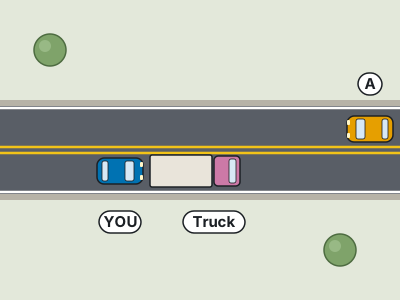
- Passing is prohibited for traffic in both directions
- Only trucks may cross the line to pass
- The center line marks a lane reserved for bicycles
- Passing is permitted whenever the road looks clear
Show answer
Passing is prohibited for traffic in both directions. A solid yellow line on both sides of the centerline marks a place where passing is not allowed. The restriction applies in both directions, so a clear-looking roadway does not create an exception. The truck choice invents a vehicle class exemption, and the bicycle-lane choice confuses a centerline with a lane designation. Before changing position, read the pavement marking on your side and the surrounding roadway. A double solid yellow line is a firm cue to stay in lane unless another lawful movement applies, such as a permitted turn.
13. You carry cargo on a Florida passenger vehicle. How far may it extend beyond the right side fenders?
- Up to 2 feet
- Up to 6 inches
- Up to 4 feet
- Any distance if it is flagged
Show answer
Up to 6 inches. Florida limits side overhang on passenger vehicles. A load may not extend beyond the fenders on the left side at all, and it may not extend more than 6 inches beyond the line of the fenders on the right side. Two feet and four feet are far too wide for a passenger car, and the four foot figure comes from the rule for loads that project from the rear. Flags mark a projecting load, but they do not make an illegal side overhang legal.
14. How did you agree to DUI chemical testing?
- Verbal promise at the stop
- Signature on the driver license
- Payment of a testing fee
- Nothing implies consent
Show answer
Signature on the driver license. Consent is signed, not spoken: by law you agreed, when signing your driver license, to take the requested blood, urine, or breath tests. The license signature is the implied-consent contract every Florida driver accepts with the card. No roadside promise, fee payment, or fresh agreement is needed, and claiming no consent exists contradicts the statute. That is why refusal carries its own automatic suspension: the driver is breaking a testing promise already made and signed.
15. How close to a flashing signal, stop sign, or traffic signal may a Florida driver park?
- No closer than 15 feet
- No closer than 20 feet
- No closer than 50 feet
- No closer than 30 feet
Show answer
No closer than 30 feet. Florida's no parking list includes within 30 feet of any flashing signal, stop sign, or traffic signal, and within 30 feet of a rural mailbox on a state highway between 8 am and 6 pm. Fifty feet is the railroad crossing distance, and 20 feet is the distance from the entrance to a fire, ambulance or rescue station. Parking is also barred on overpasses, in tunnels, in front of driveways, by yellow curbs and on the roadway side of a parked vehicle.
16. What is the tire-blowout procedure?
- Ease off gas, no brakes, steer, slow, soft-brake, pull off
- Slam the brakes immediately
- Jerk the wheel hard
- Speed up to stabilize
Show answer
Ease off gas, no brakes, steer, slow, soft-brake, pull off. Blowouts demand gentleness, not panic: take your foot off the gas without touching the brakes, concentrate on steering, slow down gradually, brake softly only once the car is under control, then pull completely off the pavement. Slamming the brakes, jerking the wheel, or speeding up each convert a manageable flat into a rollover or a lane departure. The shredded tire still rolls and steers if you let it; smooth inputs nurse it to the shoulder where the spare and the jack wait.
17. How should a Florida driver change following distance when roads are wet from rain?
- Decrease it to stay with the vehicle ahead
- Keep exactly four seconds in every condition
- Use the shoulder as an extra stopping lane
- Increase it because wet roads lengthen stopping distance
Show answer
Increase it because wet roads lengthen stopping distance. Rain makes roads slick and increases braking and stopping distance, so the handbook tells drivers to increase following distance. Four seconds is the minimum for favorable conditions, not a ceiling that applies during every storm. Closing the gap reduces reaction room, and the shoulder is not a substitute for space in the travel lane. Slow down, turn on headlights with the wipers, and leave extra room ahead.
18. What evaluation follows a first DUI conviction?
- An evaluation for addiction-treatment need
- No evaluation is needed
- A vehicle appraisal
- A credit check
Show answer
An evaluation for addiction-treatment need. Every first DUI sentence includes an evaluation to determine the need for treatment for addiction. The screening separates the one-time mistake from the emerging dependency and routes the latter into treatment before the next offense. Skipping evaluation, appraising the car, or checking credit each miss the point: the court is diagnosing the driver, not the finances or the vehicle. Second and third convictions repeat the evaluation, because recurrence itself signals deepening addiction.
19. How should you adjust following distance when being passed?
- Speed up to block the pass
- Move left to help
- Sound the horn continuously
- Leave more space ahead so the pass completes safely
Show answer
Leave more space ahead so the pass completes safely. When another driver passes you, Florida asks you to open extra space in front of your vehicle so the pass can be completed safely. The passing car needs a gap to return to the lane, and crowding forward closes it. Speeding up to block, drifting left, or blasting the horn all endanger the maneuver and can provoke a head-on collision. Easing off and holding your lane is the cooperative, legal response that gets everyone past the conflict point with room to spare.
20. What is the exception to always parking on the right side?
- One-way streets
- Dead-end streets
- Gravel roads
- Private driveways
Show answer
One-way streets. The right-side parking rule carries one stated exception: one-way streets. On ordinary two-way roads every driver parks on the right facing traffic, but a one-way street's single flow direction makes left-side parking workable. Dead ends, gravel surfaces, and private driveways create no exception in the handbook's rule. Even where the exception applies, the car must still face the direction of traffic and sit fully clear of the travel lane with brake set and keys out.
QualitySpace is expanding to Florida
We are a California-based independent insurance brokerage working on licensing in more states. We cannot help with Florida insurance yet. Leave your email and we will let you know when we can.
Every question is written from the official Official Florida Driver License Handbook. Need paper? Printable FL practice test with answer key.
Last verified 2026-09-07. How we check every question · Study all 500 as flashcards
Frequently asked questions
How many questions are on this Florida practice test?
This fixed set has 20 questions. It is test 17 of 25 from the 500 question Florida bank. The real FL exam asks 50 questions and you need 40 correct.
What is the passing score for the real Florida test?
40 out of 50 (80 percent) That figure comes from the official Florida source cited on the DMV facts page.
How does this fixed test relate to the full Florida bank?
Each numbered test is a fixed set of 20 questions in a fixed order, so you can retake the same test later and compare. Every test mixes road signs and the other topics in about the same proportion as the full bank. Tests 1 to 25 together cover every question in the Florida bank once. The full practice page mixes the whole bank at random.
Last verified 2026-09-07. See the Florida DMV facts page for sourced state details.