
Test 8 of 25 · 20 questions · Free 2026
FL Permit Practice Test 8
Jump to the test ↓A fixed 20 question set from the Florida bank with answers and plain English explanations. The real FL exam is 50 questions, 80 percent to pass; take the full length version on the main practice page.
Question 1 of 20 · 0 right so far
All 20 questions in test 8
Every question below comes from the Florida question bank on this page. Open a question to see the correct answer and the explanation. Nothing here is hidden behind a signup.
1. What medical steps should older drivers take?
- Skip checkups entirely
- Regular exams and ask how meds affect driving
- Drive only when sick
- Double all medications
Show answer
Regular exams and ask how meds affect driving. Aging drivers protect themselves with medicine's help: get regular medical and eye exams to catch conditions affecting driving, and ask the doctor or pharmacist how medications, especially in combination, affect driving. Skipping checkups, driving sick, and doubling doses each invite impairment behind the wheel. Exercise for flexibility and strength, vehicle adjustments like knobs and larger mirrors, and avoiding sunglasses in dim light plus risky times complete the older-driver safety plan.
2. Your Florida insurance lapses and you do not send FLHSMV proof of new coverage. How long can your license and plate be suspended?
- Up to 30 days
- Up to six months
- They cannot be suspended for a lapse
- Up to three years
Show answer
Up to three years. Insurers must notify FLHSMV when a policy is cancelled or not renewed. FLHSMV then asks for proof of new coverage, and without it the driver license and license plate can be suspended for up to three years. Thirty days and six months understate the penalty, and a lapse clearly can lead to suspension. Turning in the plate before cancelling insurance avoids the suspension and reinstatement fees. To lift a suspension after a conviction, you must get insurance and pay a reinstatement fee of $150 to $500.
Study this in the handbook: Insurance, registration and vehicle equipment
3. What parking fees can a mobility-impaired permit holder skip?
- No parking fees on public streets, highways, or metered spaces
- Free gasoline at state pumps
- No tolls on any expressway
- Free vehicle registration
Show answer
No parking fees on public streets, highways, or metered spaces. Drivers with a mobility impairment who hold the proper permit park free: no parking fees on any public street, highway, or metered space, plus the right to use spaces reserved for persons with disabilities. The exemption removes cost as a barrier to accessible parking near destinations. Gasoline, tolls, and registration carry no parallel exemption. The privilege depends on displaying the permit or plate and on the vehicle actually transporting the person with the disability who owns it.
Study this in the handbook: Learner's license, practice hours and teen curfews
4. What judgments does alcohol impair in traffic?
- Judging distance, speed, movement, and controlling the car
- Only reading signs
- Only using turn signals
- Only parking straight
Show answer
Judging distance, speed, movement, and controlling the car. Spatial judgment fails under alcohol: drivers have trouble judging the distance, speed, and movement of other vehicles, plus trouble controlling their own. Sign reading, signal use, and parking suffer too, but the handbook singles out the motion-perception collapse that makes lane changes, merges, and intersections deadly. A driver who cannot tell how fast others approach cannot pick safe gaps. Combined with slowed reactions, the perception failure turns ordinary traffic into a guessing game the impaired driver loses.
Study this in the handbook: DUI, implied consent and zero tolerance
5. When may you turn left on red in Florida?
- Never turn on red
- Only right turns on red
- Left from one-way to one-way, after stop and yield
- Any left on red
Show answer
Left from one-way to one-way, after stop and yield. Left on red has exactly one legal shape: from a one-way street onto a one-way street with traffic moving to the left, after a complete stop and yielding. Never-turn readings miss both this and the right-on-red exception, right-only readings miss the left exception, and any-left readings would send drivers into oncoming lanes. Both red-turn exceptions also yield to pedestrians in the crosswalk and to oncoming or crossing traffic before moving.
Study this in the handbook: Traffic signals, pedestrian signals and railroad crossings
6. How many points does unlawful speed resulting in a crash carry in Florida?
- 6 points
- 3 points
- 4 points
- No points, only a fine
Show answer
6 points. When unlawful speeding results in a crash, Florida assigns 6 points, the highest tier on the speeding portion of the point table. By comparison, minor speeding without a crash draws 3 or 4 points depending on how far over the limit the driver was. The 6-point value matches other grave outcomes such as leaving a crash scene with significant property damage. A single speed-caused crash therefore puts a driver halfway to a 30-day suspension at 12 points within 12 months.
7. What is better than swerving into oncoming traffic?
- Swerve off the road rather than into oncoming traffic
- Swerve into oncoming traffic
- Skid off the road deliberately
- Close your eyes
Show answer
Swerve off the road rather than into oncoming traffic. Unavoidable crashes still offer least-bad choices: better to swerve off the road than into oncoming traffic, and better to drive off under control than to skid off. Head-on closing speeds double the violence, and skids surrender the steering that picks the softest target. Eye-closing abandons even that choice. The hierarchy continues: stationary objects beat oncoming vehicles, same-direction hits beat head-ons, and soft hedges beat solid trees. Choose the roadside over the centerline every time.
Study this in the handbook: Move Over Law and emergency vehicles
8. What minimum tire tread depth does Florida's equipment standard call for?
- 1/32 of an inch
- 2/32 of an inch
- 1/4 of an inch
- 3/32 of an inch
Show answer
3/32 of an inch. Florida's required equipment list says tires should have a minimum tread of at least 3/32 of an inch, with no worn spots showing the ply. Worn tread cannot channel water away, which raises the risk of hydroplaning and longer stops on wet pavement. One thirty second and two thirty seconds of an inch are shallower than the Florida standard. A quarter inch is close to new tire depth and is more than the minimum the handbook requires.
Study this in the handbook: Insurance, registration and vehicle equipment
9. What does a school crossing sign tell a driver to do?
- Maintain the posted speed because the sign is only informational
- Slow down, watch for children, stop if necessary, and obey crossing guards
- Stop only when a school bus is displaying red lights
- Use the shoulder to pass children who are crossing
Show answer
Slow down, watch for children, stop if necessary, and obey crossing guards. A school crossing sign warns that children may be crossing the road. Florida tells drivers to slow down, watch for children, stop if necessary, and obey signals from crossing guards. The sign does not limit the response to school-bus activity, and it is not permission to maintain speed. Passing on the shoulder would place a vehicle where vulnerable road users may be present. Reduce speed before the crossing, scan both sides, and follow the guard’s direction even if the lane appears open at first.
10. What kinds of information can Florida traffic signs give drivers?
- Traffic rules, hazards, roadway location, directions, and roadway services
- The vehicle's maintenance schedule and fuel grade
- Only the name of the road's owner
- Only weather forecasts and emergency phone numbers
Show answer
Traffic rules, hazards, roadway location, directions, and roadway services. Florida says traffic signs communicate several kinds of roadway information, including rules, hazards, location, directions, and services. A sign may therefore tell you to stop, warn about a condition, identify where you are, point toward a destination, or show where help and amenities are available. Ownership, vehicle maintenance, fuel grade, and weather forecasts are not the listed purposes. Use the sign's color, shape, symbols, and words together so you can identify both the message category and the driving response it calls for.
Study this in the handbook: Pavement markings
11. During a traffic stop, what should you do after pulling to the side safely?
- Exit immediately and walk toward the officer
- Keep the engine running and turn up the audio to signal cooperation
- Turn off the engine and audio devices, then stay in the vehicle unless directed out
- Move back into traffic as soon as the officer reaches the car
Show answer
Turn off the engine and audio devices, then stay in the vehicle unless directed out. Florida's traffic-stop guidance asks drivers to turn off the engine and audio devices, then remain in the vehicle unless the officer directs them to exit. Those actions reduce confusion and help the officer observe the situation. Leaving without direction can create a safety problem, while keeping the engine and audio running ignores the requested preparation. Reentering traffic is not part of the stop procedure. Activate the turn signal, pull over when safe, keep your hands visible, and follow clear instructions calmly.
Study this in the handbook: Move Over Law and emergency vehicles
12. Where must your car be relative to the crosswalk at a red light?
- Stop across the stripes
- Hang the bumper over the walk
- Creep into the crosswalk
- Keep every part clear of the crosswalk
Show answer
Keep every part clear of the crosswalk. Red lights do not license crosswalk parking: never block the crosswalk when stopped, and do not stop with any portion of the vehicle overhanging it. Stripes, bumpers, and creeping all steal the protected path pedestrians need, forcing them around the car and into live lanes. Stop behind the crosswalk line, or behind the stop line where marked, and hold there until the light releases you. The crosswalk belongs to walkers for the whole stop, not just while someone is visibly crossing.
Study this in the handbook: Right of way at intersections and roundabouts
13. How do illegal drugs affect driving ability?
- They improve driving focus
- They impair reflexes, judgment, and alertness
- They only affect passengers
- They wear off in minutes
Show answer
They impair reflexes, judgment, and alertness. Illegal and controlled drugs attack the same skills as alcohol: marijuana and its cousins impair reflexes, judgment, and alertness alongside many other dangerous side effects. Worse, they can add a false sense of alertness and self-confidence, or swing the other way into drowsiness and inability to react to simple situations. Focus improvements, passenger-only effects, and minutes-long durations all deny the documented pharmacology. Driving under any impairing drug, legal or not, supports the same DUI charge as alcohol.
14. When driving in fog or heavy rain, which headlight setting does the handbook recommend?
- High beams, because reflected light always improves the view
- Parking lights only, because headlights create too much glare
- No lights, if the driver can still see the lane edge
- Low beams, because high beams reflect off fog and impair visibility
Show answer
Low beams, because high beams reflect off fog and impair visibility. Low visibility from fog, smoke, or heavy rain requires headlights, and the handbook specifies low beams. High beams can reflect from fog and make it harder to see, so using them is the tempting but unsafe option. Parking lights are not a substitute for headlights, and darkness or reduced visibility is not a reason to drive unlit. Turn on low beams, use wipers and defrosters, and follow edge lines as visual guides while reducing distractions and speed.
Study this in the handbook: Night driving and headlights
15. What do double solid yellow lines mean?
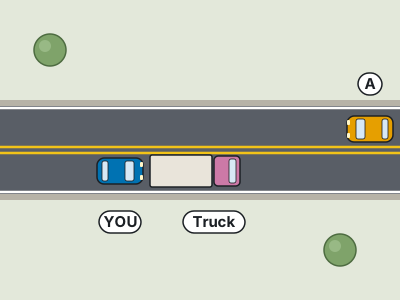
- Passing is permitted for traffic moving in both directions
- No passing in either direction, except a safe left turn or a safe pass around a bicyclist
- Only trucks may cross the lines to pass slower traffic
- A driver may cross whenever the road ahead looks clear
Show answer
No passing in either direction, except a safe left turn or a safe pass around a bicyclist. Double solid yellow lines prohibit vehicles traveling in either direction from passing or crossing the lines. Florida still allows a left turn or a pass around a bicyclist when that maneuver is safe, but those limited permissions do not create a general passing zone. The choice allowing traffic in both directions to pass ignores the meaning of solid lines. The truck-only option invents an exception, and a clear view alone does not authorize crossing. Treat the marking as a barrier for ordinary passing, then check separately for a lawful turn or bicyclist maneuver.
Study this in the handbook: Pavement markings
16. At a two-way stop, which vehicle has the right-of-way when one vehicle turns and the other goes straight?
- The vehicle making the turn
- The vehicle going straight
- The vehicle that arrived last
- Neither vehicle until both reverse
Show answer
The vehicle going straight. Florida states that at a two-way stop, the turning vehicle yields to the vehicle going straight. The straight-moving vehicle has the right-of-way through the conflict area, while the turning driver must wait for a safe opening. Arrival order does not override this specific two-way-stop rule, and neither driver should reverse simply because the other is present. Stop where required, check for pedestrians and bicyclists, confirm the path is clear, and let the vehicle continuing straight proceed before beginning the turn.
Study this in the handbook: Right of way at intersections and roundabouts
17. Which painted curb color bans parking?
- Yellow painted curbs
- White painted curbs
- Green signs
- Blue reflectors
Show answer
Yellow painted curbs. Painted curbs speak a color language, and yellow means no parking: Florida bans parking by yellow painted curbs. The yellow line marks fire access, loading needs, sight-line clearances, or other keep-clear purposes the curb owner has designated. White curbs generally allow short passenger stops where posted, green signs give guidance or permission, and blue marks disabled access rather than a general ban. When the curb is yellow, keep rolling to a legal space.
Study this in the handbook: Passing, turning and parking
18. What do high speeds do to stopping distances and crash severity?
- They shorten stopping distances
- They only affect tire wear
- They greatly increase stopping distances and crash severity
- They improve steering response
Show answer
They greatly increase stopping distances and crash severity. Speed punishes twice: it stretches the pavement needed to stop and it magnifies the violence when stopping fails. Florida's handbook states both effects in one sentence, linking high speeds to longer stopping distances and more severe crashes. The physics behind it is the squared relationship between speed and energy, which is why small speed increases produce outsized harm. Tire wear and steering feel are side issues; the dominant costs of speed are measured in feet of stopping distance and severity of injury.
Study this in the handbook: Following distance, stopping and speed limits
19. What movement is prohibited at an intersection posted with a NO RIGHT TURN sign?
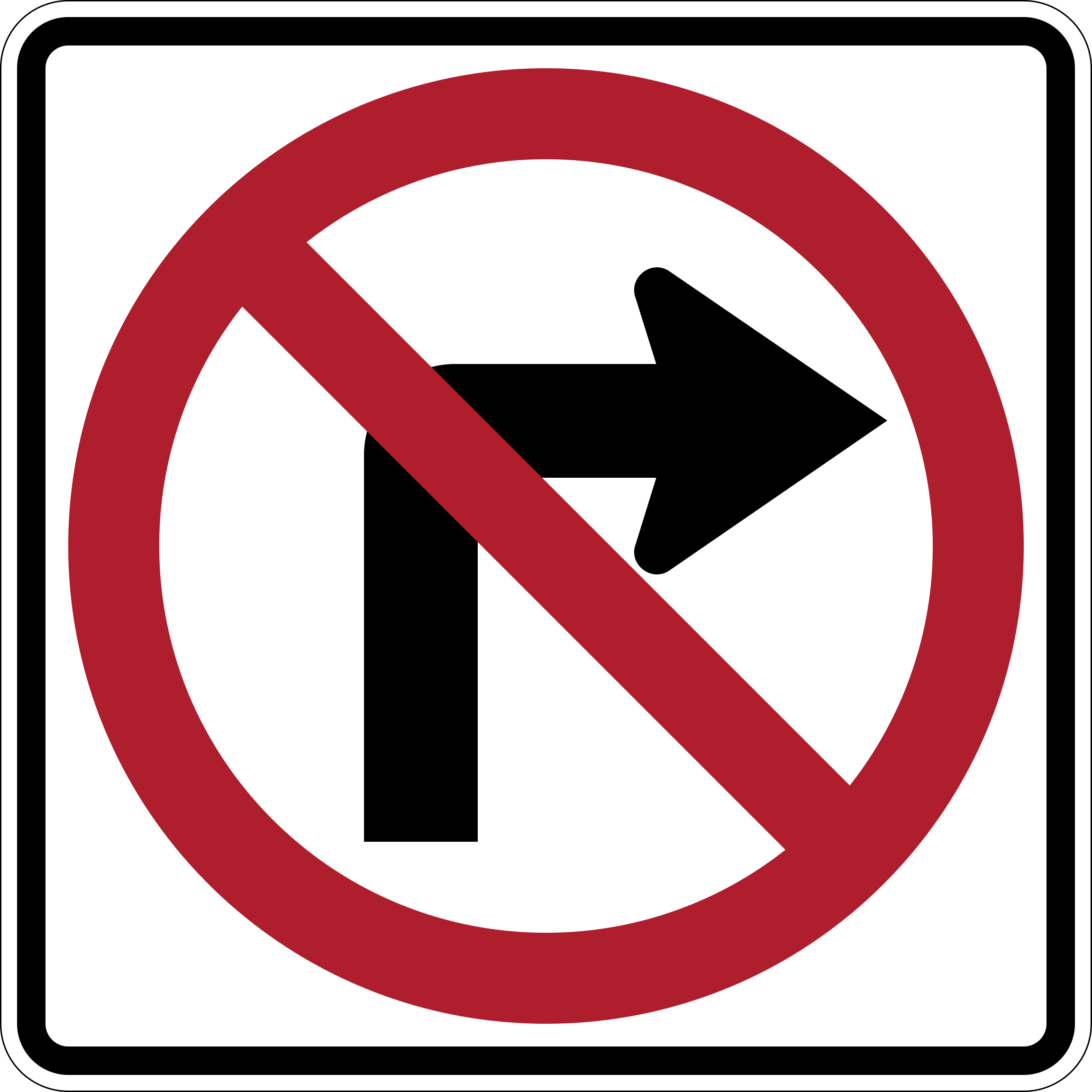
- Driving straight through the intersection
- Parking on the right side of the roadway
- Turning right at that intersection
- Turning left after yielding to traffic
Show answer
Turning right at that intersection. NO RIGHT TURN bans the right-turn movement at the marked intersection. A driver may not make that turn simply because the signal is red or because the route appears clear. The straight-ahead choice is not prohibited by this symbol, and parking position is unrelated to the intersection movement. The left-turn option describes a different path. Match the symbol to the planned maneuver before entering the intersection, then select a permitted direction and obey any other signal control.
20. Before receiving an unrestricted Florida license, how much supervised driving practice is required and how much must be at night?
- 30 total hours, including 5 at night
- 50 total hours, including 10 at night
- 60 total hours, including 15 at night
- 40 total hours, including 10 at night
Show answer
50 total hours, including 10 at night. Florida requires a parent, guardian, or responsible adult age 21 or older to certify at least 50 hours of driving experience, including 10 hours at night, for the under-18 licensing path. The 30, 40, and 60-hour totals alter the stated practice requirement, while the five and 15-hour night figures also miss the handbook's number. Treat the night portion as part of the 50-hour total, not as extra hours added on top. A log or certification should reflect both figures before the applicant advances.
Study this in the handbook: Learner's license, practice hours and teen curfews
QualitySpace is expanding to Florida
We are a California-based independent insurance brokerage working on licensing in more states. We cannot help with Florida insurance yet. Leave your email and we will let you know when we can.
Every question is written from the official Official Florida Driver License Handbook. Need paper? Printable FL practice test with answer key.
Last verified 2026-10-05. How we check every question · Study all 500 as flashcards
Frequently asked questions
How many questions are on this Florida practice test?
This fixed set has 20 questions. It is test 8 of 25 from the 500 question Florida bank. The real FL exam asks 50 questions and you need 40 correct.
What is the passing score for the real Florida test?
40 out of 50 (80 percent) That figure comes from the official Florida source cited on the DMV facts page.
How does this fixed test relate to the full Florida bank?
Each numbered test is a fixed set of questions in a fixed order, so you can retake the same test later and compare. Every test mixes road signs and the other topics in about the same proportion as the full bank. Tests 1 to 25 together cover every question in the Florida bank once. The full practice page mixes the whole bank at random.
Last verified 2026-10-05. See the Florida DMV facts page for sourced state details.