
Test 25 of 25 · 20 questions · Free 2026
FL Permit Practice Test 25
Jump to the test ↓A fixed 20 question set from the Florida bank with answers and plain English explanations. The real FL exam is 50 questions, 80 percent to pass; take the full length version on the main practice page.
Question 1 of 20 · 0 right so far
All 20 questions in test 25
Every question below comes from the Florida question bank on this page. Open a question to see the correct answer and the explanation. Nothing here is hidden behind a signup.
1. What should you expect behind buses or trucks at railroad crossings?
- Speed past them
- Be prepared to stop behind them
- Honk them through
- Pass on the shoulder
Show answer
Be prepared to stop behind them. Many buses and trucks must stop at railroad crossings even when gates are up and lights are silent, so expect the unexpected: be prepared to stop when following them toward the tracks. Speeding past, honking them through, or shoulder-passing around the stop all collide with vehicles obeying the law. The required stop applies to city and school buses and hazmat carriers among others. Hang back, watch for brake lights and door openings, and never pull around a vehicle stopped at the rails.
2. Who is charged for an unrestrained passenger?
- No one is charged
- Only the car owner
- Only the youngest passenger
- Drivers for under-18s; adults for themselves
Show answer
Drivers for under-18s; adults for themselves. Belt tickets follow responsibility: drivers are charged when any passenger under eighteen rides improperly restrained, while passengers eighteen and older are charged themselves for their own violation. No-one, owner-only, and youngest-only readings scramble the statute's plain split. The driver-as-guardian rule makes the pre-trip belt check part of every departure with kids aboard. Adults keep their own duty; only children borrow the driver's.
3. Under Florida's Three Crashes in Three Years law, how long does the driver have to finish the required course and driving test?
- 30 days, or a fine is added
- One year, or points are added
- 90 days, or the license is cancelled
- There is no deadline
Show answer
90 days, or the license is cancelled. A driver convicted of a third traffic offense that caused a crash within 36 months must complete an approved driver improvement course with behind the wheel training and pass an extended driving test with a license examiner. Those requirements must be finished within 90 days, or the license is cancelled. Thirty days and one year are the wrong windows, and the penalty is cancellation, not a fine or points. There is a firm deadline.
4. Why use extra caution at intersections?
- Speed through them
- Close your eyes
- Follow closely through
- Use extra caution; crashes concentrate there
Show answer
Use extra caution; crashes concentrate there. Intersections top the crash map: use extra caution approaching them, because crashes happen at intersections more than any other place. Speeding through, eye-closing, and tailgating through each maximize exposure where cross traffic, turns, signals, and pedestrians collide. Slow early, cover the brake, scan both ways twice, and expect red-light runners and turning trucks. The intersection repays paranoia with survival better than any other roadway feature.
5. What do double solid white lines mean?
- Cross freely
- Cross to speed
- Never cross or change lanes there
- Cross at night only
Show answer
Never cross or change lanes there. Double solid white lines are walls between same-direction lanes: crossing them or changing lanes there is not allowed. Free crossing, speed crossing, and night-only crossing each violate the absolute ban that double solid paint declares. These pairs guard high-risk spots like tunnels, bridges, and gore areas where a lane change could be catastrophic. Hold your lane through the double solid zone and wait for the marking to break before moving.
6. Under Florida's zero-tolerance rule, what BAL automatically suspends the driving privilege of a driver under 21?
- .02 or higher
- .00 or higher
- .05 or higher
- .08 or higher
Show answer
.02 or higher. Florida's zero-tolerance provision applies to a driver under 21 who is stopped by law enforcement with a BAL of .02 or higher. The stated result is an automatic six-month suspension of the driving privilege. The .05 figure triggers a substance abuse course, not the threshold asked here. The .08 figure is the general adult administrative-suspension level, and .00 is stricter than the handbook's stated cutoff. In a youth-driver scenario, look first for the zero-tolerance section and its .02 number.
7. When parking beside a curb on a public road, how close should the right wheels be?
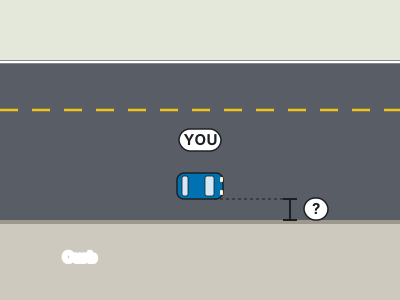
- Within 36 inches of the curb
- Within 12 inches of the curb or side of the roadway
- Touching the curb with both tires
- At least six feet from the curb
Show answer
Within 12 inches of the curb or side of the roadway. Florida instructs drivers to park on the right side of the road, parallel to the curb in the direction of traffic, with the right-hand wheels parallel to and within 12 inches of the curb or side of the roadway. Thirty six inches leaves the vehicle too far out, six feet is not a curbside parking position, and the handbook does not tell drivers to press the tires against the curb. Set the parking brake, secure the transmission, and check surrounding traffic before opening a door or pulling away. The cue is close and parallel, not angled or distant.
8. What does a yellow arrow mean?
- The green arrow is ending; stop if safe
- Speed up to beat it
- It means go
- Ignore it at night
Show answer
The green arrow is ending; stop if safe. Yellow arrows warn of an ending protected movement: the green arrow is ending or the light is about to turn red, so stop if you can safely do so. Speeding to beat it, reading it as go, or ignoring it after dark each gamble with the red that follows. Like a yellow ball, the yellow arrow protects the intersection clearance interval; entering on yellow is lawful only when stopping safely is impossible. Cover the brake and prepare to stop when any arrow burns yellow.
9. What do flashing red lights at a railroad crossing indicate?
- A train is approaching and the driver must stop
- A service area is nearby
- The road has changed to one way
- The crossing is open for immediate crossing
Show answer
A train is approaching and the driver must stop. At many railroad crossings, flashing red lights and bells accompany the crossbuck. When those lights begin to flash, a train is approaching, so the driver must stop immediately. Treating the crossing as open or reading the signal as a service or lane marker ignores the railroad warning. Slow while approaching every crossing, stay off the tracks, and never drive around a lowered gate. The red flash is a direct stop cue because the train has priority and cannot stop quickly for a vehicle.
10. What does the round yellow railroad warning sign tell a Florida driver?

- A roundabout is ahead and traffic moves counter-clockwise
- A highway-railroad crossing is ahead, so slow and prepare to stop
- The railroad crossing has already been passed
- Bicycles are prohibited on the roadway
Show answer
A highway-railroad crossing is ahead, so slow and prepare to stop. The round yellow railroad symbol is advance notice of a highway-railroad crossing. It gives the driver time to reduce speed, scan the tracks, and prepare to stop before reaching the crossing. The roundabout choice relies only on the shape and ignores the railroad symbol. Do not wait for gates or lights before becoming alert. Treat the sign as an early warning, then approach slowly enough to stop if a train, signal, gate, or flagger requires it.
11. What lane practice is required while driving through a roundabout?
- Do not change lanes in the roundabout
- Change lanes whenever another exit is closer
- Stop in the circle before choosing an exit
- Drive clockwise to make lane changes easier
Show answer
Do not change lanes in the roundabout. Florida describes roundabouts as one way, counterclockwise intersections and directs drivers not to change lanes in the circle. Changing lanes while circulating can cut across another vehicle's path, especially near an exit. Stopping in the roundabout disrupts moving traffic and is also prohibited. Clockwise travel is the wrong direction. Choose the appropriate lane before entering, yield to traffic already in the roundabout, maintain a steady path, and signal before exiting. The central island is not a place to pause or reposition.
12. Why does the Florida handbook describe texting while driving as especially dangerous?
- It affects only a driver's hearing
- It involves visual, manual, and cognitive distractions
- It removes the need to watch traffic signals
- It is dangerous only above 70 MPH
Show answer
It involves visual, manual, and cognitive distractions. Texting is especially hazardous because it combines all three distraction categories: visual distraction takes the eyes from the road, manual distraction takes the hands from the wheel, and cognitive distraction diverts thought from driving. The other options incorrectly limit the risk to speed, hearing, or signals. A useful memory cue is three-part interference: eyes, hands, and mind are all pulled away from safe vehicle control.
13. Which elevated structure is it against the law to park on?
- Parking garages
- Overpasses
- Marked lots
- Metered spaces
Show answer
Overpasses. Overpasses share the bridge problem: elevated pavement with narrow shoulders, guardrails instead of escape room, and fast traffic with no place to dodge. Parking on an overpass is against the law for the same reason as parking on bridges and in tunnels. Garages, marked lots, and rest areas hold stopped cars safely off the traveled way. A forced breakdown stop on an overpass calls for maximum visibility and minimum time: flashers on, car as far right as possible, occupants behind the rail.
14. According to Florida's handbook, if you triple the speed of a car, what happens to its force of impact?
- Three times
- Four times
- Six times
- Nine times
Show answer
Nine times. Crash force grows much faster than speed because impact energy rises with the square of velocity. Florida's handbook makes this concrete with two multipliers: doubling speed quadruples the force of impact, and tripling speed multiplies it nine times. That is why even moderate speeding turns survivable collisions into fatal ones. The striking power of the vehicle, not just the driver's reaction time, is what makes high-speed crashes so destructive. Respecting the limit keeps impact forces within the range vehicle safety systems are designed to handle.
15. What is the jail maximum for a first DUI conviction?
- Not more than 6 months
- Not more than 30 days
- Not more than 5 years
- No jail is possible
Show answer
Not more than 6 months. First-offense DUI jail time caps at not more than six months, before enhancements. The ceiling rises to nine months when the BAL reaches .15 or higher or a minor was in the vehicle. Thirty days understates the court's power, five years belongs to felony territory far beyond a first DUI, and no-jail readings ignore a listed penalty. Jail joins the fine, service, probation, revocation, school, evaluation, and possible interlock in a sentence designed to punish once and deter forever.
16. Who may use Florida HOV lanes?
- Any solo driver
- Carpools of 2+ and decal LEVs
- Trucks only
- Motorcycles only
Show answer
Carpools of 2+ and decal LEVs. High occupancy vehicle lanes reward sharing the ride: some highways reserve the left lane for vehicles with two or more occupants or hybrid and low-emission vehicles. Low-emission vehicles need a decal and a completed FLHSMV form to qualify solo. Solo conventional drivers, trucks as a class, and motorcycles as a class gain no automatic right. HOV lanes show themselves by signs and diamond pavement symbols with a striped buffer, and cars may enter and exit only at designated points.
17. Which way should you run from a car stalled on tracks?
- Run straight away from the train
- Run along the tracks
- Stay in the car
- Run at 45 degrees toward the train
Show answer
Run at 45 degrees toward the train. Escaping a stalled car on the tracks has a counterintuitive direction: if a train is coming, run at a forty-five-degree angle away from the tracks but toward the train. Debris and the struck car fly forward with the train's motion, so the toward-train angle keeps you out of the wreckage path. Straight-away, along-track, and stay-inside choices each keep you in the impact or debris zone. Get everyone out immediately first, then run the angle and call for help from safety.
18. A Florida learner's license holder has had the license for four months. Until what time may they now drive?
- Only during daylight hours
- Until 11 p.m.
- Until 10 p.m.
- Until 1 a.m.
Show answer
Until 10 p.m.. For the first three months, a Florida learner may drive only during daylight hours. After three months the learner may drive until 10 p.m., always with a licensed driver 21 or older. Daylight only is the rule for the first three months, so it no longer applies at four months. Eleven p.m. is the limit for a 16-year-old with a driver license, and 1 a.m. is the limit for a 17-year-old license holder. Neither applies to a learner's license.
19. Why does more following distance help avoid collisions?
- It wastes fuel
- It angers other drivers
- It gives more time to react
- It shortens trips
Show answer
It gives more time to react. Distance is time: the more space between your vehicle and others, the more time you have to perceive a hazard, decide, and act. Florida's handbook states this as the core payoff of following distance, which is why it prescribes a four-second minimum in favorable conditions and more when conditions worsen. Fuel, feelings, and trip length are beside the point. Every extra second of gap is an extra second of reaction time, and reaction time is what separates near misses from collisions.
20. How close to oncoming traffic may you still be in the left lane?
- Before coming within 200 feet of approaching traffic
- After forcing oncoming cars aside
- At the last possible instant
- Only when the road widens
Show answer
Before coming within 200 feet of approaching traffic. Oncoming traffic sets a hard deadline: you must be back in the right lane before coming within 200 feet of any approaching vehicle. Two cars closing at highway speed erase 200 feet in about a second, so the margin is already thin. Forcing oncoming drivers onto the shoulder, delaying to the last instant, or waiting for a wider road all gamble with a head-on collision. If the gap cannot accommodate the full pass with this margin, the handbook's answer is simple: stay behind and wait.
QualitySpace is expanding to Florida
We are a California-based independent insurance brokerage working on licensing in more states. We cannot help with Florida insurance yet. Leave your email and we will let you know when we can.
Every question is written from the official Official Florida Driver License Handbook. Need paper? Printable FL practice test with answer key.
Last verified 2026-09-07. How we check every question · Study all 500 as flashcards
Frequently asked questions
How many questions are on this Florida practice test?
This fixed set has 20 questions. It is test 25 of 25 from the 500 question Florida bank. The real FL exam asks 50 questions and you need 40 correct.
What is the passing score for the real Florida test?
40 out of 50 (80 percent) That figure comes from the official Florida source cited on the DMV facts page.
How does this fixed test relate to the full Florida bank?
Each numbered test is a fixed set of 20 questions in a fixed order, so you can retake the same test later and compare. Every test mixes road signs and the other topics in about the same proportion as the full bank. Tests 1 to 25 together cover every question in the Florida bank once. The full practice page mixes the whole bank at random.
Last verified 2026-09-07. See the Florida DMV facts page for sourced state details.