
Test 14 of 25 · 20 questions · Free 2026
FL Permit Practice Test 14
Jump to the test ↓A fixed 20 question set from the Florida bank with answers and plain English explanations. The real FL exam is 50 questions, 80 percent to pass; take the full length version on the main practice page.
Question 1 of 20 · 0 right so far
All 20 questions in test 14
Every question below comes from the Florida question bank on this page. Open a question to see the correct answer and the explanation. Nothing here is hidden behind a signup.
1. When a pedestrian countdown begins and the hand symbol is flashing, who may enter the crosswalk?
- Anyone who can reach the other side before zero
- Only people accompanied by an adult
- Drivers turning across the crosswalk
- Only pedestrians already in the crosswalk
Show answer
Only pedestrians already in the crosswalk. The flashing hand phase means a person who has not entered should not begin crossing. People already in the crosswalk should continue to a safe landing, but a new entrant may be caught in the roadway when the solid hand appears. A countdown is not a race to beat zero, and an adult escort does not change the signal. Drivers still must watch the crosswalk and yield when pedestrians are present, especially during a turn.
2. How should you manage sleepiness on long trips?
- Push through to arrive faster
- Drink coffee and speed up
- Break every 100 miles or 2 hours; nap and buddy up
- Open the window only
Show answer
Break every 100 miles or 2 hours; nap and buddy up. Long trips need planned rest: break every hundred miles or two hours, and if sleepiness still comes, find a safe place to stop and take a nap, or use the buddy system and switch drivers. Pushing through, caffeinated speeding, and window-only fixes each leave fatigue driving the car. The hundred-mile rhythm prevents drowsiness while naps and buddy swaps cure it. Schedule the stops before departure so rest never feels like lost time.
3. What does a Speeding Fines Doubled sign warn?
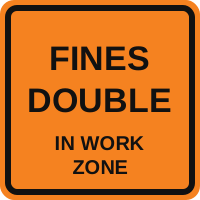
- Fines double for speeding there
- Fines are waived
- Speed limits are lifted
- Only warnings are given
Show answer
Fines double for speeding there. Doubled-fine zones announce themselves: the Speeding Fines Doubled sign posts in active school and work zones, warning that speeding citations there carry twice the fine. Waivers, lifted limits, and warnings-only readings invert a sign that exists to protect children and workers with heavier punishment. The doubling pairs with possible civil penalties and course requirements. Slow early when the orange or fluorescent zone signs appear, because the doubled fine starts where the zone starts.
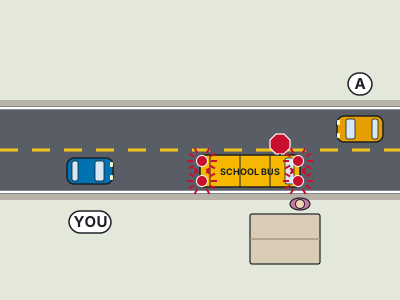
4. A school bus stops with its red signal on a two-way Florida road. What must vehicles in both directions do?
- Only vehicles behind the bus must stop
- Stop in both directions until the signal is withdrawn and children are clear
- Opposing traffic may pass at 15 MPH
- Both directions may continue if no child is visible
Show answer
Stop in both directions until the signal is withdrawn and children are clear. On a two-way street or highway, Florida requires every driver moving in either direction to stop for a school bus displaying its stop signal while children are picked up or dropped off. The stop continues until the signal is withdrawn and all children are clear of the roadway. The opposite-direction exception applies to a divided highway with a raised barrier or sufficiently wide unpaved median, not this two-way road. Visibility of a child does not remove the duty to stop.
5. What if you ignore construction zone directions?
- Illegal, and dangerous to zone workers
- Legal if careful
- Legal at night
- Only a warning
Show answer
Illegal, and dangerous to zone workers. Work-zone disobedience is a crime with victims: failing to slow and use caution as directed by signs, flaggers, or officers is illegal and dangerous to those working in the construction zone. Careful, nighttime, and warnings-only readings excuse conduct the handbook condemns outright. Orange diamonds, channeling drums, arrow panels, and flaggers all speak with the law's voice through the site. Slow early, follow every direction, and protect the crew standing feet from your bumper.
6. What follows 18 points within 18 months?
- 3-month suspension
- Warning letter
- $50 fine
- Nothing happens
Show answer
3-month suspension. Eighteen points in eighteen months costs a season of driving: a three-month suspension follows the eighteen-point threshold. Warnings, small fines, and nothing-happens readings understate a table that climbs from thirty days at twelve points to a full year at twenty-four. Out-of-state and federal convictions count the same as Florida ones, so points follow the driver home. Minors face even faster business-purpose restrictions on the way to these adult thresholds.
7. Someone uses a Florida disabled parking permit that belongs to another person. What penalty can follow?
- A $25 parking ticket only
- A written warning
- A first degree felony
- A second degree misdemeanor, punishable by a $500 fine
Show answer
A second degree misdemeanor, punishable by a $500 fine. Using or obtaining a disabled parking permit that belongs to someone else can be charged in Florida as a second degree misdemeanor, punishable by a $500 fine. The illegally parked vehicle can also be towed and the permit confiscated. A $25 parking ticket and a written warning understate the offense, and it is a misdemeanor, not a felony. Even with a valid permit displayed, the vehicle must actually be transporting the person with the disability who owns the permit before it may use a reserved space.
8. A driver is convicted of a first DUI in Florida with a BAL of .16. What is the maximum jail term?
- Not more than 30 days
- Not more than 9 months
- Not more than 6 months
- Not more than 5 years
Show answer
Not more than 9 months. A first DUI conviction carries up to 6 months in jail, but a BAL of .15 or higher, or a minor in the vehicle, raises the maximum to 9 months. At .16 the higher cap applies, so 6 months is the ordinary first offense limit and not the answer here. Thirty days is not a figure in the table, and five years is far beyond a first DUI. The .15 BAL also raises the fine to $1,000 to $2,000 and brings an ignition interlock period of at least six continuous months when one is ordered.
9. Which way must a parallel-parked car face?
- In the direction of traffic
- Facing oncoming traffic
- Either direction is fine
- Facing the nearest driveway
Show answer
In the direction of traffic. Parallel-parked cars must face the direction of traffic on their side of the road. Wrong-way parking forces a driver to pull out against the flow and blinds oncoming motorists with misaimed headlights at night. The direction rule pairs with the right-side rule: park on the right, facing forward with traffic, except on one-way streets where the exception applies. Either-direction parking and driveway-aimed parking are not options the handbook allows.
10. Why add following distance when stopped behind a vehicle on an incline?
- Stop beside the vehicle
- Follow closer to prevent rolling
- Increase distance; it may roll back
- Pass on the shoulder immediately
Show answer
Increase distance; it may roll back. A vehicle stopped ahead of you on an incline may roll backward before it moves forward, especially with a manual transmission or a heavy load. Florida therefore lists stops behind another vehicle on a grade among the situations requiring extra following distance. Pulling close invites a rollback bump, stopping beside blocks lanes, and shoulder passing is illegal and dangerous. Hanging back a few extra feet costs nothing and absorbs the rollback without contact or panic braking.
11. What does Florida's handbook say improves safety regarding speed and aggression?
- Speeding only endangers the speeder
- Aggressive driving is acceptable on interstates
- Obey limits and avoid aggressive driving
- Speed limits are advisory at night
Show answer
Obey limits and avoid aggressive driving. Florida's handbook opens its speeding section with a blunt premise: speeding endangers everyone on the road, not just the driver. It then prescribes the remedy: obeying speed limits and not driving aggressively improves safety by reducing both the probability and the severity of crashes. Aggressive driving is never acceptable, limits bind at night as well as by day, and bystanders, passengers, and other motorists all share the risk. Calm, limit-obeying driving is the handbook's core safety message.
12. What does a single solid white line between same-direction lanes indicate?
- Opposing traffic is directly beside you
- Do not cross unless avoiding a hazard
- Change lanes immediately
- Passing is required before the line ends
Show answer
Do not cross unless avoiding a hazard. A single solid white line separates lanes moving in the same direction, but drivers should not cross it unless avoiding a hazard. It is not a centerline for opposing traffic, and it does not command an immediate lane change or a passing maneuver. Keep the vehicle within its lane, scan ahead for the reason the line is solid, and move only when safety requires it. A broken white line, by contrast, permits a lane change when safe.
13. What must you do near a pedestrian with a white cane?
- Honk and proceed
- Swerve around them
- Stop, yield, and use extra caution
- Flash high beams at them
Show answer
Stop, yield, and use extra caution. White canes and service animals mark pedestrians who cannot see you coming: come to a complete stop, yield the right-of-way, and use extra caution around a visually impaired pedestrian carrying a white cane with a red tip or guided by a service animal. Honking startles without guiding, swerving gambles on their path, and headlight flashes are meaningless to someone who cannot see. The same stop-yield-caution duty extends to mobility-impaired pedestrians and confused or incapacitated walkers. Patience here is the law, not charity.
14. Under Florida law, which people must wear safety belts as a general requirement?
- All drivers, front-seat passengers, and passengers under age 18
- Only front-seat occupants when traveling on highways
- Only the driver and children under age 13
- Passengers under age 18 only when the vehicle is moving above 30 MPH
Show answer
All drivers, front-seat passengers, and passengers under age 18. The Florida requirement names three groups: every driver, every front-seat passenger, and every passenger younger than 18. It is not limited to highways, higher speeds, or children below 13. The highway front-seat answer leaves out drivers and minors riding in the rear, while the 30 MPH answer invents a speed threshold. Before moving, scan the front and back seats and make sure the people covered by this rule are buckled. Seat belts protect occupants only when worn correctly every time.
15. Once the lead vehicle of a Florida funeral procession enters an intersection, what may the rest of the procession do?
- Follow through the intersection regardless of traffic control devices
- Stop and wait for the next green light
- Proceed only if the light is still green
- Yield to cross traffic one vehicle at a time
Show answer
Follow through the intersection regardless of traffic control devices. Drivers, bicyclists and pedestrians must yield the right of way to funeral processions. When the funeral lead vehicle enters an intersection, the remaining vehicles in the procession may follow through the intersection regardless of any traffic control devices. Procession vehicles should have their headlights on or may use flashing hazard lights, which is how you recognize the group. Do not cut into or through the line.
16. An animal runs onto the roadway ahead and a collision cannot be avoided. What does the Florida handbook say to do?
- Honk continuously and keep the same speed
- Accelerate and steer toward the animal to pass it quickly
- Swerve sharply onto the shoulder without checking for hazards
- Do not swerve; keep the vehicle under control and on the roadway
Show answer
Do not swerve; keep the vehicle under control and on the roadway. Florida says that if a collision with an animal is inevitable, do not swerve to avoid it; keep the vehicle under control and on the roadway. When there is time to avoid the animal, the handbook advises reducing speed, tapping the brakes, and sounding the horn, and braking hard without locking the wheels if no vehicles are close behind. Keeping the same speed or accelerating removes reaction time, and a sharp swerve onto the shoulder can cost control of the vehicle. Report a crash involving a large animal such as a deer to law enforcement.
17. What are directional signals legally for?
- To wave followers past
- To signal only your own turns and lane changes
- To flash decorative patterns
- To replace the horn
Show answer
To signal only your own turns and lane changes. Directionals speak only for your own car: the law forbids using them to tell drivers behind you that they can pass. Waving followers past with your blinker invites them into a passing move you cannot guarantee, since you cannot see their blind spots or the oncoming lane they will use. Decorative flashing and horn replacement abuse the signal's safety meaning. Use the lamps solely to announce your turns, lane changes, and stops, and let followers make their own passing decisions.
18. What must you do when vacating for a stopped emergency vehicle?
- Swerve without warning
- Move over silently
- Flash high beams only
- Vacate the lane and signal your intention
Show answer
Vacate the lane and signal your intention. Moving over for a stopped emergency is itself a lane change with rules: vacate the lane closest to the stationary vehicle and signal your intention to change lanes. Unsignaled swerves, silent drifts, and beam-flashes alone all skip the required communication with drivers behind and beside you. The signal is parenthesized right in the vacate rule because the maneuver happens beside a crisis scene where everyone is distracted. Signal, check mirrors and blind spot, then give the workers the whole lane.
19. What fine follows a third DUI conviction?
- $500 to $1,000
- $2,000 to $5,000, at least $4,000 if aggravated
- $100 to $500
- $10,000 fixed
Show answer
$2,000 to $5,000, at least $4,000 if aggravated. Third-offense fines start where the second aggravated tier peaked: $2,000 to $5,000, with not less than $4,000 when the BAL reaches .15 or higher or a minor was in the vehicle. First-offense figures, hundred-dollar figures, and five-figure fixed sums each miss the listed range. The fine joins up to twelve months in jail, a 180-day revocation minimum, twenty-one school hours, addiction evaluation, and a two-year interlock in a sentence meant to end the pattern or end the driving.
20. What is the designated driver's drinking rule?
- Drink moderately
- Drink nothing; friends take keys and find rides
- Drink only beer
- Drink only after midnight
Show answer
Drink nothing; friends take keys and find rides. The designated driver abstains completely: do not drink, because one drink is one too many. Moderate, beer-only, and after-midnight allowances all violate the zero-drink rule for the evening's driver. The group backs the rule with action: friends don't let friends drive drunk, so take the keys from anyone about to drive impaired and help them get a safe ride home. Total abstinence for one plus intervention by all is the system that works.
QualitySpace is expanding to Florida
We are a California-based independent insurance brokerage working on licensing in more states. We cannot help with Florida insurance yet. Leave your email and we will let you know when we can.
Every question is written from the official Official Florida Driver License Handbook. Need paper? Printable FL practice test with answer key.
Last verified 2026-09-07. How we check every question · Study all 500 as flashcards
Frequently asked questions
How many questions are on this Florida practice test?
This fixed set has 20 questions. It is test 14 of 25 from the 500 question Florida bank. The real FL exam asks 50 questions and you need 40 correct.
What is the passing score for the real Florida test?
40 out of 50 (80 percent) That figure comes from the official Florida source cited on the DMV facts page.
How does this fixed test relate to the full Florida bank?
Each numbered test is a fixed set of 20 questions in a fixed order, so you can retake the same test later and compare. Every test mixes road signs and the other topics in about the same proportion as the full bank. Tests 1 to 25 together cover every question in the Florida bank once. The full practice page mixes the whole bank at random.
Last verified 2026-09-07. See the Florida DMV facts page for sourced state details.