
Test 7 of 25 · 20 questions · Free 2026
FL Permit Practice Test 7
Jump to the test ↓A fixed 20 question set from the Florida bank with answers and plain English explanations. The real FL exam is 50 questions, 80 percent to pass; take the full length version on the main practice page.
Question 1 of 20 · 0 right so far
All 20 questions in test 7
Every question below comes from the Florida question bank on this page. Open a question to see the correct answer and the explanation. Nothing here is hidden behind a signup.
1. When must a Florida driver attend a Traffic Collision Avoidance Course after a crash?
- After any crash, even with no damage
- Only after a DUI crash
- Only when the other driver asks for it
- When found at fault in a crash where someone was taken for medical treatment, or after a second crash in two years
Show answer
When found at fault in a crash where someone was taken for medical treatment, or after a second crash in two years. Florida requires the Traffic Collision Avoidance Course when a driver is found at fault in a crash where someone was injured and taken to a medical facility, or when it is the driver's second collision in two years. Not every crash triggers it. DUI has its own school and is not the trigger here, and the other driver has no say. Separate rules apply for a third crash related offense within 36 months, which adds an extended driving test.
Study this in the handbook: Points, suspensions and school buses
2. During what hours does Florida law require headlights?
- Between sunset and sunrise
- Only after midnight in areas without streetlights
- Only when driving on a limited access highway
- Only when another vehicle flashes its headlights
Show answer
Between sunset and sunrise. Florida law requires headlights between sunset and sunrise. The rule is not limited to highways, and a driver should not wait for another motorist to signal a problem. Reduced visibility can also require lights under separate guidance, but the hours in this question are the nighttime requirement. Turn the headlights on as daylight fades, keep the lenses clean, and use low beams when approaching other vehicles. Remembering sunset to sunrise gives you a reliable cue before darkness makes it harder to see or be seen.
Study this in the handbook: Night driving and headlights
3. Who may ride a motorcycle in Florida without a helmet?
- A rider 21 or older who carries at least $10,000 in medical insurance
- Any rider 18 or older
- Any rider with a motorcycle endorsement
- Only riders on roads posted at 35 MPH or less
Show answer
A rider 21 or older who carries at least $10,000 in medical insurance. Florida requires motorcycle operators to wear a helmet unless they are 21 or older and also carry a medical insurance policy providing at least $10,000 in medical benefits for injuries. Both conditions must be met. Turning 18 is not enough, and holding the motorcycle endorsement, which every motorcycle operator needs anyway after an approved safety course, does not waive the helmet rule. The road's speed limit plays no part in the exception. Motorcycle and moped operators are also not required to carry Personal Injury Protection insurance.
Study this in the handbook: Bicycles, trucks, motorcycles and pedestrians
4. What should you do if the gas pedal remains down?
- Switch off the engine immediately at highway speed
- Pump the accelerator until it releases
- Pull the parking brake sharply before steering
- Shift into neutral and steer to a safe place
Show answer
Shift into neutral and steer to a safe place. With a jammed accelerator, remove your foot from the pedal, shift an automatic transmission into neutral, use controlled braking, and steer to a safe place. Turning off the engine immediately can remove steering ability, and pumping the pedal does not follow the emergency sequence. A sharp parking brake application can cause a loss of control. Once stopped safely, address the mechanical problem and obtain help rather than continuing into traffic with the defect.
Study this in the handbook: After a crash and vehicle emergencies
5. What does Florida law require about your keys when you leave a parked car?
- Take them out of the vehicle
- Leave them in the ignition
- Hide them on the tire
- Hand them to a stranger
Show answer
Take them out of the vehicle. Florida law requires drivers to take the keys out of the vehicle before leaving it. The statute targets crimes of opportunity: keys left in the ignition turn every passerby into a potential car thief and every child into a potential runaway-car operator. Hiding keys on the tire fools no experienced thief, and handing them to a stranger is worse than leaving them. Pocket the keys along with turning off the engine and locking the doors, and the parked car is as secure as the driver can make it.
Study this in the handbook: Passing, turning and parking
6. What should you do when followed too closely?
- Slow down and keep to the right
- Speed up to escape
- Brake-check the follower
- Swerve onto the shoulder
Show answer
Slow down and keep to the right. A tailgater behind you is a hazard you manage by making yourself easy to pass: slow down and keep to the right. Easing off widens your own forward cushion so you will not need to brake hard, while holding right opens the passing lane. Speeding up to escape often just raises the stakes, brake-checking invites the rear-end collision you fear, and shoulder swerves trade a tailgater for a roadside obstacle. Let the impatient driver by and reclaim your safety margin.
Study this in the handbook: Right of way at intersections and roundabouts
7. For how long does a Florida DUI conviction remain on a driver’s record?
- 10 years
- 75 years
- Only until probation ends
- Until the license is renewed
Show answer
75 years. Florida states that a DUI conviction must remain on the driving record for 75 years. Renewing a license or completing probation does not erase that record period, and the handbook does not give a ten-year alternative. The long retention period shows why impaired driving can affect a person well beyond the immediate traffic stop, fine, or license action. The useful exam cue is the unusual number, 75 years. Keep it separate from shorter suspension or revocation periods, which address driving privileges rather than how long the conviction remains recorded.
Study this in the handbook: DUI, implied consent and zero tolerance
8. When must you obey the school-zone speed limit?
- During indicated times or when the light flashes
- Only on weekends
- Only when children are visible
- Only during summer school
Show answer
During indicated times or when the light flashes. The school-zone speed limit binds during the indicated times posted on the signs or whenever the zone's warning light is flashing. Either trigger alone is enough: posted hours cover the regular arrival and dismissal windows, while the flashing light can activate the limit at other times children are present. Weekends, visible children, and summer sessions are not the test; the signs and signals are. Missing an active school-zone limit risks a doubled fine, so the safe habit is to cover the brake and check the signals at every school approach.
9. Where are your vehicle's blind spots?
- Directly ahead only
- In the mirrors clearly
- Near the rear corners, invisible in mirrors
- Under the car
Show answer
Near the rear corners, invisible in mirrors. Blind spots hide beside the mirrors' reach: areas near the left and right rear corners of your vehicle that you cannot see in the rear-view mirrors or with peripheral vision. Directly-ahead, mirror-visible, and under-car readings each misplace zones the handbook pins to the rear corners. Before lane changes, passes, and certain turns, swing your head to check these areas directly. Never cruise in someone else's blind spot; move forward or drop back so the other driver can see you.
Study this in the handbook: Following distance, stopping and speed limits
10. How much probation can a first DUI conviction bring?
- No probation is available
- Up to 1 year
- Up to 5 years
- Up to 10 years
Show answer
Up to 1 year. A first DUI conviction can carry probation of up to one year, alongside the fine, community service, possible jail time, revocation, DUI school, evaluation, and possible interlock. Probation supervision enforces the remaining conditions: treatment attendance, abstinence checks, and offense-free living. Five- and ten-year terms exceed the first-offense ceiling, and probation-free sentencing ignores a listed penalty. Violating probation can resurrect jail time, so the year demands the same discipline as the rest of the sentence.
Study this in the handbook: DUI, implied consent and zero tolerance
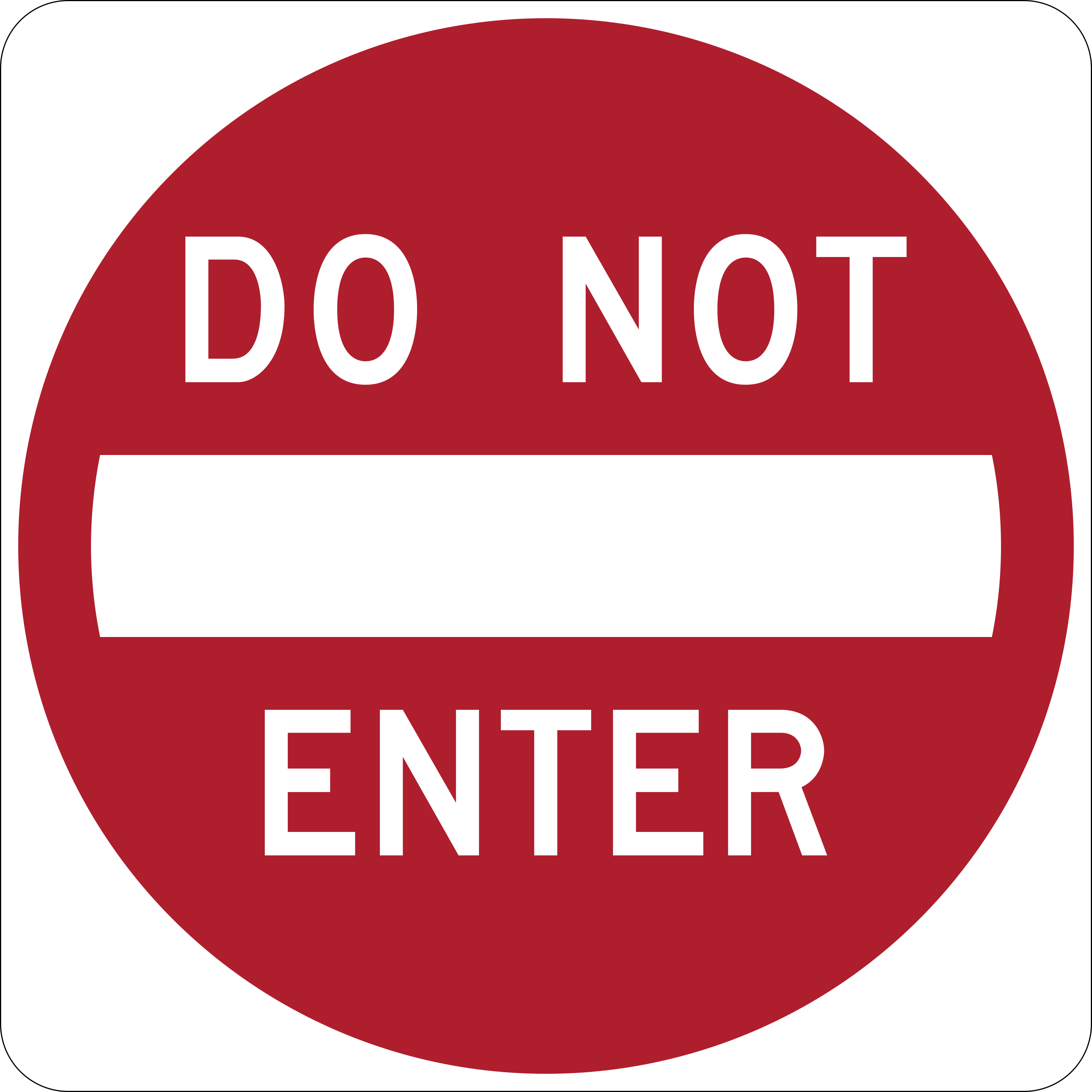
11. What does a DO NOT ENTER sign mean when it faces a Florida driver?
- Parking is prohibited for the next block
- Entry is prohibited on that one-way street or roadway
- The road is ending and vehicles may continue carefully
- Only trucks must turn around
Show answer
Entry is prohibited on that one-way street or roadway. DO NOT ENTER marks a one-way street or roadway from the side where entry is forbidden. A driver facing it should not proceed into that roadway and should find a lawful route instead. The parking choice addresses a different restriction, and the road-ending choice wrongly treats the sign as a warning. Read the red message before following an arrow or entering a ramp. The key cue is prohibition of entry, not a temporary instruction to slow down.
Study this in the handbook: Road sign colors and regulatory signs
12. What does a No Turn on Red sign require?
- Turn freely on red
- Turn after any stop
- Turn only at night
- Wait for the green signal; no turns on red
Show answer
Wait for the green signal; no turns on red. Some intersections forbid every red turn: where No Turn on Red posts, you must not turn right or left during the red light but wait for the green signal. Free turns, any-stop turns, and night-only readings each ignore a sign that suspends both red-turn exceptions. Heavy pedestrian flows, blind corners, or conflicting transit lanes usually motivate the ban. Stop, hold, and turn only when green releases the movement.
13. What is the youngest age at which you can get a Florida learner's license?
- 14
- 15
- 16
- 15 and a half
Show answer
15. A Florida learner's license is available at 15. The applicant must also pass the vision and Class E knowledge exams, and an applicant under 18 who is not married needs a parent or legal guardian to sign the application. Fourteen is too young. Sixteen is the minimum age for a Class E driver license, the next step after the learner stage. Fifteen and a half does not appear among the handbook's learner requirements. A learner under 18 then holds the license for 12 months, or until turning 18, before moving up.
Study this in the handbook: Learner's license, practice hours and teen curfews
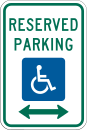
14. What does blue signify on signs and markings?
- Stop and yield only
- Construction zones only
- Warning of curves only
- Driver guidance, including disabled parking spaces
Show answer
Driver guidance, including disabled parking spaces. Blue guides rather than commands: the color means driver guidance and also marks parking spaces reserved for disabled drivers. Stop, construction, and curve readings belong to red, orange, and yellow respectively. Blue service signs point to gas, food, motels, and hospitals, while blue pavement markings reserve the accessible spaces nearest entrances. Using a blue-marked space requires the displayed permit and the permit owner's presence in the vehicle.
Study this in the handbook: Pavement markings
15. What does the Florida handbook tell you about a wounded motorcycle or bicycle rider's helmet at a crash scene?
- Remove it immediately to help breathing
- Loosen the strap and lift it slightly
- Do not attempt to remove it
- Remove it only if the rider is unconscious
Show answer
Do not attempt to remove it. Among its first aid rules, the handbook says not to attempt to remove the helmet of an injured motorcycle or bicycle rider, because the rider may have a neck or spinal injury that removal could worsen. Leave that to trained responders. The same section says to treat injured people for shock regardless of whether they appear to be in shock, since shock slows body functions and can be fatal.
Study this in the handbook: After a crash and vehicle emergencies
16. When is passing on hills or curves prohibited?
- Whenever you feel confident
- On hills or curves with under 500 feet of sight
- Only at night
- Only in rain
Show answer
On hills or curves with under 500 feet of sight. Crest and curve passing demands sight distance: never pass on hills or curves where you cannot see at least 500 feet ahead. A hidden oncoming car, cyclist, or obstruction beyond the rise leaves no escape once committed to the left lane. Confidence, darkness, and rain are not the test; measured visibility is. The 500-foot rule works with the 100-foot intersection rule and the solid-line bans to keep passing to open, visible, predictable road where surprises cannot hide.
Study this in the handbook: Passing, turning and parking
17. What is double parking, and is it legal?
- Marked spaces
- Rest areas
- Beside another parked car
- Shoulders
Show answer
Beside another parked car. Double parking, stopping on the roadway side of another parked vehicle, is against the law. The second car sits fully in the travel lane, blocking traffic, hiding pedestrians, and forcing dangerous swerves. Marked spaces, rest areas, and shoulders are where waiting cars belong, even for a quick pickup. No urgency excuses it: hazard flashers do not legalize a lane blockage, and the few seconds saved are never worth the crash risk imposed on everyone forced around.
Study this in the handbook: Passing, turning and parking
18. How many points does unlawful speed 15 MPH or less over the limit carry in Florida?
- No points
- 2 points
- 3 points
- 4 points
Show answer
3 points. Florida's point table starts minor speeding at 3 points: unlawful speed 15 MPH or less over the lawful or posted speed. Cross into 16 MPH or more over and the value rises to 4 points, and speeding that causes a crash draws 6. Points accumulate toward suspension at 12 in 12 months, 18 in 18 months, and 24 in 36 months, so even a 3-point ticket matters. Electing a driver improvement course can avoid the points for eligible minor violations.
19. How do you pass a protected vehicle on a two-lane road?
- Slow to 20 MPH below the limit
- Maintain full speed
- Stop in the lane
- Speed up past quickly
Show answer
Slow to 20 MPH below the limit. Two lanes leave no escape lane, so speed is the cushion: slow down to twenty miles per hour below the posted limit past the stopped protected vehicle. Full speed, mid-lane stops, and acceleration past all deny the workers any margin. Where the limit itself is twenty or less, the rule bottoms out at five miles per hour. The twenty-below figure also governs multi-lane drivers who cannot vacate safely, making it the universal fallback cushion.
Study this in the handbook: Passing, turning and parking
20. What does a green drawbridge signal mean?
- Stop and wait
- Proceed with caution
- Speed across
- Back up
Show answer
Proceed with caution. Green on the drawbridge means go carefully: proceed with caution across the span. The caution honors the narrow deck, the marine equipment, and the traffic queued behind you, not a fully normal road. Stop-and-wait wastes the release, speeding across ignores the warning to stay alert, and backing up endangers the queue. Cross steadily, hold your lane on the grating, and clear the bridge so the next opening cycle can begin on time.
QualitySpace is expanding to Florida
We are a California-based independent insurance brokerage working on licensing in more states. We cannot help with Florida insurance yet. Leave your email and we will let you know when we can.
Every question is written from the official Official Florida Driver License Handbook. Need paper? Printable FL practice test with answer key.
Last verified 2026-10-05. How we check every question · Study all 500 as flashcards
Frequently asked questions
How many questions are on this Florida practice test?
This fixed set has 20 questions. It is test 7 of 25 from the 500 question Florida bank. The real FL exam asks 50 questions and you need 40 correct.
What is the passing score for the real Florida test?
40 out of 50 (80 percent) That figure comes from the official Florida source cited on the DMV facts page.
How does this fixed test relate to the full Florida bank?
Each numbered test is a fixed set of questions in a fixed order, so you can retake the same test later and compare. Every test mixes road signs and the other topics in about the same proportion as the full bank. Tests 1 to 25 together cover every question in the Florida bank once. The full practice page mixes the whole bank at random.
Last verified 2026-10-05. See the Florida DMV facts page for sourced state details.