
Test 22 of 25 · 20 questions · Free 2026
FL Permit Practice Test 22
Jump to the test ↓A fixed 20 question set from the Florida bank with answers and plain English explanations. The real FL exam is 50 questions, 80 percent to pass; take the full length version on the main practice page.
Question 1 of 20 · 0 right so far

All 20 questions in test 22
Every question below comes from the Florida question bank on this page. Open a question to see the correct answer and the explanation. Nothing here is hidden behind a signup.
1. What area or activity does the five-sided school sign identify?
- An adult pedestrian-only recreation area
- A railroad station crossing
- A public park with no special traffic rule
- A school area where drivers should watch for children
Show answer
A school area where drivers should watch for children. The school sign means the driver is near a school and must watch for children at all times, not just during school hours. The park and adult recreation choices mistake the sign’s purpose, while the railroad option belongs to a different warning family. Reduce speed when conditions call for it, watch the roadside and crossings, and be ready for children whose movements may be unpredictable. The five-sided shape is a useful visual cue for school-related activity.
2. Passing a stopped school bus in Florida causes a serious injury. What community service does the driver face?
- 120 hours in a trauma center or hospital
- 10 hours at any charity
- 50 hours of roadside litter pickup
- None, because the $1,500 fine replaces it
Show answer
120 hours in a trauma center or hospital. When passing a stopped school bus causes serious injury or death, Florida requires 120 hours of community service served in a trauma center or hospital. The same penalty list adds a victim's impact panel or driver improvement course, six points, a suspension of at least one year, and a $1,500 fine. Ten hours at a charity or 50 hours of litter pickup do not match the listed service. The fine does not replace the service; both apply.
3. Unless posted otherwise, what is Florida's standard speed limit on streets and highways?
- 55 MPH
- 45 MPH
- 65 MPH
- 70 MPH
Show answer
55 MPH. Florida's standard speed table assigns 55 MPH to streets and highways that are not otherwise posted and are not limited access facilities. That default sits between the 30 MPH municipal, business, and residential limit and the 70 MPH limited access limit. The asterisk on the table means these are maximum speeds except where otherwise posted, so a lower sign always controls. Drivers must also slow below the default when weather, roadway, or traffic conditions demand it, because the limit assumes favorable conditions.
4. Within what distance of intersections, bridges, tunnels, or crossings is passing banned?
- 50 feet
- 75 feet
- 100 feet
- 500 feet
Show answer
100 feet. Complex zones get a 100-foot passing ban: within 100 feet of an intersection, bridge, viaduct, tunnel, or railroad crossing, passing is prohibited. Each of these features hides conflicts, narrows escape room, or mixes crossing traffic with through traffic. Fifty and 75 feet fall short of the required buffer, while 500 feet belongs to hill and curve sight distance, not zone approaches. Check the distance early: if a listed feature lies within 100 feet, hold your lane and wait until well past it.
5. Which highway pavement is it against the law to park on?
- Highway pavement not marked for parking
- Marked parallel spaces
- Rest area stalls
- Parking garage levels
Show answer
Highway pavement not marked for parking. Highway pavement is for moving traffic unless signs or markings say otherwise, so parking on pavement not marked for parking is against the law. Unmarked pavement stops surprise approaching drivers who expect every car there to be moving at speed. Marked parallel spaces, rest area stalls, and garage levels are the pavement set aside for stopped cars. When in doubt on a highway, the shoulder in a genuine emergency is the only lawful refuge, and even that is time-limited.
6. What must you do when a faster vehicle overtakes you from behind?
- Stay left and speed up
- Move out of the left lane
- Move further left
- Stop in the left lane
Show answer
Move out of the left lane. Florida's left-lane law is explicit: a driver must move out of the left lane when being overtaken from behind by another vehicle traveling at a faster speed. The left lane exists for passing, not cruising, and camping in it forces faster traffic into risky right-side passes. Speeding up to race, edging further left, or stopping in the lane all compound the violation. Yield the lane promptly and the highway sorts itself by speed as designed.
7. What should a driver do when approaching a Florida intersection controlled by a flashing yellow light?
- Come to a complete stop and wait for green
- Accelerate to clear the intersection quickly
- Ignore the signal because it has no legal meaning
- Proceed with caution after reducing speed
Show answer
Proceed with caution after reducing speed. A flashing yellow light calls for caution rather than the mandatory stop used by a flashing red light. Reduce speed, scan for vehicles and pedestrians, and continue only when the intersection is safe. Stopping and waiting for green confuses yellow with a stop control and would unnecessarily hold traffic. The signal can appear at a dangerous intersection or before a warning sign, so the driver should actively look for the condition being announced. Think of the yellow flash as a prompt to slow, observe, and make a careful decision.
8. What should you check before starting the engine?
- Start with blocked mirrors
- Clear view, lock doors, belt everyone
- Leave doors unlocked
- Skip the seat check
Show answer
Clear view, lock doors, belt everyone. Departure starts with a cockpit sweep: move anything blocking your view of mirrors or roadway, lock all car doors, and fasten your belt plus confirm every passenger's. Blocked-mirror starts blind the driver, unlocked doors risk ejection and intrusion, and skipped checks strand the seat and mirrors out of position. Park-or-neutral selected, seat and mirrors adjusted without leaning, view clear, doors locked, belts on: the six-step launch every trip deserves.
9. Which additional vehicle is protected by Florida's expanded Move Over Law when it is stopped roadside and displaying a warning?
- Any vehicle parked legally at a shopping center
- Only a police car displaying blue lights
- A disabled motor vehicle with warning lights, flares, signage, or a visibly present person
- A moving vehicle traveling below the speed limit
Show answer
A disabled motor vehicle with warning lights, flares, signage, or a visibly present person. Florida extends roadside protection to a disabled motor vehicle when it is stopped and gives a warning through hazard lights, emergency flares, signage, or a visibly present person. The police-only choice is too narrow because the protection also covers disabled motorists and several work vehicles. A moving car does not meet the stopped-roadside condition. When approaching, look for the warning and people near the vehicle, then move over if safe or reduce speed under the fallback rule.
10. What should you do when a curve warning sign appears?
- Speed up before the curve
- Slow down and do not pass
- Pass quickly on the curve
- Honk through the curve
Show answer
Slow down and do not pass. Curve warning signs, including right curves, sharp turns, and reverse curves, all carry the same instruction: slow your speed and do not pass other vehicles. Curves hide oncoming traffic, shrink sight distance, and punish excess speed with lane departures and rollovers. Speeding up before the bend, passing on it, or honking instead of slowing all raise the risk. Enter below the advisory speed, hold your lane, and wait for the straightaway to pass.
11. A Florida teen is restricted to Business Purposes Only for points. Which course must the teen complete?
- A 12 hour Advanced Driver Improvement course plus 4 hours of behind the wheel training
- A 4 hour Basic Driver Improvement course only
- A 50 hour supervised driving log
- A DUI program of 21 hours
Show answer
A 12 hour Advanced Driver Improvement course plus 4 hours of behind the wheel training. The mandatory restriction for minors comes with training: a 12 hour Advanced Driver Improvement course and 4 hours of behind the wheel training from a Florida licensed commercial driving school. A basic course alone is not enough, and the 50 hour log is the learner stage requirement, not a points remedy. Twenty one hours is the DUI school length for repeat DUI offenders. The restriction itself lasts one year and grows by 90 days for each additional point.
12. On the Florida driving skills test, what may a driver use to signal a turn?
- A horn held continuously
- High beams flashed twice
- Hazard lights only while turning
- Hand signals or mechanical signals
Show answer
Hand signals or mechanical signals. The driving skills test section tells applicants to get into the proper lane, signal the turn for the last 100 feet, and use hand signals or mechanical signals. The handbook also says drivers must use vehicle directional signals or hand signals to show other drivers they are turning. A horn does not show the intended direction, hazard lights do not identify a left or right turn, and flashing high beams is not a turn indication. A signal communicates intent but does not give priority, so still yield before completing the turn.
13. What does a double yellow line that is solid on your side and broken on the other side mean?
- Passing is required before the next intersection
- Passing is not allowed in your lane
- Passing is allowed in your lane whenever you choose
- The line separates lanes traveling in the same direction
Show answer
Passing is not allowed in your lane. Florida describes a double yellow marking that is solid on your side and broken on the other as a lane where passing is not allowed. The broken line gives permission only to traffic on the opposite side when its conditions are safe. Passing whenever you choose ignores the solid line beside your vehicle, and the marking separates opposing directions rather than same-direction lanes. Identify which side of the center marking is broken before considering a pass. A solid line on your side means remain behind the vehicle ahead.
14. What is the purpose of traffic control devices in Florida construction and maintenance work areas?
- To guarantee that every lane remains open
- To permit drivers to ignore temporary speed limits
- To replace all directions from a flagger
- To direct drivers and other road users safely through the work site
Show answer
To direct drivers and other road users safely through the work site. Florida explains that traffic control devices in construction and maintenance work areas direct drivers and other road users safely through the work site. They help organize movement around changed lanes, barriers, drums, cones, and other hazards. They do not guarantee that lanes remain open, replace a flagger’s instructions, or authorize drivers to disregard temporary controls. Slow down and follow the sign, device, flagger, or law enforcement direction that applies at the work area. The key cue is safe guidance through a changed roadway, not permission to continue at normal speed.
15. What should a Florida driver do when an emergency vehicle approaches using sirens or flashing lights?
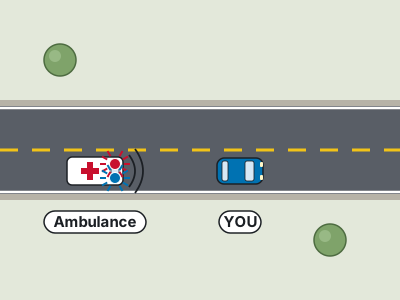
- Follow it closely through the intersection
- Stop in the center of the roadway
- Pull to the closest edge of the roadway and stop until it passes
- Continue normally if the vehicle is in another lane
Show answer
Pull to the closest edge of the roadway and stop until it passes. Florida directs motorists, bicyclists, and pedestrians to yield to emergency vehicles using sirens or flashing lights. The response is to pull immediately to the closest roadway edge and remain stopped until the vehicle passes. Blocking an intersection can obstruct the emergency route, and staying in the center or continuing normally fails to yield. The cue is edge, stop, wait, then resume only after the emergency vehicle is clear.
16. What is the minimum Florida fine for passing a stopped school bus on the side where children enter or exit?
- $165
- $265
- $465
- $900
Show answer
$465. Florida distinguishes the serious violation of passing on the side where children enter or exit from the general school-bus passing violation. The minimum fine for that child-loading side is $465. The $265 figure describes the general violation, so it is too low for the fact pattern. The $165 and $900 choices do not match the handbook's listed amounts. Treat the side of the bus as the key detail: when children use that side, the higher minimum applies.
17. What testing applies in a DUI case with death or serious injury?
- A blood test, with or without consent
- No test may be taken
- Only a breath test if agreed
- Only field sobriety exercises
Show answer
A blood test, with or without consent. Death or serious injury overrides refusal: in DUI cases involving either, you will be required to take a blood test with or without your consent. The state interest in determining impairment after grave harm defeats the ordinary right to refuse. Breath-only, agreement-only, and exercise-only alternatives do not satisfy the mandatory blood draw. The blood must be drawn by a doctor, nurse, or other health professional, and it may be drawn even if you are unconscious.
18. Which driving skills does alcohol reduce?
- Judgment, reaction, vision, and concentration
- Only night vision
- Only parallel parking
- Only radio tuning
Show answer
Judgment, reaction, vision, and concentration. Alcohol degrades the full driving skill set: judgment, reaction, vision, and concentration all decline as BAL rises. Judgment fails first, so impaired drivers misjudge their own impairment; reaction and vision follow, stretching stops and blurring hazards; concentration last, scattering attention. Single-skill readings miss the system-wide collapse that makes drinking drivers dangerous at every task. No practice, tolerance claim, or short trip exempts anyone from the chemistry.
19. Are airbags a substitute for safety belts?
- Yes, always
- No, never
- Only for adults
- Only in trucks
Show answer
No, never. Airbags assist belts; they never replace them: airbags are not a substitute for safety belts, full stop. The bag's split-second cushion works only when the belt already holds the occupant in the seat's protective pocket. Always-yes, adults-only, and trucks-only readings each invent exceptions that turn the bag from helper to hazard, since unbelted bodies meet the deploying bag out of position. Belt every trip, every seat, then let the airbag add its fraction of a second of help.
20. Who has the right-of-way when you merge onto a highway?
- Highway traffic yields to you
- You may force a gap
- You must yield to highway traffic
- The fastest car wins
Show answer
You must yield to highway traffic. The merge ramp ends your priority: merge into traffic only when safe, and yield the right-of-way to vehicles already on the highway. Mainline traffic holds the lane; the entering driver adjusts speed, finds a gap, and slips in without forcing anyone to brake or swerve. Demanding a yield, forcing a gap, or racing for position all invert the rule and cause sideswipe and rear-end crashes. Signal early, match speed in the acceleration lane, and yield gracefully when no gap exists.
QualitySpace is expanding to Florida
We are a California-based independent insurance brokerage working on licensing in more states. We cannot help with Florida insurance yet. Leave your email and we will let you know when we can.
Every question is written from the official Official Florida Driver License Handbook. Need paper? Printable FL practice test with answer key.
Last verified 2026-09-07. How we check every question · Study all 500 as flashcards
Frequently asked questions
How many questions are on this Florida practice test?
This fixed set has 20 questions. It is test 22 of 25 from the 500 question Florida bank. The real FL exam asks 50 questions and you need 40 correct.
What is the passing score for the real Florida test?
40 out of 50 (80 percent) That figure comes from the official Florida source cited on the DMV facts page.
How does this fixed test relate to the full Florida bank?
Each numbered test is a fixed set of 20 questions in a fixed order, so you can retake the same test later and compare. Every test mixes road signs and the other topics in about the same proportion as the full bank. Tests 1 to 25 together cover every question in the Florida bank once. The full practice page mixes the whole bank at random.
Last verified 2026-09-07. See the Florida DMV facts page for sourced state details.