
Test 3 of 25 · 20 questions · Free 2026
FL Permit Practice Test 3
Jump to the test ↓A fixed 20 question set from the Florida bank with answers and plain English explanations. The real FL exam is 50 questions, 80 percent to pass; take the full length version on the main practice page.
Question 1 of 20 · 0 right so far
All 20 questions in test 3
Every question below comes from the Florida question bank on this page. Open a question to see the correct answer and the explanation. Nothing here is hidden behind a signup.
1. Which record of offenses within a 5-year period requires Florida to revoke a driver license?
- Two speeding tickets
- Any single parking ticket
- Three major offenses or 15 offenses for which points are given
- Five offenses of any kind
Show answer
Three major offenses or 15 offenses for which points are given. Florida lists situations in which a license must be revoked, meaning the driving privilege is terminated. One of them is three major offenses or 15 offenses for which you receive points, all within a 5-year period. Others on the list include DUI, a felony involving a motor vehicle, and three cases of reckless driving within one year. Two speeding tickets or five offenses fall well short of that pattern, and parking tickets do not carry points at all.
Study this in the handbook: DUI, implied consent and zero tolerance
2. What roadway condition is announced by a MERGING TRAFFIC warning sign?

- Another traffic lane joins the lane you are using
- Your lane is reserved for buses only
- All traffic must stop before changing lanes
- The roadway ahead prohibits any merge
Show answer
Another traffic lane joins the lane you are using. MERGING TRAFFIC warns that another lane will join the one being used. Watch for vehicles entering, adjust speed and spacing, and yield the right-of-way when necessary. The bus-lane choice invents a vehicle restriction, while stopping all traffic is not the normal response to a merge warning. Look beyond the sign for the joining lane and keep a safe opening. The goal is a smooth, predictable merge that avoids forcing another driver to brake or swerve.
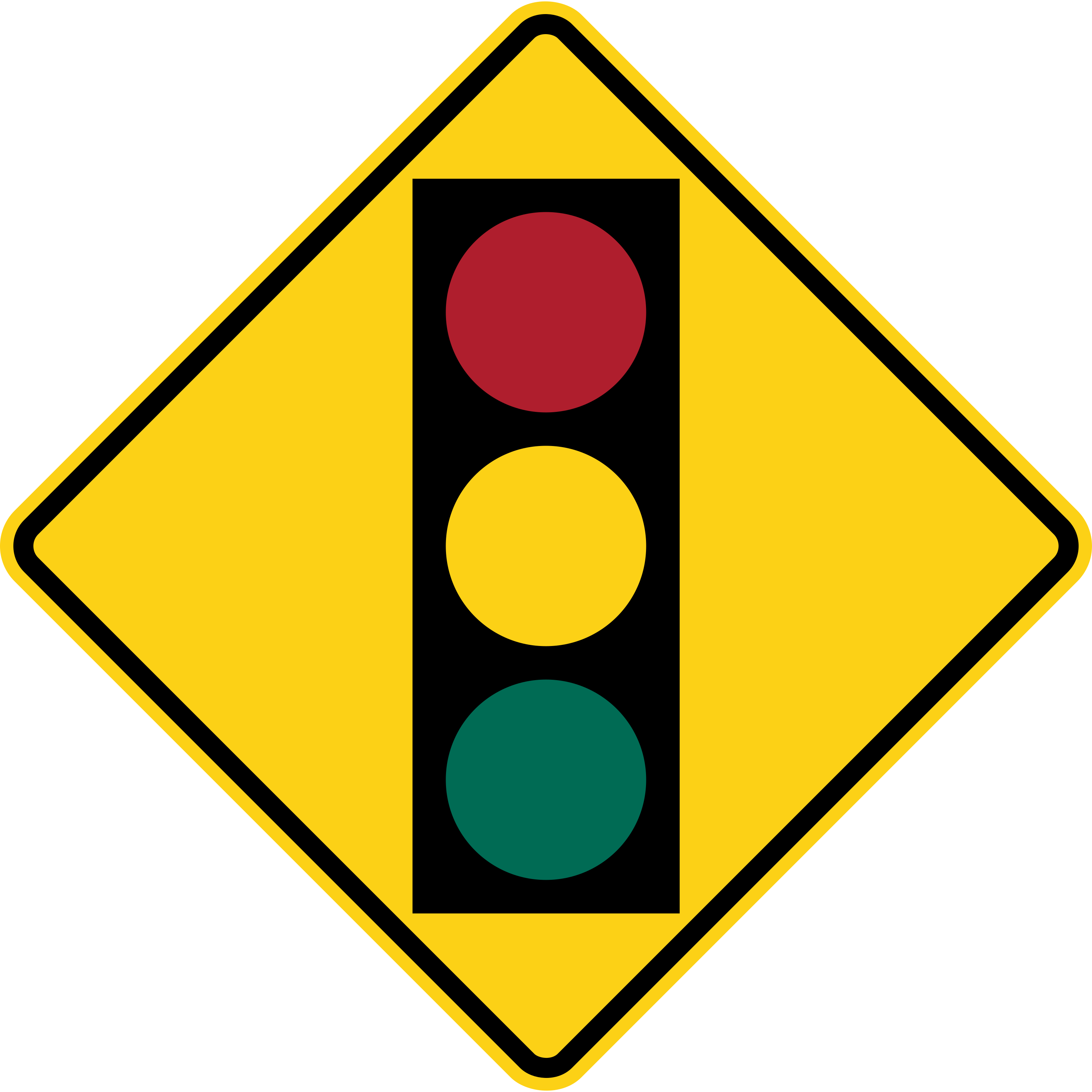
3. What hazard does a TRAFFIC SIGNAL AHEAD warning sign identify?
- A police checkpoint where all vehicles must stop
- A traffic signal at the intersection ahead
- A broken streetlight that should be reported
- A lane reserved for emergency vehicles
Show answer
A traffic signal at the intersection ahead. The warning sign announces that a traffic signal is located at the intersection ahead. It gives the driver time to slow down, especially when poor visibility may make the signal difficult to see until the last moment. The checkpoint and streetlight choices confuse a traffic-control warning with unrelated conditions. Begin observing the roadway, traffic, and signal as soon as the sign appears. Do not accelerate to beat the light; approach at a speed that allows a safe response if it changes.
4. What happens to the car and permit in disabled parking fraud?
- Tow the vehicle and confiscate the permit
- Apologize and leave
- Halve the next registration fee
- Mail a warning only
Show answer
Tow the vehicle and confiscate the permit. Permit fraud ends with steel, not paper: the illegally parked vehicle can be towed and the permit confiscated, on top of a second degree misdemeanor carrying a $500 fine or up to six months in jail. Apologies, discounts, and warning letters play no part in the statute. The tow removes the immediate obstruction from the reserved space while confiscation strips the abused credential. Lending a permit to an able-bodied driver risks the owner's own parking rights along with the borrower's record.
Study this in the handbook: Learner's license, practice hours and teen curfews
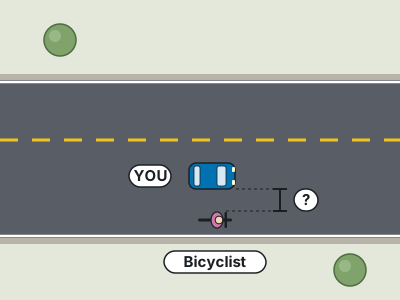
5. What minimum clearance does Florida law require when passing a bicyclist?
- Three feet
- Two feet
- A full lane
- One foot
Show answer
Three feet. Florida law requires motorists to give bicyclists a minimum of three feet of clearance and to use caution and slow speed when driving next to or passing them. On a two lane road, pass a bicyclist as you would a slow moving vehicle and only when it is safe. At intersections, assume a bicyclist is traveling straight unless the rider signals otherwise. A full lane is safer when available, but three feet is the legal minimum.
Study this in the handbook: Bicycles, trucks, motorcycles and pedestrians
6. What should you do when driving slower than the flow of traffic?
- Move to the left lane
- Stop until traffic clears
- Speed up to the fastest car
- Keep right so others may pass
Show answer
Keep right so others may pass. When you drive slower than the flow of traffic, Florida directs you to keep right so faster vehicles may safely pass. Hugging the left lane while slow blocks traffic and tempts dangerous right-side passes. Stopping on the roadway is far more hazardous than continuing slowly in the right lane, and speeding up to match the fastest car may break the limit. The keep-right rule pairs with the duty not to drive so slowly that you block or delay traffic moving at normal, safe speeds.
Study this in the handbook: Following distance, stopping and speed limits
7. Who may seek a restricted license after a DUI arrest?
- No review exists for anyone
- Only repeat offenders qualify
- A first-time offender with no prior DUI offenses
- Only commercial drivers
Show answer
A first-time offender with no prior DUI offenses. First-timers get a second-track option: a first time DUI offender who has never had prior DUI related offenses may be eligible to request a review of eligibility for a restricted driver license. Repeat offenders, commercial-only limits, and no-review readings all miss the first-offense-only gate. Accepting the restricted license waives the right to contest the suspension itself, trading the fight for limited driving. The election requires appearing at the BAR office within ten days and paying a non-refundable fee.
Study this in the handbook: DUI, implied consent and zero tolerance
8. When are lane signals used?
- To mark parking spaces
- When flow direction changes, for toll booths, and for lane openings
- Only at midnight
- Only in school zones
Show answer
When flow direction changes, for toll booths, and for lane openings. Overhead lane signals manage lanes that change purpose: they show when the direction of traffic flow changes during the day, whether a toll booth is open or closed, and which lanes are opened or closed. Parking, midnight-only, and school-only readings miss all three missions. Red X means never enter, yellow X warns the red is coming, and green arrow opens the lane while preserving every other sign and signal. Reversible rush-hour lanes are the classic use.
Study this in the handbook: Traffic signals, pedestrian signals and railroad crossings
9. What should you do leaving a bright area at night?
- Drive slowly until your eyes adjust
- Speed up to adapt faster
- Stare at oncoming lights
- Brake to a stop in the lane
Show answer
Drive slowly until your eyes adjust. Dark adaptation takes time: leaving a brightly lit area, drive slowly until your eyes adjust to the darkness. Speeding to adapt faster, staring into oncoming lamps, and lane-stopping each trade temporary blindness for new hazards. Pupils need minutes to open fully, and the interim sees little beyond the headlight cone. Ease off, lengthen following distance, and let the night resolve before resuming normal pace.
Study this in the handbook: Night driving and headlights
10. A Florida driver under 18 is already restricted to Business Purposes Only for points and then gets two more points. How is the restriction affected?
- Nothing changes
- It is extended by 90 days for each additional point
- It becomes a permanent revocation
- It is extended by 30 days in total
Show answer
It is extended by 90 days for each additional point. A Florida driver under 18 with 6 or more points in 12 months is automatically restricted for one year to driving for business purposes only. Each additional point extends the restriction by 90 days, so two more points add 180 days. The restriction does not stay the same, and the handbook does not turn it into permanent revocation. Thirty days in total is far less than the 90 days per point rule. The teen must also complete a 12 hour Advanced Driver Improvement course.
Study this in the handbook: Points, suspensions and school buses
11. If the speed limit is 20 MPH or less on a two-lane road beside a protected stopped vehicle, what speed must you use?
- 10 MPH
- 15 MPH
- The posted speed limit
- 5 MPH
Show answer
5 MPH. The special low-speed rule applies when the posted limit is 20 MPH or less. Travel at 5 MPH rather than subtracting 20 from the sign, which could produce an impossible or negative result. The 10 MPH option still exceeds the handbook figure, and keeping the posted limit ignores the protection the rule provides. Use the road sign to identify the condition, then choose the fixed five-mile-per-hour speed when the limit is 20 or below.
Study this in the handbook: Move Over Law and emergency vehicles
12. If an animal is standing near the roadway, what should you do?
- Accelerate to pass before it moves
- Slow down because it may bolt or change direction
- Swerve into oncoming traffic
- Sound the horn continuously while maintaining speed
Show answer
Slow down because it may bolt or change direction. An animal standing near the road may bolt out or change direction, so Florida says to slow down as you approach. Accelerating removes reaction time, and the handbook says it is better to swerve off the road than into oncoming traffic. A continuous horn while holding speed is not the advice; the handbook pairs any horn use with reducing speed and tapping the brakes when there is time to avoid the animal. Flash your headlights to warn other drivers, and if no vehicles are close behind, brake hard without locking the wheels.
Study this in the handbook: Night driving and headlights
13. What is the first required action after a crash involving death, injury, or property damage?
- Stop and call 911, FHP, or local law enforcement
- Wait for another driver to call for help
- Exchange information only if fault is admitted
- Leave the scene and report it later
Show answer
Stop and call 911, FHP, or local law enforcement. After a crash involving death, injury, or property damage, the handbook directs the driver to stop and call 911, FHP, or local law enforcement first. Leaving the scene creates a separate legal problem, and waiting for another driver can delay medical or traffic assistance. Exchanging information is also required during the later crash steps, but it is not a substitute for stopping and reporting the event. Turn on hazard lights, get immediate help for anyone hurt, and remain calm while following the remaining reporting and information duties.
Study this in the handbook: After a crash and vehicle emergencies
14. What fine faces a vehicle's registered owner for a camera-detected school-zone speed violation?
- $25
- $50
- $100
- $500
Show answer
$100. Under the 2023 school-zone camera law, counties and municipalities may install camera-equipped radar detection devices to enforce school-zone limits during specified periods. When the system records a violation, the registered owner of the vehicle is subject to a $100 fine. School districts using the technology must post signage warning drivers where detection is active. The owner-liability design means the ticket follows the plate, so lending your car to a school-zone speeder can still cost you.
15. Where must a driver stop in relation to a stop line?
- Before any part of the vehicle crosses the line
- After the crosswalk so the driver can see better
- Only when another vehicle is approaching
- With the front bumper resting on the line
Show answer
Before any part of the vehicle crosses the line. A white stop line marks where a driver must stop for a stop sign or red light. The vehicle must stop before any part crosses that line. Resting on the line can put the vehicle into the crossing area, and stopping beyond the crosswalk can endanger pedestrians. The requirement does not depend on seeing another vehicle. Approach under control, stop at the line, then check the intersection and crosswalk before proceeding when permitted. If no line exists, use the handbook’s alternate stopping location near the crosswalk or intersection.
Study this in the handbook: Pavement markings
16. Which lane lines prohibit passing?
- Broken white lines
- Broken yellow lines
- Lane-use arrows
- Single or double solid lines
Show answer
Single or double solid lines. Solid lane lines forbid crossing for a pass: you must not pass where a single or double-sided solid line divides the lanes. The solid marking warns that sight distance, roadside hazards, or opposing traffic make passing unsafe, and the same logic extends to a double yellow solid on your side. Broken lines of either color invite passing when clear, and lane-use arrows direct rather than prohibit. Treat every solid line as a wall for passing purposes and wait for the broken marking to resume.
Study this in the handbook: Passing, turning and parking
17. What should you do with the engine and locks when parking?
- Leave it running for quick return
- Turn it off and lock the vehicle
- Idle with lights flashing
- Leave it in gear with engine on
Show answer
Turn it off and lock the vehicle. Every parking job ends the same way: turn off the engine and lock the vehicle. A running unattended car wastes fuel, invites theft, and can creep or be knocked into gear, while unlocked doors invite burglary and joyriding. Flashing lights drain the battery and signal nothing useful to passersby. Florida then adds a legal capstone: the driver must take the keys out of the vehicle before leaving it, making key removal a statutory duty rather than mere advice.
Study this in the handbook: Passing, turning and parking
18. How long must higher insurance stay in force after a DUI conviction?
- One year
- Two years
- Three years after conviction
- Six months
Show answer
Three years after conviction. DUI keeps insurance expensive for years: the higher coverage must stay in effect for three years after the conviction, lifting early only if the driver avoids another DUI or felony traffic offense through the whole three-year period. One year, two years, and six months each understate the mandate. The elevated bodily injury and property damage limits protect the public from a proven risk at the offender's expense, and letting them lapse invites a fresh suspension on top of the DUI history.
Study this in the handbook: Insurance, registration and vehicle equipment
19. Who must do everything possible to avoid a crash?
- Only motorists
- Only at intersections
- Only when cited before
- Every driver, rider, pedestrian, and bicyclist
Show answer
Every driver, rider, pedestrian, and bicyclist. Crash avoidance is everyone's job: every driver, motorcyclist, moped rider, pedestrian, and bicyclist must do everything possible to avoid a crash. The duty overrides pride in the right-of-way; having the legal priority never excuses plowing into a preventable collision. It applies everywhere, not only at intersections, and to first-time road users as much as repeat offenders. Yield the point, brake the car, and give way even when wronged: the handbook puts avoiding the crash above winning the argument.
Study this in the handbook: Following distance, stopping and speed limits
20. What do yellow lane lines separate?
- The same direction
- Opposite directions
- Parking aisles
- Bike paths
Show answer
Opposite directions. Yellow paint warns of oncoming traffic: yellow lane lines separate lanes moving in opposite directions. Same-direction separation belongs to white, parking aisles use stall paint, and bike paths carry their own symbols. Within yellow-lined roads, broken lines permit careful passing, solid lines restrict it by side, and double solid lines ban it both ways. Read yellow as the center's caution color and keep right of it except to pass or turn lawfully.
Study this in the handbook: Pavement markings
QualitySpace is expanding to Florida
We are a California-based independent insurance brokerage working on licensing in more states. We cannot help with Florida insurance yet. Leave your email and we will let you know when we can.
Every question is written from the official Official Florida Driver License Handbook. Need paper? Printable FL practice test with answer key.
Last verified 2026-10-05. How we check every question · Study all 500 as flashcards
Frequently asked questions
How many questions are on this Florida practice test?
This fixed set has 20 questions. It is test 3 of 25 from the 500 question Florida bank. The real FL exam asks 50 questions and you need 40 correct.
What is the passing score for the real Florida test?
40 out of 50 (80 percent) That figure comes from the official Florida source cited on the DMV facts page.
How does this fixed test relate to the full Florida bank?
Each numbered test is a fixed set of questions in a fixed order, so you can retake the same test later and compare. Every test mixes road signs and the other topics in about the same proportion as the full bank. Tests 1 to 25 together cover every question in the Florida bank once. The full practice page mixes the whole bank at random.
Last verified 2026-10-05. See the Florida DMV facts page for sourced state details.