
Test 15 of 25 · 20 questions · Free 2026
FL Permit Practice Test 15
Jump to the test ↓A fixed 20 question set from the Florida bank with answers and plain English explanations. The real FL exam is 50 questions, 80 percent to pass; take the full length version on the main practice page.
Question 1 of 20 · 0 right so far
All 20 questions in test 15
Every question below comes from the Florida question bank on this page. Open a question to see the correct answer and the explanation. Nothing here is hidden behind a signup.
1. What may you do on a WALK signal?
- Never cross there
- Wait for green
- Run across quickly
- Begin crossing the street
Show answer
Begin crossing the street. WALK is the pedestrian green: when the WALK words or walking person shows, you may begin to cross the street. Never-cross readings defy the permission, vehicle-green waits misunderstand the ped cycle, and running wastes the protected interval. The companion DON'T WALK or raised hand, flashing or solid, forbids starting, and countdowns mark the clearance time for those already crossing. Step off promptly on WALK and keep a steady pace across.
2. What should you do at a Yield Ahead sign?

- Speed up to the yield
- Stop immediately where you are
- Slow down and prepare to stop or adjust to traffic
- Ignore it until the yield
Show answer
Slow down and prepare to stop or adjust to traffic. Yield Ahead gives advance notice to shed speed smoothly: slow down and be prepared to stop, or adjust speed to blend with traffic at the coming yield. Speeding up, panic stops mid-road, and ignoring the warning each waste the preparation distance the sign provides. The yield itself then works normally: give crossing traffic the right-of-way, stopping only when the way is not clear. Advance-warning signs exist to prevent the surprise stops that cause rear-end crashes.
3. How many extra points follow crash-causing texting?
- No extra points
- 1 extra point
- 3 extra points
- 6 extra points added to the violation
Show answer
6 extra points added to the violation. Texting into a crash multiplies the points: six extra points are added when texting results in a crash, on top of the three for texting itself. Zero, one, and three-added readings understate a table that also adds three for school-zone texting. Nine points from one crash-texting ticket nearly suspends a license alone. The points mirror the physics: triple-distracted drivers cause the crashes their inattention earned.
4. Where must a broken-down car go?
- All four wheels out of traffic lanes, ASAP
- One wheel off is enough
- Stay in the lane with flashers
- Abandon it in the lane
Show answer
All four wheels out of traffic lanes, ASAP. Breakdowns must clear the lanes completely: move the vehicle so all four wheels are out of traffic lanes as soon as possible, or have it moved if you cannot. One wheel off still straddles the lane, flashers-in-lane still plugs traffic, and abandonment strands a hazard for others. Then park where the car shows for two hundred feet each way, light the hazards, exit passengers on the away-from-traffic side, and call *FHP or law enforcement for help.
5. What must you do for an emergency vehicle using sirens or lights?
- Yield, pull to the closest edge, and stop until it passes
- Speed up to stay ahead
- Follow it closely through traffic
- Stop in your lane immediately
Show answer
Yield, pull to the closest edge, and stop until it passes. Sirens and flashing lights command the road: yield the right-of-way to law enforcement, fire, and other emergency vehicles, pull over to the closest edge immediately, and stop until the vehicle has passed. Speeding to stay ahead blocks its path, tailgating it through the opened traffic is separately illegal for fire trucks within 500 feet, and stopping mid-lane plugs the route. Never block intersections for the emergency either. Clear right, stop fully, and wait for the emergency to clear.
6. What penalty can a Florida driver face for permitting an unlicensed person to drive a motor vehicle?
- A written warning only
- A 60-day jail sentence and a $500 fine
- Only a parking citation
- Nothing, because the unlicensed driver alone is responsible
Show answer
A 60-day jail sentence and a $500 fine. Florida makes it illegal to permit or authorize an unlicensed person to drive a motor vehicle, and the handbook says doing so can result in a 60-day jail sentence and a $500 fine. If the vehicle is then involved in a crash that results in bodily injury or death, the person who gave permission may also have their own license suspended for one year. Responsibility does not rest only with the unlicensed driver, so never hand the keys to someone who does not hold a valid license.
7. When does a first DUI bring an ignition interlock?
- Never for a first offense
- Always for life
- If court ordered; at least 6 months if BAL .15+ or minor aboard
- Only for commercial drivers
Show answer
If court ordered; at least 6 months if BAL .15+ or minor aboard. First-offense interlock starts discretionary and turns mandatory with aggravation: the device is installed if the court orders it, but with BAL .15 or higher or a minor in the vehicle it runs at least six continuous months. Never and always readings both miss the two-track design, and commercial-only limits invent a restriction the statute does not state. Later convictions lengthen the mandate to a year and then two years. The ignition lock enforces sobriety at every start.
8. Should you move a crash victim with possible spinal injury?
- Move them at once
- Do not move possible neck or spinal injuries
- Remove their helmet
- Stand them upright
Show answer
Do not move possible neck or spinal injuries. Spinal injuries punish helpers who hurry: do not move an injured person who may have neck or spinal damage. Lifting, helmet-stripping, or standing them up can convert a survivable fracture into permanent paralysis. Keep the victim still, calm, and warm, maintain an open airway, call for professional help, and let responders with boards and collars do the moving. The helmet rule extends the same logic to riders: never pull a crashed motorcyclist's or bicyclist's helmet.
9. What is the purpose of a two-way center lane marked for left turns?
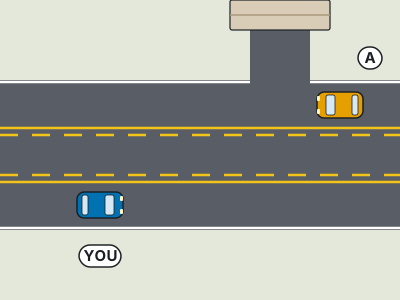
- Left turns from either direction
- Parking during a traffic stop
- Passing slower vehicles straight ahead
- Traveling straight until the next signal
Show answer
Left turns from either direction. A two-way center lane is shared by traffic from both directions for left turns. It is not a travel lane for driving straight through, a passing lane, or a parking strip. Because opposing drivers may enter it for the same purpose, use the lane only as needed to prepare for a left turn, check carefully for other vehicles, and yield before joining the destination lane. Do not remain in it longer than the turning maneuver requires.
10. Which behaviors does the Florida handbook say contribute most to crashes that kill or seriously injure?
- Driving older vehicles
- Impaired, drowsy, speeding, aggressive, and distracted driving
- Driving at night in rural areas
- Driving with passengers
Show answer
Impaired, drowsy, speeding, aggressive, and distracted driving. The handbook opens its safety discussion by naming the behaviors that most significantly contribute to crashes resulting in fatalities or serious injuries: impaired, drowsy, speeding, aggressive, and distracted driving. Before deciding to drive you should be free of alcohol, drug or prescription impairment, calm and focused. Vehicle age, rural night driving and passengers are risk factors in other contexts, but they are not the five behaviors the handbook lists.
11. How should following distance change when carrying a heavy load or pulling a trailer?
- Increase it; extra weight makes stopping and steering harder
- Decrease it to keep traffic tight
- Keep it the same always
- Drop to a one-second gap
Show answer
Increase it; extra weight makes stopping and steering harder. A heavy load or trailer adds mass that the brakes must absorb and the steering must control, so Florida directs drivers to increase following distance in that situation. The extra weight makes it harder to stop quickly and to steer correctly in an emergency. Tightening the gap to keep traffic compact trades away the very cushion the added mass demands. The rule generalizes: anything that lengthens stopping distance, including weight, water, darkness, or grades, must be matched with more space ahead.
12. What is a properly straight-in parked car?
- Angled across two spaces
- Centered with nothing in the lane
- Hanging into the traffic lane
- Over the sidewalk apron
Show answer
Centered with nothing in the lane. Straight-in parking is done right when the vehicle sits centered inside the space with no part of it extending into the traffic lane. A centered car leaves both doors usable and keeps mirrors and bumpers clear of passing traffic. Straddling two spaces steals a neighbor's spot, hanging into the lane creates a sideswipe target, and overhanging the sidewalk blocks pedestrians. Take the extra moment to straighten up: a properly parked car protects itself and everyone moving past it.
13. When parking on a hill, how should you turn the wheels?
- So a rolling car moves away from traffic or into the curb
- Toward the center of the road on every hill
- Straight ahead, regardless of the grade
- Toward traffic whenever the parking brake is set
Show answer
So a rolling car moves away from traffic or into the curb. Florida directs drivers to turn the wheels so that a vehicle that starts moving will roll away from traffic or into the curb. That positioning reduces the chance that a brake failure will send the car into moving vehicles. Straight wheels do not use the grade or curb to limit movement, and turning toward the center of the road increases exposure to traffic. Before leaving the vehicle, also set the parking brake, select Park or the appropriate manual gear, turn off the vehicle, and remove the keys.
14. What does fatigue do to a driver?
- Slowed thought, dimmed judgment and vision, dulled senses, micro-sleep
- Sharper reflexes
- Better night vision
- Improved patience
Show answer
Slowed thought, dimmed judgment and vision, dulled senses, micro-sleep. Sleepiness dismantles driving skill by skill: fatigue slows thought processes and reaction time, affects judgment and vision, impairs senses and abilities, and can cause micro-sleeping or falling completely asleep. Sharper, brighter, and calmer readings invert every documented effect. Nodding off at highway speed covers a football field per second with no one driving. Recognize the early warnings, yawning, drifting, missed exits, and stop before the micro-sleeps start.
15. What does brown mean on signs?
- Stop signs
- Construction zones
- Recreation, cultural, and historical areas
- School zones
Show answer
Recreation, cultural, and historical areas. Brown points to pleasure and heritage: the color marks areas of public recreation and cultural and historical significance. Stop red, construction orange, and school fluorescent each serve safety rather than sightseeing. Brown-and-white guide signs lead to parks, scenic areas, and historic sites worth the detour. Follow brown when exploring; follow regulatory colors when the mission is simply arriving safely and on time.
16. What happens when alcohol mixes with allergy or cold medication?
- It cancels alcohol's effects
- It has no interaction
- One drink can hit like several
- It sobers you up
Show answer
One drink can hit like several. Mixing multiplies: alcohol and drugs taken together often multiply each other's effects, so one drink plus an allergy or cold medication can hit like several drinks. Cancellation, no-interaction, and sobering claims all dangerously invert the pharmacology. The handbook's standing rule is that alcohol and drugs should not be consumed at the same time at all. Check every medication label for driving warnings, and treat any combining night as a guaranteed sober-ride night.
17. How do you elect the DUI waiver review option?
- Do nothing and wait
- Appear at BAR within 10 days, request waiver review, pay a fee
- Mail the license away
- Leave the state
Show answer
Appear at BAR within 10 days, request waiver review, pay a fee. The restricted-license option demands prompt action: appear at a BAR office within ten days of the DUI arrest, request the waiver review option, and pay a non-refundable fee. Waiting, mailing the license off, or fleeing the state each forfeit the election window and leave the full suspension in force. By accepting the restricted license the driver waives the right to a review of the suspension, so the ten-day trip is the fork between fighting and driving limited.
18. What is the highest speed limit you will find on any Florida road?
- 65 mph
- 70 mph
- 75 mph
- 80 mph
Show answer
70 mph. Florida states that its speed limit will never be higher than 70 mph, which is also the standard limit on limited access highways. Sixty five mph is lower than the top limit. Seventy five and 80 mph exceed Florida's cap. On a highway posted at 70 mph, the minimum speed is 50 mph. Speeding citations bring fines and points, and fines are doubled in school and construction zones.
19. What should you do around a truck preparing to back up?
- Help by standing behind it
- Walk behind to guide it
- Drive around closely behind
- Never cross behind it
Show answer
Never cross behind it. The rear of a backing truck is a total blind zone: the size of most trucks and trailers completely hides objects, people, and cars behind them from the driver's view. Never cross behind a truck that is preparing to back up or already backing, on foot or behind the wheel. Standing or walking behind to help puts the helper where the driver cannot see, and close drive-bys gamble that the truck holds still. Wait clear of the rear until the maneuver finishes and the truck drives forward away.
20. What should a driver do when a drawbridge signal shows yellow and the light is about to turn red?
- Accelerate onto the bridge before the signal changes
- Continue without slowing because yellow always permits passage
- Turn around immediately in the travel lane
- Stop if it can be done safely
Show answer
Stop if it can be done safely. A yellow drawbridge signal warns that the light is about to turn red and the bridge is about to start operating. A driver should stop when it is safe to do so, allowing the bridge controls to close the roadway without creating a collision. Accelerating onto the bridge treats the warning as permission to rush into a changing hazard. Yellow does not guarantee that passage remains available, and turning around in the travel lane creates a separate danger. Slow down early, check the space behind you, and stop at the marked line when safe.
QualitySpace is expanding to Florida
We are a California-based independent insurance brokerage working on licensing in more states. We cannot help with Florida insurance yet. Leave your email and we will let you know when we can.
Every question is written from the official Official Florida Driver License Handbook. Need paper? Printable FL practice test with answer key.
Last verified 2026-09-07. How we check every question · Study all 500 as flashcards
Frequently asked questions
How many questions are on this Florida practice test?
This fixed set has 20 questions. It is test 15 of 25 from the 500 question Florida bank. The real FL exam asks 50 questions and you need 40 correct.
What is the passing score for the real Florida test?
40 out of 50 (80 percent) That figure comes from the official Florida source cited on the DMV facts page.
How does this fixed test relate to the full Florida bank?
Each numbered test is a fixed set of 20 questions in a fixed order, so you can retake the same test later and compare. Every test mixes road signs and the other topics in about the same proportion as the full bank. Tests 1 to 25 together cover every question in the Florida bank once. The full practice page mixes the whole bank at random.
Last verified 2026-09-07. See the Florida DMV facts page for sourced state details.