
Test 7 of 25 · 20 questions · Free 2026
TX Permit Practice Test 7
Jump to the test ↓A fixed 20 question set from the Texas bank with answers and plain English explanations.
Question 1 of 20 · 0 right so far
All 20 questions in test 7
Every question below comes from the Texas question bank on this page. Open a question to see the correct answer and the explanation. Nothing here is hidden behind a signup.
1. What is the minimum age for a Texas provisional license?
- 16
- 15
- 17
- 18
Show answer
16. A Texas provisional license goes to drivers 16 to 18 years old who have finished a full driver education course, passed the vision and driving exams, and held a learner or hardship license for at least six months. Fifteen is the learner license age, not the provisional license age. Seventeen is not the provisional license age. At 18 a driver is no longer subject to Phase Two, and the provisional license itself expires on the holder's 18th birthday.
Study this in the handbook: Learner license and the graduated license program
2. You are passed on the left where Texas lanes are unmarked. What should you do?
- Move as far right as you can
- Move left to help them pass right
- Stop in your lane
- Speed up to match them
Show answer
Move as far right as you can. Unmarked lanes demand extra generosity to passers. Texas says that when being passed on the left where lanes are unmarked, safely move as far right as you can, making the pass as safe and easy as possible. Left moves, lane stops, and speed matches all crowd the passer. The cue is the car sweeping past on a wide unmarked road: slide right and gift the room.
Study this in the handbook: Signaling, passing and turning
3. What should you watch for entering on green in Texas?
- Close your eyes through intersections
- Speed up to beat everyone
- Ignore all other cars on green
- Watch for cars, pedestrians, and red-light racers
Show answer
Watch for cars, pedestrians, and red-light racers. Green lights still host red-light runners. Texas tells drivers to watch for cars and pedestrians in the intersection and beware reckless drivers racing to beat the red. Closed eyes, green-speeding, and car-ignoring all surrender defense. The cue is the fresh green: pause a beat, scan both cross directions, and only then commit to the intersection. A two-second pause at green has saved more lives than any hurried start ever gained.
Study this in the handbook: Traffic signals and arrows
4. What must a written notice include after a collision with an unattended vehicle?
- Only the vehicle's license plate number
- Only the weather conditions at the scene
- Only the time of day when it happened
- A statement of the circumstances of the collision
Show answer
A statement of the circumstances of the collision. When a written notice is attached to an unattended vehicle, it must provide a statement of the circumstances of the collision. The notice also includes the driver's name and address, but the question asks specifically about the collision information. A license plate number, time of day, or weather report does not replace the required description. The practical cue is to record what happened clearly while the details are fresh, then make the notice visible and secure on the damaged vehicle.
Study this in the handbook: Breakdowns, skids and crashes
5. When a school bus displays alternately flashing red lights, what must approaching drivers do?
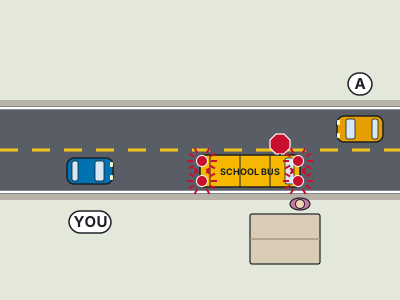
- Slow down and pass if no child is visible
- Stop and wait until the bus resumes, signals, or stops flashing red
- Stop only when approaching from behind the bus
- Pass after the first red flash
Show answer
Stop and wait until the bus resumes, signals, or stops flashing red. Drivers approaching a school bus from either direction must stop when its alternately flashing red lights are displayed. They may not pass until the bus resumes motion, the driver signals them to proceed, or the red lights are no longer flashing. Visibility of children does not change the rule, and stopping applies from either direction unless the handbook's separate controlled-access exception applies. The cue is the alternating red display: stop before reaching the bus, remain stopped, and wait for one of the listed release conditions.
Study this in the handbook: School buses and railroad crossings
6. A semitrailer circles a Texas roundabout using two lanes. What should you do?
- Squeeze past on whichever side is open
- Give them space across more than one lane
- Honk them back into a single lane
- Follow closely in their blind spot
Show answer
Give them space across more than one lane. Big rigs need the whole circle to swing through. Texas says to give space for large vehicles such as semitrailers, buses, and fire trucks that need more than one lane when driving around the circle. Squeezing past, honking, and blind-spot tailing all crowd a driver who cannot see you. The cue is the trailer tracking wide: hang back, let it use both lanes, and enter only after it clears your path.
7. How long does the average person need to think, react, and brake?
- One quarter of a second
- Exactly three seconds
- About 1-1/2 seconds
- A full ten seconds
Show answer
About 1-1/2 seconds. Thinking takes measurable road. Texas uses 1-1/2 seconds as the average time to think, react, and apply the brakes, during which the car keeps traveling before braking even begins. A quarter second describes reflexes, not the full perceive-and-react chain. Three and ten seconds overstate the average the stopping table is built on. The cue is the stopping distance math: at highway speed, those one and a half seconds consume car lengths before the brakes engage, which is why gaps and attention matter so much.
Study this in the handbook: Speed limits and following distance
8. Ignoring a Texas warning sign may result in:
- Permission to continue without reducing speed
- A traffic violation, in addition to increased safety risk
- A requirement to stop at every warning sign
- An automatic change to a regulatory sign
Show answer
A traffic violation, in addition to increased safety risk. Texas describes warning signs as notices of conditions immediately ahead, including hazards, changes in direction, or another situation requiring attention. The handbook also cautions that disregarding them may be a traffic violation. A warning sign does not automatically require a full stop, and it does not become a regulatory sign simply because a driver ignores it. Use the sign as an early response cue: pay attention, follow its instructions, and reduce speed to at least the posted speed when applicable.
Study this in the handbook: Sign shapes, colors and meanings
9. What does the Texas Standard Colors table explain?
- How to calculate a driver’s BAC
- What commonly used road-sign colors mean
- When a vehicle inspection expires
- Which lane a bicycle must use
Show answer
What commonly used road-sign colors mean. The Standard Colors table explains the meanings of colors commonly used on road signs. Color gives a driver quick context, but the full sign message, shape, and roadway situation still determine the needed response. The table is not a guide to BAC calculations, inspection expiration, or bicycle lane placement. When a color appears ahead, use it as an initial cue, then read the sign and check the surrounding traffic condition before acting.
Study this in the handbook: Sign shapes, colors and meanings
10. At an all-way stop, if two vehicles arrive at the same time, which vehicle should go first?
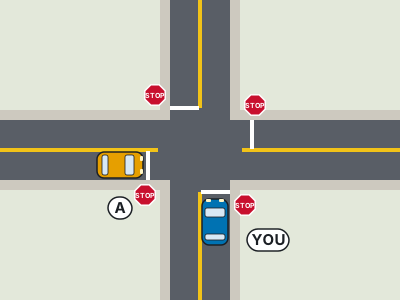
- The vehicle on the other driver's right
- The vehicle on the other driver's left
- The vehicle that is larger
- The vehicle that honks first
Show answer
The vehicle on the other driver's right. When vehicles reach an all-way stop simultaneously, yield to the vehicle on your right. The rule is based on position, not vehicle size, speed, or which driver makes a sound. First come to a complete stop, assess who arrived first, and use the right-side rule only when arrival is simultaneous. The left-side choice reverses the required priority and could cause both vehicles to enter together. A clear pause and deliberate glance to the right provide the needed cue before proceeding.
Study this in the handbook: Right of way at intersections
11. What does a solid yellow left-edge line mean in Texas?
- Drive on it to pass slow traffic
- Park on it during emergencies
- Cross it to reach an exit faster
- Stay right of it; left of it is prohibited
Show answer
Stay right of it; left of it is prohibited. The left-edge yellow line is a wall, not a guide to cross. Texas says the solid yellow line on the left road edge warns that driving left of it is prohibited. Passing, parking, and exit-chasing across it all violate the rule. The cue is the unbroken yellow at the pavement's left rim: everything drivable lies to its right. Cross it only in a genuine emergency, when no legal path remains at all.
Study this in the handbook: Pavement markings and lanes
12. When turning right, when should you begin signaling?
- Only after entering the intersection
- Exactly 10 feet before the turn
- At least 100 feet before the turn
- After completing the turn
Show answer
At least 100 feet before the turn. A right turn should be signaled at least 100 feet before the turn. Early notice gives following and crossing traffic time to understand your intended movement and react. Signaling after entering the intersection is too late, and the ten-foot choice does not provide the handbook's required distance. Keep the signal active while approaching and turning, and position the vehicle correctly before the corner. The concrete cue is to count a full 100 feet of advance notice, not merely tap the control at the corner.
Study this in the handbook: Signaling, passing and turning
13. What action does a red octagonal stop sign require?

- Slow down and continue if the intersection appears empty
- Stop only when another vehicle is approaching
- Come to a complete stop, yield, and then proceed carefully
- Stop after the crosswalk and then check for traffic
Show answer
Come to a complete stop, yield, and then proceed carefully. The handbook treats a stop sign as a complete-stop requirement, not a suggestion to slow down. Stop before the crosswalk, intersection, or sign, then yield to pedestrians or other vehicles before proceeding carefully. An empty-looking intersection does not remove the duty to stop. Stopping after the crosswalk places the vehicle too far forward and can block the crossing. Use the location of the stop line or crosswalk as the visual cue for where the vehicle must settle before moving again.
Study this in the handbook: Sign shapes, colors and meanings
14. After a breath or blood specimen shows a BAC of 0.08 or greater, what suspension period may apply for a first offense?
- 30 days
- 90 days
- 180 days
- Two years
Show answer
90 days. When a breath or blood specimen shows a BAC of 0.08 or greater, the handbook says a driver license may be suspended for 90 days for the first offense, with longer periods for subsequent offenses. The 30-day and 180-day choices belong to other penalty settings, while two years is not the first-offense period described here. Connect the 0.08 threshold to the adult DWI suspension table, then distinguish the first offense from later violations.
Study this in the handbook: DWI, open containers and implied consent
15. On a Texas numbered highway outside an urban district, what is the table speed limit for passenger cars?
- 70 mph
- 55 mph
- 60 mph
- 85 mph
Show answer
70 mph. The Texas speed table lists 70 mph for passenger cars on a highway numbered by Texas or the U.S. outside an urban district, including Farm to Market and Ranch to Market roads. Sixty mph is the limit on highways that are not numbered and on numbered highways for inspected school buses. Fifty five mph is not in the table. Eighty five mph is the top of the posted range on some limited access highways, not the default for numbered roads.
Study this in the handbook: Suspensions, revocations and license penalties
16. What is the first Texas defensive driving habit?
- Stare at the phone
- Close eyes at intersections
- Stay alert with eyes moving at all times
- Nap on straight roads
Show answer
Stay alert with eyes moving at all times. Attention is the defensive driver's first tool. Texas lists staying alert with constantly moving eyes first among crash-avoidance habits. Phones, closed eyes, and naps all abandon the watch. The cue is every glance cycle: mirrors, road, sides, repeat without pause. Scan mirrors every five seconds and the far road twelve seconds ahead. Commentary driving aloud keeps the brain locked on hazards.
Study this in the handbook: Seat belts, phones and distracted driving
17. What is the Texas penalty for repeat disabled-parking violations?
- Up to $1,250 plus community service
- A free warning forever
- A medal for persistence
- Towing of the enforcement officer
Show answer
Up to $1,250 plus community service. Repeat disabled-parking abuse climbs steeply. Texas raises the fine with additional offenses up to $1,250 for five or more, adding community service. Warnings, medals, and officer-towing are fantasies. The cue is the count: each repeat multiplies money and service until the habit breaks. Judges may also order vehicle impoundment for the worst repeat offenders in Texas. The message is simple: steal access and pay dearly.
Study this in the handbook: Where you may not park
18. What is a Texas occupational license?
- A license to sell license plates
- A permit to drive without insurance
- A restricted license for essential needs after suspension or revocation
- A lifetime exemption from all traffic law
Show answer
A restricted license for essential needs after suspension or revocation. Losing your license does not always mean losing your job. Texas offers an occupational or essential need license, a special restricted license for people whose driving privilege was canceled, suspended, revoked, or denied for certain offenses. Plate sales, uninsured driving, and law exemptions are not its purpose. The cue is the court order after suspension: essential trips like work, school, and groceries may continue under tight restrictions.
Study this in the handbook: Suspensions, revocations and license penalties
19. May you park or idle on a Texas sidewalk or crosswalk?
- Park with two wheels on the sidewalk to save space
- Stop on the crosswalk when traffic backs up
- Stand idling across a sidewalk gap briefly
- Never park, stop, or stand on either
Show answer
Never park, stop, or stand on either. Sidewalks and crosswalks belong to people on foot. Texas bans parking, stopping, or standing a vehicle on a sidewalk or crosswalk, with no allowance for partial blockage or short idling. Saving space, waiting out a backup, and brief pauses all put walkers, wheelchair users, and children into live traffic. The cue is the concrete path or painted stripes: keep every inch of your vehicle clear of them, stopping before the crosswalk line even when the light is green and traffic ahead is stacked.
Study this in the handbook: Where you may not park
20. How should drivers watch for pedestrians, whether or not the pedestrian has the right-of-way?
- Look only for pedestrians at traffic lights
- Always remain alert for individuals on foot
- Watch only after a horn is sounded
- Assume pedestrians will yield to vehicles
Show answer
Always remain alert for individuals on foot. The handbook says drivers should always look out for pedestrians whether those pedestrians have the right-of-way or not. A traffic light or horn does not eliminate the need to scan the road, and drivers should not assume a person on foot will yield. Slow near crossings, driveways, transit stops, and crowded sidewalks, and be ready to stop when a pedestrian enters the vehicle path. Alert observation is the first protection for people outside vehicles.
Study this in the handbook: Right of way at intersections
QualitySpace is expanding to Texas
We are a California-based independent insurance brokerage working on licensing in more states. We cannot help with Texas insurance yet. Leave your email and we will let you know when we can.
Every question is written from the official Texas Driver Handbook. Need paper? Printable TX practice test with answer key.
Last verified 2026-10-05. How we check every question · Study all 500 as flashcards
Frequently asked questions
How many questions are on this Texas practice test?
This fixed set has 20 questions. It is test 7 of 25 from the 500 question Texas bank.
How does this fixed test relate to the full Texas bank?
Each numbered test is a fixed set of questions in a fixed order, so you can retake the same test later and compare. Every test mixes road signs and the other topics in about the same proportion as the full bank. Tests 1 to 25 together cover every question in the Texas bank once. The full practice page mixes the whole bank at random.
Last verified 2026-10-05. See the Texas DMV facts page for sourced state details.