
Test 16 of 25 · 20 questions · Free 2026
TX Permit Practice Test 16
Jump to the test ↓A fixed 20 question set from the Texas bank with answers and plain English explanations.
Question 1 of 20 · 0 right so far
All 20 questions in test 16
Every question below comes from the Texas question bank on this page. Open a question to see the correct answer and the explanation. Nothing here is hidden behind a signup.
1. How does a downgrade change passing a Texas truck?
- Slow down because trucks crawl downhill
- Speed up, since truck momentum grows downhill
- Stop until the truck passes
- Ignore the grade entirely
Show answer
Speed up, since truck momentum grows downhill. Gravity turns a heavy truck into a runaway train on downgrades. Texas warns that downhill truck momentum builds speed, so you may need to increase your own speed to complete the pass, and to pass trucks larger than cars with extra room. Slowing, stopping, and ignoring the grade all surrender to the physics. The cue is the descent: plan a longer, faster pass with generous clearance.
2. Your street ends at a Texas through street. What must you do?
- Speed through without stopping
- Yield only to the left
- Stop and yield to vehicles on the through street
- Honk and proceed first
Show answer
Stop and yield to vehicles on the through street. A street that ends must bow to the street that continues. Texas says that approaching a through-street intersection from a dead-ending street, you must stop and yield to vehicles on the through street. Speeding through, one-sided yields, and honking all defy the rule. The cue is the T stem beneath you: your road ends, so every through driver owns the priority until you find a safe gap.
3. What must you avoid when braking on Texas ice?
- Lock them to stop in a straight line
- Avoid locking them, since it kills steering and control
- Pump them only after a full stop
- Disconnect them and use the parking brake
Show answer
Avoid locking them, since it kills steering and control. Locked wheels on ice turn the car into a sled. Texas warns to avoid locking the brakes on ice because it causes a loss of steering and control. Deliberate locking, post-stop pumping, and brake disconnection all abandon directional control. The cue is the slippery surface under braking: press smoothly, keep the wheels rolling so steering still works, and let anti-lock systems pulse if equipped.
4. What fine applies for disobeying the railroad grade crossing law?
- A warning with no fine for a first offense
- Community service only
- A fine of $50 to $200
- Automatic license revocation for a year
Show answer
A fine of $50 to $200. Railroad crossing violations carry a set dollar penalty. Texas subjects anyone who fails to obey the railroad grade crossing law to a fine of $50 to $200. There is no warning-only pass for a first offense, and community service alone is not the listed penalty. Revocation for a year far exceeds this fine schedule. The cue is the crossing law itself: gates, signals, and markings must be obeyed every time, because the penalty prices a moment of impatience that could cost lives.
5. When must a Texas driver use headlights, besides the period from 30 minutes after sunset to 30 minutes before sunrise?
- Whenever the radio is on
- Only when it rains
- Only on unlit highways
- Any time individuals or vehicles cannot be seen clearly for at least 1,000 feet
Show answer
Any time individuals or vehicles cannot be seen clearly for at least 1,000 feet. Texas requires headlights beginning 30 minutes after sunset and ending 30 minutes before sunrise, or any time individuals or vehicles cannot be seen clearly for at least 1,000 feet. Because that second test turns on visibility rather than the clock, it can apply in daylight too. At night, avoid looking directly into approaching headlights and shift your eyes down to the lower right side of your lane. Drive at a speed that lets you stop within the distance lit by your headlights.
6. When passing on a two-lane road, when should the driver return to the right lane?
- Before the passed vehicle disappears from the left mirror
- As soon as the front bumper passes the other vehicle
- After safely clearing the vehicle and seeing it in the rearview mirror
- Only after an oncoming driver flashes the headlights
Show answer
After safely clearing the vehicle and seeing it in the rearview mirror. The passing procedure says to remain left until the overtaken vehicle has been safely cleared and can be seen in the rearview mirror. That view gives the driver evidence of enough separation before moving back into the right lane. Returning when only the front bumper is ahead can cut across the other vehicle, while waiting for an oncoming signal is not the handbook's test. Keep the lane change smooth, use the right turn signal, and switch it off after the maneuver is complete.
7. Can showers, coffee, or exercise sober up a Texas driver?
- Cold showers and black coffee sober you up
- Only time sobers you; showers, coffee, and exercise do not
- Exercise burns alcohol off instantly
- Loud music restores normal driving
Show answer
Only time sobers you; showers, coffee, and exercise do not. Folk sobriety cures fail every time. Texas busts the myth directly: cold showers, black coffee, and exercise will not make a person sober, and only time, shaped by body weight, drink count, and food, minimizes alcohol's effects. Showers, coffee, workouts, and music all leave impairment untouched. The cue is the clock: about an hour per drink must pass, and no shortcut spends that time faster.
8. A red X glows above your Texas highway lane. What must you do?
- Do not drive in that lane
- Speed up to clear it fast
- Stop in the lane immediately
- Flash your lights and stay
Show answer
Do not drive in that lane. A red X closes the lane below it. Texas lane-use control signals warn that if a red X appears above a lane, a driver should not drive in that lane. Speeding through, stopping inside, and flashing through all disobey the closure. The cue is the overhead signal: red X means the lane ahead is blocked or reversed, so merge out early and never enter beneath it.
9. A 17-year-old Texas driver has two separate traffic convictions within 12 months. What can DPS do?
- Nothing until the driver turns 18
- Only send a warning letter
- Automatically cancel the license with no hearing
- Suspend or revoke the license after a proper hearing
Show answer
Suspend or revoke the license after a proper hearing. For a driver under 18, two or more separate traffic convictions within any 12 month period give DPS authority to suspend or revoke the license after a proper hearing. The threshold for adults is higher, four in 12 months or seven in 24 months, so teens face action sooner. DPS does not have to wait until the driver turns 18, and the handbook does not limit the response to a warning. The action follows a hearing, so an automatic cancellation with no hearing is wrong.
10. A minor in Texas is convicted of a first non-driving alcohol offense, such as possession. Which community service range applies?
- 8 to 12 hours
- 20 to 40 hours
- 40 to 60 hours
- 100 hours
Show answer
8 to 12 hours. A first non-driving alcohol offense by a Texas minor is a Class C misdemeanor with a fine of up to $500, 8 to 12 hours of community service, and a mandatory alcohol awareness course, plus a 30 day license suspension. Twenty to 40 hours is the second offense range. Forty to 60 hours belongs to later and more serious minor offenses, such as a third offense at ages 17 to 21. One hundred hours is not in the table. If the minor is under 18, a parent may also have to attend the alcohol awareness course.
11. What information do vertical rectangular traffic signs generally provide?
- Advance warnings of railroad crossings only
- Exclusive warnings about roadway hazards
- Directions for school crossings and school approaches
- Regulatory instructions for traffic behavior
Show answer
Regulatory instructions for traffic behavior. The handbook identifies the vertical rectangle as the shape generally used for regulatory signs. Such signs tell drivers what they should or should not do, including speed, lane, turn, or stopping requirements. A railroad warning is associated with a round sign, while hazard warnings generally use a diamond. The pentagon shape marks school advance and school crossing signs. Shape recognition is a quick study aid, but always read the displayed words or symbols because the shape gives the category, not every detail of the instruction.
12. What can caffeine do for a drunk Texas driver?
- It helps drowsy drivers but cannot sober a drunk driver
- It fully sobers any drunk driver
- It doubles intoxication safely
- It replaces sleep entirely
Show answer
It helps drowsy drivers but cannot sober a drunk driver. Caffeine masks fatigue, not intoxication. Texas notes that while caffeine can help drowsy drivers stay alert, it cannot make a drunk driver sober, and ordinary amounts do not improve a drunk driver's ability. Full sobriety, safe doubling, and sleep replacement all overstate the stimulant. The cue is the wide-awake drunk: alert feeling with impaired ability is the most dangerous combination of all.
13. A Texas street is torn up for repairs. Where may you stop beside it?
- Stop to watch the work for a minute
- Park opposite the trench if one lane stays open
- Idle beside the crew to ask directions
- Never stop, stand, or park where you would obstruct traffic
Show answer
Never stop, stand, or park where you would obstruct traffic. Work sites squeeze the road, so your stopped car must not squeeze it further. Texas bans stopping, standing, or parking alongside or opposite any street excavation or obstruction when doing so would obstruct traffic. Watching, direction asking, and partial-lane excuses all fail the test. The cue is the dug-up street or blocked lane: if your vehicle would pinch traffic at the pinch point, keep moving to a place that leaves the work zone passable.
14. A tow truck sits stopped with lights flashing on a Texas multi-lane road. What must you do?
- Stop in your lane immediately
- Speed past before responders look up
- Move out of the lane closest to the stopped vehicles
- Flash high beams to warn the workers
Show answer
Move out of the lane closest to the stopped vehicles. The Move Over law clears a buffer lane around roadside crews. When an emergency medical, law enforcement, fire, tow, utility, or TxDOT vehicle sits stopped with lights activated on a multi-lane road, Texas requires moving out of the lane closest to it, or slowing down where moving over is impossible. Stopping in a live lane and speeding past both endanger the crew. High beams blind night workers instead of helping. The cue is flashing roadside lights: shift one lane away early so responders get a full empty lane of protection.
15. What must a driver do at a steady red light before making an otherwise permitted right turn?
- Stop before the crosswalk or intersection and yield
- Turn immediately without yielding to pedestrians
- Roll through if no cross traffic is visible
- Wait for a green arrow in every case
Show answer
Stop before the crosswalk or intersection and yield. At a steady red light, the driver must stop before entering the crosswalk or intersection. A right turn may be made unless prohibited by law, but the driver must yield to pedestrians and other traffic lawfully using the intersection. Rolling through fails the required stop, and an empty-looking roadway does not remove the duty to check. A green arrow is not required for every permitted right turn. The cue is red first: stop at the proper point, confirm the turn is allowed, then yield before moving.
16. What movement is prohibited at an intersection displaying a no U-turn sign?
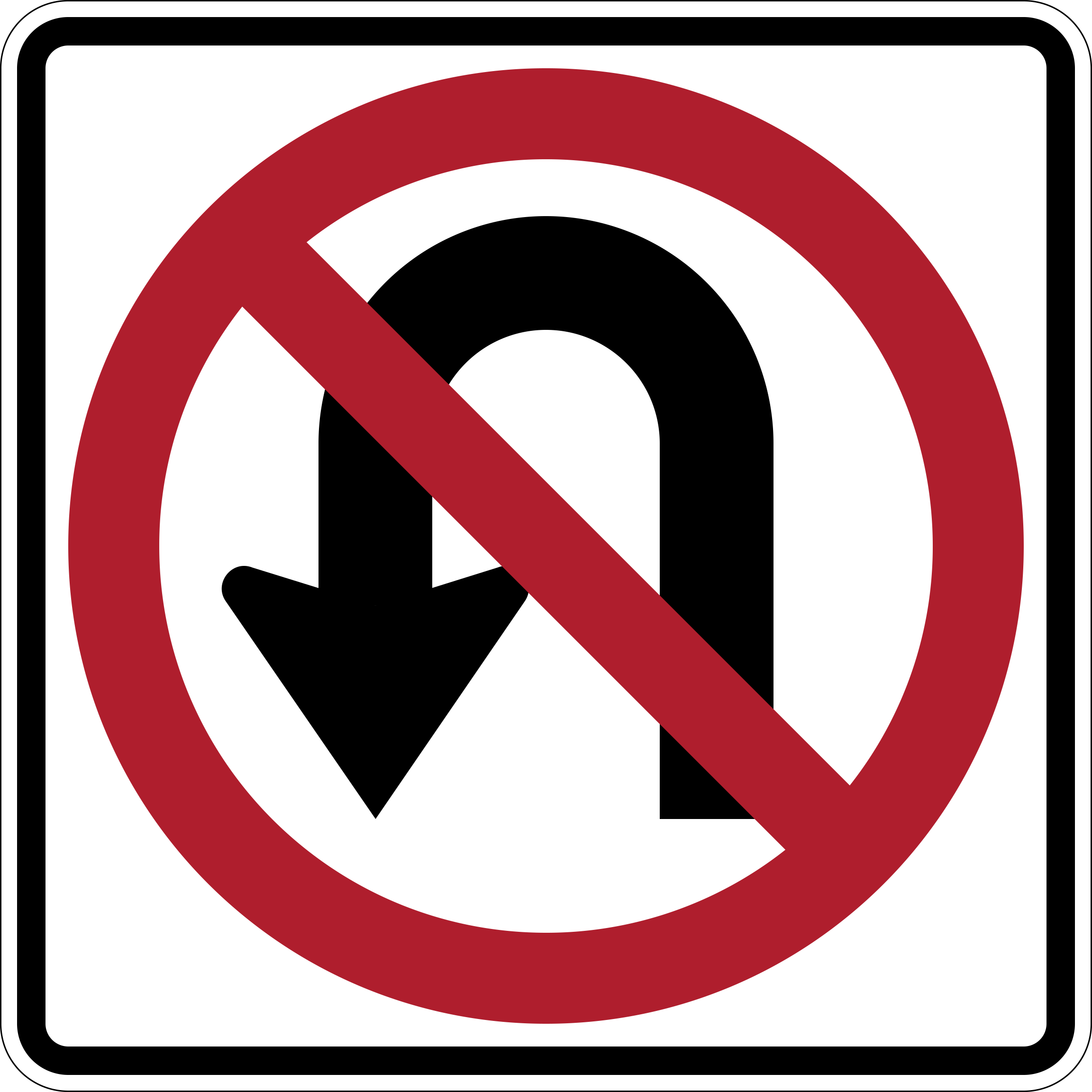
- A left turn into a side street
- A U-turn
- Passing a slower vehicle
- A right turn on a green signal
Show answer
A U-turn. A no U-turn sign prohibits turning the vehicle around at that intersection. It does not by itself ban every left turn, passing maneuver, or right turn on a green signal. The important distinction is the exact movement pictured by the sign. Before initiating a turn, compare the intended path with the crossed U-shaped arrow and obey the local restriction. If a route reversal is needed, continue until reaching a location where turning around is permitted and safe.
17. At a steady yellow light, when should you stop before entering the intersection?
- Only after entering the intersection
- Never, because yellow means accelerate
- When you can stop safely before the nearest crosswalk
- Only when a police officer is present
Show answer
When you can stop safely before the nearest crosswalk. A steady yellow light warns that the signal is changing to red. Stop before the nearest crosswalk when doing so can be accomplished safely. If stopping safely is not possible, proceed cautiously through the intersection before the light turns red. The choice to continue after entering the intersection reverses the stopping point, and accelerating is not the handbook response. As the light changes, check your distance and speed rather than braking abruptly. The practical cue is whether a controlled stop can be made before the crosswalk.
18. What should a driver do when leaving a vehicle?
- Leave the motor running and remove the key
- Turn off the motor, set the parking brake, and remove the key
- Set the parking brake only when on a hill
- Open the door without checking behind the vehicle
Show answer
Turn off the motor, set the parking brake, and remove the key. When leaving a vehicle, the handbook directs the driver to turn the motor off, set the parking brake, and remove the key. These steps secure the vehicle and reduce the chance of an unattended car moving or being entered improperly. Leaving the motor running, using only the brake on a hill, or opening the door without checking behind does not include the full safety sequence. Before opening the door, also look behind for oncoming traffic so the exit does not create a roadside hazard.
19. What may a Texas hardship license be based on?
- A minor establishing the necessity to drive
- Any adult request without supporting circumstances
- A desire to avoid driver education
- A license application with no authorized adult signature
Show answer
A minor establishing the necessity to drive. Texas may issue a hardship license to a minor who establishes the necessity to drive, and the license may carry restrictions based on the qualifying hardship. The process still requires an application executed by an authorized adult and the required testing and original-applicant requirements. A general adult request, a desire to skip education, or an unsigned application does not describe the hardship process. The key cue is documented necessity, not convenience or an automatic exception to licensing requirements.
20. How should you treat another driver's Texas blind spot?
- Camp in it to save fuel
- Nap in it during jams
- Use it as a rest area
- Pass through it or drop back out of it
Show answer
Pass through it or drop back out of it. Blind spots hide you from the passed driver's decisions. Texas says when passing, never drive or linger in the other driver's blind spot. Camping, napping, and resting there all park invisibly beside a potential lane change. The cue is the trailer's midsection beside you: complete the pass or fall back where mirrors work. Trucks have huge right-side blind zones where cars disappear completely from mirrors. Assume invisibility until you see the driver face.
QualitySpace is expanding to Texas
We are a California-based independent insurance brokerage working on licensing in more states. We cannot help with Texas insurance yet. Leave your email and we will let you know when we can.
Every question is written from the official Texas Driver Handbook. Need paper? Printable TX practice test with answer key.
Last verified 2026-09-07. How we check every question · Study all 500 as flashcards
Frequently asked questions
How many questions are on this Texas practice test?
This fixed set has 20 questions. It is test 16 of 25 from the 500 question Texas bank.
How does this fixed test relate to the full Texas bank?
Each numbered test is a fixed set of 20 questions in a fixed order, so you can retake the same test later and compare. Every test mixes road signs and the other topics in about the same proportion as the full bank. Tests 1 to 25 together cover every question in the Texas bank once. The full practice page mixes the whole bank at random.
Last verified 2026-09-07. See the Texas DMV facts page for sourced state details.