
Test 15 of 25 · 20 questions · Free 2026
TX Permit Practice Test 15
Jump to the test ↓A fixed 20 question set from the Texas bank with answers and plain English explanations.
Question 1 of 20 · 0 right so far
All 20 questions in test 15
Every question below comes from the Texas question bank on this page. Open a question to see the correct answer and the explanation. Nothing here is hidden behind a signup.
1. What safe speed range applies on Texas snow or ice?
- Any speed under 30 mph is safe
- The posted limit is always safe
- No speed range is safe; use extreme caution
- Double the posted limit to cross quickly
Show answer
No speed range is safe; use extreme caution. Snow and ice erase every normal speed assumption. Texas winter guidance states there is no such thing as a safe speed range on snow or ice, demanding extreme caution until you learn what traction your tires actually have. Fixed safe numbers, posted limits, and faster crossings all pretend grip exists. The cue is the white or glazed surface: test traction gently, cut speed far below normal, and treat every block as a new surface.
2. You are hit by a fleeing driver in Texas. What should you do?
- Report it to law enforcement for investigation
- Forget it ever happened
- Chase the other driver yourself
- Post about it only on social media
Show answer
Report it to law enforcement for investigation. Hit-and-run victims need police, not vigilantes. Texas says to report a hit-and-run crash to law enforcement for investigation. Forgetting, chasing, and posting-only all abandon the case. The cue is the fleeing taillights: memorize the plate, call police, and let professionals pursue. Note the fleeing car color, make, and partial plate if seen at all. Witness names and dashcam footage strengthen the case greatly.
3. Why should a driver slow down and increase following distance when the road is wet?
- Rain automatically raises the legal speed limit
- Wet roads become slippery and make the vehicle harder to control
- Wet pavement makes every vehicle stop instantly
- Following distance matters only on dry roads
Show answer
Wet roads become slippery and make the vehicle harder to control. The handbook explains that wet roads become slippery, making a vehicle harder to control, so the driver should slow down and increase the following distance. Extra space allows more time to react and more room for braking when traction is reduced. Rain does not change the posted speed limit, and slippery pavement does not make a car stop instantly. The cue is the first water on the road: reduce speed before control is lost and open the space ahead before traffic compresses it.
4. Before passing on a two-lane road, what blind-spot check does the handbook describe?
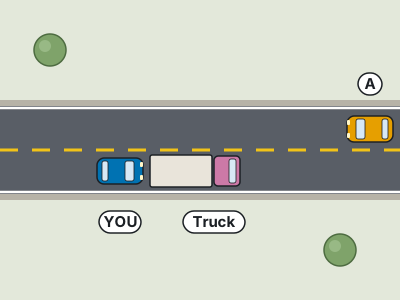
- Use only the inside mirror because the shoulder view is enough
- Look over the shoulder after checking the rearview and side mirrors
- Check the blind spot after moving into the opposite lane
- Rely on the horn instead of visually checking behind
Show answer
Look over the shoulder after checking the rearview and side mirrors. Before passing, the driver checks the rearview mirror and side mirrors, then looks over the shoulder into the blind spot to confirm that the roadway is clear and another vehicle is not already passing. Waiting until the vehicle has entered the opposite lane is too late for a safe decision. A horn can alert someone ahead but cannot reveal every vehicle beside or behind the car. Make the mirror and shoulder check before signaling and moving left, while also confirming that oncoming traffic leaves enough time and space.
5. Why must you look back while backing out in Texas?
- Look back before and while backing up
- Back quickly to surprise no one
- Trust the backup camera completely
- Close the windows to hear better
Show answer
Look back before and while backing up. Small children hide below mirror and window lines between parked cars. Texas warns that children often play between parked cars and requires looking back before and while backing up. Speeding in reverse, blind camera trust, and window tricks all gamble with a life. The cue is any residential or lot backing move: turn your head, scan the full rear path, and keep looking until the car is straight and rolling forward again.
6. What speed limit applies on a Texas public beach declared by the county?
- 30 mph, like an urban district
- 15 mph
- 50 mph, like a farm road
- 70 mph, like a numbered highway
Show answer
15 mph. Beach driving is capped low to protect crowds. Texas sets 15 mph for beaches and county roads next to a public beach when the commissioners court declares it, the same floor as alleys. Urban 30, farm road 50, and numbered highway 70 limits belong to very different places. The cue is sand and swimmers: where people walk, play, and sunbathe beside traffic, the table keeps every vehicle at a crawl.
7. You face a round green light and want to turn left in Texas. What must you do?
- Turn without looking, since green means go
- Cut off oncoming cars to save time
- Wait for a red light to turn
- Yield to all approaching opposite-direction traffic first
Show answer
Yield to all approaching opposite-direction traffic first. A plain green light does not protect a left turn. Texas allows turning left on green but requires yielding to all traffic approaching from the opposite direction before turning. Blind turns, cutoffs, and red-light waits all mangle the rule. The cue is the round green without an arrow: creep to the turn point, watch the oncoming stream, and complete the turn only when the gap is truly safe.
8. What is a Texas crossing inventory number for?
- The train's top speed
- The engineer's name
- The ticket price
- The exact crossing location for the railroads
Show answer
The exact crossing location for the railroads. Every crossing carries a unique federal identity for emergencies. Texas explains that the USDOT National Crossing Inventory Number identifies the exact location of the crossing to the railroads, posted alongside the railroad's emergency contact. Speeds, names, and prices are not its job. The cue is the small sign on the signal post: in a stall or malfunction, read that number to dispatchers so help finds the right rails.
9. After passing all your Texas exams, you get a temporary license. How long can you use it?
- 10 days
- 90 days
- 45 days or until the permanent license arrives
- One year
Show answer
45 days or until the permanent license arrives. Texas issues a temporary license after all exams are passed, and it is good for 45 days or until the permanent card arrives by mail. If the card has not arrived within 45 days, the handbook says to contact the customer service center. Ten days is too short. Ninety days is the application holding period after a failed exam, and one year is not a temporary license term. Keep the temporary license with you when driving until the permanent one comes.
10. How do tranquilizers and sedatives affect Texas drivers?
- They sharpen driving reflexes
- They are safe in any dose
- They only affect nighttime driving
- They depress the nervous system; sedated drivers are unsafe
Show answer
They depress the nervous system; sedated drivers are unsafe. Calming drugs calm driving skill away too. Texas describes tranquilizer and sedative-hypnotic drugs including barbiturates as powerful depressants, and warns that tired or over-sedated drivers are not good drivers. Sharpened reflexes, safe doses, and nighttime-only readings all deny the pharmacology. The cue is the prescription bottle: sedation warnings mean the car keys stay home. Mixing them with alcohol deepens the depression toward unconsciousness and death.
11. How should Texans dress to walk at night?
- Wear all black always
- Walk without any light
- Hide from headlights
- Wear white or bright clothes, carry light or reflector
Show answer
Wear white or bright clothes, carry light or reflector. Night walkers must glow to live. Texas says to wear white or light clothing and carry a light or reflector after dark. Black, unlit, and hiding readings court death. The cue is the sunset: dress bright and flash light at every crossing. Reflective vests and blinking armbands multiply visibility far beyond pale cloth. Walk facing traffic so headlights sweep across your gear.
12. A Texas minor gives a breath specimen showing a detectable amount of alcohol, but below 0.08. What is the suspension for a first offense?
- Suspended for 30 days
- Suspended for 60 days
- Suspended for 180 days
- No suspension, because the BAC is under 0.08
Show answer
Suspended for 60 days. Under Texas zero tolerance, a minor whose specimen shows any detectable alcohol while driving in a public place loses the license, even below the 0.08 adult limit. The first offense suspension is 60 days, the second is 120 days, and the third and later offenses bring 180 days. Thirty days is the first non-driving alcohol offense suspension. One hundred eighty days is the third offense figure and also the first refusal figure. Being under 0.08 does not help a minor.
13. What does the orange color identify in a work zone?
- Motorist services
- Construction and maintenance devices
- Public recreation and scenic guidance
- Permitted movements and direction guidance
Show answer
Construction and maintenance devices. Orange is the basic color for construction and maintenance traffic control devices. This color helps drivers recognize temporary work-zone guidance among ordinary roadway information. Blue identifies motorist services, brown identifies public recreation and scenic guidance, and green identifies permitted movements or direction guidance. When orange signs, drums, cones, panels, or arrow devices appear, expect a changed traffic pattern, slow as needed, and watch carefully for workers and equipment near the roadway.
14. What do pavement markings help drivers do, according to the Texas handbook?
- Receive warnings, direction, and traffic regulation from the roadway
- Ignore traffic signs whenever the markings are visible
- Identify only the nearest fuel station
- Replace every traffic signal at an intersection
Show answer
Receive warnings, direction, and traffic regulation from the roadway. Pavement markings work with signs and signals to warn and direct drivers and to regulate traffic. They are an active part of the roadway's control system, not merely decoration or a substitute for every other device. Seeing a marking does not authorize ignoring a sign or signal, and markings do not identify fuel stations. The safest reading combines the line pattern with nearby signs, lane position, and traffic movement. Before crossing or changing lanes, identify whether the marking permits, guides, or restricts that maneuver.
15. On a Texas road above 30 mph in good conditions, what minimum following gap does the handbook recommend?
- Four seconds
- Two seconds
- Ten seconds
- One second
Show answer
Four seconds. For speeds above 30 mph during good road conditions, Texas recommends a four-second gap between your vehicle and the one ahead. The two-second choice applies to speeds of 30 mph or less, so it is the most tempting alternative when the speed threshold is overlooked. One second leaves little room for perception and braking, and ten seconds is not the handbook minimum for this setting. Increase the interval when weather, traffic, visibility, or the road surface reduces available traction or reaction time.
16. Do the Texas GDL Phase One requirements apply to Class M motorcycle licenses?
- Yes, every Class M applicant must hold a learner license for six months
- Only Phase Two applies to Class M licenses
- No, Phase One requirements do not apply to Class M licenses
- Only applicants over 18 are exempt
Show answer
No, Phase One requirements do not apply to Class M licenses. The handbook expressly excludes Class M motorcycle licenses from the GDL Phase One requirements. It also says there is no minimum time a person must hold a restricted motorcycle license before applying for a Class M license. The six-month holding period belongs to the under-18 learner or hardship path for a provisional license, not to every motorcycle applicant. Do not confuse the motorcycle licensing class with the staged teen restrictions that govern learner and provisional licenses.
17. What roadway transition does a divided highway warning sign announce?

- Opposing flows of traffic are separated by a median island ahead
- The median may be crossed wherever the driver chooses
- A three-way intersection requires an immediate U-turn
- The road becomes a one-way street with no opposing traffic
Show answer
Opposing flows of traffic are separated by a median island ahead. The divided highway warning sign advises that opposing traffic will be separated by a median island. The driver should recognize the upcoming split and follow the roadway channel around the median. It does not announce a three-way intersection, permit crossing the median, or make the road one-way without opposing traffic. Reduce speed if needed, stay within the marked side of the highway, and keep right of the median structure as the separation begins.
18. What does Texas say about vehicles on light-rail tracks?
- Park on them to wait
- Stop on them for photos
- Drive along them slowly
- Never drive, stop, or park on them
Show answer
Never drive, stop, or park on them. Rails are exclusively for trains. The Texas light-rail safety table forbids driving, stopping, or parking on the tracks as dangerous and illegal. Waiting, photos, and slow drives all trespass. The cue is the steel in the street: cross only at designated points and never linger on it. Queued traffic must never stop on the rails while waiting for a signal. Keep the crossing box fully clear at all times.
19. What is the Texas penalty for a minor's second non-driving alcohol offense?
- A medal for repeat attendance
- Expungement with no penalty
- Class C misdemeanor, up to $500, 20 to 40 service hours, possible course
- A mandatory parade
Show answer
Class C misdemeanor, up to $500, 20 to 40 service hours, possible course. The second non-driving alcohol offense grows the service burden. Texas sets a Class C misdemeanor with up to a $500 fine, 20 to 40 hours of community service, and a possibly required alcohol awareness course, plus longer suspension. Medals, expungement, and parades mock the table. The cue is the repeat row: service hours double from the first offense's 8 to 12.
20. What is Texas angle parking?
- Parking on the sidewalk
- Parking in the travel lane
- Parking diagonally to the curb
- Parking on a bridge
Show answer
Parking diagonally to the curb. Angle parking aims cars nose-in at a slant. The Texas glossary defines it as parking diagonally to the curb. Sidewalks, travel lanes, and bridges are not angle spaces. The cue is the slanted stripes: enter nose-first within the lines and back out carefully when leaving. Backing out of angle spaces demands extra care, since cross traffic hides behind tall neighbors. Creep out slowly with hazards flashing until clear.
QualitySpace is expanding to Texas
We are a California-based independent insurance brokerage working on licensing in more states. We cannot help with Texas insurance yet. Leave your email and we will let you know when we can.
Every question is written from the official Texas Driver Handbook. Need paper? Printable TX practice test with answer key.
Last verified 2026-09-07. How we check every question · Study all 500 as flashcards
Frequently asked questions
How many questions are on this Texas practice test?
This fixed set has 20 questions. It is test 15 of 25 from the 500 question Texas bank.
How does this fixed test relate to the full Texas bank?
Each numbered test is a fixed set of 20 questions in a fixed order, so you can retake the same test later and compare. Every test mixes road signs and the other topics in about the same proportion as the full bank. Tests 1 to 25 together cover every question in the Texas bank once. The full practice page mixes the whole bank at random.
Last verified 2026-09-07. See the Texas DMV facts page for sourced state details.