
Test 25 of 25 · 20 questions · Free 2026
TX Permit Practice Test 25
Jump to the test ↓A fixed 20 question set from the Texas bank with answers and plain English explanations.
Question 1 of 20 · 0 right so far
All 20 questions in test 25
Every question below comes from the Texas question bank on this page. Open a question to see the correct answer and the explanation. Nothing here is hidden behind a signup.
1. When may a driver cross a broken or dashed yellow line?
- Never, because yellow lines always prohibit crossing
- Only after stopping for ten seconds
- To pass or change lanes if it is safe
- Only when a police officer is behind the vehicle
Show answer
To pass or change lanes if it is safe. Broken or dashed yellow lines permit passing or changing lanes when the maneuver is safe. The word safe matters because the driver must still consider oncoming traffic, sight distance, road conditions, and other markings or signs. The claim that yellow always prohibits crossing ignores the difference between broken and solid lines. A ten-second stop and a following police vehicle are not conditions listed by the handbook. Before crossing, confirm that the opposing lane is clear and that you can complete the maneuver without creating a conflict.
2. Does the Texas driveway parking prohibition apply whether the vehicle is occupied or not?
- Yes, both parking and standing idling are prohibited
- No, it applies only when the driver leaves the vehicle
- No, it applies only when the engine is off
- Yes, but only during posted business hours
Show answer
Yes, both parking and standing idling are prohibited. Texas applies this restriction whether the vehicle is occupied or not. The rule covers parking and allowing a vehicle to stand idling, so remaining in the driver seat does not create permission to block the driveway. Turning the engine off also does not make the location lawful, and the handbook does not limit the rule to business hours. Keep the driveway opening clear whenever you stop, regardless of how short the stop is or who remains inside.
3. Under Texas's Administrative License Revocation law, what may DPS do when a driver over 21 fails a breath or blood test?
- Give a vehicle registration discount
- Suspend the license or driving privilege
- Issue a replacement license without review
- Require only a new road test
Show answer
Suspend the license or driving privilege. Administrative License Revocation, or ALR, is how DPS handles a driving privilege after an alcohol test. The handbook says DPS may suspend the license or driving privilege of a driver over 21 who fails a breath or blood test with an alcohol level of 0.08 or more. It may also suspend anyone who refuses the test and anyone under 21 with any detectable alcohol. Getting the license back after an ALR suspension costs a $125 reinstatement fee.
4. What should you check before a Texas pass?
- Close your eyes and go
- Check signs, markings, zones, and oncoming left-lane traffic
- Pass without looking
- Trust luck alone
Show answer
Check signs, markings, zones, and oncoming left-lane traffic. A pass needs homework before commitment. Texas says to check well ahead for signs, markings, and no-passing zones plus oncoming left-lane traffic. Blind, unlooked, and lucky passes all gamble lives. The cue is the open left lane: verify signs, paint, and emptiness before entering it. At night add extra margin, since oncoming headlights hide true closing speed. When uncertain, abandon the pass and fall back.
5. What do green and blue Texas signs mean?
- Green bans all movement
- Blue means stop at once
- Both mark school zones
- Green guides permitted moves; blue guides motorist services
Show answer
Green guides permitted moves; blue guides motorist services. Cool colors inform rather than command. In the Texas code, green means permitted movements and direction guidance, while blue means motorist services guidance. Bans, stops, and school zones belong to other colors. The cue is the green exit panel or blue gas-food sign: follow for guidance, not orders. When lost, follow green toward the next town and blue toward fuel and food. Neither color ever issues a ticketable order by itself.
6. What form does a Texas driver crash report require?
- On any scrap of paper
- By text message only
- On a TxDOT specified form
- By shouting at the courthouse
Show answer
On a TxDOT specified form. Unofficial reports need official paper. Texas requires the written crash report on a TxDOT specified form, available from the TxDOT website. Scraps, texts, and shouting all fail the filing. The cue is the uninvestigated crash: download the form, fill it fully, and file within ten days. Missing the ten-day deadline can complicate insurance claims and trigger penalties. File early even when fault seems obvious to you.
7. A winding-road sign appears in Texas. How should you drive?
- Speed up to straighten the curves
- Drive slowly and carefully, without passing
- Stop at each curve to look
- Tailgate through the curves
Show answer
Drive slowly and carefully, without passing. A winding road strings blind bends together. Texas says a winding road ahead means drive slowly and carefully, without passing. Speeding, curve-by-curve stops, and tailgating all gamble against hidden oncoming cars. The cue is the snaking warning sign: settle to a calm pace, hold your lane through every bend, and pass nothing until the road straightens. Hills and trees hide oncoming cars until the last second on these roads.
8. What offense does a Texas minor commit driving with detectable alcohol?
- A free pass with no record
- A traffic warning only
- A fishing license suspension
- The criminal offense of Driving Under the Influence of Alcohol by a Minor
Show answer
The criminal offense of Driving Under the Influence of Alcohol by a Minor. Any detectable alcohol puts a minor driver in criminal territory. Texas states that a minor operating a vehicle in public or a watercraft with any detectable amount commits the criminal offense of Driving Under the Influence of Alcohol by a Minor. Free passes, warnings, and fishing penalties trivialize the charge. The cue is the word criminal: minor DUI is prosecuted, recorded, and punished, not waved away.
9. You fail the Texas knowledge exam on your first try. What happens to your application?
- It is held for 90 days; after 90 days or three failed exams, a new application and fee are required
- It is cancelled and you must wait one year
- You may retake the exam the same day as many times as needed
- It is held for 30 days, then a new fee is due
Show answer
It is held for 90 days; after 90 days or three failed exams, a new application and fee are required. When a Texas applicant fails on the first attempt, the application stays open for 90 days. Once 90 days pass or the applicant fails three exams, whichever comes first, a new application and fee are required. The application is not cancelled for a year after one failure. Unlimited same day retakes are not offered, since the third failure ends the application. Thirty days is not the holding period in the handbook.
10. What does the Texas handbook say about coasting downhill with the transmission in neutral?
- It is allowed if your foot stays near the brake
- It is illegal
- It is allowed only on grades posted for trucks
- It is recommended to save fuel
Show answer
It is illegal. The handbook states plainly that it is illegal to coast on a downgrade with the gears or transmission in neutral. For a steep hill, the handbook says you can shift your car into a low gear to help slow your vehicle, and it repeats the warning: never coast in neutral, and in a car with a standard transmission, never coast with your foot on the clutch. Both rules appear in the handbook, one under Coasting and one under Driving Down a Steep Hill.
11. In Texas, what is the penalty for driving around a warning sign or barricade placed where water is over the road?
- A Class B misdemeanor: up to $2,000 and/or up to 180 days in jail
- A Class C misdemeanor: $1 to $200 and no jail time
- A Class A misdemeanor: up to $4,000 and/or up to one year in jail
- A written warning and a required driving safety course
Show answer
A Class B misdemeanor: up to $2,000 and/or up to 180 days in jail. Driving around a warning sign or barricade is normally a misdemeanor with a $1 to $200 fine. When the sign or barricade has been placed where water is over any portion of a road, street, or highway, the offense becomes a Class B misdemeanor punishable by a fine of up to $2,000 and/or up to 180 days in jail. Water across a road may hide a missing segment of roadbed or a missing bridge, and twelve inches of water will float many cars.
12. How close to a crosswalk at an intersection may you park in Texas?
- No closer than 10 feet
- No closer than 15 feet
- No closer than 30 feet
- No closer than 20 feet
Show answer
No closer than 20 feet. Whether a vehicle is occupied or not, Texas says not to park it or let it stand idling within 20 feet of a crosswalk at an intersection. Other distances on the same list cover different places: 15 feet from a fire hydrant, 20 feet from a fire station driveway entrance, and 30 feet on the approach to any flashing signal, stop sign, yield sign, or other traffic control signal at the side of the road. Parking on a crosswalk itself is also banned.
13. What does a white speed limit sign tell a driver?
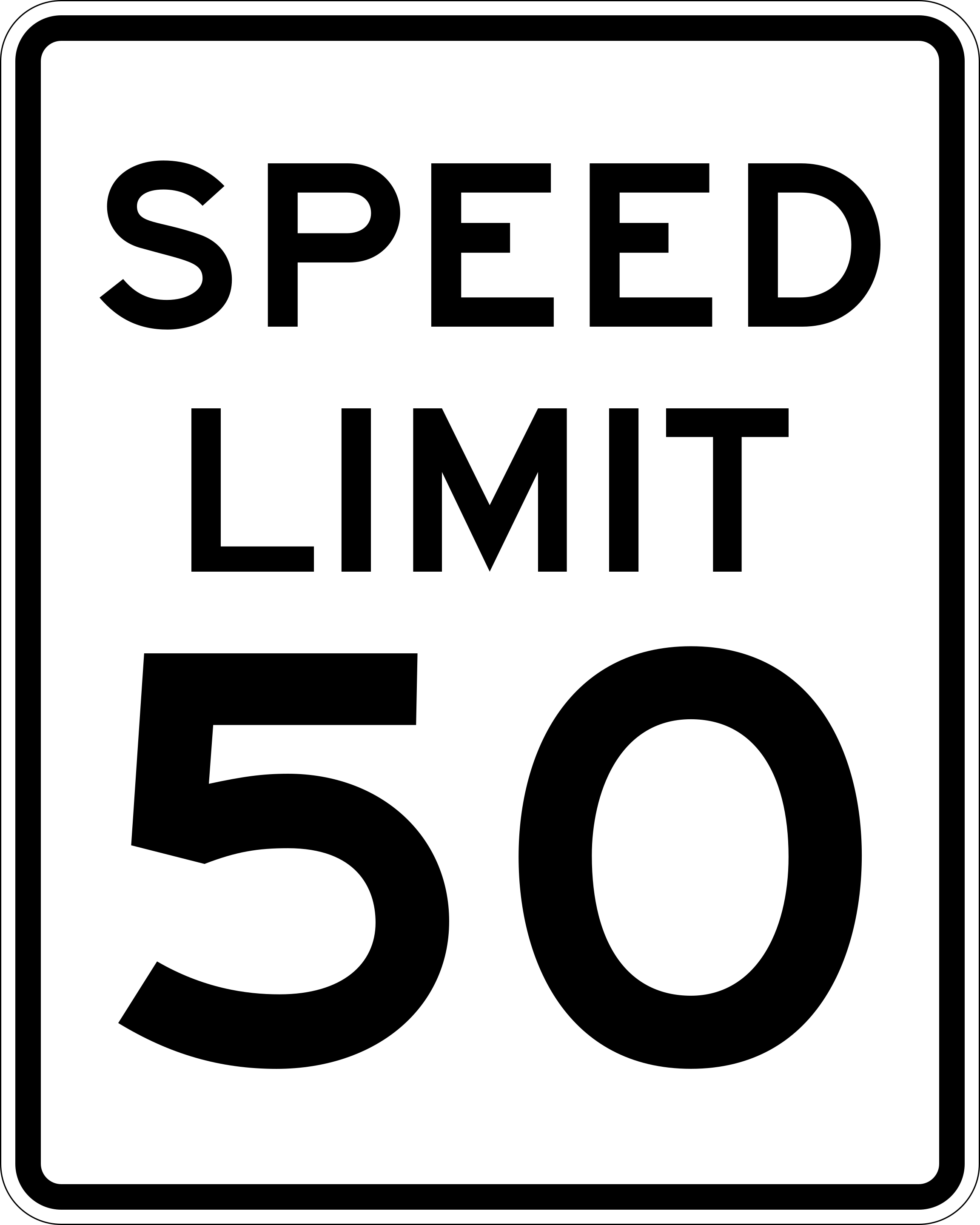
- An advisory speed that may always be exceeded
- That trucks alone may use the roadway
- The minimum speed required in every condition
- The maximum speed permitted on the roadway
Show answer
The maximum speed permitted on the roadway. A speed limit sign states the maximum speed permitted for the roadway, including the listed day or night conditions when those are shown. It is regulatory, not merely advisory, and it applies to more than trucks. The posted number also does not require that speed when weather, traffic, or visibility makes a slower pace necessary. Read the sign as an upper boundary, then adjust downward whenever safe control requires it.
14. A Texas walker skips a nearby pedestrian tunnel. Who yields?
- Ignore the tunnel completely
- Cross above it for fun
- Yield to all vehicles for skipping it
- Close the tunnel entrance
Show answer
Yield to all vehicles for skipping it. Provided crossings must be used or priority is lost. Texas says pedestrians who skip an available tunnel or overhead crossing must yield to all vehicles. Ignoring, joy-crossing, and closing the tunnel all miss the rule. The cue is the stairs or bridge nearby: use the safe path, or surrender priority on the street. Stairs and ramps may slow you, but they beat gambling against traffic every time.
15. When do Texas adults imply DWI specimen consent?
- Only on private land
- Only for minors
- Only with a court order
- When arrested for intoxicated driving of a car or boat in public
Show answer
When arrested for intoxicated driving of a car or boat in public. Driving and boating in public imply test consent for adults. Texas says adults consent to specimens when arrested for operating a motor vehicle or watercraft in public while intoxicated. Private-land, minor-only, and court-order readings all narrow the law. The cue is the public-place arrest: consent was given with the license itself. Refusing the test triggers its own suspension separate from the DWI case. Consent today avoids extra penalties tomorrow.
16. What does Texas say about drinking while walking roads?
- Never walk roads while drinking or impaired
- Drink while walking freely
- Stagger into traffic
- Sleep on the center line
Show answer
Never walk roads while drinking or impaired. Impaired walking kills nearly as surely as impaired driving. Texas forbids walking on roads while under the influence or consuming alcohol, naming it a pedestrian crash factor. Free drinking, staggering, and line sleeping all court death. The cue is the bottle: impaired feet belong off the road entirely. Designated walkers and rideshares serve groups heading home from bars. Planning the walk home matters as much as planning the drive.
17. What does the Texas windshield sticker prove?
- It decorates the windshield
- It replaces the driver license
- It proves registration and inspection together
- It pays all tolls
Show answer
It proves registration and inspection together. One sticker now does two jobs. Texas says the windshield registration sticker serves as combined proof of registration and inspection after the systems merged. Decoration, license replacement, and toll payment are not its roles. The cue is the single sticker: no separate inspection decal is needed anymore. Keep a printed inspection report in the glove box as backup proof. Officers can verify both registration and inspection from the single sticker.
18. Where do Texas overhead pedestrian signs hang?
- Over the roadway at the crosswalk
- Buried under the pavement
- Inside the nearest building
- A mile before the crossing
Show answer
Over the roadway at the crosswalk. Overhead signs hang where drivers cannot miss them. Texas places Overhead Pedestrian Crossing signs over the roadway at the crosswalk. Buried, indoor, and distant placements defeat the purpose. The cue is the sign spanning your lane above the stripes: pedestrians may step out at any moment. Slow beneath it and scan both curbs, since activated crossings still surprise drivers. Children dart from behind parked cars near these signs without any warning.
19. You pull out of a private driveway onto a city street. What must you do first?
- Roll straight through if no sidewalk exists
- Stop before the sidewalk and yield to all approaching traffic and pedestrians
- Yield only to vehicles, since pedestrians must wait
- Enter quickly so cross traffic can see you
Show answer
Stop before the sidewalk and yield to all approaching traffic and pedestrians. Emerging from a private road, alley, building, or driveway puts you last in priority. Texas requires a stop before the sidewalk, then yielding to every approaching vehicle and every pedestrian. Skipping the stop where no sidewalk exists misses the point; the stop protects the pedestrian path and gives you a sight line. Pedestrians keep their protection here, so yielding only to cars is wrong. Darting out to be seen startles others. The cue is leaving private ground for public road: stop early, look both ways, and wait for a full gap.
20. A tire blows out at Texas highway speed. What should you do?
- Brake hard and steer sharply
- Speed up to stabilize the car
- Ease off the gas, brake gently, and steer straight to a stop
- Turn off the engine immediately
Show answer
Ease off the gas, brake gently, and steer straight to a stop. A blowout demands gentle deceleration in a straight line. Texas says not to hit the brakes suddenly and hard, but to take your foot off the gas, gently apply the brakes, and steer straight ahead to a stop. Hard braking or sharp steering can flip the crippled car. Speeding worsens the wobble. Killing the engine steals power steering and brakes. The cue is the bang and pull: hold the wheel firmly, ease off the gas, brake softly, and roll straight to the shoulder.
QualitySpace is expanding to Texas
We are a California-based independent insurance brokerage working on licensing in more states. We cannot help with Texas insurance yet. Leave your email and we will let you know when we can.
Every question is written from the official Texas Driver Handbook. Need paper? Printable TX practice test with answer key.
Last verified 2026-09-07. How we check every question · Study all 500 as flashcards
Frequently asked questions
How many questions are on this Texas practice test?
This fixed set has 20 questions. It is test 25 of 25 from the 500 question Texas bank.
How does this fixed test relate to the full Texas bank?
Each numbered test is a fixed set of 20 questions in a fixed order, so you can retake the same test later and compare. Every test mixes road signs and the other topics in about the same proportion as the full bank. Tests 1 to 25 together cover every question in the Texas bank once. The full practice page mixes the whole bank at random.
Last verified 2026-09-07. See the Texas DMV facts page for sourced state details.