
Test 13 of 25 · 20 questions · Free 2026
TX Permit Practice Test 13
Jump to the test ↓A fixed 20 question set from the Texas bank with answers and plain English explanations.
Question 1 of 20 · 0 right so far
All 20 questions in test 13
Every question below comes from the Texas question bank on this page. Open a question to see the correct answer and the explanation. Nothing here is hidden behind a signup.
1. How should Texans walk without sidewalks?
- Walk in the traffic lane
- Walk left facing traffic, stepping off for cars
- Lie down on the shoulder
- Walk with back to traffic
Show answer
Walk left facing traffic, stepping off for cars. Facing traffic buys reaction time. Texas tells sidewalk-less walkers to use the left road edge and step off the pavement for approaching cars. Lane walking, lying down, and back-turned walking all invite strikes. The cue is the missing sidewalk: face the headlights and yield the pavement. Carry a flashlight after dark and wear bright reflective bands on limbs. Never assume a driver sees you until eye contact confirms it.
2. What information should you exchange with other drivers after a crash when requested and available?
- Names, addresses, phone numbers, vehicle and license details, and insurance information
- A cash payment instead of identifying information
- Nothing unless the damage exceeds $1,000
- Only your first name and color of vehicle
Show answer
Names, addresses, phone numbers, vehicle and license details, and insurance information. After a crash, the handbook calls for exchanging identifying and insurance information when requested and available. That includes names, addresses, phone numbers, vehicle identification and license plate numbers, driver license information, and insurance information. A first name alone is incomplete, cash is not a substitute for the record, and the duty is not limited only to crashes over a particular damage amount. Stay calm, write the information accurately from the documents, and also note the location and any witnesses.
3. What does the handbook table of warning signs provide?
- A list of driver license fees
- Examples of common warning signs
- A chart of fuel prices
- A schedule of vehicle inspections
Show answer
Examples of common warning signs. The handbook introduces its warning-sign table as a collection of examples of common warning signs. The table helps a driver connect familiar symbols with the conditions they warn about, such as changes in direction or hazards ahead. It is not a fee schedule, inspection calendar, or fuel-price chart. Study the sign image and its meaning together, then use the warning as an early cue to slow down, scan ahead, and prepare for the condition described.
4. What information does an advisory speed sign provide before a turn?
- The minimum speed required on every part of the highway
- The speed at which all following vehicles must travel
- The legal speed limit for the entire county
- The highest speed at which the turn can be traveled safely
Show answer
The highest speed at which the turn can be traveled safely. An advisory speed sign identifies the highest speed at which a driver can safely travel around the upcoming turn. It helps the driver adjust for geometry and visibility at that location, but it is not the roadway's universal legal speed limit. It also does not require every vehicle to match one speed or establish a countywide minimum. The cue is placement near a turn: reduce to a manageable speed before entering the curve, while still obeying the posted limit and conditions.
5. When may a driver cross a broken line on a two-way road?
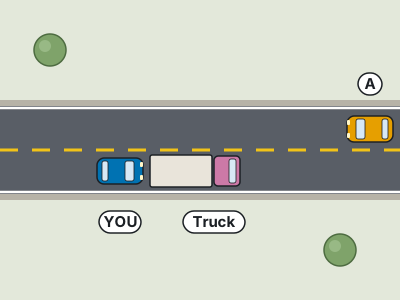
- Whenever the driver wants to avoid traffic
- Only after stopping for ten seconds
- When passing another vehicle or when the right half is closed, if safe
- Never under any circumstance
Show answer
When passing another vehicle or when the right half is closed, if safe. On a two-way rural road, a driver may cross a broken line when passing another vehicle or when the right half of the road is closed, provided the maneuver is safe. The marking creates a possible crossing opportunity, not a blanket invitation to move across whenever traffic is inconvenient. A ten-second stop is not required, and saying never ignores the handbook's listed situations. Check oncoming traffic, sight distance, roadway condition, and the line itself before crossing, then return to the proper side when the maneuver is complete.
6. Unless posted otherwise, what is the Texas speed limit in an alley?
- 30 mph, like any urban district
- 45 mph, like a county highway
- 60 mph, like an unnumbered highway
- 15 mph
Show answer
15 mph. Alleys get the lowest table speed in Texas. The speed table sets 15 mph for alleys, matching beaches and posted beach county roads, while urban districts default to 30 mph and rural numbered highways run far higher. Treating an alley like a normal street ignores its blind corners, pedestrians, and delivery stops. The cue is the narrow passage itself: at 15 mph you can stop for a child, a backing car, or a dumpster rolling into your path.
7. An adult Texas driver arrested for DWI refuses to give a breath or blood specimen for the first time. How long is the license suspended?
- A 30 day suspension
- A 90 day suspension
- A 180 day suspension
- No suspension without a conviction
Show answer
A 180 day suspension. Refusing a breath or blood specimen in Texas brings a 180 day suspension, and up to 730 days for later refusals. Ninety days is the first offense suspension for a driver who takes the test and shows 0.08 or more, so refusing carries the longer penalty. Thirty days is not the refusal period. The suspension is administrative under implied consent, so it does not wait for a criminal conviction. A $125 reinstatement fee applies to these Administrative License Revocation suspensions.
8. What does a DO NOT ENTER sign indicate?
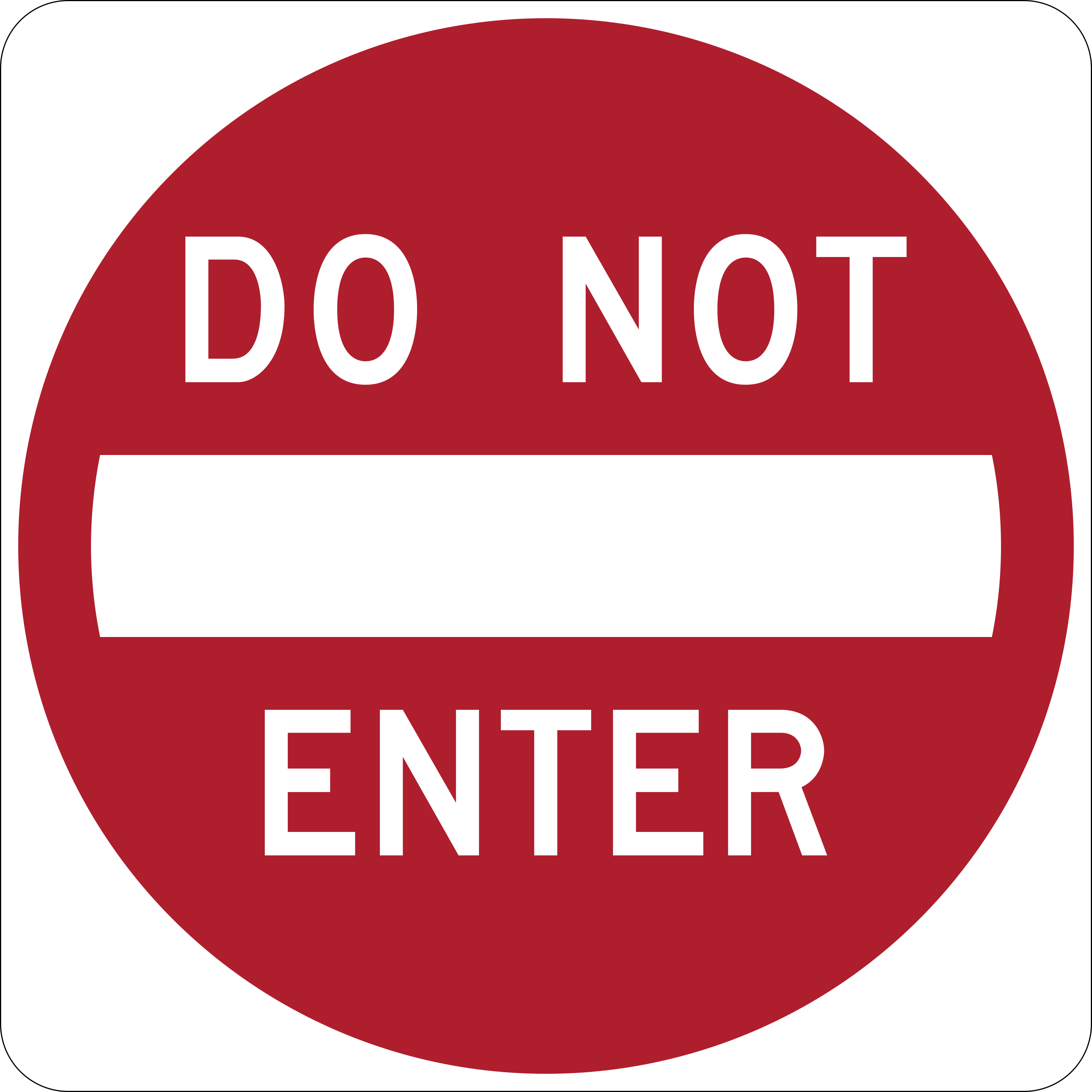
- The road is open only for parking
- The road ahead carries one-way traffic coming toward you, so you must not enter
- The driver may enter after yielding to pedestrians
- The roadway ahead is closed to all traffic and a detour is required
Show answer
The road ahead carries one-way traffic coming toward you, so you must not enter. The Texas handbook says a DO NOT ENTER sign means the road or street ahead is for one-way traffic traveling in the opposite direction. You must not drive in that direction, or you will be driving into oncoming traffic, so yielding to pedestrians first does not make entry lawful. The sign does not mark a road that is open only for parking, and it does not describe a road closure with a detour. Choose another route instead.
9. When parallel parking beside a right-hand curb, how far may the vehicle's wheels be from the curb or edge of the road?
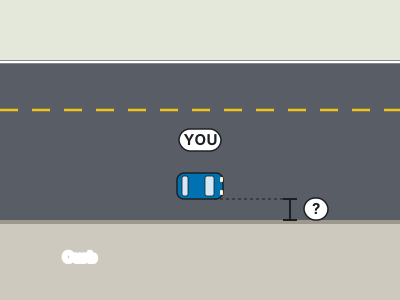
- At least 3 feet
- No more than 6 feet
- Exactly 24 inches
- No more than 18 inches
Show answer
No more than 18 inches. The parallel-parking procedure says the vehicle should not be more than 18 inches from the curb or edge of the road. This keeps the parked car out of the travel path while leaving room for traffic. A distance of at least three feet or six feet is too far, and exactly 24 inches exceeds the stated maximum. After backing into the space, straighten the wheels and check the final position. Use the curb or roadway edge as the reference, not the vehicle parked ahead.
10. What must a Texas driver provide when applying for an original driver license if the driver owns a vehicle requiring financial responsibility?
- A vehicle sales receipt from the dealer
- Evidence of financial responsibility
- A school attendance certificate
- A completed parking citation
Show answer
Evidence of financial responsibility. For an original Texas driver license, an applicant who owns a vehicle that requires financial responsibility must provide evidence of that responsibility. The handbook also allows a statement that the applicant does not own such a motor vehicle. A sales receipt does not prove current coverage, and school or parking documents address unrelated matters. Before an original application, distinguish proof of insurance or qualifying responsibility from ownership paperwork. The key condition is ownership of a vehicle subject to the financial-responsibility requirement.
11. What is the penalty for fleeing minor Texas crash damage?
- Life in prison
- A parade in your honor
- Class C misdemeanor up to $500
- A free car wash
Show answer
Class C misdemeanor up to $500. Small hit-and-runs still draw criminal records. Texas punishes a first failure-to-stop under $200 in damages as a Class C misdemeanor up to $500. Life terms, parades, and car washes are fantasies. The cue is the small dent: even minor flight is a crime, not a courtesy issue. The misdemeanor record still shows on background checks for years afterward. Honesty at the scene costs far less than flight.
12. Your car stalls in Texas floodwater. What should you do?
- Stay inside and wait for the water to drop
- Get out quickly and move to higher ground
- Restart the engine repeatedly until it catches
- Climb onto the roof and nap
Show answer
Get out quickly and move to higher ground. A stalled car in rising water becomes a trap within minutes. Texas relays emergency officials' order: if your vehicle stalls in floodwater, get out quickly and move to higher ground, and better yet turn around before entering. Waiting inside, grinding the starter, and roof naps all cede time to the current. The cue is the dead engine in water: abandon the car at once, take children and go bags, and climb beyond the water's reach.
13. Your car stalls on railroad tracks and will not restart. What should you try?
- Get out and try to push the car off the tracks
- Stay belted inside and wait for the train to stop
- Shift to neutral and nap until help arrives
- Abandon the car in the middle of the lane without trying
Show answer
Get out and try to push the car off the tracks. A stalled car on the rails is an emergency you must work to clear. Texas says never to stop on the tracks, and if your car stalls there and will not restart, get out and try to push it clear. If pushing fails, get help rather than standing by. Staying belted inside bets your life on a train that cannot stop in time. Doing nothing wastes the seconds that matter. The cue is a dead engine on the rails: exit, push toward safety, and if the car will not move, leave it and call for help from clear of the tracks.
14. Before opening your car door after parking, what must you do?
- Stare into oncoming headlights to stay awake
- Keep the doors unlocked for a fast exit
- Leave the engine running for heat
- Look behind for traffic before opening your door
Show answer
Look behind for traffic before opening your door. Dooring a cyclist or stepping into traffic ruins a finished park. Texas says that when you leave your vehicle, after shutting off the motor, setting the brake, and removing the key, be sure to look behind for oncoming traffic before opening your car door. Headlight staring, unlocked doors, and idling engines address nothing about the exit moment. The cue is your hand on the handle: check the mirror and blind spot for bikes, cars, and runners, then open into a confirmed clear gap.
15. Which convictions bring mandatory Texas license suspension?
- DWI, drug offenses, and intoxication manslaughter or assault
- Only parking tickets
- Only speeding under 5 mph over
- Only expired registration
Show answer
DWI, drug offenses, and intoxication manslaughter or assault. Serious criminal convictions trigger automatic license loss. Texas lists driving while intoxicated by alcohol or drugs, drug offenses, and intoxication manslaughter or intoxication assault among the mandatory-suspension convictions. Parking, minor speeding, and registration lapses sit far below this tier. The cue is the conviction type: crimes involving intoxication and drugs cost the privilege itself, not merely a fine. Learn these three by heart, because any one of them ends legal driving on conviction day.
16. What should a driver always observe for the roadway on which they are driving?
- The posted speed limit
- The speed of the vehicle behind them
- The largest speed limit in the state
- The speed suggested by a passenger
Show answer
The posted speed limit. The handbook directs drivers to be aware of and observe the posted speed limit for the roadway on which they are driving. A driver should not substitute the speed of a following vehicle, a statewide maximum from another road, or a passenger suggestion. Posted signs control the location, while traffic, weather, and visibility may require a slower speed. Scan for the sign when entering the road and keep the vehicle within the limit.
17. What must a driver do when a flashing yellow arrow permits a left turn?
- Turn immediately before opposing traffic moves
- Yield only to vehicles turning right
- Stop until a steady green arrow appears
- Yield to oncoming traffic before turning
Show answer
Yield to oncoming traffic before turning. A flashing yellow arrow allows a driver to turn left only after yielding the right-of-way to oncoming traffic. The arrow signals that the turn may be made, but it does not remove conflicts with vehicles approaching from the opposite direction. Turning immediately can cut across that traffic, and waiting for a steady green arrow is more restrictive than the handbook rule. The signal also does not limit the yield duty to vehicles turning right. Slow, look through the turn path, identify opposing traffic, and complete the turn only after yielding.
18. How vigilantly must Texas drivers watch for pedestrians?
- Watch only when pedestrians have signals
- Look only at marked crosswalks
- Watch for people on foot whether or not they have priority
- Ignore jaywalkers completely
Show answer
Watch for people on foot whether or not they have priority. Pedestrian safety overrides priority arguments. Texas says drivers should always watch for people on foot whether or not they hold the right-of-way. Signal-only, crosswalk-only, and jaywalker-ignoring habits all gamble with lives. The cue is any human near the road: expect the unexpected step, cover the brake, and yield the tonnage advantage you hold. Children, phone-starers, and impaired walkers all step out where least expected every day.
19. What is the Texas penalty for possessing an open alcohol container in a car?
- A fine of up to $500
- Automatic jail for a year
- License revocation for life
- Vehicle confiscation
Show answer
A fine of up to $500. The open container law prices the first conviction modestly but firmly. Texas punishes possessing an open alcohol container in a vehicle passenger area on a public highway, whether moving, stopped, or parked, with a fine not to exceed $500. Year-long jail, lifetime revocation, and confiscation all exceed this tier. The cue is the open can or bottle within reach: the fine applies even parked, so keep alcohol sealed and out of the passenger area.
20. What wireless communication device rule applies to Texas drivers under 18, including use of a hands-free device?
- Only texting is prohibited; calling is allowed hands-free
- Hands-free use is always permitted
- Use is restricted, including hands-free use, except in an emergency
- Use is allowed whenever the vehicle is moving below 30 mph
Show answer
Use is restricted, including hands-free use, except in an emergency. Texas restricts drivers under 18 from using a wireless communication device, and the rule expressly includes hands-free devices. The only stated exception is an emergency. A hands-free option is therefore not a general workaround, and the rule is broader than a texting-only ban. Vehicle speed also does not create permission. When reviewing this requirement, remember that the driver's age triggers the restriction and that the emergency exception is narrow.
QualitySpace is expanding to Texas
We are a California-based independent insurance brokerage working on licensing in more states. We cannot help with Texas insurance yet. Leave your email and we will let you know when we can.
Every question is written from the official Texas Driver Handbook. Need paper? Printable TX practice test with answer key.
Last verified 2026-09-07. How we check every question · Study all 500 as flashcards
Frequently asked questions
How many questions are on this Texas practice test?
This fixed set has 20 questions. It is test 13 of 25 from the 500 question Texas bank.
How does this fixed test relate to the full Texas bank?
Each numbered test is a fixed set of 20 questions in a fixed order, so you can retake the same test later and compare. Every test mixes road signs and the other topics in about the same proportion as the full bank. Tests 1 to 25 together cover every question in the Texas bank once. The full practice page mixes the whole bank at random.
Last verified 2026-09-07. See the Texas DMV facts page for sourced state details.