
Test 1 of 25 · 20 questions · Free 2026
TX Permit Practice Test 1
Jump to the test ↓A fixed 20 question set from the Texas bank with answers and plain English explanations.
Question 1 of 20 · 0 right so far
All 20 questions in test 1
Every question below comes from the Texas question bank on this page. Open a question to see the correct answer and the explanation. Nothing here is hidden behind a signup.
1. How much slower must a distracted driver react before crashes double, according to the Texas handbook?
- A half second
- Five seconds
- Two seconds
- One tenth of a second
Show answer
A half second. The handbook's distraction list includes reading, watching other people and aggressive drivers, talking or texting on a phone or CB radio, using navigation devices, daydreaming, and other mental distractions. It then gives a stark figure: if drivers react a half second slower because of distractions, crashes double. The other intervals are not the handbook's number. Its first tip is to learn every safety and usage feature of in-vehicle electronics, including your phone, before you drive.
Study this in the handbook: Seat belts, phones and distracted driving
2. What legal force do Texas warning signs carry?
- They are mere suggestions
- Disregarding them may be a traffic violation
- They apply only to trucks
- They expire at sunset
Show answer
Disregarding them may be a traffic violation. Warning signs carry legal weight behind the safety advice. Texas says warning signs must be observed for safety, and disregarding them may be a traffic violation. Suggestions-only, trucks-only, and sunset-expiry readings all excuse disobedience the law does not allow. The cue is any yellow diamond: heed it for safety first, and know the ticket book backs it up. Insurance points and fines both follow drivers who treat diamonds as decoration.
Study this in the handbook: Sign shapes, colors and meanings
3. The Texas handbook warns about driving through flooded roads. How deep must water be to float many cars?
- Two inches
- Twelve inches
- Six inches
- Three feet
Show answer
Twelve inches. Texas gives three flood depths to remember: six inches of water reaches the bottom of most passenger cars and can cause loss of control and stalling, twelve inches will float many cars, and two feet of rushing water will carry away pickup trucks, SUVs, and most other vehicles. Two inches is not a threshold in the handbook. Six inches causes stalling and loss of control rather than floating. Three feet is more than the depth that already sweeps away large vehicles.
4. What is the Texas penalty for a minor's second DUI offense?
- Class C misdemeanor, up to $500, 40 to 60 service hours, possible course
- No penalty for a second offense
- Automatic felony with prison time
- A written warning and a refund
Show answer
Class C misdemeanor, up to $500, 40 to 60 service hours, possible course. A second minor DUI keeps the misdemeanor class but grows the service hours. Texas punishes a second offense as a Class C misdemeanor with up to a $500 fine, 40 to 60 hours of community service, and a possibly required alcohol awareness course. No-penalty, felony, and warning readings all miss the table. The cue is the offense count: the fine stays capped while the service hours climb from the first offense's 20 to 40.
Study this in the handbook: Zero tolerance alcohol laws for minors
5. What is step one of Texas parallel parking?
- Pick a space smaller than the car
- Choose a fitting space, signal, stop even two feet out
- Skip signaling to save time
- Stop three car lengths past
Show answer
Choose a fitting space, signal, stop even two feet out. Parallel parking starts with setup, not steering. Texas step one says to choose a large enough space, then signal and stop even with the front car about two feet out from the space. Undersized spaces, skipped signals, and overshot stops all doom the maneuver. The cue is the open gap: claim it with a signal and stage alongside before ever turning the wheel.
Study this in the handbook: Where you may not park
6. What attitude does Texas require toward the right-of-way in every situation?
- Take it quickly before the other driver reacts
- Demand it by sounding your horn
- Assume trucks will always give it to you
- Treat it as something given, never taken
Show answer
Treat it as something given, never taken. Texas frames the right-of-way as a courtesy extended between drivers, not a prize to seize. Even when the rules clearly favor you, the handbook warns that if the other driver fails to follow them, you should give way rather than force the issue. Horn sounding and quick lunges escalate danger, and assuming large vehicles will yield is wishful thinking. The cue is any conflict over space: slow, communicate, and let the other driver go if there is doubt, because arriving safely matters more than arriving first.
Study this in the handbook: Right of way at intersections
7. Across the street from a fire station entrance, how far from that entrance does the Texas no parking zone extend?
- 75 feet
- 20 feet
- 50 feet
- 15 feet
Show answer
75 feet. Texas sets two fire station distances. On the station's own side, do not park or stand within 20 feet of the driveway entrance. On the side of the street opposite the entrance, the no parking zone reaches 75 feet from the entrance. Both limits apply whether or not anyone is in the vehicle, and they sit on the same list as the 15 foot fire hydrant rule and the 20 foot crosswalk rule. Remember the bigger number for the far side of the street.
Study this in the handbook: Where you may not park
8. How should a stuck Texas car warn traffic?
- Hide the breakdown
- Remove all reflectors
- Turn lights off
- Set portable warning devices for oncoming traffic
Show answer
Set portable warning devices for oncoming traffic. Stranded cars must announce themselves far ahead. Texas says portable warning devices should warn oncoming traffic when the car cannot leave the road. Hiding, stripping, and darkening all invite rear-end crashes. The cue is the stuck car: triangles or flares go out behind it first. Place the farthest device hundreds of feet behind the car for highway speeds. Retrieve them only when safely back in the vehicle.
Study this in the handbook: Night and highway driving
9. What are solid white lines commonly used to control on a Texas roadway?
- The direction of opposing traffic only
- Railroad crossing gates
- The legal boundary of a parking lot
- Lane use, road edges, shoulders, and transitions
Show answer
Lane use, road edges, shoulders, and transitions. Solid white lines may mark pavement edges and shoulders, channelizing, transitions, and lane use control. They organize traffic moving in the same general direction or define where a lane begins and ends, rather than separating opposing traffic like yellow center markings. The railroad and parking-lot choices are unrelated to the listed pavement uses. Crossing a solid white line should be avoided if possible, so treat it as guidance that limits unnecessary lane movement and identifies the intended path through a roadway change.
Study this in the handbook: Pavement markings and lanes
10. What are the two phases of Texas's Graduated Driver License program?
- Phase One for motorcycles and Phase Two for commercial licenses
- Phase One for learner licenses and Phase Two for provisional licenses
- Phase One for vehicle registration and Phase Two for insurance
- Phase One for adults and Phase Two for senior drivers
Show answer
Phase One for learner licenses and Phase Two for provisional licenses. Texas divides the Graduated Driver License program into two stages. Phase One applies to learner licenses, and Phase Two applies to provisional licenses. The program is designed to phase in driving privileges for applicants under 18, so motorcycle, commercial, registration, insurance, adult, and senior classifications do not describe its two phases. Remember the progression in order: supervised learning comes first, followed by the provisional stage with additional restrictions before full privileges.
Study this in the handbook: Learner license and the graduated license program
11. A Texas minor races on a public street. What follows?
- It earns extra credit
- It is legal on tracks
- It only affects adults
- It brings automatic under-21 suspension
Show answer
It brings automatic under-21 suspension. Street racing ends young licenses automatically. Texas lists racing on a public highway or street among under-21 automatic suspension offenses. Credit, legality, and adult-only readings are nonsense. The cue is the starting flag on public pavement: for minors it costs the privilege itself. A second racing offense can bring jail time on top of the license loss. Legal tracks offer the same thrill without the record.
Study this in the handbook: Suspensions, revocations and license penalties
12. What do Texas route marker signs tell you?
- What the weather will be
- What road you are or will be on
- Where to buy souvenirs
- How fast to drive
Show answer
What road you are or will be on. The Lone Star shield names your road. Texas says route marker signs tell drivers what road they are or will be traveling on. Weather, souvenirs, and speeds come from other signs. The cue is the numbered shield: match it to your trip plan and confirm every turn. Farm-to-Market and Ranch-to-Market shields share the same Texas shape and colors. Learn the number before leaving, since rural turns come fast.
13. Who is the designated driver, by Texas definition?
- The heaviest drinker in the group
- Whoever owns the newest car
- The last person to arrive
- The person who decided ahead not to drink and drives the drinkers
Show answer
The person who decided ahead not to drink and drives the drinkers. Planning beats willpower at midnight. The Texas glossary defines the designated driver as the person who decides ahead of time not to drink and is appointed to drive the others who do. Heaviest drinkers, new cars, and late arrivals are anti-definitions. The cue is the advance decision: the plan is made sober, before the first round, and the designated driver holds it all night.
14. A Texas crossbuck shows multiple tracks. What should you do?
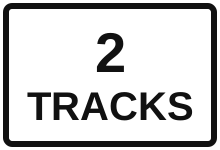
- Speed up to clear the tracks fast
- Stop on the tracks to count trains
- Slow, look, listen, and yield, noting the track count
- Ignore the sign in daylight
Show answer
Slow, look, listen, and yield, noting the track count. Multi-track crossings hide a second train behind the first. Texas says that where more than one track is crossed, the sign shows the number of tracks, and drivers must always slow down, look, listen, and yield to approaching trains. Speeding, track stops, and daylight exemptions all court disaster. The cue is the number plate under the crossbuck: each track needs its own clear look before you cross.
15. How should you pace a pass around a Texas truck?
- Cruise beside the truck for company
- Slow down next to the cab
- Pass quickly without lingering alongside
- Stop on the shoulder to let it pass
Show answer
Pass quickly without lingering alongside. Lingering in a truck's blind zone invites a lane-change squeeze. Texas says to complete your pass as quickly as possible and never stay alongside the other vehicle. Cruising beside, slowing at the cab, and shoulder stops all prolong the exposure. The cue is the trailer wall beside you: pass decisively, clear it fully, and return only when the whole truck shows in your mirror.
Study this in the handbook: Trucks, motorcycles, bicycles and pedestrians
16. How must you aim your wheels parking on a Texas grade?
- Park anywhere, since hills are always empty
- Turn the front wheels toward the curb or road edge on any grade
- Leave the wheels straight to save the tires
- Point the wheels uphill to catch the curb
Show answer
Turn the front wheels toward the curb or road edge on any grade. Gravity is always ready to roll your parked car downhill. Texas requires turning the front wheels to the curb or side of the road when standing on any grade, so a rollaway grounds itself instead of gathering speed. Straight wheels, empty-hill assumptions, and uphill-only aiming all miss the rule. The cue is any slope under your tires: cut the wheel toward the curb or shoulder edge, set the brake, and let the curb be your backup brake.
Study this in the handbook: Where you may not park
17. May you drive left on a Texas four-lane road?
- Stay right; never use the left for cruising
- Cruise the left lane always
- Weave between directions
- Drive the center line
Show answer
Stay right; never use the left for cruising. Multi-lane roads give each direction its own left boundary. Texas bans left-side driving where two or more lanes run each way. Left cruising, weaving, and center riding all invade opposing flow. The cue is the multi-lane cross-section: your leftmost legal tire stays right of the center. Passing on these roads uses the left lane of your own direction only. The center line is a wall, never a lane.
Study this in the handbook: Signaling, passing and turning
18. After passing a large truck, when should you move back into the lane in front of it?
- When you can see the entire front of the truck in your rearview mirror
- As soon as your rear bumper clears the truck's front bumper
- When the truck driver sounds the horn
- After you count to two
Show answer
When you can see the entire front of the truck in your rearview mirror. Trucks take much longer to stop than cars, and the handbook warns never to cut into the open space in front of a truck because that removes the driver's cushion of safety. It says to move back only when you can see the entire front of the truck in your rearview mirror, and then to maintain your speed. A truck driver may flash the lights after you pass as a signal that it is clear for you to pull back in.
Study this in the handbook: Trucks, motorcycles, bicycles and pedestrians
19. How do you finish a Texas pass?
- Cut back without signaling
- Stay in the left lane forever
- Signal right and return to the right lane
- Stop in the left lane
Show answer
Signal right and return to the right lane. Passes end with a signaled return. The Texas passing sequence finishes by signaling right and returning to the right lane after clearing. Unsignaled cuts, left camping, and lane stops all break the pattern. The cue is the cleared vehicle in your mirror: signal and slide home. Check the side mirror too, since the passed car may also be moving. Smooth predictable returns keep both drivers safe.
Study this in the handbook: Signaling, passing and turning
20. Why should drivers learn the shapes used on Texas traffic signs?

- Every sign shape gives permission to speed up
- Shape recognition replaces reading the sign's message
- Shape recognition helps drivers know what to do from a distance
- Only round signs can communicate warnings
Show answer
Shape recognition helps drivers know what to do from a distance. Recognizing sign shapes helps a driver understand what to do while approaching from a distance. The outline can provide an early category cue before the words or symbol are easy to read, but it does not authorize speeding or replace the sign's full message. Round signs are not the only signs that communicate warnings. A useful habit is to identify the shape first, reduce speed when the situation calls for it, and then read the wording or symbol to confirm the required action.
Study this in the handbook: Sign shapes, colors and meanings
QualitySpace is expanding to Texas
We are a California-based independent insurance brokerage working on licensing in more states. We cannot help with Texas insurance yet. Leave your email and we will let you know when we can.
Every question is written from the official Texas Driver Handbook. Need paper? Printable TX practice test with answer key.
Last verified 2026-10-05. How we check every question · Study all 500 as flashcards
Frequently asked questions
How many questions are on this Texas practice test?
This fixed set has 20 questions. It is test 1 of 25 from the 500 question Texas bank.
How does this fixed test relate to the full Texas bank?
Each numbered test is a fixed set of questions in a fixed order, so you can retake the same test later and compare. Every test mixes road signs and the other topics in about the same proportion as the full bank. Tests 1 to 25 together cover every question in the Texas bank once. The full practice page mixes the whole bank at random.
Last verified 2026-10-05. See the Texas DMV facts page for sourced state details.