
Test 12 of 25 · 20 questions · Free 2026
TX Permit Practice Test 12
Jump to the test ↓A fixed 20 question set from the Texas bank with answers and plain English explanations.
Question 1 of 20 · 0 right so far
All 20 questions in test 12
Every question below comes from the Texas question bank on this page. Open a question to see the correct answer and the explanation. Nothing here is hidden behind a signup.
1. Where must Texas pedestrians cross streets?
- Cross anywhere to save time
- Run across highways
- Cross at intersections, never mid-block
- Crawl under stopped cars
Show answer
Cross at intersections, never mid-block. Mid-block crossings hide walkers from drivers. Texas tells pedestrians never to cross between intersections, since mid-street crossing is dangerous. Anywhere, highway, and under-car readings court death. The cue is the corner: walk to it and cross with the signals. Drivers cannot brake for walkers hidden between parked cars mid-block. Corners give both sides the sight lines needed to share safely.
2. What does this two-way traffic warning sign tell a driver to do?
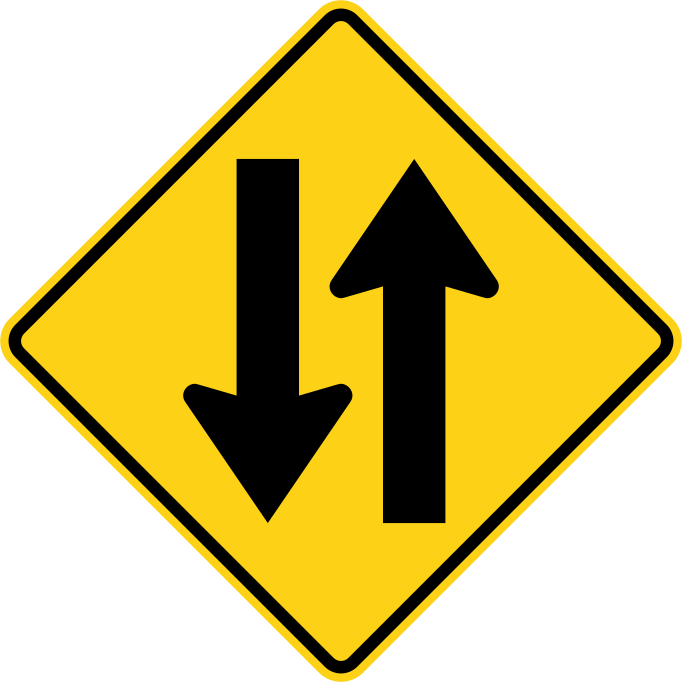
- Drive in the right-hand lane and expect oncoming traffic in the left-hand lane
- Pass on either side without checking
- Expect a median to begin and separate all traffic
- Treat the roadway as one-way in the driver's direction
Show answer
Drive in the right-hand lane and expect oncoming traffic in the left-hand lane. The two-way traffic sign, with arrows pointing in opposite directions, warns that the road ahead carries traffic both ways. The handbook says to drive in the right-hand lane and expect oncoming traffic in the left-hand lane. The sign does not authorize passing on either side, does not announce a median that separates traffic, and does not mean the road becomes one-way in your direction. Keep right, watch the centerline, and be careful about passing where oncoming vehicles may appear.
3. How long may a new Texan run out-of-state plates?
- It must be crushed at once
- It may run 30 days, then must register
- It gains lifetime exemption
- It must leave the state
Show answer
It may run 30 days, then must register. Newcomers get a one-month grace period on wheels. Texas allows a freshly resident or newly employed nonresident's vehicle 30 days of operation before Texas registration becomes mandatory. Crushing, exemptions, and exile are fictions. The cue is the move or hire date: count thirty days to the county tax office. Students and military members follow separate residency exceptions under Texas law. Check the county website before the deadline lapses.
4. Who may establish or alter Texas speed limits under the handbook?
- Only individual drivers on the roadway
- Only vehicle manufacturers
- Only the federal government for every road
- The Texas Transportation Commission, regional mobility authorities, and local governments
Show answer
The Texas Transportation Commission, regional mobility authorities, and local governments. The handbook gives authority to the Texas Transportation Commission, regional mobility authorities, and local governments to raise or lower speed limits based on traffic studies and other statutory requirements. Drivers cannot change a limit by agreement, and vehicle manufacturers do not set roadway rules. Federal control is not the exclusive authority described. When entering a new road, look for the posted limit and follow the sign in force at that location.
5. What is the penalty for a first offense of refusing a breath or blood specimen as a minor?
- A 30-day suspension
- A two-year suspension
- A 180-day driver license suspension
- No suspension if the driver was not intoxicated
Show answer
A 180-day driver license suspension. For a minor's first refusal to provide a breath or blood specimen, the listed consequence is a 180-day suspension of the driver license, or denial of driving privilege if the person is not licensed. The thirty-day figure belongs to a different alcohol-related offense, while two years applies to second and subsequent refusals. The rule concerns refusal itself, not a later proof of intoxication. Treat the implied-consent decision seriously, because declining the test can trigger its own suspension.
6. A Texas T-intersection warning sign appears. What must you do?
- Drive straight through the intersection
- Turn left or right and be ready to yield
- Stop and back up immediately
- Ignore the sign after midnight
Show answer
Turn left or right and be ready to yield. The T sign warns that straight ahead is not an option. Texas says you must turn left or right and be prepared to yield at the intersection if necessary. Straight-through driving, instant backups, and midnight exemptions all ignore the sign. The cue is the T shape: pick a turning direction early, slow for the stop, and yield to the through traffic before joining it.
7. What do regulatory traffic signs help protect?
- Only the appearance of road surfaces
- Only vehicles traveling after dark
- The age of every licensed driver
- The safety of all road users
Show answer
The safety of all road users. Regulatory signs communicate rules that guide driver behavior, and the handbook notes that these signs help protect the safety of all road users. Their purpose is broader than road appearance, driver age, or nighttime travel. Read the sign as an instruction that applies to the traffic situation around you, then obey the required or prohibited movement. A sign may control turning, lane use, parking, or another action, so do not assume its message is limited to one type of vehicle or one time of day.
8. What does Texas law prohibit a driver from doing with a cell phone while driving?
- Reading, writing, or sending messages
- Pulling safely off the road to make a call
- Using it to contact law enforcement during an emergency
- Letting a passenger make a call
Show answer
Reading, writing, or sending messages. While driving, it is against Texas law to read, write, or send messages on a cell phone or portable wireless device. The handbook allows emergency contact with law enforcement, and it advises pulling safely off the road before making a call. A passenger can also handle the call when possible. The key distinction is active message use while the vehicle is being driven. Put the device away before moving, and pull completely off the roadway if an urgent call is necessary.
9. If the posted speed limit is below 25 mph, how fast must you travel when approaching a stopped emergency vehicle with activated lights?
- Less than 5 mph
- Exactly 5 mph
- 20 mph below the posted limit
- The posted limit, unless a lane change is impossible
Show answer
Less than 5 mph. The low-speed condition has its own threshold. When the posted speed limit is less than 25 mph, a driver approaching the stopped emergency vehicle must slow to less than 5 mph. The 20 mph reduction belongs to roads posted at 25 mph or more, so applying it here can produce the wrong result. Exactly 5 mph is also not the stated standard because the handbook says less than 5 mph. Check the posted limit before choosing which part of the rule applies.
10. When may a Texas bicyclist take the full lane instead of riding to the right?
- Never
- When overtaking another vehicle, preparing to turn left, or avoiding unsafe road conditions
- Only on roads posted 30 mph or less
- Only at night
Show answer
When overtaking another vehicle, preparing to turn left, or avoiding unsafe road conditions. Texas lists situations that allow a bicyclist to take the full lane: overtaking and passing another vehicle going the same direction, preparing for a left turn at an intersection or onto a private road or driveway, and unsafe conditions in the road such as fixed or moving objects, parked or moving vehicles, or a lane too narrow to share. Drivers should expect a rider to move left for those reasons and leave safe passing room.
11. If an officer directs traffic differently from a traffic signal, whose instruction must the driver follow?
- The law enforcement officer directing traffic
- The illuminated signal because it always controls
- The driver in the adjacent lane
- The instruction on the nearest route sign
Show answer
The law enforcement officer directing traffic. Texas requires drivers to obey a law enforcement officer whenever that officer is directing traffic, even when the instruction would ordinarily conflict with a traffic law or signal. Following the illuminated signal automatically could send a driver into the path the officer is trying to protect. An adjacent driver has no authority to override either source, and a route sign gives guidance rather than a personal command. Slow down, watch the officer's hand signals, and follow the direction being given at that moment.
12. You must stop on a rural Texas highway shoulder. What visibility is required?
- Hide the car behind a curve for safety
- Make sure it is visible for at least 200 feet each way
- Cover it with a tarp to avoid dust
- Leave it straddling the center line
Show answer
Make sure it is visible for at least 200 feet each way. A car forced onto a rural highway must be seen early from both directions. Texas requires that when you cannot park off the road outside an urban area, your vehicle must be visible for at least 200 feet from each direction, with room left for others to pass. Hiding behind curves, tarps, and center lines all defeat visibility. The cue is the open road behind and ahead: place triangles or the car itself where approaching drivers get a full 200 feet of warning.
13. When Texas sets a speed limit, how do day and night limits compare?
- The same limit for daytime and nighttime
- A lower limit every night by law
- No limit at night on rural roads
- Double the day limit after midnight
Show answer
The same limit for daytime and nighttime. One number covers the whole clock. Texas requires any entity that sets or changes a speed limit to establish the same limit for daytime and nighttime. Automatic night reductions, open night speeding on rural roads, and doubled midnight limits all contradict the rule. The cue is the sign itself: whatever it posts applies around the clock, and drivers adjust below it for darkness rather than consulting a second number.
14. What is the penalty for a first offense of Driving Under the Influence by a Minor in Texas?
- A fine of up to $2,000 and 72 hours to 180 days in jail
- A warning and a phone call to the parents
- Two to ten years in prison
- A fine of up to $500, 20 to 40 hours of community service, and an alcohol awareness course
Show answer
A fine of up to $500, 20 to 40 hours of community service, and an alcohol awareness course. A first offense of Driving Under the Influence by a Minor is a Class C misdemeanor with a fine of up to $500, 20 to 40 hours of community service, and a required alcohol awareness course; a parent of a minor under 18 may also have to attend. A fine up to $2,000 with 72 hours to 180 days in jail is the first offense DWI penalty, which applies when the driver is intoxicated at 0.08 or more. A warning understates the offense, and two to ten years in prison belongs to a third DWI.
15. Which child passenger restraint rule applies in Texas?
- A child may use an adult belt at any age if seated in the back
- Every child under 12 must use a rear-facing seat regardless of height
- A child under 8 must use a federally approved child car seat unless taller than 4 feet 9 inches
- Only children under 4 years old need a federally approved restraint
Show answer
A child under 8 must use a federally approved child car seat unless taller than 4 feet 9 inches. Texas requires a federally approved child car seat for a child under 8 who occupies a seat equipped with a safety belt, unless that child is more than 4 feet 9 inches tall. Age alone does not make every young passenger rear-facing, and sitting in the back does not eliminate the restraint requirement. The rule also reaches beyond children under four. The cue is to check both measurements: under eight and not over 4 feet 9 inches means use the approved child seat.
16. What cell phone rule applies to Texas drivers under 18?
- Illegal for under-18 drivers except in an emergency
- Legal for all ages with any headset
- Legal for teens after 9 p.m.
- Banned for adults but fine for teens
Show answer
Illegal for under-18 drivers except in an emergency. Teen drivers get no hands-free pass in Texas. The handbook states that under 18, using a cell phone while driving is illegal even with a hands-free device, except in an emergency. All-ages permission, night windows, and adult-only bans all invert the rule. The cue is the driver's age: teen drivers must silence the phone completely and pull over for any call that cannot wait for arrival.
17. Where are Texas in-roadway lights typically placed?
- At midblock crossings and roundabout approaches, among others
- Only inside tunnels
- Only on private driveways
- Never in Texas
Show answer
Only inside tunnels. In-roadway lights guard the spots where pedestrians meet traffic without signals. Texas uses them as an alternative to traffic lights for pedestrian safety, typically at midblock crossings, school crosswalks, marked crosswalks on uncontrolled approaches, or ahead of roundabouts. Tunnels, driveways, and never-lists contradict the text. The cue is the crosswalk without a signal: glowing pavement dots may be the only warning you get.
18. What care does Texas require when leaving a parking space?
- Pull out fast before traffic notices
- Back out using only the mirrors
- Check mirrors, look back, signal, and watch for children
- Honk continuously while backing
Show answer
Check mirrors, look back, signal, and watch for children. Leaving a space reverses every parking hazard. Texas says to use caution, check all mirrors for obstructions especially pedestrians and children, look back before and while backing, and signal to notify other drivers. Fast pull-outs, mirrors-only backing, and constant honking each skip a safeguard. The cue is the reverse gear: scan mirrors, turn your head, signal your intent, and creep out ready to stop for a child darting between bumpers.
19. An adult Texas driver refuses a specimen again. What suspension applies?
- A weekend safety course only
- License frame confiscation
- 180 days, or up to 730 days for later refusals
- A doubling of the vehicle registration fee
Show answer
180 days, or up to 730 days for later refusals. Adult refusals stack steeply. Texas suspends the license for 180 days on a refusal, rising to up to 730 days for subsequent offenses. Courses, plate frames, and registration fees are not the penalty. The cue is the refusal history: the first no costs half a year, and later refusals can cost two full years off the road. A second refusal treated lightly the first time becomes a two-year exile the next.
20. A court impounds the vehicle of an owner convicted a second time of driving in Texas without evidence of financial responsibility. For how long?
- Impounded for 30 days
- Impounded for 60 days
- Impounded for one year
- Impounded for 180 days
Show answer
Impounded for 180 days. A second or later conviction for driving without evidence of financial responsibility brings a license suspension, a fine of $350 to $1,000, and court impoundment of the vehicle for 180 days when the driver owned it at the time of the offense and still owns it on the conviction date. Thirty days, 60 days, and one year are not the stated period. The court will not release the vehicle until evidence of financial responsibility is presented.
QualitySpace is expanding to Texas
We are a California-based independent insurance brokerage working on licensing in more states. We cannot help with Texas insurance yet. Leave your email and we will let you know when we can.
Every question is written from the official Texas Driver Handbook. Need paper? Printable TX practice test with answer key.
Last verified 2026-09-07. How we check every question · Study all 500 as flashcards
Frequently asked questions
How many questions are on this Texas practice test?
This fixed set has 20 questions. It is test 12 of 25 from the 500 question Texas bank.
How does this fixed test relate to the full Texas bank?
Each numbered test is a fixed set of 20 questions in a fixed order, so you can retake the same test later and compare. Every test mixes road signs and the other topics in about the same proportion as the full bank. Tests 1 to 25 together cover every question in the Texas bank once. The full practice page mixes the whole bank at random.
Last verified 2026-09-07. See the Texas DMV facts page for sourced state details.