
Key points
When leaving your vehicle, turn the motor off, set the parking brake and remove the key.
Source: Handbook p. 42
“When you leave your vehicle, turn the motor off, set the parking brake and remove the key.”
Texas Driver Handbook, Handbook p. 42Do not park within 15 feet of a fire hydrant.
Source: Handbook p. 42
“Whether occupied or not, do not park or allow a vehicle to stand idling: 1. In front of a public or private driveway 2. Within 15 feet of a fire hydrant”
Texas Driver Handbook, Handbook p. 42Do not park within 20 feet of a crosswalk at an intersection.
Source: Handbook p. 42
“Within 20 feet of a crosswalk at an intersection”
Texas Driver Handbook, Handbook p. 42Do not park within 30 feet of a flashing signal, stop sign, yield sign or traffic signal at the side of the road.
Source: Handbook p. 42
“Within 30 feet upon the approach to any flashing signal, stop sign, yield sign, or other traffic control signal located at the side of a road”
Texas Driver Handbook, Handbook p. 42Do not park within 20 feet of a fire station driveway, or within 75 feet across the street from its entrance.
Source: Handbook p. 42
“Within 20 feet of the driveway entrance to any fire station and on the side of a street opposite the entrance to any fire station within 75 feet of entrance”
Texas Driver Handbook, Handbook p. 42Do not park within 50 feet of the nearest rail of a railroad crossing.
Source: Handbook p. 42
“Do not park a vehicle, occupied or not, within 50 feet of the nearest rail of a railroad crossing.”
Texas Driver Handbook, Handbook p. 42If you must stop on a rural highway, make sure your vehicle can be seen for at least 200 feet each way.
Source: Handbook p. 42
“Be sure your vehicle can be seen for at least 200 feet from each direction”
Texas Driver Handbook, Handbook p. 42Parking illegally in a disabled space is a fine of $500 to $750 for a first offense.
Source: Handbook p. 42
“Illegally parking in a space reserved for individuals with disabilities is a misdemeanor punishable by a fine of $500 to $750 for the first offense.”
Texas Driver Handbook, Handbook p. 42Do not park more than 18 inches from the curb or edge of the road.
Source: Handbook p. 44
“Do not park more than 18 inches from the curb or edge of the road.”
Texas Driver Handbook, Handbook p. 44An unattended car on a grade must have its front wheels turned to the curb or side of the road.
Source: Handbook p. 43
“when standing on any grade, without turning the front wheels to the curb or side of the road.”
Texas Driver Handbook, Handbook p. 43
Numbers to know
| Number | What it means | Manual |
|---|---|---|
| 15 feet | no parking distance from a fire hydrant | Handbook p. 42 |
| 20 feet | no parking distance from a crosswalk | Handbook p. 42 |
| 30 feet | no parking distance from a stop sign, yield sign or signal | Handbook p. 42 |
| 20 feet | no parking distance from a fire station driveway | Handbook p. 42 |
| 75 feet | no parking distance across from a fire station entrance | Handbook p. 42 |
| 50 feet | no parking distance from a railroad crossing | Handbook p. 42 |
| 200 feet | visibility needed when stopped on a rural highway | Handbook p. 42 |
| $500 to $750 | first offense fine for illegal disabled parking | Handbook p. 42 |
| 18 inches | maximum distance from the curb | Handbook p. 44 |
Recognize these signs
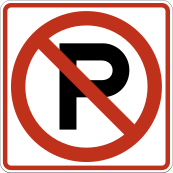
No parking 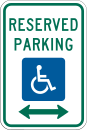
Disabled parking
3 questions from the Texas practice test
1. How close to a fire hydrant may a vehicle be parked in Texas?
- No closer than 5 feet
- No closer than 30 feet
- No closer than 50 feet
- No closer than 15 feet
Show answer
No closer than 15 feet. Texas says that, whether occupied or not, you must not park or allow a vehicle to stand idling within 15 feet of a fire hydrant. The same list bars parking in front of a public or private driveway, within 20 feet of a crosswalk at an intersection, within 30 feet on the approach to a flashing signal, stop sign, yield sign, or traffic signal at the side of the road, and within 20 feet of a fire station driveway. Five feet is too close, and 30 and 50 feet belong to other rules.
2. In Texas, how far from a stop sign, yield sign, or traffic signal at the side of the road must you park?
- At least 15 feet
- At least 30 feet on the approach
- At least 20 feet
- At least 50 feet
Show answer
At least 30 feet on the approach. The Texas no parking list includes within 30 feet upon the approach to any flashing signal, stop sign, yield sign, or other traffic control signal located at the side of a road. The rule applies whether the vehicle is occupied or not, and it covers standing idling as well as parking. Fifteen feet is the hydrant distance, and 20 feet applies to crosswalks at intersections and fire station driveways. Fifty feet is the railroad crossing distance, not the distance from a sign or signal.
3. When parallel parking beside a right-hand curb, how far may the vehicle's wheels be from the curb or edge of the road?
- At least 3 feet
- No more than 6 feet
- Exactly 24 inches
- No more than 18 inches
Show answer
No more than 18 inches. The parallel-parking procedure says the vehicle should not be more than 18 inches from the curb or edge of the road. This keeps the parked car out of the travel path while leaving room for traffic. A distance of at least three feet or six feet is too far, and exactly 24 inches exceeds the stated maximum. After backing into the space, straighten the wheels and check the final position. Use the curb or roadway edge as the reference, not the vehicle parked ahead.
Practice this topic
Lock it in with parking questions from the free Texas practice test. Every answer comes with a plain English explanation.
Source: the Texas Driver Handbook, Chapter 7: Parking, Stopping, or Standing. This lesson is a plain English summary, not the law itself; where it differs, the manual and the statute govern. Last checked 2026-09-27.