
Key points
A car at 55 mph can stop in about 240 feet.
Source: Handbook p. 51
“The average passenger car traveling at 55 mph can stop in approximately 240 feet”
Texas Driver Handbook, Handbook p. 51A fully loaded tractor-trailer may take more than 400 feet to stop.
Source: Handbook p. 51
“A fully loaded tractor-trailer may take more than 400 feet to completely stop”
Texas Driver Handbook, Handbook p. 51On a level highway it takes three to five seconds longer to pass a truck than a car.
Source: Handbook p. 51
“On a level highway, it takes three to five seconds longer to pass a truck than a car.”
Texas Driver Handbook, Handbook p. 51Never cut in front of a truck. Cutting into the space in front of a truck removes the driver's cushion of safety.
Source: Handbook p. 51
“Never cut in front of a truck. Cutting into the open space in front of a truck or bus removes the driver’s cushion of safety.”
Texas Driver Handbook, Handbook p. 51Always take a second look for motorcycles before turning, especially before left turns.
Source: Handbook p. 52
“always take a second look for a motorcycle before turning at an intersection, particularly when making left turns.”
Texas Driver Handbook, Handbook p. 52When turning right, merge with bicycle traffic rather than turning across it.
Source: Handbook p. 53
“A motorist should merge with bicycle traffic when preparing for a right turn. Avoid turning directly across the path of bicycle traffic.”
Texas Driver Handbook, Handbook p. 53Bicyclists must ride as far right as possible only when a car and bicycle can safely share the lane side by side, and some conditions let a bicyclist take the full lane.
Source: Handbook p. 53
“only when the lane can be shared safely by a car and a bicycle, side-by-side. Even then, there are certain conditions that allow a bicyclist to take the full lane.”
Texas Driver Handbook, Handbook p. 53Yield to pedestrians at uncontrolled intersections and to those with a WALK signal.
Source: Handbook p. 23
“Drivers must give the right-of-way to pedestrians: 1. At an uncontrolled intersection (there are not any traffic signs or signals for the pedestrian to enter the crosswalk) 2. If the pedestrian has a WALK signal”
Texas Driver Handbook, Handbook p. 23If the light changes after a pedestrian enters the crosswalk, still give the pedestrian the right of way.
Source: Handbook p. 23
“If the light changes after the pedestrian has entered the crosswalk, still give the pedestrian the right-of-way.”
Texas Driver Handbook, Handbook p. 23Watch for pedestrians with an assistance animal or a white cane, which shows the person may be blind, partially blind or disabled.
Source: Handbook p. 61
“Be alert to a pedestrian guided by an assistance animal or carrying a white cane. The white cane indicates the person may be blind, partially blind, or disabled.”
Texas Driver Handbook, Handbook p. 61
Numbers to know
| Number | What it means | Manual |
|---|---|---|
| 55 mph | speed used for the stopping comparison | Handbook p. 51 |
| 240 feet | car stopping distance at 55 mph | Handbook p. 51 |
| 400 feet | loaded truck stopping distance | Handbook p. 51 |
| 3 to 5 seconds | extra time to pass a truck | Handbook p. 51 |
Recognize these signs

Pedestrian crossing 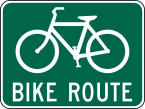
Bike route
3 questions from the Texas practice test
1. When may a Texas bicyclist take the full lane instead of riding to the right?
- Never
- When overtaking another vehicle, preparing to turn left, or avoiding unsafe road conditions
- Only on roads posted 30 mph or less
- Only at night
Show answer
When overtaking another vehicle, preparing to turn left, or avoiding unsafe road conditions. Texas lists situations that allow a bicyclist to take the full lane: overtaking and passing another vehicle going the same direction, preparing for a left turn at an intersection or onto a private road or driveway, and unsafe conditions in the road such as fixed or moving objects, parked or moving vehicles, or a lane too narrow to share. Drivers should expect a rider to move left for those reasons and leave safe passing room.
2. How should drivers watch for pedestrians, whether or not the pedestrian has the right-of-way?
- Look only for pedestrians at traffic lights
- Always remain alert for individuals on foot
- Watch only after a horn is sounded
- Assume pedestrians will yield to vehicles
Show answer
Always remain alert for individuals on foot. The handbook says drivers should always look out for pedestrians whether those pedestrians have the right-of-way or not. A traffic light or horn does not eliminate the need to scan the road, and drivers should not assume a person on foot will yield. Slow near crossings, driveways, transit stops, and crowded sidewalks, and be ready to stop when a pedestrian enters the vehicle path. Alert observation is the first protection for people outside vehicles.
3. Where are in-street pedestrian crossing signs placed?
- Only on the right-hand roadside shoulder
- In the roadway at the crosswalk on a center line, lane line, or median island
- At the nearest railroad crossing
- Above the roadway on a traffic signal mast
Show answer
In the roadway at the crosswalk on a center line, lane line, or median island. Texas describes in-street pedestrian crossing signs as being placed in the roadway at the crosswalk. Their permitted locations include the center line, a lane line, or a median island. They are not roadside signs on the left or right, and the handbook does not place them overhead on a signal mast. The railroad choice concerns a separate warning system. When driving toward a marked crossing, expect the sign to stand within the roadway and reduce speed for people who may enter the crosswalk.
Practice this topic
Lock it in with right of way questions from the free Texas practice test. Every answer comes with a plain English explanation.
Source: the Texas Driver Handbook, Chapter 9: Some Special Driving Situations. This lesson is a plain English summary, not the law itself; where it differs, the manual and the statute govern. Last checked 2026-09-27.