
Key points
If a school bus shows alternately flashing red lights, you must stop, whichever direction you approach from.
Source: Handbook p. 23
“If you approach a school bus from either direction and the bus is displaying alternately flashing red lights, you must stop.”
Texas Driver Handbook, Handbook p. 23Do not pass until the bus moves, the driver signals you on or the red lights stop flashing.
Source: Handbook p. 23
“Do not pass the school bus until: 1. The school bus has resumed motion; 2. You are signaled by the driver to proceed; or 3. The red lights are no longer flashing.”
Texas Driver Handbook, Handbook p. 23You need not stop for a school bus on a different road, or on a controlled-access highway where the bus is in a loading zone and pedestrians may not cross.
Source: Handbook p. 23
“It is not necessary to stop when passing a school bus on a different road or when on a controlled-access highway where the bus is stopped in a loading zone and pedestrians aren’t permitted to cross.”
Texas Driver Handbook, Handbook p. 23A first conviction for passing a stopped school bus is a fine of $500 to $1,250.
Source: Handbook p. 23
“Table 15: Penalties for Failure to Yield Right-of-Way to School Bus Conviction Penalty 1st conviction A fine of $500 - $1,250.”
Texas Driver Handbook, Handbook p. 23Stop between 15 and 50 feet from the nearest rail when a signal warns of a train or a gate is lowered.
Source: Handbook p. 21
“stop between 15 and 50 feet from the nearest rail if: 1. A clearly visible railroad signal warns of an approaching train 2. A crossing gate is lowered or a flag person warns of an approaching train”
Texas Driver Handbook, Handbook p. 21You must also stop when an approaching train is within about 1,500 feet of the crossing.
Source: Handbook p. 21
“approaching train is within about 1,500 feet of the crossing. The train will produce an audible signal to identify the immediate hazard.”
Texas Driver Handbook, Handbook p. 21Breaking the railroad crossing law brings a fine of $50 to $200.
Source: Handbook p. 22
“A person who fails to obey the law regarding railroad grade crossings is subject to a fine of $50 to $200.”
Texas Driver Handbook, Handbook p. 22If red lights are flashing at a crossing, stop and stay stopped until the train passes and the lights stop.
Source: Handbook p. 22
“If red lights are flashing at a railroad crossing, stop. If a train is approaching, remain stopped until the train passes and the lights stop flashing.”
Texas Driver Handbook, Handbook p. 22Trains do not and cannot stop at crossings. Trains always have the right of way.
Source: Handbook p. 22
“Remember, trains do not and cannot stop at crossings. Trains always have the right-of-way.”
Texas Driver Handbook, Handbook p. 22
Numbers to know
| Number | What it means | Manual |
|---|---|---|
| $500 to $1,250 | fine for a first school bus conviction | Handbook p. 23 |
| 15 to 50 feet | where to stop from the nearest rail | Handbook p. 21 |
| 1,500 feet | train distance that requires you to stop | Handbook p. 21 |
| $50 to $200 | fine for a railroad crossing violation | Handbook p. 22 |
Recognize these signs
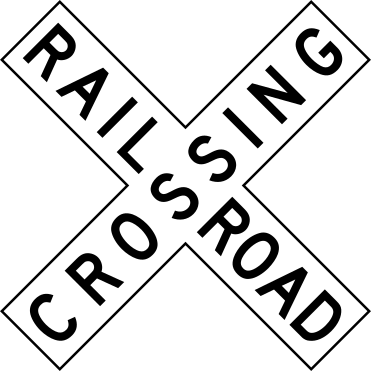
Railroad crossbuck 
Railroad crossing ahead 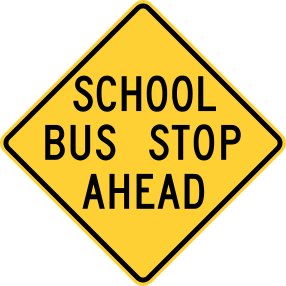
School bus stop ahead
3 questions from the Texas practice test
1. When a school bus displays alternately flashing red lights, what must approaching drivers do?
- Slow down and pass if no child is visible
- Stop and wait until the bus resumes, signals, or stops flashing red
- Stop only when approaching from behind the bus
- Pass after the first red flash
Show answer
Stop and wait until the bus resumes, signals, or stops flashing red. Drivers approaching a school bus from either direction must stop when its alternately flashing red lights are displayed. They may not pass until the bus resumes motion, the driver signals them to proceed, or the red lights are no longer flashing. Visibility of children does not change the rule, and stopping applies from either direction unless the handbook's separate controlled-access exception applies. The cue is the alternating red display: stop before reaching the bus, remain stopped, and wait for one of the listed release conditions.
2. When is it unnecessary to stop for a school bus under the Texas handbook?
- When passing on a different road or on a controlled-access highway where pedestrians cannot cross to the bus
- Whenever the driver cannot see children near the bus
- When the approaching vehicle is traveling under 15 mph
- Whenever the bus is on the opposite side of any road
Show answer
When passing on a different road or on a controlled-access highway where pedestrians cannot cross to the bus. Texas makes an exception when the driver is passing a school bus on a different road, or when the bus is in a controlled-access highway loading zone where pedestrians are not permitted to cross. The exception is not based on an ordinary opposite direction, low speed, or a driver's inability to see children. On the same road with flashing red lights, the stop duty remains. The cue is to identify the physical roadway relationship and whether pedestrians can cross before relying on the exception.
3. At a railroad crossing with flashing red lights, what must a driver do?
- Slow down, then cross before the gates begin to lower
- Stop and remain stopped until the train passes and the lights stop flashing
- Stop only if the train is already visible
- Drive around the gate after checking the nearest track
Show answer
Stop and remain stopped until the train passes and the lights stop flashing. Flashing red lights at a railroad crossing require a stop. If a train is approaching, the driver must remain stopped until the train passes and the lights stop flashing. Trying to beat a gate or relying only on whether the train is visible ignores the warning system and the possibility of another track or obstructed view. Driving around a lowered gate is especially dangerous. The cue is red crossing lights: stop before the crossing, wait through the warning, and proceed only after release.
Practice this topic
Lock it in with emergencies questions from the free Texas practice test. Every answer comes with a plain English explanation.
Source: the Texas Driver Handbook, Chapter 4: Right-of-Way. This lesson is a plain English summary, not the law itself; where it differs, the manual and the statute govern. Last checked 2026-09-27.