
Test 6 of 25 · 20 questions · Free 2026
TX Permit Practice Test 6
Jump to the test ↓A fixed 20 question set from the Texas bank with answers and plain English explanations.
Question 1 of 20 · 0 right so far
All 20 questions in test 6
Every question below comes from the Texas question bank on this page. Open a question to see the correct answer and the explanation. Nothing here is hidden behind a signup.
1. You drive on a single lane road that meets a divided highway. To whom must you yield?
- The vehicles on the single or two lane road always go first
- Whoever arrives first, with no regard to road type
- The vehicles traveling on the divided or three or more lane road
- Only commercial trucks on either road
Show answer
The vehicles traveling on the divided or three or more lane road. Texas gives priority to the bigger road. When a single or two lane road meets a divided road or a road with three or more lanes, drivers on the smaller road must yield to traffic on the larger one. Arrival order does not override this rule, and vehicle type does not decide it either. The cue is the road you are on: if your road has one or two lanes and the crossing road is divided or has three or more lanes, wait for a safe gap in that heavier traffic before entering or crossing.
Study this in the handbook: Right of way at intersections
2. When turning left, to whom must a driver yield the right-of-way?
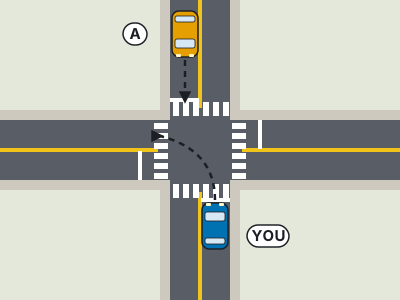
- Only a vehicle entering from the same street
- A vehicle waiting behind the turning driver
- A vehicle coming straight through from the other direction
- No one if the turn signal is on
Show answer
A vehicle coming straight through from the other direction. A left turn crosses the path of traffic coming straight from the opposite direction, so the handbook requires the turning driver to yield to that vehicle. A turn signal communicates intent but does not grant priority. The vehicle behind is not the specific conflict described, and traffic from the same street is too broad to state the rule accurately. Before turning, look for oncoming traffic, wait for a safe opening, and complete the turn only after the opposing path is clear.
Study this in the handbook: Right of way at intersections
3. You find a carbon monoxide poisoning victim. What should you do?
- Move them to fresh air and call 911
- Give them coffee and keep driving
- Open every window and speed up
- Lay them in the trunk to rest
Show answer
Move them to fresh air and call 911. Carbon monoxide poisoning is a race against an invisible gas. Texas says that on encountering a poisoning victim, move them to fresh air and call 911. Coffee, speed, and trunk rest all waste the rescue window while exposure continues. The cue is the symptom cluster of headache, dizziness, or collapse around a running engine or exhaust leak: get the person breathing clean air first, then summon professionals.
4. What do warning signs alert drivers to?
- Only destinations outside the city
- Conditions that are immediately ahead
- A guaranteed clear travel lane
- The location of every parked vehicle
Show answer
Conditions that are immediately ahead. Warning signs alert drivers to conditions immediately ahead and tell them what to look for. Those conditions can include road hazards, changes in direction, or another situation that requires attention. They do not identify every parked vehicle or guarantee that a lane is clear, and they are not limited to destinations outside a city. Use the sign as an early cue to reduce speed, scan the roadway, and prepare for the specific condition shown.
Study this in the handbook: Sign shapes, colors and meanings
5. What do Texas pennant and diamond signs warn of?
- Pennant warns of no-pass zones; diamond warns of hazards
- Both mark picnic areas
- Both mean full speed ahead
- Both ban all trucks
Show answer
Pennant warns of no-pass zones; diamond warns of hazards. Shape carries meaning before words register. In the Texas shape table, the pennant gives advance warning of no passing zones, while the diamond warns exclusively of existing or possible road hazards. Picnics, speed-ups, and truck bans are fictions. The cue is the sideways triangle versus the diamond: one guards passing, the other guards everything dangerous. Spotting the shape early buys the seconds needed to read the words calmly.
Study this in the handbook: Sign shapes, colors and meanings
6. Another car starts passing you on a Texas road. What should you do?
- Speed up to stay ahead
- Swerve left to block
- Hold speed and lane
- Brake hard to fall behind
Show answer
Hold speed and lane. Being passed calls for predictable steadiness. Texas says that when another vehicle passes, do not increase speed and stay in your lane. Speeding up, blocking, and brake slams all destabilize the pass. The cue is the overtaking car drawing even: hold your line and pace so the passer can judge the move and return safely. Patience here keeps two cars from drag-racing side by side down the highway.
Study this in the handbook: Signaling, passing and turning
7. What does a Texas Y-intersection sign warn of?
- A Y-intersection or side road traffic ahead
- A dead end with no outlet
- A roundabout with five exits
- A ferry crossing
Show answer
A Y-intersection or side road traffic ahead. The Y sign forks your attention, not necessarily your route. Texas describes it as a Y-intersection or side road traffic to the right. Dead ends, five-exit circles, and ferries use different signs. The cue is the forking symbol: another stream may join from the side, so scan right and hold your lane. Signal your branch choice early so followers behind you can plan theirs.
8. A Texas driver has a 16-year-old passenger who is not wearing a safety belt. What fine can the driver be assessed for that passenger?
- $25 to $50
- $100 to $200
- $25 to $250
- No fine, if the passenger is in the back seat
Show answer
$100 to $200. When a passenger under 17 rides without a safety belt, Texas assesses a fine of $100 to $200 to the driver. The $25 to $50 range is the fine for a driver who does not buckle up and for a passenger 15 or older who rides unbelted, so a 16-year-old passenger can also be cited separately at that amount. The $25 to $250 range is for a child under 8 and shorter than 4 feet 9 inches who is not in a child safety seat. The back seat is not an exemption, since Texas has no exemptions to the safety belt laws, only limited defenses such as a physician's note.
Study this in the handbook: Seat belts, phones and distracted driving
9. Where does the Texas handbook say to shift your eyes when an approaching vehicle's headlights are blinding?
- Straight at the headlights
- To the left edge of the road
- Into the rearview mirror
- Down to the lower right side of your lane
Show answer
Down to the lower right side of your lane. The Texas handbook says to avoid looking directly into the headlights of approaching vehicles and to shift your eyes down to the lower right side of your traffic lane. Looking to the left edge of the road or into the rearview mirror is not the direction the handbook gives. At night, slow down and be sure you can stop within the distance lit by your own headlights, and use low beams within 500 feet of an approaching vehicle.
Study this in the handbook: Night and highway driving
10. What should drivers do when mail, delivery, or trash-collection vehicles frequently stop in the roadway?
- Proceed with caution and, if possible, change lanes before safely passing
- Follow closely until the vehicle reaches its destination
- Stop in the opposite lane and wait for a signal
- Pass immediately on the shoulder without slowing
Show answer
Proceed with caution and, if possible, change lanes before safely passing. The handbook warns that mail, delivery, and trash-collection vehicles often stop in the roadway. Drivers should proceed with caution and, when possible, change lanes before safely passing. Passing on the shoulder creates a separate hazard, following closely removes reaction space, and stopping in an opposing lane is not the stated response. Look for a stopped service vehicle early, ease off the accelerator, check the adjacent lane, and move over only when the path is clear.
Study this in the handbook: Suspensions, revocations and license penalties
11. What is the minimum age for a Texas learner license?
- 14, with a parent's signature
- 16, with no course needed
- 15, with driver education
- 15 and a half, with driver education
Show answer
15, with driver education. A Texas learner license is available at 15, once the applicant completes the classroom part of a driver education course and passes the vision and knowledge exams. Fourteen is too young in Texas. Sixteen is the minimum for a provisional license, and driver education is still required. The learner license lets the teen practice with a licensed driver at least 21 years old who has at least one year of experience and sits beside the driver.
Study this in the handbook: Learner license and the graduated license program
12. When may you turn left on red in Texas?
- Never turn on red
- Turn left from any lane
- Ignore pedestrians
- Turn left if both streets are one-way, unless barred
Show answer
Turn left if both streets are one-way, unless barred. Two one-ways make a left-on-red legal. Texas allows turning left on red when both streets run one-way, unless prohibited by law, with full yield to pedestrians and traffic. Never-turn, any-lane, and pedestrian-ignoring readings all mangle the rule. The cue is the double one-way: stop first, confirm no ban, then turn into the matching lane. Stop fully first, then creep for a clear view of cross traffic and walkers. Many downtown corners ban the move with separate signs.
Study this in the handbook: Traffic signals and arrows
13. What following interval is best for a beginning Texas driver?
- A one-second gap to match traffic flow
- Tailgating to learn from the leader
- Varying the gap randomly for practice
- A four-second following interval
Show answer
A four-second following interval. New drivers need extra margin for slower hazard response. Texas calls a four-second following interval the best practice for a beginning or less experienced driver, well above the two-second minimum for slow city speeds. One second leaves no room for surprise. Tailgating to learn copies risk instead of skill. Random gaps confuse everyone nearby. The cue is your own experience level: until scanning, braking, and judgment feel automatic, hold four seconds so mistakes have somewhere harmless to go.
Study this in the handbook: Speed limits and following distance
14. May you stop or park on a railroad track in Texas?
- Stop briefly to check the schedule board
- Never stop, stand, or park there
- Wait on the tracks when gates malfunction
- Idle across the rails at rush hour
Show answer
Never stop, stand, or park there. Rails are the most dangerous place to stop a car. Texas prohibits stopping, standing, or parking on any railroad track. Checking schedules, waiting out a malfunction, and idling in traffic never justify resting on the rails. The cue is the steel in front of you: never enter the crossing unless the far side has room for your whole vehicle, and if traffic stops you short, wait before the tracks instead.
Study this in the handbook: Where you may not park
15. What is the Texas penalty for a third or later DWI?
- A $200 ticket with no jail
- First-offense treatment forever
- License points only
- Up to $10,000, 2 to 10 years in TDCJ, 180 days to 2 years suspension
Show answer
Up to $10,000, 2 to 10 years in TDCJ, 180 days to 2 years suspension. The third DWI ends misdemeanor treatment for good. Texas punishes third and subsequent DWI offenses with up to $10,000, 2 to 10 years in TDCJ, and 180 days to 2 years of license suspension. Small tickets, perpetual first-offense leniency, and points-only outcomes ignore the escalation table. The cue is the conviction count: two priors convert the next DWI into a felony prison sentence.
Study this in the handbook: DWI, open containers and implied consent
16. You cannot get off a rural Texas road. What space must you leave?
- Block the road to warn others
- Leave plenty of room for others to pass
- Park sideways for visibility
- Leave the doors wide open
Show answer
Leave plenty of room for others to pass. A forced roadside stop must still let traffic flow. Texas says that when off-road parking is impossible, leave plenty of room for others to pass, plus visibility and lights. Blocking, sideways, and open-door tactics all multiply the hazard. The cue is the narrow escape: squeeze as far right as physics allows and keep the lane passable. At night add flares or reflectors well behind the car for extra warning. Never stand in the lane while waiting for help to arrive.
Study this in the handbook: Where you may not park
17. A Texas minor operates a boat under the influence. What follows for driving?
- It is legal on weekends
- It triggers automatic suspension for drivers under 21
- It earns a boating award
- Only the boat is fined
Show answer
It triggers automatic suspension for drivers under 21. Texas reaches beyond highways to keep drunk minors from any helm. Driving or operating a watercraft under the influence of alcohol by a minor sits on the Alcoholic Beverage Code list that brings automatic suspension of an under-21 driving privilege. Weekend passes, awards, and boat-only fines are fictions. The cue is the minor at any controls: drink and drive a boat, and the car license suffers too.
Study this in the handbook: Suspensions, revocations and license penalties
18. How close to an approaching vehicle must you be before Texas requires you to switch to low beam headlights?
- Within 1,000 feet
- Within 200 feet
- Within 500 feet
- Within 100 feet
Show answer
Within 500 feet. Texas tells drivers to use low beam headlights when they are within 500 feet of an approaching vehicle. The same list also calls for low beams when following within 300 feet behind another vehicle, when driving on lighted roads, and when driving in fog, heavy rain, sleet, snow, or dust. The 1,000 foot figure belongs to a different rule: headlights must be on whenever people or vehicles cannot be seen clearly for at least 1,000 feet.
Study this in the handbook: Night and highway driving
19. How should you light a Texas truck at night?
- Always dim your headlights
- Use high beams always
- Turn lights off
- Flash strobes constantly
Show answer
Always dim your headlights. Truck mirrors magnify headlight glare. Texas says to always dim when following a truck at night. High beams, dark running, and strobes all blind or hide dangerously. The cue is the trailer ahead after dark: drop to lows and hold a long gap. Dirty headlights scatter glare worse than bright clean ones for truckers. Keep lenses clean and aimed correctly year-round.
Study this in the handbook: Trucks, motorcycles, bicycles and pedestrians
20. A Texas road-closed sign blocks your path. What should you do?

- Speed up through the closure
- Drive around the barricade
- Wait for the road to reopen
- Find a detour or other route
Show answer
Find a detour or other route. Closed means closed. Texas says that when the road ahead is not open to any traffic, look for a detour or other route. Speeding, barricade-running, and roadside waits all defy the closure. The cue is the ROAD CLOSED assembly: turn early onto the marked detour. Barricades may hide washed-out pavement or missing bridges just beyond them. Never move or drive around closure devices for any reason.
Study this in the handbook: Right of way at intersections
QualitySpace is expanding to Texas
We are a California-based independent insurance brokerage working on licensing in more states. We cannot help with Texas insurance yet. Leave your email and we will let you know when we can.
Every question is written from the official Texas Driver Handbook. Need paper? Printable TX practice test with answer key.
Last verified 2026-10-05. How we check every question · Study all 500 as flashcards
Frequently asked questions
How many questions are on this Texas practice test?
This fixed set has 20 questions. It is test 6 of 25 from the 500 question Texas bank.
How does this fixed test relate to the full Texas bank?
Each numbered test is a fixed set of questions in a fixed order, so you can retake the same test later and compare. Every test mixes road signs and the other topics in about the same proportion as the full bank. Tests 1 to 25 together cover every question in the Texas bank once. The full practice page mixes the whole bank at random.
Last verified 2026-10-05. See the Texas DMV facts page for sourced state details.