
Test 9 of 25 · 20 questions · Free 2026
TX Permit Practice Test 9
Jump to the test ↓A fixed 20 question set from the Texas bank with answers and plain English explanations.
Question 1 of 20 · 0 right so far
All 20 questions in test 9
Every question below comes from the Texas question bank on this page. Open a question to see the correct answer and the explanation. Nothing here is hidden behind a signup.
1. A Texas railroad crossing warning sign appears. What should you do?
- Speed through before it activates
- Stop on the tracks to look
- Slow down, be ready to stop, and never try to beat a train
- Honk continuously across the tracks
Show answer
Slow down, be ready to stop, and never try to beat a train. Railroad warning signs demand early respect. Texas says the railroad crossing sign means a crossing sits within a few hundred feet: slow down, prepare to stop, stop if a train comes, and never try to beat one. Speeding through, track stops, and honking all court disaster. The cue is the round yellow advance sign: cover the brake, look both ways, and be fully stopped if steel wheels approach.
2. What is the penalty for a first conviction of passing a stopped school bus?
- A warning letter from the school district
- Ten hours of community service
- A fine of $500 to $1,250
- A weekend in county jail
Show answer
A fine of $500 to $1,250. Passing a stopped school bus is priced steeply from the first offense. Texas sets a fine of $500 to $1,250 for a first conviction of failing to yield to a school bus showing alternating flashing lights, with larger fines, possible suspension, and jail for repeat or injury cases. A warning letter or community service understates the penalty. A weekend in jail is not the first-offense schedule. The cue is the bus penalty table: the law treats endangering schoolchildren as a serious money offense from the start.
Study this in the handbook: Right of way at intersections
3. A fire truck has answered an alarm on a city street. Which action is prohibited under Texas driving rules?
- Driving or parking on the street where the fire truck answered the alarm
- Moving to the right edge and yielding to the fire truck
- Stopping at least 500 feet away from the fire truck
- Using a different street to pass the emergency scene
Show answer
Driving or parking on the street where the fire truck answered the alarm. Texas bars a driver from driving or parking on the street where a fire truck has answered an alarm. The restriction protects firefighters and keeps the emergency route open for arriving or departing equipment. A nearby driver should choose another route and avoid adding congestion at the scene. The 500-foot rule in this section concerns following a fire truck or ambulance with flashing red lights, not a general permission to use the emergency street. A useful cue is to treat the response street as closed until the emergency activity is finished.
Study this in the handbook: Emergency vehicles and the move over law
4. How expensive can a Texas DWI fine be?
- No more than $50 in any case
- Only the cost of a bail bondsman
- Some fines range as high as $10,000 plus legal costs
- A fixed $200 ticket statewide
Show answer
Some fines range as high as $10,000 plus legal costs. A DWI arrest opens a deep financial hole. Texas warns that driving while intoxicated and driving under the influence arrests are humiliating and costly, with some fines ranging as high as $10,000 before bail, attorney, and court-ordered expenses. Fifty-dollar caps, bondsman-only costs, and flat $200 tickets all trivialize the schedule. The cue is the arrest itself: beyond the fine sit license actions, program fees, and insurance consequences that dwarf the courtroom number.
Study this in the handbook: DWI, open containers and implied consent
5. How should you choose lanes in a multi-lane Texas roundabout?
- Change lanes freely inside the circle
- Enter without yielding to save time
- Pick the entry lane from the advance sign and hold it
- Stop at every exit to check
Show answer
Pick the entry lane from the advance sign and hold it. Multi-lane roundabouts punish improvisation. Texas says to observe the advance lane movement sign for choosing the correct entry lane and never change lanes while driving in the circle. Free lane swaps, unyielded entries, and exit-by-exit stops each break the flow the design depends on. The cue is the diagram sign before the circle: read it, commit to a lane, and ride that lane all the way to your exit.
6. What is the fine for a first offense of illegally parking in a Texas disabled parking space?
- $500 to $750
- $25 to $50
- $100 to $200
- $2,000 to $4,000
Show answer
$500 to $750. Parking illegally in a disabled space in Texas is a misdemeanor with a fine of $500 to $750 for a first offense. The fine rises with more offenses, up to $1,250 for five or more, and later offenses also bring community service. Twenty five to fifty dollars is the safety belt fine, and $100 to $200 is the fine for unbelted passengers under 17. Two thousand to four thousand dollars is far beyond this offense.
Study this in the handbook: Where you may not park
7. Under Texas law, what level of alcohol brings an administrative license suspension for a driver under 21?
- 0.04 or more
- 0.08 or more
- Any detectable amount of alcohol
- 0.02 or more
Show answer
Any detectable amount of alcohol. Under the Texas Administrative License Revocation law, DPS may suspend the license of a driver over 21 whose breath or blood test shows 0.08 or more, of any person who refuses a breath or blood test, and of a driver under 21 for any detectable amount of alcohol. For a minor the handbook names no numeric threshold at all; any detectable amount is enough. Refusal itself triggers a suspension, so a driver cannot avoid consequences by declining the test.
Study this in the handbook: DWI, open containers and implied consent
8. What is the fine for a first conviction of driving in Texas without evidence of financial responsibility?
- $175 to $350
- $25 to $50
- $500 to $750
- $1,000 to $4,000
Show answer
$175 to $350. A first conviction for driving without evidence of financial responsibility in Texas carries a fine of $175 to $350. Twenty five to fifty dollars is the fine for not wearing a safety belt. Five hundred to seven hundred fifty dollars is the first offense fine for illegally using a disabled parking space. A later conviction brings a license suspension, a fine of $350 to $1,000, and impoundment of the vehicle if the driver owns it. The court may dismiss the charge if a policy was in effect when the citation was issued.
Study this in the handbook: Exams, insurance and vehicle inspection
9. When is it safe to pass on a Texas road?
- Wait patiently until passing is safe
- Pass on every hill
- Pass in every curve
- Pass against all markings
Show answer
Wait patiently until passing is safe. Patience prevents passing crashes. Texas warns passing is not always safe and demands waiting for the right time. Hill, curve, and marking-defying passes all gamble blind. The cue is the clear straight stretch: pass only with full sight and legal markings. No appointment is worth a head-on collision on a blind pass. Arriving late beats never arriving at all. One safe pass beats ten risky ones every time.
Study this in the handbook: Signaling, passing and turning
10. How should Texas hill parking aim the wheels?
- Leave them straight always
- Angle them per the grade and curb diagrams
- Remove them entirely
- Point them at the sky
Show answer
Angle them per the grade and curb diagrams. Hill parking aims wheels to catch a roll. The Texas hill diagrams direct turning wheels to the curb, back of wheels to the curb, or to the right with no curb, depending on grade direction and curb presence. Straight, removed, and skyward wheels all abandon the backup brake. The cue is the slope: match the diagram to your hill. Downhill parks aim the front wheels at the curb as the primary catch. Uphill with a curb turns the backs of the wheels curbward.
Study this in the handbook: Where you may not park
11. What instruction is associated exclusively with an octagon-shaped traffic sign?
- Yield
- School crossing
- Railroad warning
- Stop
Show answer
Stop. The Texas table of signs by shape says the octagon is used exclusively for stop signs. Knowing the shape helps a driver know what to do while still approaching from a distance. Yield signs use an equilateral triangle, school advance and school crossing signs use a pentagon, and railroad advance warning signs are round. When you see the octagon, prepare to come to a complete stop before the crosswalk, intersection, or sign, then yield and proceed carefully.
Study this in the handbook: Sign shapes, colors and meanings
12. When a yield sign marks a road joining another road, what must the driver do?
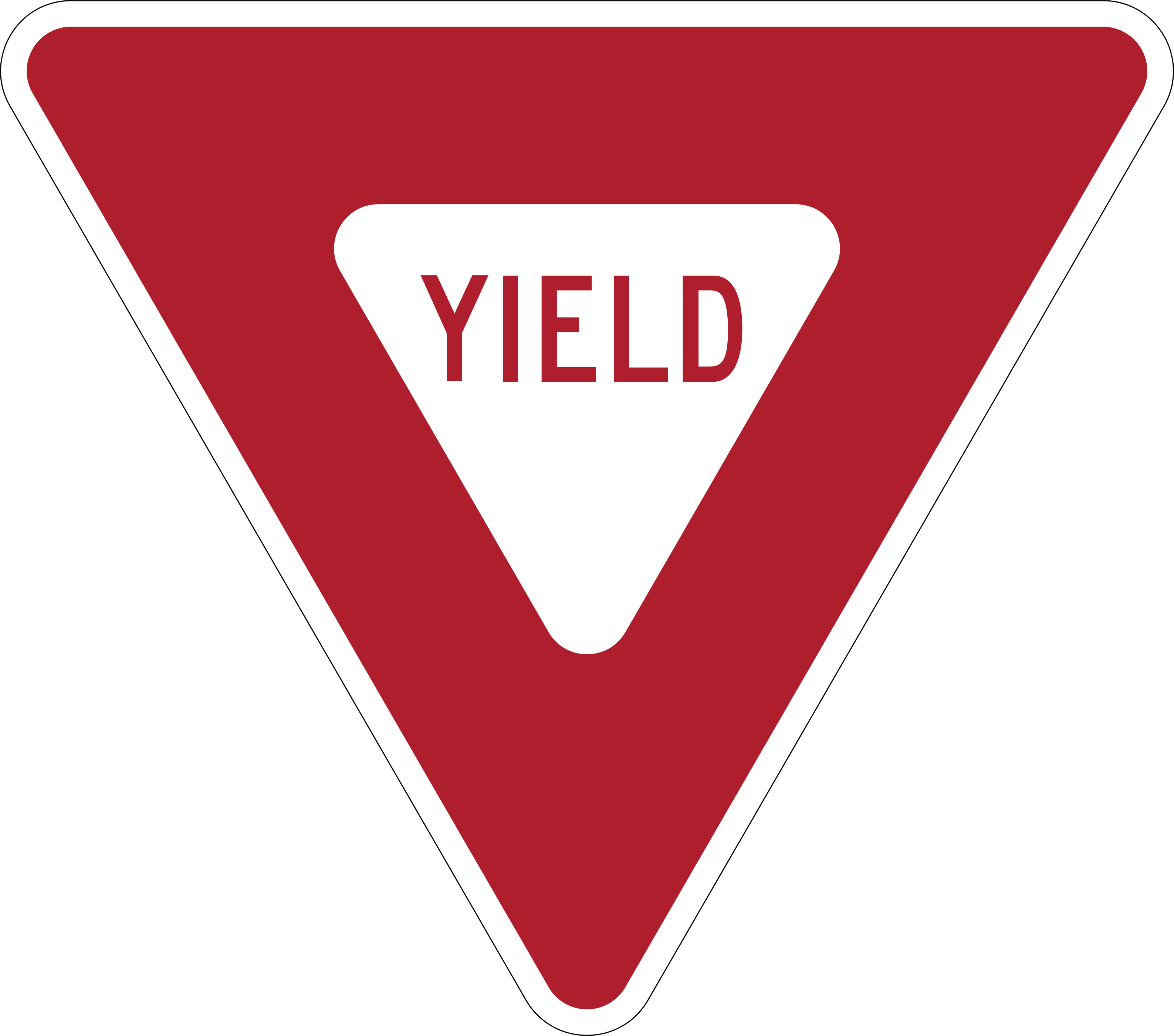
- Continue without checking because the entering driver has priority
- Accelerate to enter before traffic on the other road
- Stop every time, even when the road is clear
- Slow down or stop as needed and yield to traffic, pedestrians, or bicycles
Show answer
Slow down or stop as needed and yield to traffic, pedestrians, or bicycles. A yield sign requires the driver to give priority to road users on the other road. The handbook allows slowing or stopping as necessary, so a full stop is not automatic when the way is clear. The driver must still watch for vehicles, pedestrians, and bicycles. Accelerating to beat traffic reverses the priority rule, while proceeding without checking ignores the reason for the sign. The practical cue is to reduce speed early, scan the joining road, and stop if yielding cannot otherwise be completed safely.
Study this in the handbook: Right of way at intersections
13. Where are Texas pedestrian hybrid beacons installed?
- At any unmarked road edge
- Only at a marked crosswalk
- Inside highway tunnels
- On private driveways
Show answer
Only at a marked crosswalk. Hybrid beacons serve marked crossings exclusively. Texas says pedestrian hybrid beacons are installed only at a marked crosswalk. Unmarked edges, tunnels, and driveways never qualify. The cue is the dark beacon over striped pavement: it sleeps until a pedestrian activates it, then runs its warning sequence. Drivers must stop on its red phases exactly as for any traffic signal. Never run a dark beacon that has just activated for a waiting pedestrian.
14. Why is a Texas AFAD remotely operated?
- The flagger must stand in the lane
- It works only at night
- It needs no operator at all
- Remote operation lets the flagger stand clear of traffic
Show answer
Remote operation lets the flagger stand clear of traffic. Distance saves flagger lives. Texas says the AFAD is designed for remote operation so the flag person can stand out of the traffic lane. In-lane standing, night-only limits, and operator-free claims all miss the design. The cue is the empty lane with a working paddle: the human controls it from a protected spot nearby. Drivers should still watch for the operator nearby, since work zones change by the minute.
15. In darkness or bad weather, how should you match speed to vision?
- Drive at the posted limit regardless of visibility
- Slow until you can stop within the distance you can see
- Speed up to spend less time in the dark
- Follow the taillights ahead as closely as possible
Show answer
Slow until you can stop within the distance you can see. Your headlights set your real speed limit at night and in bad weather. Texas says you should always be able to stop within the distance you can see ahead, and never over-drive your range of vision. The posted limit assumes clear daylight conditions. Speeding through darkness shortens your reaction margin to zero. Clinging to taillights borrows someone else's crash. The cue is the edge of your light: if an obstacle appeared just past it, your speed must still allow a full stop before reaching the end of that visible area.
Study this in the handbook: Speed limits and following distance
16. What must a driver do when bad weather or low visibility affects normal driving conditions?
- Adjust speed and following distance to help avoid crashes
- Use the posted maximum as a required speed
- Stop in the travel lane whenever clouds appear
- Keep the posted speed and shorten the gap ahead
Show answer
Adjust speed and following distance to help avoid crashes. Posted limits are designed for normal conditions, so heavy traffic, bad weather, and low visibility require a driver to adjust both speed and following distance. The point is to preserve time and traction when hazards are harder to see or a vehicle needs more room to stop. Holding the maximum speed or shortening the gap removes that safety margin. A driver does not need to stop merely because clouds appear, but should make a deliberate reduction whenever conditions make ordinary speed unsafe.
Study this in the handbook: Suspensions, revocations and license penalties
17. What is the penalty for a first conviction of driving in Texas without a license?
- A fine of up to $2,000
- A fine of up to $200
- 30 days in jail
- A warning only
Show answer
A fine of up to $200. A first conviction for driving without a license in Texas carries a fine of up to $200, and a second within a year carries $25 to $200. A $2,000 fine is far beyond the first offense penalty. Jail and a warning are not what the table lists for a first conviction. The penalty becomes a Class A misdemeanor, with a fine up to $4,000 and up to 365 days in jail, when the unlicensed driver is also uninsured and causes a crash with serious injury or death.
Study this in the handbook: Exams, insurance and vehicle inspection
18. What legal status do Texas bicycles hold?
- Toys with no rules
- Vehicles with the same rights, duties, and penalties
- Pedestrians on wheels
- Exempt from all laws
Show answer
Vehicles with the same rights, duties, and penalties. Bikes are traffic, full stop. Texas declares a bicycle a vehicle whose riders hold the same rights and responsibilities, face the same penalties, and collect the same record points as motorists. Toys, pedestrians, and exemptions all deny the equality. The cue is the cyclist in the lane: a legal driver of a legal vehicle. Running a stop sign on a bicycle writes points to the same driver record. Ride every intersection exactly as if driving a car.
19. What do Texas travel information signs show?
- The price of gasoline
- The local weather
- The time of day
- Direction and distance to cities, airports, and destinations
Show answer
Direction and distance to cities, airports, and destinations. Travel information panels plan the miles ahead. Texas says they tell which way to go and how far to cities, airports, and other destinations. Prices, weather, and clocks come from elsewhere. The cue is the blue or green distance panel: read it to time fuel, rest, and arrival. Lodging and food icons beneath the panel list what each exit offers. Exit only where services match your fuel gauge and appetite.
20. What change does the handbook require in bad weather when following another vehicle on a highway?
- Reduce the interval to two seconds
- Keep the interval unchanged at one second
- Follow closely so spray cannot block the lane
- Increase the interval to at least four seconds
Show answer
Increase the interval to at least four seconds. In bad weather, the highway guidance says to increase the following time to at least four seconds. Rain, spray, reduced visibility, and a slick surface can delay recognition and lengthen braking, so added space provides a margin for both vehicles. The two-second choice moves in the wrong direction, and one second is especially inadequate. Following closely does not improve visibility or control. Count the gap from when the vehicle ahead passes a fixed point until your vehicle reaches it, then add time when conditions worsen.
Study this in the handbook: Night and highway driving
QualitySpace is expanding to Texas
We are a California-based independent insurance brokerage working on licensing in more states. We cannot help with Texas insurance yet. Leave your email and we will let you know when we can.
Every question is written from the official Texas Driver Handbook. Need paper? Printable TX practice test with answer key.
Last verified 2026-10-05. How we check every question · Study all 500 as flashcards
Frequently asked questions
How many questions are on this Texas practice test?
This fixed set has 20 questions. It is test 9 of 25 from the 500 question Texas bank.
How does this fixed test relate to the full Texas bank?
Each numbered test is a fixed set of questions in a fixed order, so you can retake the same test later and compare. Every test mixes road signs and the other topics in about the same proportion as the full bank. Tests 1 to 25 together cover every question in the Texas bank once. The full practice page mixes the whole bank at random.
Last verified 2026-10-05. See the Texas DMV facts page for sourced state details.