
Test 5 of 25 · 20 questions · Free 2026
TX Permit Practice Test 5
Jump to the test ↓A fixed 20 question set from the Texas bank with answers and plain English explanations.
Question 1 of 20 · 0 right so far
All 20 questions in test 5
Every question below comes from the Texas question bank on this page. Open a question to see the correct answer and the explanation. Nothing here is hidden behind a signup.
1. What is the suspension for a third non-driving alcohol offense by a Texas minor aged 17 through 20?
- 30 days
- 180 days
- 60 days
- One year
Show answer
180 days. For a minor who is at least 17 but less than 21, the third non-driving alcohol offense carries a 180-day driver-license suspension, or denial of the privilege if the person is not licensed. Thirty days is the first-offense period and 60 days is the second-offense period. The one-year choice does not match this table. Read both qualifiers together, the offense count and the age range, because the under-17 third-offense row has a different result.
Study this in the handbook: Suspensions, revocations and license penalties
2. At 30 mph or less in good conditions, what following gap must you keep?
- At least 2 seconds in good road conditions
- One car length no matter the speed
- At least 10 seconds at all times
- No gap is needed under 30 mph
Show answer
At least 2 seconds in good road conditions. Short gaps fit slow speeds only. Texas sets a minimum two-second interval between your car and the one ahead at 30 mph or less in good conditions, growing to four seconds above 30 mph and longer when roads turn poor. One car length shrinks dangerously as speed rises. Ten seconds at all times wastes road capacity and is not the rule. Needing no gap under 30 mph invites rear-end crashes. The cue is your speedometer: at city speeds keep two seconds, and stretch the gap as speed or hazard grows.
Study this in the handbook: Speed limits and following distance
3. According to the Texas handbook, what is the most common crash between cars and motorcycles?
- A car rear ending a motorcycle on the highway
- A motorcycle striking an opening car door
- A car turning left in front of a motorcycle at an intersection
- A motorcycle sliding on a wet curve
Show answer
A car turning left in front of a motorcycle at an intersection. The handbook names left turns as the most common crash between cars and motorcycles: at an intersection, a car driver turns left in front of an oncoming motorcycle. Riders are easy to miss because a motorcycle's profile is small and its speed and distance are harder to judge. The handbook tells drivers to always take a second look for a motorcycle before turning at an intersection, particularly when making left turns.
Study this in the handbook: Trucks, motorcycles, bicycles and pedestrians
4. At an uncontrolled intersection, to which vehicle must a driver yield?
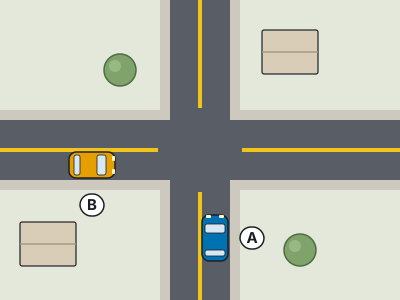
- A vehicle that has entered or is approaching from the driver's right
- A vehicle approaching from the left in every case
- The vehicle with the larger engine
- Only a vehicle displaying a turn signal
Show answer
A vehicle that has entered or is approaching from the driver's right. At an intersection without signs, signals, multiple-lane priority, or pavement priority, Texas directs a driver to yield to a vehicle that has entered or is approaching from the right. The driver should also confirm that the other road is clear and that the other motorist yields before proceeding. Vehicle size and engine power do not establish priority. A vehicle from the left does not automatically go first, and a turn signal is not the condition stated by the rule. Slow down early and check both directions.
Study this in the handbook: Right of way at intersections
5. What is highway hypnosis, according to the Texas handbook?
- A tire losing contact with wet pavement
- A failure of the headlights to illuminate the road
- A legal suspension imposed after a traffic conviction
- Drowsiness or unawareness caused by reduced activity and steady sounds
Show answer
Drowsiness or unawareness caused by reduced activity and steady sounds. Highway hypnosis is a condition of drowsiness or unawareness brought on by reduced activity and the steady sounds of wind, engine, and tires. It can make a driver less alert even on a familiar, straight road. The wet-pavement description is hydroplaning, the lighting choice describes an equipment problem, and a license suspension is an administrative or legal action. The handbook recommends stopping at least every two hours or 100 miles, shifting the eyes among different objects, and avoiding an excessively long driving day.
Study this in the handbook: Night and highway driving
6. What does a Texas no-trucks sign mean?
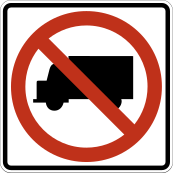
- All trucks may enter
- No trucks may use or enter that roadway
- Only red trucks may enter
- Trucks must speed through
Show answer
No trucks may use or enter that roadway. Some roads cannot bear truck weight or size. The Texas sign bars trucks from using or entering the posted roadway. Open entry, color rules, and speed-throughs all defy the ban. The cue is the truck-prohibition panel: find the truck route instead. Local delivery trucks should check alternate routes before starting their runs. Ignorance of the sign never excuses the violation.
Study this in the handbook: Sign shapes, colors and meanings
7. What does riding in a Texas blind spot mean?
- They see you perfectly
- They welcome you there
- They likely cannot see you
- They will protect you
Show answer
They likely cannot see you. Blind spots are called blind for a reason. Texas warns that drivers in or near another's blind spot are likely invisible to that driver. Perfect sight, welcomes, and protection are fantasies. The cue is the missing face in their mirror: if you cannot see them, they cannot see you. Motorcycles vanish entirely in car blind spots at highway speed. A deliberate head-check saves riders every single day.
Study this in the handbook: Signaling, passing and turning
8. What light should you switch on at a Texas night stop?
- Turn all lights off
- Flash high beams at the officer
- Close all windows tightly
- Turn on the interior dome light
Show answer
Turn on the interior dome light. Night stops run on visibility and trust. Texas says that at night, turn on the interior dome light so the officer can see inside. Dark cabins, blinding beams, and sealed windows all raise tension. The cue is the spotlight behind: light your interior to show empty hands and calm compliance. Keep the dome lit until the officer finishes and releases you to leave. Darkness returning mid-stop can restart tension unnecessarily.
9. What does a Texas freeway ramp meter do?
- They photograph license plates
- The red or green meter directs when to enter the freeway
- They dispense toll change
- They measure car weight
Show answer
The red or green meter directs when to enter the freeway. Metered ramps dose freeway entries one by one. Texas says the ramp meter's red or green directs motorists when to enter the freeway, with yellow flashers warning the ramp ahead is metered. Cameras, change machines, and scales are unrelated. The cue is the small signal on the ramp: stop on red, go on green, and merge at the freed pace.
10. A car leaves your Texas frontage road for the highway. Who yields?
- Claim priority over the highway
- Stop sideways across the ramp
- Speed onto the highway blindly
- Yield, since frontage traffic serves highway entries and exits
Show answer
Yield, since frontage traffic serves highway entries and exits. Frontage roads exist to feed the highway, not fight it. Texas requires frontage drivers to yield to vehicles entering or about to enter the frontage road from the highway, and equally to those leaving the frontage road for the highway. Priority claims, sideways stops, and blind merges all invert the relationship. The cue is the ramp junction in either direction: highway-bound and highway-born traffic both outrank the frontage flow.
Study this in the handbook: School buses and railroad crossings
11. What are in-roadway lights for on Texas roads?
- They warn of unseen conditions and may demand slowing or stopping
- They decorate the road for holidays
- They mark legal parking spaces
- They replace all traffic signs
Show answer
They warn of unseen conditions and may demand slowing or stopping. Lights buried in the pavement flag hidden danger. Texas says in-roadway lights warn road users of approaching conditions they may not see, which might require slowing down or stopping completely. Decorations, parking marks, and sign replacements all miss the purpose. The cue is the glowing dots in the asphalt: something ahead needs your attention, so ease off and prepare to stop.
12. A crossing gate is lowered but you see no train yet. What must you do?
- Drive around the gate if no train is visible
- Stop only if a police officer is present
- Honk and proceed slowly across
- Stop between 15 and 50 feet from the nearest rail
Show answer
Stop between 15 and 50 feet from the nearest rail. Lowered gates and flag warnings carry the same stop command as a signal. Texas requires stopping between 15 and 50 feet from the nearest rail when a crossing gate is lowered or a flag person warns of an approaching train. Driving around gates is illegal and deadly because a second train may be hidden behind the first. No officer needs to be present for the duty to apply, and honking changes nothing. The cue is the gate arm or the flagger: stop in the measured band and wait until the crossing fully clears.
Study this in the handbook: School buses and railroad crossings
13. How does Texas punish intoxication assault?
- A parking ticket and a course
- Community service only
- Third degree felony, up to $10,000, 2 to 10 years in TDCJ
- A $50 fine with no jail
Show answer
Third degree felony, up to $10,000, 2 to 10 years in TDCJ. Drunk driving that seriously injures someone becomes a prison felony. Texas grades intoxication assault as a third degree felony with up to a $10,000 fine and 2 to 10 years in the Texas Department of Criminal Justice, plus license suspension. Tickets, service-only, and $50 fines belong to far lesser offenses. The cue is the injury link: impairment plus serious bodily injury turns the DWI into years behind bars.
Study this in the handbook: Zero tolerance alcohol laws for minors
14. How should you drive down a steep Texas hill?
- Shift to a low gear; never coast in neutral or ride the clutch
- Shift to neutral and coast to save fuel
- Ride the brakes all the way down
- Speed up to shorten the descent
Show answer
Shift to a low gear; never coast in neutral or ride the clutch. Gravity plus a long grade can cook your brakes before the bottom. Texas says that driving down a steep hill, you can shift into a low gear to help slow the vehicle, and never coast in neutral or with a foot on the clutch. Coasting surrenders engine braking. Riding the brakes overheats them into fade. Speeding compounds both risks. The cue is the downgrade sign: drop a gear early, let the engine hold speed, and save the brakes for fine control.
Study this in the handbook: Breakdowns, skids and crashes
15. Your Texas car wears snow tires on an icy street. What must you do about distance?
- Close up, since snow tires grip ice fully
- Keep your distance, because snow tires still slide on ice
- Tailgate to stay in the cleared tracks
- Hold the dry-pavement gap exactly
Show answer
Keep your distance, because snow tires still slide on ice. Snow tires improve snow traction but still skate on ice. Texas warns that snow tires will slide on ice or packed snow, so to keep safe you must keep your distance. Closing up, tailgating tracks, and dry gaps all pretend the tires grip. The cue is the icy sheen under snow-rated rubber: open a long interval, brake early and softly, and expect slides despite the tread.
Study this in the handbook: Breakdowns, skids and crashes
16. What do overhead lane arrows tell Texas drivers?
- Which lanes follow a highway route
- Where to change a tire
- Where to buy fireworks
- Which lane has the smoothest ride
Show answer
Which lanes follow a highway route. Overhead arrows assign lanes to routes. Texas says the arrows show which lanes to use to follow a particular highway route. Tires, fireworks, and smoothness are not their message. The cue is the arrow bank over a split: match your lane to your route before the gore. Through drivers should avoid exit-only lanes well before the split point. Last-second lane jumps across solid lines cause many crashes.
17. How should trucks treat a Texas clearance sign?
- Enter fast to clear it
- Stay out if your load exceeds the posted figure
- Measure it with a tape
- Ignore it in daylight
Show answer
Stay out if your load exceeds the posted figure. Overheight loads peel open on low structures. Texas says the underpass height is posted, and drivers must not enter if the load tops the figure. Fast entries, tape measures, and daylight exemptions all gamble with the bridge. The cue is the clearance number: know your height and detour when it does not fit. Rental trucks and RVs most often strike low bridges on unfamiliar routes. Measure total height with cargo loaded before every trip.
18. After a crash that is not investigated, when must a qualifying written report be filed with TxDOT?
- Within 24 hours in every case
- On the first day of the next month
- No later than the 10th day after the crash
- Only when a police officer requests it
Show answer
No later than the 10th day after the crash. When the crash is not investigated by law enforcement and meets the handbook's stated injury, death, and damage conditions, the written report must be filed with TxDOT no later than the tenth day after the crash. The rule is not a universal 24-hour requirement and does not wait for an officer's request. Record the date immediately, determine whether the qualifying conditions apply, and obtain the specified TxDOT form. The practical cue is the tenth-day deadline, which should be treated as an outside limit.
Study this in the handbook: Breakdowns, skids and crashes
19. Can a parked Texas vehicle cause a crash?
- Only moving cars can crash
- Parked cars are always safe
- An improperly parked vehicle may also cause a crash
- Parking lots have no crashes
Show answer
An improperly parked vehicle may also cause a crash. Danger does not end when the engine stops. Texas opens its parking chapter warning that not all crashes involve moving vehicles, because an improperly parked car may also cause a crash. Moving-only, always-safe, and lot-immunity readings all deny the toll of bad parks. The cue is every crooked, blind, or blocking park you see: placement itself is a driving decision with crash consequences.
Study this in the handbook: Where you may not park
20. When does a Texas learner license issued to a minor expire?
- On the minor’s 18th birthday
- On the driver’s 21st birthday
- Six months after issuance
- After the first road test
Show answer
On the minor’s 18th birthday. A Texas learner license issued to a minor expires on that minor’s 18th birthday. The six-month period belongs to the minimum time a learner, hardship, or combination license must be held before Phase Two eligibility, not the card expiration date. The age 21 choice confuses another licensing threshold, and passing a road test does not determine the printed expiration. Separate the expiration date from the waiting period for the next licensing phase.
Study this in the handbook: Learner license and the graduated license program
QualitySpace is expanding to Texas
We are a California-based independent insurance brokerage working on licensing in more states. We cannot help with Texas insurance yet. Leave your email and we will let you know when we can.
Every question is written from the official Texas Driver Handbook. Need paper? Printable TX practice test with answer key.
Last verified 2026-10-05. How we check every question · Study all 500 as flashcards
Frequently asked questions
How many questions are on this Texas practice test?
This fixed set has 20 questions. It is test 5 of 25 from the 500 question Texas bank.
How does this fixed test relate to the full Texas bank?
Each numbered test is a fixed set of questions in a fixed order, so you can retake the same test later and compare. Every test mixes road signs and the other topics in about the same proportion as the full bank. Tests 1 to 25 together cover every question in the Texas bank once. The full practice page mixes the whole bank at random.
Last verified 2026-10-05. See the Texas DMV facts page for sourced state details.