
Test 8 of 25 · 20 questions · Free 2026
TX Permit Practice Test 8
Jump to the test ↓A fixed 20 question set from the Texas bank with answers and plain English explanations.
Question 1 of 20 · 0 right so far
All 20 questions in test 8
Every question below comes from the Texas question bank on this page. Open a question to see the correct answer and the explanation. Nothing here is hidden behind a signup.
1. What should a driver do when the road is wet?
- Keep the same speed and interval
- Speed up and follow more closely
- Slow down and increase the following distance
- Brake hard while turning
Show answer
Slow down and increase the following distance. When the road is wet, Texas tells drivers to slow down and increase the following distance. Rain can make the surface slippery, reduce available traction, and leave less time to respond if the vehicle ahead brakes. Speeding up or following more closely removes the margin the rule is designed to create. Keeping the same interval ignores the changed condition, while hard braking during a turn can reduce control. A practical cue is to make the adjustment as soon as rain begins, then keep enough space to stop within the visible roadway.
Study this in the handbook: Speed limits and following distance
2. How far ahead do Texas exit signs appear?
- 50 feet before the exit
- At the exit gore only
- At least 1,000 yards ahead
- After passing the exit
Show answer
At least 1,000 yards ahead. Exit signs give a half-mile of warning. Texas places them usually at least 1,000 yards ahead of the exit. Fifty-foot, gore-only, and after-exit readings all defeat trip planning. The cue is the first green exit panel: a thousand yards to merge right calmly. Missing an exit means continuing to the next one, never backing up. Backing on freeways kills more drivers than the delay ever could.
Study this in the handbook: Night and highway driving
3. What does a Texas no-parking sign require?
- Park behind the sign post
- Park across the street facing it
- Park at night when unseen
- Do not park there at all
Show answer
Do not park there at all. No-parking signs mean exactly what they say. Texas states plainly not to park where an official sign prohibits parking. Post-hiding, across-street, and nighttime evasions all violate the order. The cue is the sign's zone: find legal parking elsewhere instead of gaming its edges. Arguing with the officer about sign visibility almost never voids the ticket in court. Photograph the scene only after moving the car legally.
Study this in the handbook: Where you may not park
4. Who besides the state may change Texas speed limits?
- Only federal courts may alter them
- They are fixed forever once printed
- Cities and counties may change them
- Drivers may vote on them annually
Show answer
Cities and counties may change them. Local governments share speed authority with the state. Texas warns drivers that cities and counties have the authority to change table limits, alongside the Transportation Commission and regional mobility authorities acting on traffic studies. Federal courts do not set Texas speed zones. Printed tables are starting points, not permanent law. Driver votes play no role. The cue is the sign on the street: a city or county may have studied the road and posted something different from the statewide table, and the sign wins.
Study this in the handbook: Suspensions, revocations and license penalties
5. Where is stopping or standing always prohibited in Texas?
- Inside an intersection
- Past the stop line when turning
- Under a green arrow only
- Beside a parked bus at a stop
Show answer
Inside an intersection. Intersections must stay open for crossing traffic and emergency passes. Texas prohibits parking, stopping, or standing a vehicle within an intersection. Edging past the stop line to turn is a driving maneuver, not parking, and green arrows govern movement rather than stopping. Bus stops have their own rules. The cue is the box formed by the crossing streets: never let your vehicle come to rest inside it, and never enter unless you can clear it completely.
Study this in the handbook: Where you may not park
6. How does Texas say to avoid skids before they start?
- Slow down in poor road and weather conditions and check the tires
- Speed up to power through bad patches
- Ignore tire wear until inspection month
- Brake hard at the first drop of rain
Show answer
Slow down in poor road and weather conditions and check the tires. Skids are cheaper to prevent than to escape. Texas says to avoid skid situations by slowing down when road and weather conditions are poor, and to check tires because old or worn tread is dangerous. Powering through, ignoring wear, and panic braking each invite the slide. The cue is the sky and the pavement together: when rain, ice, or worn rubber stack the odds, cut speed early and keep tread legal and deep.
Study this in the handbook: Breakdowns, skids and crashes
7. What alcohol crash toll does the Texas handbook report?
- No deaths involve alcohol anymore
- 940 killed with an alcohol-impaired driver, 26% of traffic deaths
- Only property damage results
- Fewer than ten deaths per year
Show answer
940 killed with an alcohol-impaired driver, 26% of traffic deaths. The handbook opens its alcohol chapter with body counts. Citing 2018 TxDOT crash facts, Texas reports 940 people killed in crashes with a driver under the influence of alcohol, representing 26% of all traffic deaths. Zero-death, property-only, and single-digit readings deny the published toll. The cue is the percentage: more than one in four Texas traffic deaths ties to alcohol, which is why the chapter treats every drink before driving as a lethal risk.
Study this in the handbook: DWI, open containers and implied consent
8. A 16-year-old Texas driver holds a provisional license. How many passengers under 21 who are not family members may ride along?
- None at all
- No more than one
- Up to two
- Up to three, if all wear seat belts
Show answer
No more than one. During Phase Two of the Texas Graduated Driver License program, a provisional driver may not drive with more than one passenger under 21 who is not a family member. That means one such passenger is allowed and a second is not. Saying none at all is stricter than the rule, and two or three passengers exceed it; seat belts do not change the count. Family members are not counted toward the limit. The restriction lasts until the driver's 18th birthday.
Study this in the handbook: Supervised practice and Phase Two limits
9. What do round Texas traffic signs mark?
- School advance warnings
- Hospital entrances
- Railroad advance warnings
- Airport terminals
Show answer
Railroad advance warnings. Round signs belong to the rails alone. In the Texas shape table, round means railroad advance warning signs, distinct from pentagon school signs and octagon stops. Schools, hospitals, and airports use other shapes. The cue is the yellow circle with a black X and R: tracks lie ahead, so prepare to stop. Slow early for the circle, because trains need more than a mile to stop.
Study this in the handbook: Sign shapes, colors and meanings
10. Unless posted otherwise, what is the Texas speed limit in an urban district?
- 25 mph
- 30 mph
- 35 mph
- 45 mph
Show answer
30 mph. The Texas speed limits table sets 30 mph in an urban district and 15 mph in an alley. Twenty five mph is below the Texas table figure of 30. Thirty five and 45 mph are not the urban district figure. Cities and counties can change these limits, and posted signs control where they appear. Whatever the limit, drivers must slow down in heavy traffic, bad weather, or low visibility.
Study this in the handbook: Speed limits and following distance
11. Which posted Texas speed limits bind drivers?
- Obey posted minimum and maximum limits
- Obey only maximums
- Obey only minimums
- Ignore both in light traffic
Show answer
Obey posted minimum and maximum limits. Both ends of the speed range bind drivers. Texas requires obeying posted minimum and maximum speed limits, which order traffic flow under normal conditions. Maximum-only, minimum-only, and light-traffic exemptions all rewrite the duty. The cue is the paired sign: stay between its two numbers. Driving far below the minimum can earn a ticket for impeding traffic flow. Match surrounding speeds while staying inside both posted numbers.
Study this in the handbook: Suspensions, revocations and license penalties
12. What are vertical rectangle Texas signs for?
- Regulatory signs
- Picnic tables
- Swimming pools
- Movie theaters
Show answer
Regulatory signs. Tall white rectangles issue orders. Texas says vertical rectangles are generally for regulatory signs like limits and lane rules. Picnics, pools, and theaters never appear on them. The cue is the upright white panel: obey its instruction as law. Speed limits, lane rules, and parking bans all share this upright white form. Disobeying one is a ticketable offense, not a suggestion.
Study this in the handbook: Sign shapes, colors and meanings
13. What does a solid yellow line on your side beside a broken yellow line on the other side mean?
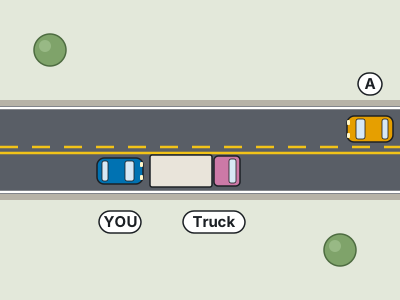
- Both directions may pass without restriction
- Both directions must stop before crossing the lines
- Your side may pass but the other side may not
- Your side may not pass, while the other side may pass when safe
Show answer
Your side may not pass, while the other side may pass when safe. A solid yellow line next to your lane signals that passing from your side is prohibited. The broken line on the opposing side indicates that traffic there may pass when conditions are safe. The markings assign different permissions to the two directions, so reading only the broken line would be unsafe. The unrestricted and reversed interpretations are wrong because they ignore which line is adjacent to your lane. Stay behind the line and wait for a lawful passing section before overtaking.
Study this in the handbook: Pavement markings and lanes
14. What are Texas mileposts for?
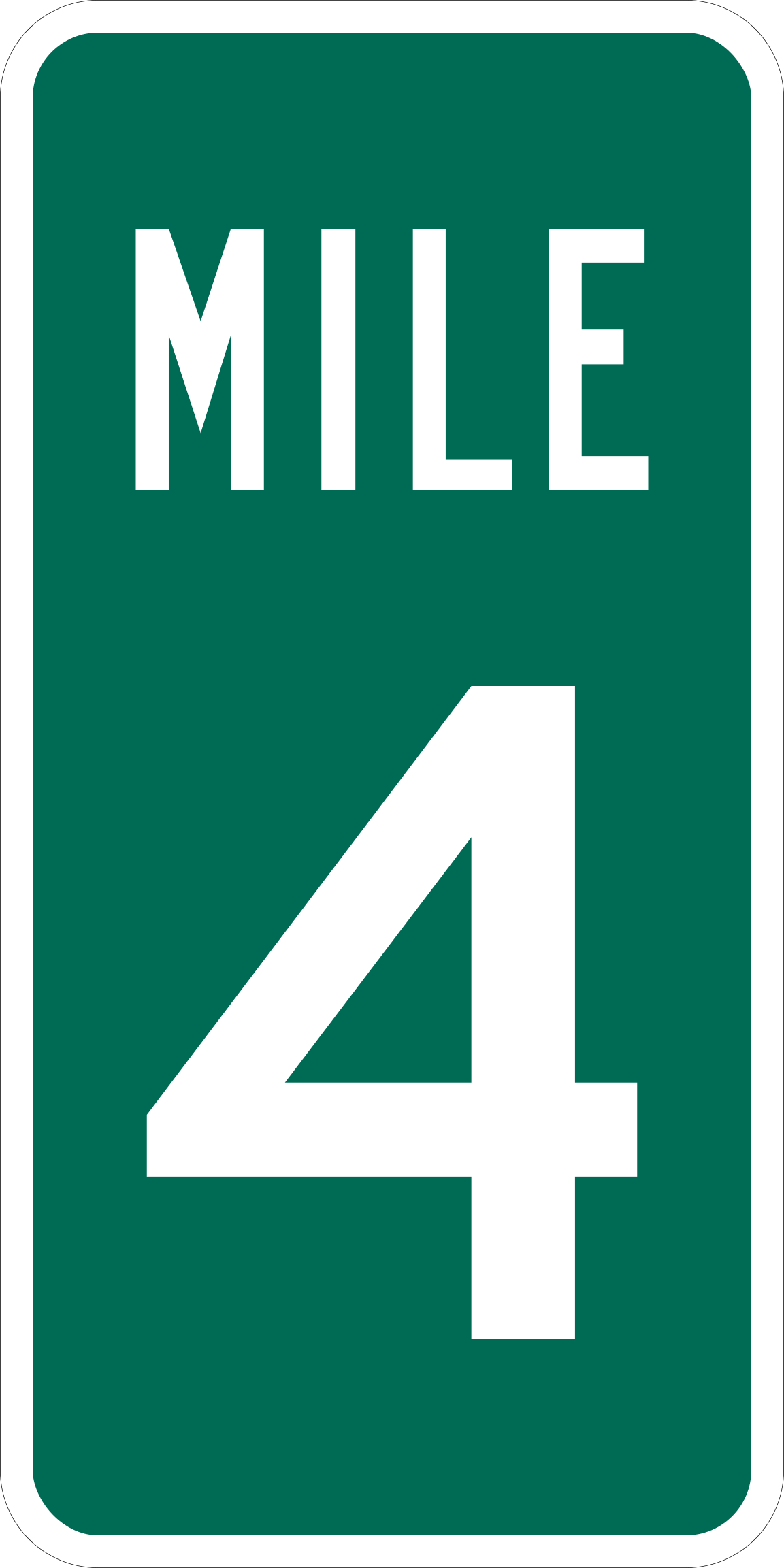
- They locate crashes, breakdowns, and emergencies
- They mark speed trap zones
- They count passing cars
- They show the time of day
Show answer
They locate crashes, breakdowns, and emergencies. Small green markers solve big location problems. Texas says mileposts identify the locations of crashes, breakdowns, and other emergencies. Speed traps, car counts, and clocks are not their job. The cue is the little number plate: read it to dispatchers so help finds you on a long empty highway. Memorize the nearest milepost number whenever you stop on an interstate shoulder. It anchors every emergency call you might need to make.
15. For a driver age 21 or older, what BAC level is described as legally intoxicated?
- 0.10 or more only
- 0.02 or more
- 0.05 or more
- 0.08 or more
Show answer
0.08 or more. The handbook states that a person age 21 or older is legally intoxicated at a BAC of 0.08 or more. This is a legal threshold, not a guarantee that lower levels are safe or that impairment begins only at that number. The other figures are not the adult limit stated here. Alcohol can affect judgment and reaction before the threshold is reached, so the safest plan is to use a sober driver. Never use a drink count as a substitute for a safe ride.
Study this in the handbook: DWI, open containers and implied consent
16. What does Texas say about crossing a solid white line?
- Cross them freely at any time
- Avoid crossing them if possible
- Treat them as lane dividers to straddle
- Use them as acceleration lanes
Show answer
Avoid crossing them if possible. Solid white lines channel traffic and should stay uncrossed. Texas says crossing a solid white line should be avoided if possible, since these lines mark edges, shoulders, channelizing, transitions, and lane-use control. Free crossing, straddling, and acceleration uses all defeat the channeling. The cue is the unbroken white stripe: hold your lane and cross only when truly necessary. Watch for them at merges, exits, and lane drops where discipline matters most.
Study this in the handbook: Pavement markings and lanes
17. You buy a vehicle in Texas. How long do you have to register it?
- Within 10 days of purchase
- Within 60 days of purchase
- Within 90 days of purchase
- Within 30 days of purchase
Show answer
Within 30 days of purchase. Texas requires an owner to register a newly purchased vehicle within 30 days of purchase. Ten days is too short. Sixty days is how long buyers' temporary tags are recognized, and 90 days is how long a vehicle inspection report stays valid, so both belong to other rules. A new resident has the same 30 day window: after establishing residency or taking a job in Texas, the vehicle may be driven for 30 days and then must be registered in Texas.
18. Which habits does Texas ban to prevent carbon monoxide poisoning?
- Run the engine in a closed garage to warm up
- Follow trucks closely with vents wide open
- Idle parked with windows shut
- Never do any of these; all risk carbon monoxide poisoning
Show answer
Never do any of these; all risk carbon monoxide poisoning. Carbon monoxide kills quietly in enclosed and trailing-air spaces. Texas lists among its prohibitions leaving the motor running in a garage and leaving vents open when following closely behind another car, alongside idling parked with closed windows. Warm-ups, drafting trucks, and sealed idling each invite the deadly gas inside. The cue is any running engine near still or exhaust-filled air: ventilate, separate from the exhaust source, and never idle in an enclosed space.
19. Besides flaggers, what may guide Texas work zones?
- Fireworks and marching bands
- Free coffee stands
- Pilot vehicles, advance signs, or temporary signals
- Permanent concrete walls only
Show answer
Pilot vehicles, advance signs, or temporary signals. Work zones layer multiple guides for safety. Texas says temporary traffic control can also include pilot or escort vehicles, advanced warning signs, or temporary traffic signals. Fireworks, coffee, and walls-only readings invent nonsense. The cue is the zone approach: follow the pilot car, read every advance sign, and obey temporary signals as if permanent. Never pass a pilot car or ignore a temporary signal, even when the road looks clear ahead.
20. An unpaved county road meets a paved farm road. Who has the right-of-way?
- The driver who honks first
- The vehicles traveling on the paved road
- The driver on the unpaved road, to keep dust down
- Neither; both must stop and take turns
Show answer
The vehicles traveling on the paved road. Pavement decides this one. A driver coming off an unpaved road onto a paved road must yield to the vehicles already traveling on the paved surface. Honking never creates a right-of-way, and there is no dust exception that favors the unpaved road. Taking turns sounds polite but is not the rule. The cue is the surface change under your tires: leaving gravel or dirt for pavement means you wait until the paved road traffic leaves a safe gap.
Study this in the handbook: Right of way at intersections
QualitySpace is expanding to Texas
We are a California-based independent insurance brokerage working on licensing in more states. We cannot help with Texas insurance yet. Leave your email and we will let you know when we can.
Every question is written from the official Texas Driver Handbook. Need paper? Printable TX practice test with answer key.
Last verified 2026-10-05. How we check every question · Study all 500 as flashcards
Frequently asked questions
How many questions are on this Texas practice test?
This fixed set has 20 questions. It is test 8 of 25 from the 500 question Texas bank.
How does this fixed test relate to the full Texas bank?
Each numbered test is a fixed set of questions in a fixed order, so you can retake the same test later and compare. Every test mixes road signs and the other topics in about the same proportion as the full bank. Tests 1 to 25 together cover every question in the Texas bank once. The full practice page mixes the whole bank at random.
Last verified 2026-10-05. See the Texas DMV facts page for sourced state details.