
Test 18 of 25 · 20 questions · Free 2026
TX Permit Practice Test 18
Jump to the test ↓A fixed 20 question set from the Texas bank with answers and plain English explanations.
Question 1 of 20 · 0 right so far
All 20 questions in test 18
Every question below comes from the Texas question bank on this page. Open a question to see the correct answer and the explanation. Nothing here is hidden behind a signup.
1. How should you alert a Texas driver before passing?
- Flash high beams to blind them
- Tailgate until they move
- Pass on the shoulder silently
- Tap the horn when necessary to alert them
Show answer
Tap the horn when necessary to alert them. A short horn tap announces a pass the mirrors may miss. The Texas passing sequence says to tap the horn when necessary to alert the driver ahead, after checking distance and before moving left. Blinding beams, tailgating, and silent shoulder passes all skip the courtesy signal. The cue is the drowsy or drifting leader: a light tap says a pass is coming before you commit to the left lane.
2. What causes most Texas motor vehicle crashes?
- Bad luck and fate
- Alien interference
- Speeding, failure to yield or stop, and alcohol
- Too many traffic signs
Show answer
Speeding, failure to yield or stop, and alcohol. Three behaviors dominate the Texas crash toll. The handbook says most crashes result from speeding, failure to yield or stop appropriately, and driving under the influence. Fate, aliens, and sign counts dodge responsibility. The cue is every crash report: one of these three choices sits behind the wheel in most of them. Each of the three is a choice, which means most crashes were preventable by drivers. Mastering speed, yield, and sobriety prevents the vast majority.
3. Which vehicles must Texas drivers yield to when signaled?
- Only police cars with sirens
- Only fire trucks with ladders
- Only ambulances with patients
- Police, fire, ambulance, and other emergency vehicles with siren, bell, or red light
Show answer
Police, fire, ambulance, and other emergency vehicles with siren, bell, or red light. Every flavor of emergency response owns the right-of-way when signaling. Texas requires yielding to police cars, fire trucks, ambulances, and other emergency vehicles sounding a siren or bell or flashing red. Police-only, ladder-only, and patient-only readings all narrow the list illegally. The cue is any emergency signal behind or ahead: siren, bell, or flashing red means clear a path at once.
4. According to the Texas handbook, about how long does it take the body to get rid of each drink?
- About 15 minutes
- About one hour
- About three hours
- It depends only on drinking coffee
Show answer
About one hour. The Texas handbook says it takes about one hour for the body to rid itself of each drink. Only time lowers the effect of alcohol, and the rate depends on body weight, number of drinks, and food intake. Fifteen minutes is far too quick, and three hours overstates the average. Black coffee, cold showers, and exercise do not make a person sober. If someone has been drinking, a person who has not been drinking should drive.
5. A Texas school bus without a commercial inspection runs an unnumbered rural highway. What is its limit?
- 70 mph, like passenger cars
- 55 mph, like a city arterial
- 60 mph, like inspected buses
- 50 mph
Show answer
50 mph. Uninspected buses on unnumbered roads sit at the bottom of the table. Texas sets 50 mph for school buses that have not passed a commercial vehicle inspection or that travel on highways not numbered by Texas or the U.S. The 70 mph car limit and the 60 mph inspected-bus limit both require conditions this bus lacks. The 55 figure appears nowhere in the Texas table. The cue is the combination: no inspection sticker plus no route number means 50, the lowest rural highway speed in the table.
6. Which record can lead Texas DPS to suspend a license, after a hearing, for repeated traffic violations?
- Two traffic convictions within any 12 month period
- Three traffic convictions within any 36 month period
- Four or more traffic convictions within any 12 month period
- Ten traffic convictions within any 5 year period
Show answer
Four or more traffic convictions within any 12 month period. DPS may suspend or revoke a license after a hearing for repeated violations: four or more separate traffic convictions within any 12 months, or seven or more within any 24 months. Two convictions in 12 months is the threshold for drivers under 18, not for all drivers. Three in 36 months and ten in five years are not Texas thresholds. A reinstatement fee is required for these discretionary suspensions.
7. When a stop line is present at a traffic sign or signal, where must the driver stop?
- Behind the stop line
- After the crosswalk or intersection
- Only beside the curb
- On top of the stop line
Show answer
Behind the stop line. White stop lines are painted across pavement lanes at traffic signs or signals, and drivers are required to stop behind the line. Stopping on or beyond it can place the vehicle into the crosswalk, intersection, or path controlled by the signal. The curb is not the reference point supplied by the marking. If no stop line is present, the handbook separately explains where to stop in relation to a crosswalk. Look for the painted line early and complete the stop before reaching it.
8. At an uncontrolled intersection you legally hold the right-of-way. What must you still do?
- Make sure the other driver actually yields before proceeding
- Proceed at once since the law is on your side
- Flash your lights and claim the intersection
- Stop and wave every other driver through first
Show answer
Make sure the other driver actually yields before proceeding. Being legally right is not the same as being safe. At an intersection with no signs, signals, multiple lanes, or pavement markings to assign priority, you may technically hold the right-of-way yet still must confirm the other driver yields before you go. Charging ahead because the law favors you invites a crash with a driver who misjudges or ignores the rule. Flashing lights and waving everyone through are not the guidance. The cue is uncertainty: watch the other vehicle, confirm it is yielding, then proceed.
9. When must you report Texas fixture damage to TxDOT?
- Never report it
- Report to TxDOT by the 10th day if damage tops $1,000
- Report only if injured
- Report after one year
Show answer
Report to TxDOT by the 10th day if damage tops $1,000. Uninvestigated fixture crashes still need state paper. Texas requires the TxDOT report within ten days when damage exceeds $1,000. Never, injury-only, and year-late readings all violate the duty. The cue is the broken sign or fence: document and file promptly. Unreported damage discovered later still traces back through paint and parts evidence. Filing promptly protects honest drivers from suspicion. Keep a copy of the filed report with your insurance records for years.
10. Which side should Texans use entering parked cars?
- Enter from the traffic side
- Use the curb side when possible
- Climb through windows
- Exit into moving lanes
Show answer
Use the curb side when possible. The curb side shelters car entries and exits. Texas says to get in and out on the curb side when possible. Traffic sides, windows, and moving lanes all expose bodies to strikes. The cue is the parked car: circle to the curb before opening any door. Children should exit only after the car fully stops at the curb. Adults must model the curb-side habit every single trip.
11. What factors control how time reduces alcohol effects?
- The car's paint color
- The day of the week
- Body weight, drink count, and food intake over time
- The driver's shoe size
Show answer
Body weight, drink count, and food intake over time. Sobering up runs on biology, not tricks. Texas says only time, based on body weight, number of drinks, and food intake, can minimize alcohol's effects. Paint, weekdays, and shoe sizes are nonsense factors. The cue is the personal math: heavier bodies, fewer drinks, and full stomachs shorten the impairment curve, but only the clock finishes it. Eating first and spacing drinks only softens the peak; the total time stays the same.
12. You hit an unattended Texas car. What must you do?
- Drive away quietly
- Stop and find the owner or leave a visible written notice
- Deny everything later
- Move their car too
Show answer
Stop and find the owner or leave a visible written notice. Empty cars still have owners with rights. Texas says that hitting an unattended vehicle means immediately stopping and either finding the operator or owner to give your name and address, or leaving a secure visible written notice. Drive-offs, denials, and moving their car all compound the wrong. The cue is the empty dented car: stop, search, and if nobody appears, write and attach.
13. To fight highway hypnosis on a long trip, how often does the Texas handbook say to stop?
- Every four hours or 250 miles
- Only once you start to feel sleepy
- Every eight hours
- At least every two hours or every 100 miles
Show answer
At least every two hours or every 100 miles. Highway hypnosis is drowsiness or unawareness brought on by the steady sounds of wind, engine, and tire hum. The handbook's first defense is to stop often: even if you feel well, stop at least every two hours or every 100 miles, get out, walk around, and let your muscles relax. It also says not to drive more than eight hours per day and to keep shifting your eyes between near and far objects.
14. What does Texas say about parking across a curb ramp?
- Block it briefly while loading groceries
- Never block an access or curb ramp
- Use it as a shortcut ramp for carts
- Park across it if no wheelchair is near
Show answer
Never block an access or curb ramp. Curb ramps are doorways for wheelchair users. Texas forbids blocking an access or curb ramp, with no allowance for quick loading, cart shortcuts, or the apparent absence of wheelchair users. A blocked ramp strands people in the street or forces long detours. The cue is the sloped cut in the curb: keep it and its landing zone fully clear at all times, treating it like a driveway that must never be blocked.
15. What does a solid yellow line on your side of the road mark?
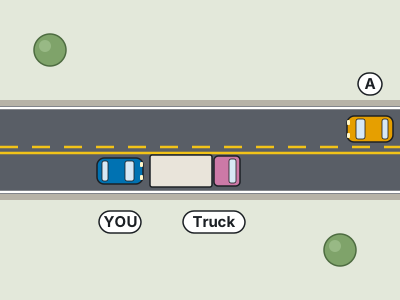
- A no-passing zone
- A passing lane that must be used
- A pedestrian-only crossing
- A lane reserved for parking
Show answer
A no-passing zone. A solid yellow line on your side marks a no-passing zone. The marking warns that crossing to overtake is prohibited there, so a driver should remain behind the vehicle ahead until a legal passing opportunity appears. It is not a parking boundary, a mandatory passing lane, or a pedestrian crossing. Broken yellow lines have a different meaning and may permit passing or changing lanes when safe. Check the pavement on your side of the road before beginning any maneuver that would cross the center line.
16. A green arrow appears at the same time as a red light. What may the driver do?
- Proceed without checking because the arrow grants absolute priority
- Remain stopped until every signal turns green
- Turn in any direction permitted by the lane
- Proceed in the arrow's direction after yielding to traffic and pedestrians
Show answer
Proceed in the arrow's direction after yielding to traffic and pedestrians. A green arrow shown with a red light permits movement in the arrow's direction, but the driver must proceed carefully after yielding to other vehicles and pedestrians. The arrow controls the permitted direction; it does not erase the duty to check the intersection. Remaining stopped until every signal changes would ignore the protected movement, while turning elsewhere exceeds what the arrow authorizes. The visual cue is the combination of signals: follow the arrow, scan the path, yield as required, and then complete only that movement.
17. What extra penalty hits repeat Texas disabled-parking abuse?
- Fines up to $1,250 plus community service
- Nothing at all
- A thank-you card
- Free parking for a year
Show answer
Fines up to $1,250 plus community service. Repeat disabled-parking theft adds service to money. Texas raises fines to $1,250 for five or more offenses and adds community service to additional offenses. Nothing, cards, and free parking mock the escalation. The cue is the repeat count: each offense buys money and hours. Courts may impound vehicles of the worst habitual violators as well. Respect for access laws keeps independence for everyone.
18. How should Texans walk around a stopped train?
- Walk between the cars
- Climb over the couplers
- Never walk in front of, between, or behind a train
- Race across the tracks
Show answer
Never walk in front of, between, or behind a train. Stopped trains move without warning. The Texas light-rail table orders never walking in front of, between, or behind a train. Weaving, climbing, and racing all gamble with silent steel. The cue is the standing train: give it a full berth and cross only at marked points. Freight yards post the same rule for workers and visitors alike. Treat every rail car as if it could roll any second.
19. What maneuver is prohibited where a no left turn sign is posted?
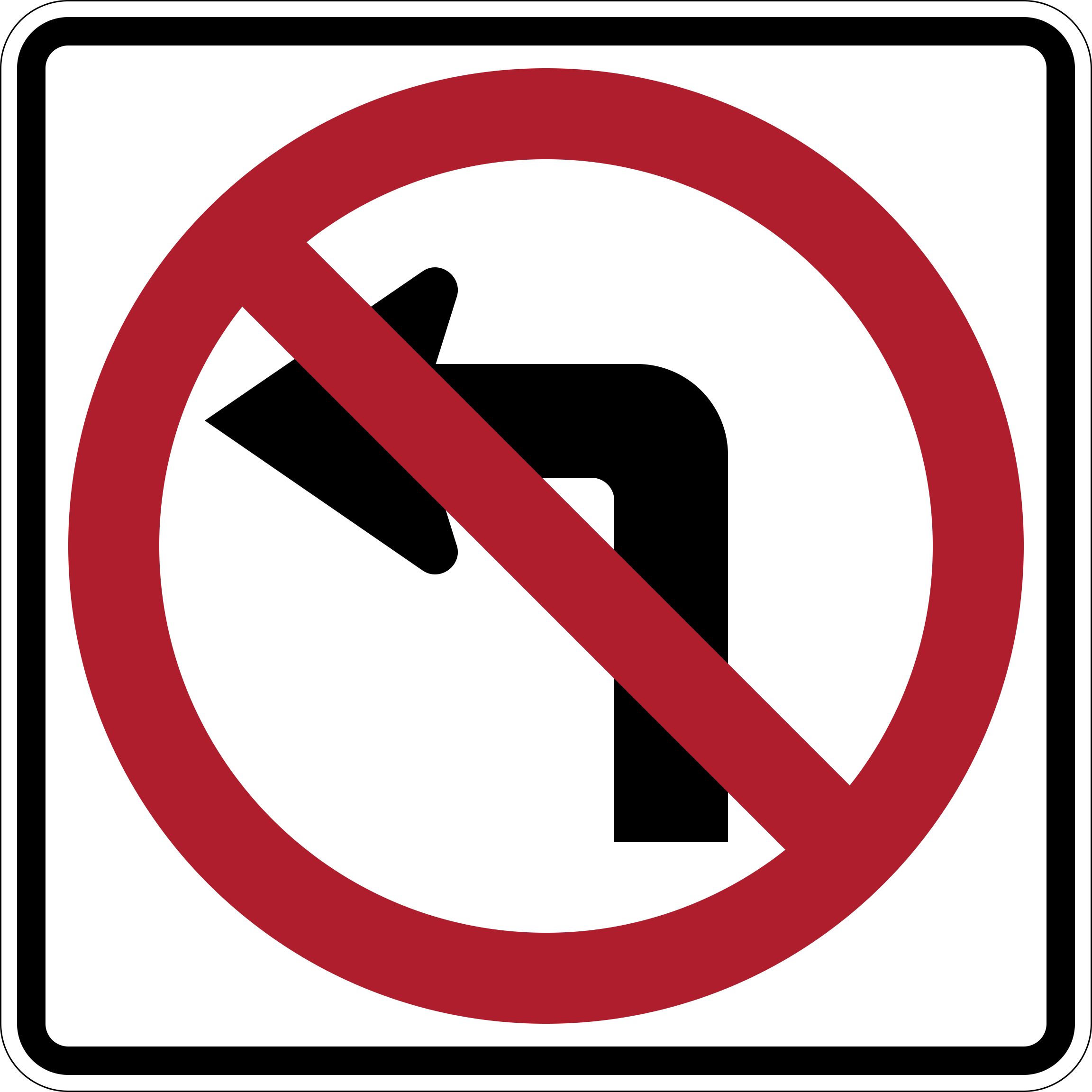
- Turning left at that intersection
- Making a U-turn at every location nearby
- Going straight through the intersection
- Turning right after yielding
Show answer
Turning left at that intersection. The no left turn sign applies to a left turn at the intersection where it is posted. It does not automatically prohibit going straight, turning right, or making a U-turn at every nearby location. Read the pictured movement rather than treating the red slash as a ban on all travel. A driver who reaches this sign should choose another permitted direction, check signals and traffic, and avoid beginning the prohibited turn even if the road appears empty.
20. What kind of license carries the Phase Two GDL driving restrictions?
- A standard unrestricted license
- A commercial learner permit
- A provisional license
- A motorcycle license with no restrictions
Show answer
A provisional license. The handbook defines a provisional license as a driver license issued to persons 16 to 18 years of age with Phase Two graduated driver license restrictions applied. It is marked provisional and expires on the holder’s 18th birthday. A standard unrestricted license does not identify this teen phase, a commercial learner permit is different, and the motorcycle choice incorrectly removes restrictions. Look for the word provisional when the question describes Phase Two passenger and time limits.
QualitySpace is expanding to Texas
We are a California-based independent insurance brokerage working on licensing in more states. We cannot help with Texas insurance yet. Leave your email and we will let you know when we can.
Every question is written from the official Texas Driver Handbook. Need paper? Printable TX practice test with answer key.
Last verified 2026-09-07. How we check every question · Study all 500 as flashcards
Frequently asked questions
How many questions are on this Texas practice test?
This fixed set has 20 questions. It is test 18 of 25 from the 500 question Texas bank.
How does this fixed test relate to the full Texas bank?
Each numbered test is a fixed set of 20 questions in a fixed order, so you can retake the same test later and compare. Every test mixes road signs and the other topics in about the same proportion as the full bank. Tests 1 to 25 together cover every question in the Texas bank once. The full practice page mixes the whole bank at random.
Last verified 2026-09-07. See the Texas DMV facts page for sourced state details.