
Test 2 of 25 · 20 questions · Free 2026
TX Permit Practice Test 2
Jump to the test ↓A fixed 20 question set from the Texas bank with answers and plain English explanations.
Question 1 of 20 · 0 right so far
All 20 questions in test 2
Every question below comes from the Texas question bank on this page. Open a question to see the correct answer and the explanation. Nothing here is hidden behind a signup.
1. What does a flashing yellow traffic light warn drivers to do?
- Slow down and proceed with caution
- Stop and remain until a green light appears
- Accelerate to clear the intersection
- Ignore the signal as a malfunction
Show answer
Slow down and proceed with caution. A flashing yellow light warns drivers to slow down and proceed with caution. It does not impose the complete stop required by a flashing red signal, but it also does not give permission to accelerate blindly through the intersection. The green-light option adds a waiting requirement that the handbook does not state, and ignoring the signal removes the intended warning. Reduce speed enough to evaluate vehicles, pedestrians, and the path ahead before continuing through the controlled area.
Study this in the handbook: Traffic signals and arrows
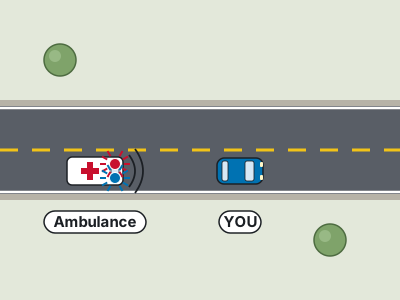
2. When an emergency vehicle is sounding a siren or showing a flashing red light, what should a driver do if traffic allows?
- Follow within 500 feet to use the cleared path
- Pull to the right edge of the road and stop
- Stop in the middle of the intersection
- Accelerate so the emergency vehicle cannot pass
Show answer
Pull to the right edge of the road and stop. Texas requires drivers to yield to police cars, fire trucks, ambulances, and other emergency vehicles using the listed warnings. If traffic allows, the driver should pull to the right edge and stop. Following closely behind a fire truck or ambulance is specifically restricted, and stopping in an intersection can block the emergency route. Accelerating creates a conflict rather than yielding. Watch mirrors and intersections for the approaching vehicle, signal early, and make room at the right side whenever it can be done safely.
Study this in the handbook: Emergency vehicles and the move over law
3. What are horizontal rectangle Texas signs for?
- Stop signs
- Guide signs
- Yield signs
- Railroad signs
Show answer
Guide signs. Wide flat rectangles deliver information. Texas says horizontal rectangles are generally for guide signs, distinct from octagon stops, triangle yields, and round railroad warnings. The cue is the broad green panel: read destinations and distances, not commands. Overhead gantries use the same wide shape for lane assignments at splits. Read them a full mile before the gore point. Brown recreation panels share the shape with different colors and purposes.
Study this in the handbook: Sign shapes, colors and meanings
4. A Texas driver is caught driving while the license is suspended, with no prior conviction for it and no other aggravating factor. What is the offense?
- A Class C misdemeanor with a fine of up to $500
- A felony with prison time
- A Class A misdemeanor with up to one year in jail
- A civil violation with no fine
Show answer
A Class C misdemeanor with a fine of up to $500. Basic driving while license invalid in Texas is a Class C misdemeanor, punishable by a fine of up to $500. It becomes a Class B misdemeanor, with a fine up to $2,000 and up to 180 days in jail, after a prior conviction, when driving uninsured, or when the suspension came from a DWI offense. A Class A misdemeanor applies only when the uninsured driver causes a crash with serious injury or death. It is not a felony at this basic level, and it is not a civil matter without a fine.
Study this in the handbook: Suspensions, revocations and license penalties
5. Where are Texas white stop lines painted?
- Diagonally across intersections
- Only on dirt roads
- Across pavement lanes at signs or signals
- On the roofs of tunnels
Show answer
Across pavement lanes at signs or signals. Stop lines sit where the stop decision happens. Texas says white stop lines are painted across pavement lanes at traffic signs or signals. Diagonals, dirt roads, and tunnel roofs are not their home. The cue is the wide white bar across your lane: halt behind it and creep only after the full stop. Crossing the bar before stopping counts as running the sign or signal.
Study this in the handbook: Pavement markings and lanes
6. A Texas sign prohibits parking or standing. What is banned?
- Never park or stand idling there
- Park for under five minutes
- Idle with hazards flashing
- Stop only to check a map
Show answer
Never park or stand idling there. Posted bans cover parking and idling alike. Texas forbids parking or standing idling wherever an official sign prohibits parking or standing. Five-minute, hazard-flashing, and map-checking excuses all fail. The cue is the posted face: the sign, not your stopwatch or flashers, decides. Even a running engine with a driver aboard counts as standing under this rule. Move along to a legal bay instead of testing the sign.
Study this in the handbook: Where you may not park
7. What does Texas say about over-the-counter drugs and driving?
- Read labels and beware antihistamines, cold medicines, and sleep aids
- Take extra doses to stay alert
- Mix all medicines for best effect
- Ignore labels; only alcohol impairs
Show answer
Read labels and beware antihistamines, cold medicines, and sleep aids. The pharmacy aisle hides driving hazards. Texas warns that many over-the-counter drugs cause drowsiness affecting driving, and to read labels carefully with antihistamines, cold preparations, and any medicine that relaxes or promotes sleep. Extra doses, mixing, and label-ignoring all multiply impairment. The cue is the fine print: drowsiness warnings mean arranging another ride or waiting out the dose. When in doubt, skip the dose-and-drive gamble and let someone else take the wheel that day.
Study this in the handbook: DWI, open containers and implied consent
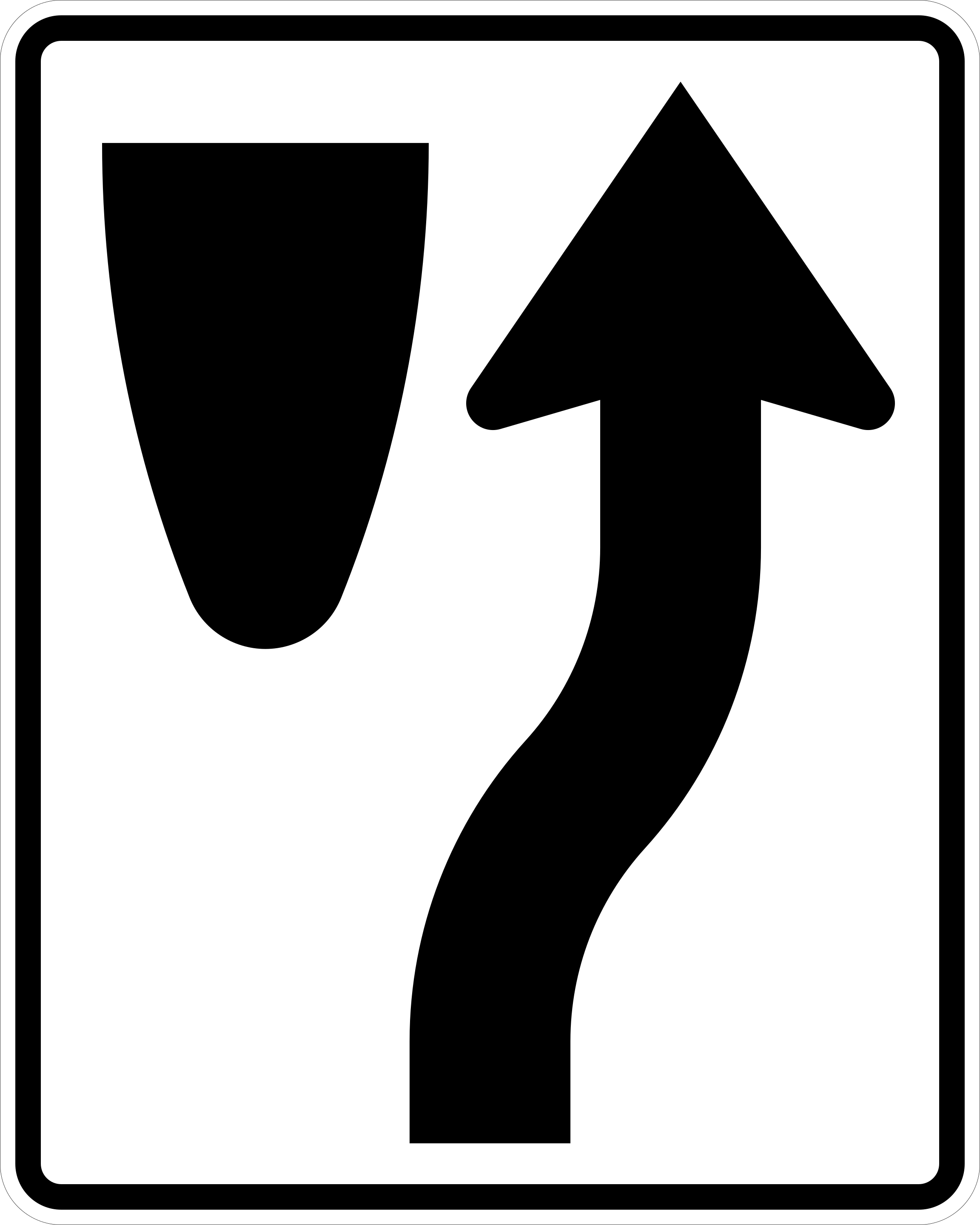
8. When a keep right sign marks an obstruction or island, where should you drive?
- To the left of the sign unless passing
- Across the median to avoid the obstruction
- To the right of the sign
- In either direction without slowing
Show answer
To the right of the sign. The keep right sign directs traffic around an island, median, or other obstruction. The handbook's instruction is to drive to the right of the sign, so crossing left around the object is not an equivalent choice. The sign does not permit crossing a median or ignoring the obstruction. Reduce speed as needed, follow the marked channel, and keep the vehicle on the right side of the object before returning to the normal lane.
Study this in the handbook: Sign shapes, colors and meanings
9. What should a driver do if a pedestrian is crossing or attempting to cross the street?

- Slow down, use the horn if necessary, and be prepared to stop
- Accelerate before the pedestrian reaches the lane
- Pass closely without changing speed
- Stop only if a passenger gives a warning
Show answer
Slow down, use the horn if necessary, and be prepared to stop. Texas directs a driver who sees a pedestrian crossing or attempting to cross to slow down, use the horn if necessary, and be prepared to stop. The instruction calls for early speed control and attention to the person’s path, not a last-second maneuver. Accelerating reduces reaction time, passing closely leaves little room, and waiting for a passenger adds a delay that the roadway does not allow. Scan both sides of the street near crossings, cover the brake, and yield whenever the pedestrian’s movement creates a conflict.
Study this in the handbook: Trucks, motorcycles, bicycles and pedestrians
10. How should Texans exit buses and streetcars?
- Run into traffic at once
- Jump from the moving bus
- Be extra careful exiting streetcars and buses
- Close eyes while exiting
Show answer
Be extra careful exiting streetcars and buses. Transit exits drop walkers into live traffic. Texas urges extra care when getting off streetcars and buses. Running, jumping, and blind exits all court strikes. The cue is the open door: pause, scan both ways, then step to the curb. Drivers must also stop behind buses with flashing red loading lights. Both sides share duty when transit doors open. Hold small children hands firmly until fully on the sidewalk.
Study this in the handbook: Trucks, motorcycles, bicycles and pedestrians
11. Where should Texas walkers wait to cross?
- Wait in the street
- Cross against the light
- Stand behind parked cars
- Wait on the curb until green or Walk
Show answer
Wait on the curb until green or Walk. Curbs are the walker's safe harbor. Texas says to wait on the curb, not in the street, until signals turn green or read Walk. Street waits, red crossings, and hidden stands all risk strikes. The cue is the curb edge: one step back from traffic until the signal invites you. Make eye contact with stopped drivers before stepping off the curb edge. A waved-through driver may still miss a second lane threat.
Study this in the handbook: Trucks, motorcycles, bicycles and pedestrians
12. How does social cocaine use affect Texas drivers?
- Sharper attention
- Lapses in attention and concentration
- Better coordination
- Perfect safety
Show answer
Lapses in attention and concentration. Cocaine shreds the focus driving demands. Texas cites research that typical social amounts produce lapses in attention and concentration. Sharper, better, and perfect readings deny the science. The cue is the confident user: impairment hides behind the high. Combining cocaine with alcohol multiplies crash risk far beyond either drug alone. Polydrug impairment fools users into false confidence. Brain scans show attention networks failing long before users notice anything wrong.
Study this in the handbook: DWI, open containers and implied consent
13. What does Texas grooved pavement do?
- The road is closed
- The road is made of glass
- The road is newly painted
- Grooves cut wet-weather slipperiness
Show answer
Grooves cut wet-weather slipperiness. Grooved pavement grips where smooth pavement slides. Texas says grooving lessens slippery pavement in wet weather. Closures, glass, and paint are not its meaning. The cue is the humming texture under your tires in rain: traction engineered into the road. Grooves also sing through the tires as an audible wet-weather reminder. Heed the hum and ease off the accelerator. Slow early and keep inputs smooth through the wet zone.
14. How should you handle speed on a Texas freeway exit ramp?
- Hold freeway speed to the toll booth
- Speed up to beat the ramp meter
- Stop at the top of the ramp
- Slow on the ramp to meet the slower limit at the bottom
Show answer
Slow on the ramp to meet the slower limit at the bottom. Exit ramps are deceleration zones by design. Texas says to slow down on the exit ramp so that off the highway you sit within the new, slower speed limit. Freeway-speed exits, meter races, and ramp-top stops all abuse the design. The cue is the exit gore: begin braking on the ramp itself and arrive at the surface street already legal.
Study this in the handbook: Night and highway driving
15. Your Texas crash injures someone. Where must you stop?
- Drive home and report later
- Stop at the scene without blocking traffic more than needed
- Park a mile away
- Keep driving to work
Show answer
Stop at the scene without blocking traffic more than needed. Injury crashes freeze you to the scene. Texas requires immediately stopping at or as close as possible to the scene without obstructing traffic more than necessary. Home trips, mile parks, and commutes all constitute flight. The cue is the injured person: stop, help, and stay until released. Turn on hazard lights immediately so approaching traffic sees the stopped scene. Move only as far as needed to avoid blocking lanes.
Study this in the handbook: Breakdowns, skids and crashes
16. When must you notify police after a Texas crash?
- Only when the moon is full
- Only for crashes with trucks
- Only on weekends
- Injury, immovable vehicles, flight, or suspected intoxication
Show answer
Injury, immovable vehicles, flight, or suspected intoxication. Four triggers always summon police. Texas says to notify law enforcement at once for injury or fatality, vehicles stuck on the roadway, a driver fleeing the scene, or suspected intoxication. Lunar, truck-only, and weekend readings are nonsense. The cue is any one of the four: call immediately rather than negotiating privately. When in doubt about severity, calling is always the safer legal choice. An official report protects every honest party afterward.
Study this in the handbook: Breakdowns, skids and crashes
17. What is step two of Texas parallel parking?
- Check oncoming traffic, cut wheels right, back slowly to the curb
- Cut wheels left and floor it
- Back with eyes closed
- Turn wheels right and drive forward
Show answer
Check oncoming traffic, cut wheels right, back slowly to the curb. The back-in swings the nose clear of oncoming cars. Texas step two says to confirm no interference with oncoming traffic, then cut the front wheels fully right and back slowly toward the curb. Left cuts, blind backing, and forward driving all wreck the geometry. The cue is the rearward arc: slow, tight, and mirror-checked all the way to the curb.
Study this in the handbook: Where you may not park
18. Why does the Texas handbook say not to park in the striped area beside a disabled parking space?
- It is reserved for motorcycles
- It is a fire lane
- It is a loading zone for deliveries
- It is space for wheelchair lifts
Show answer
It is space for wheelchair lifts. The handbook says do not park in striped areas adjacent to disabled parking spaces, or in a striped area in front of a business entrance next to a disabled space, because striped areas are for wheelchair lifts. The same section lists other Texas rules: you may not park in a disabled space without a disabled plate or windshield card, you may not lend your card, and you may not block an access or curb ramp.
Study this in the handbook: Where you may not park
19. For a driver age 18 to 84, how often must a Texas driver license be renewed?
- Every four years
- Every eight years
- Every sixteen years
- Every six years
Show answer
Every eight years. A Texas driver license must be renewed every eight years, and the fee table shows a license for ages 18 to 84 expires eight years after the previous expiration date. Renewal is made in person unless you are eligible to renew online, by mail, or by phone. Separately, every driver must appear in a driver license office at least once every sixteen years for a vision exam and to update the photo, signature, and fingerprints.
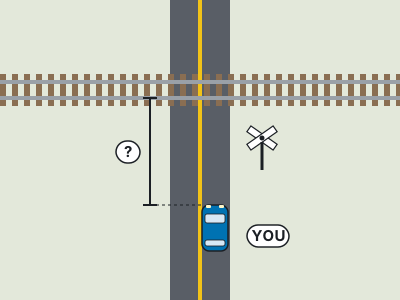
20. When a railroad signal warns of an approaching train, where must a Texas driver stop?
- Within 5 feet of the rail
- At least 100 feet from the crossing
- Between 15 and 50 feet from the nearest rail
- Anywhere behind the crossbuck
Show answer
Between 15 and 50 feet from the nearest rail. When approaching a railroad grade crossing, stop between 15 and 50 feet from the nearest rail if a clearly visible railroad signal warns of an approaching train, a crossing gate is lowered or a flag person warns of a train, a driver is required to stop by an official traffic control device, or a train is approaching. Five feet is too close and 100 feet is outside the window. Stay stopped until the train has cleared and the signals stop.
Study this in the handbook: School buses and railroad crossings
QualitySpace is expanding to Texas
We are a California-based independent insurance brokerage working on licensing in more states. We cannot help with Texas insurance yet. Leave your email and we will let you know when we can.
Every question is written from the official Texas Driver Handbook. Need paper? Printable TX practice test with answer key.
Last verified 2026-10-05. How we check every question · Study all 500 as flashcards
Frequently asked questions
How many questions are on this Texas practice test?
This fixed set has 20 questions. It is test 2 of 25 from the 500 question Texas bank.
How does this fixed test relate to the full Texas bank?
Each numbered test is a fixed set of questions in a fixed order, so you can retake the same test later and compare. Every test mixes road signs and the other topics in about the same proportion as the full bank. Tests 1 to 25 together cover every question in the Texas bank once. The full practice page mixes the whole bank at random.
Last verified 2026-10-05. See the Texas DMV facts page for sourced state details.